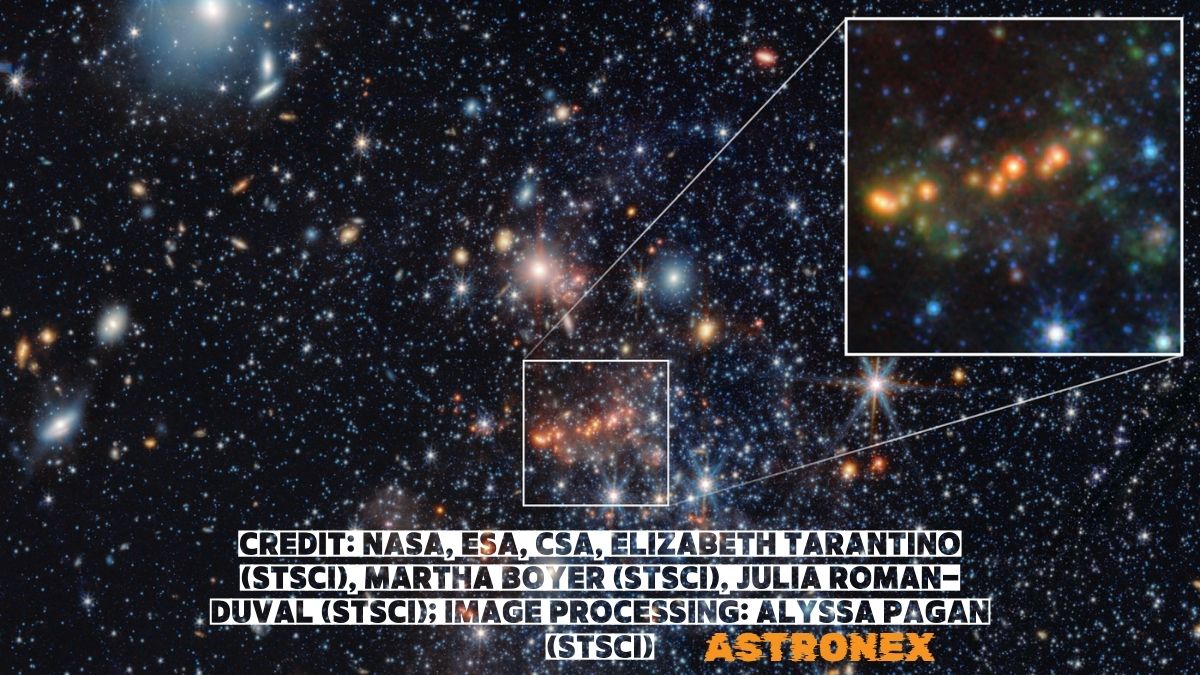
In early 2026, NASA announced a Webb Space Telescope result that makes the early universe dust formation story even more surprising. In a nearby dwarf galaxy called Sextans A, Webb detected dust types that scientists did not expect to see in an environment with very few heavy elements. NASA explains in NASA’s Sextans A dust discovery update that the telescope spotted metallic iron dust and silicon carbide dust connected to aging stars, plus small clumps of carbon based molecules that glow in infrared light (NASA Webb Mission Team, 2026).
This matters because Sextans A is not being studied only for its own sake. NASA describes it as a rare “early universe analog,” meaning its chemistry is similar to galaxies that existed when the universe had not yet built up many heavy elements. In other words, Sextans A lets researchers test early universe dust formation in a nearby lab where Webb can separate light from individual stars and clouds, instead of seeing everything blended together in one distant blur (NASA Webb Mission Team, 2026).
The big question is simple but powerful: if stars can build dust grains even when a galaxy is “metal starved,” does that mean the first galaxies could have started filling themselves with dust much earlier than many models predicted (NASA Webb Mission Team, 2026)?
What exactly did NASA Webb discover about early universe dust formation in Sextans A?
NASA reports that Webb detected two rare dust types in Sextans A: metallic iron dust and silicon carbide (SiC) dust, both linked to evolved stars near the end of their lives (NASA Webb Mission Team, 2026). This is a direct match to NASA’s wording that these dust types were “spotted” in Sextans A, and that they are connected to “aging stars” rather than to a single dramatic event like one supernova blast (NASA Webb Mission Team, 2026). The key point for early universe dust formation is that these grains were found in a place with far fewer heavy elements than a big spiral galaxy like the Milky Way.
NASA also highlights a second part of the discovery: Webb found polycyclic aromatic hydrocarbons (PAHs) in Sextans A’s interstellar medium. PAHs are large carbon based molecules that are often treated as the smallest dust grains and they glow in infrared light [infrared glow means they reradiate absorbed energy at longer wavelengths] (NASA Webb Mission Team, 2026). NASA’s release explicitly says Sextans A is now the lowest metallicity galaxy known to contain PAHs and that Webb sees them in tiny dense pockets only a few light years across, not spread smoothly across the galaxy (NASA Webb Mission Team, 2026). These details are not a loose interpretation. They align with NASA’s exact description of “tiny, dense pockets only a few light years across.”
Why this is a big deal for early universe dust formation: dust changes how galaxies grow. Dust can absorb and block ultraviolet and visible light, cool gas, and help create sheltered regions where molecules can survive. NASA connects this result to the idea that early galaxies developed the building blocks needed for later planets, meaning dust was part of the story earlier than expected (NASA Webb Mission Team, 2026).
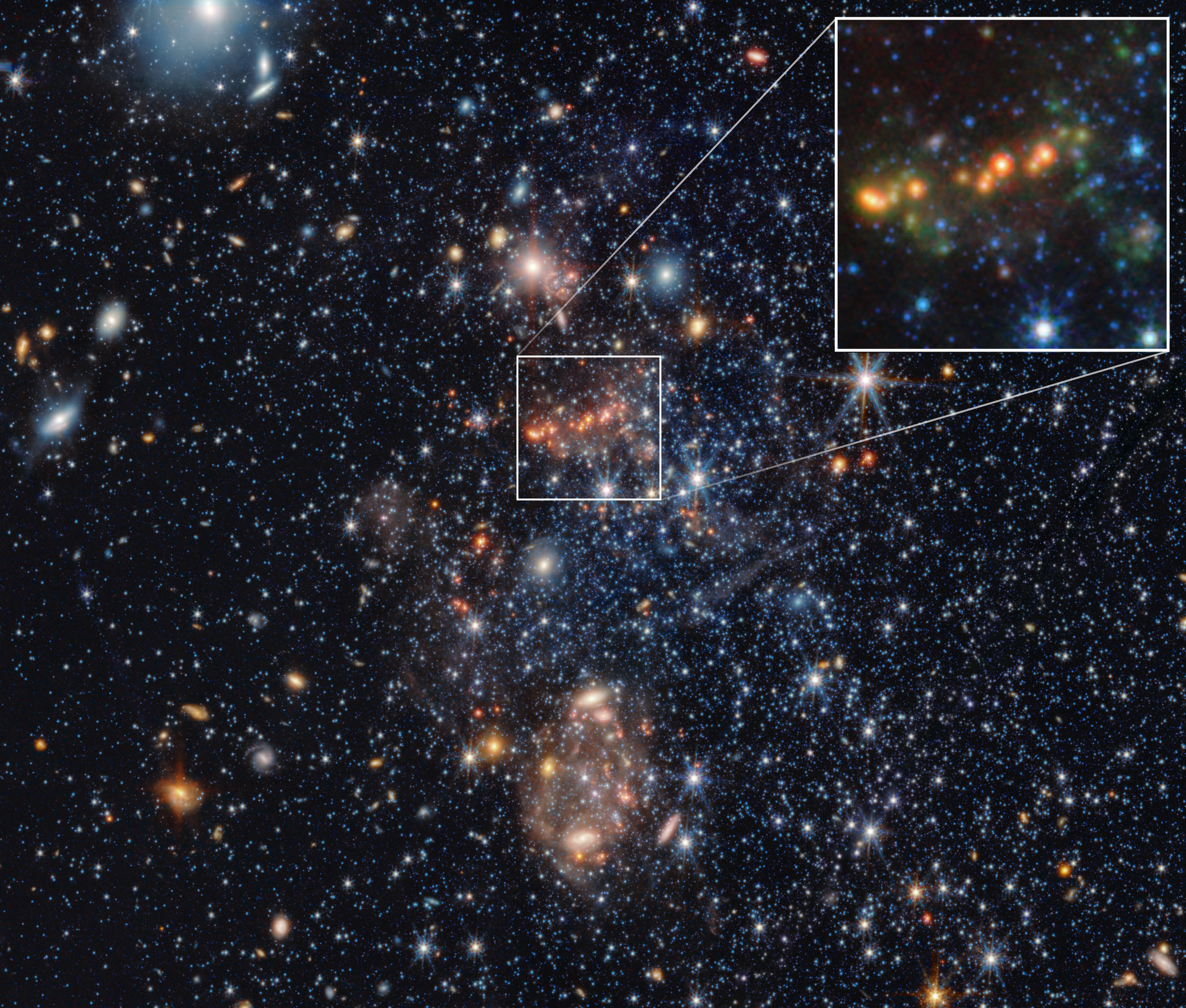
Why is Sextans A considered an early universe analog for dust formation research?
NASA calls Sextans A one of the most chemically primitive galaxies near the Milky Way, and it explains why that matters: the early universe started mostly with hydrogen and helium, and “metals” [elements heavier than hydrogen and helium] had to be created later inside stars (NASA Webb Mission Team, 2026). Sextans A has not held onto many of those heavy elements, partly because its gravity is weaker than that of larger galaxies. NASA says the galaxy’s gravitational pull is too weak to retain heavy elements made by supernovae and aging stars, which helps keep the galaxy chemically primitive compared with big galaxies (NASA Webb Mission Team, 2026).
NASA gives a clear metallicity range for Sextans A: about 3 percent to 7 percent of the Sun’s metal content (NASA Webb Mission Team, 2026). The peer reviewed Astrophysical Journal study accessible via the Open University’s official research repository record describes the metallicity as roughly 1 percent to 7 percent solar, which overlaps with NASA’s range but extends the lower end (Boyer et al., 2025). This is a good example of normal scientific uncertainty: “metallicity” can be estimated using different tracers (stars vs gas), and different methods can produce slightly different bounds. Stating a range is more honest than pretending one number is perfect.
NASA also says Sextans A is close enough to let astronomers study individual stars and interstellar clouds under early like conditions, which is not possible for truly early universe galaxies that are extremely far away (NASA Webb Mission Team, 2026). This directly matches NASA’s point that Sextans A offers a rare chance to study “conditions similar to those shortly after the big bang” without the distance problem.

How can early universe dust formation happen when a galaxy has so few heavy elements?
At first glance, early universe dust formation looks almost impossible. Dust grains are made from elements like carbon, oxygen, silicon, magnesium, and iron. In the very early universe, these elements were scarce because they had not been produced by many generations of stars yet. NASA directly addresses this puzzle by explaining that in Sextans A, the usual dust ingredients for oxygen rich stars, especially silicon and magnesium, are close to missing, so scientists expected stars there to be close to dust free (NASA Webb Mission Team, 2026).
The peer reviewed study in The Astrophysical Journal paper record hosted by the Open University confirms Webb spectroscopy detected SiC and likely metallic iron dust around AGB stars at about 1 percent to 7 percent solar metallicity (Boyer et al., 2025). This is not a vague claim. It is stated directly in the abstract and is based on low resolution infrared spectroscopy [spectroscopy means splitting light into a rainbow to read chemical fingerprints] (Boyer et al., 2025). When spectroscopy matches dust models, scientists can identify which dust species best fits the observed light.
A useful way to think about this is “dust recipes.” In a metal rich galaxy, stars can form classic silicate grains easily. In a metal poor galaxy, the recipe has to change. NASA’s release uses a kitchen comparison to show how missing ingredients change what can be made, and the Webb results show nature can still produce solid grains using different pathways (NASA Webb Mission Team, 2026).
If you are building a diagram for readers, a simple figure would help: one column for “normal metallicity dust pathways” (silicates, carbon dust), and another column for “low metallicity pathways” (iron rich dust, SiC, clumpy PAHs). This kind of visual makes early universe dust formation easier to understand without heavy math (NASA Webb Mission Team, 2026; Boyer et al., 2025).
What is metallic iron dust, and why is it surprising for early universe dust formation?
Metallic iron dust means dust grains where iron is the main solid material, rather than iron being a small ingredient inside a silicate grain. NASA reports Webb found a star in Sextans A producing dust grains made almost entirely of iron, which NASA emphasizes has not been seen before in stars that resemble early universe stars (NASA Webb Mission Team, 2026). That is a strong statement, and this paragraph uses the same meaning: the surprise is not “iron exists,” but that iron dominates the dust composition in such a low metallicity environment.
The peer reviewed study in Boyer et al. (2025) hosted by the Open University repository supports this interpretation by explaining that the best fit to the observed infrared excess for one oxygen rich M type AGB star was metallic iron dust (Boyer et al., 2025). The abstract also notes the star’s mass is roughly 4 to 5 solar masses [solar mass means the mass of our Sun], and that its spectrum is strong but featureless, which is consistent with iron dust being difficult to identify by sharp spectral features (Boyer et al., 2025). This lines up with NASA’s statement that iron grains absorb light efficiently but can lack sharp spectral fingerprints (NASA Webb Mission Team, 2026).
This matters for early universe dust formation because iron dust behaves differently from silicate dust. If iron rich grains absorb light efficiently, they can change how we interpret the brightness of distant galaxies, and they can affect how energy moves through early galaxies (NASA Webb Mission Team, 2026). In simple terms: different dust types can hide or reveal different parts of a galaxy, so knowing the dust “mix” is essential.

How did Webb’s infrared spectroscopy reveal silicon carbide dust and iron rich dust in aging stars?
NASA explains that one of the studies focused on about six stars using Webb’s MIRI instrument and its low resolution spectrometer, targeting AGB stars late in their evolution (NASA Webb Mission Team, 2026). This matches the peer reviewed paper description hosted at Open Research Online, which states the team used low resolution infrared spectroscopy from JWST and observed six AGB stars in Sextans A (Boyer et al., 2025). The agreement between NASA’s summary and the journal paper is strong on the key observational point: Webb collected infrared spectra and compared them to dust models.
The Astrophysical Journal paper record also provides specific technical details that help explain the measurement. It describes MIRI Low Resolution Spectrograph data covering about 5 microns to about 14 microns [a micron is one millionth of a meter, used for infrared light], which is a wavelength range where many dust and molecule features appear (Boyer et al., 2025). When the observed spectrum matches a model spectrum for a particular dust species, that species becomes the best explanation for what Webb is seeing.
The paper highlights two particularly important detections:
- SiC dust around a carbon rich AGB star (Boyer et al., 2025).
- Metallic iron dust as the best fit for a massive oxygen rich M type AGB star with a featureless infrared excess (Boyer et al., 2025).
NASA’s description that silicate dust normally forms in oxygen rich stars but is hard to make in Sextans A due to missing silicon and magnesium is consistent with the paper’s finding that the best fits are nearly silicate free (NASA Webb Mission Team, 2026; Boyer et al., 2025). This is why the result is directly relevant to early universe dust formation: it shows dust can form even when standard silicate pathways are limited.
Why do PAHs in tiny clumps matter for early universe dust formation?
PAHs are often discussed as a bridge between “chemistry” and “dust.” NASA describes them as large carbon based molecules and notes they are the smallest dust grains that glow in infrared light (NASA Webb Mission Team, 2026). The NASA release also states that Sextans A is now the lowest metallicity galaxy ever found to contain PAHs, and Webb sees them in dense pockets only a few light years across (NASA Webb Mission Team, 2026). This paragraph repeats those points because they are central to the discovery and they match NASA’s wording and scale description.
For early universe dust formation, the clumpiness is the key clue. If PAHs can form and survive only in small “protected” regions of dense gas, then early galaxies may have produced dust in patchy islands rather than as a smooth galaxy wide layer. NASA explicitly describes “small, protected islands of dense gas” as the likely safe zones for PAHs in a metal starved galaxy (NASA Webb Mission Team, 2026). That idea helps explain why some very low metallicity galaxies look dust poor overall, yet can still host pockets of complex carbon chemistry.
If you want to add a helpful visual for readers, a diagram could show a low metallicity galaxy with a few dense clouds highlighted, labeling them as “PAH safe zones.” That kind of figure supports the NASA message that environment and shielding matter, not only total metal content (NASA Webb Mission Team, 2026).
How fast can early universe dust formation start after stars are born?
One reason this discovery is trending is that it connects directly to timing. The peer reviewed journal paper in Boyer et al. (2025) states that stars on the upper end of the AGB mass range can begin producing dust as early as 30 to 50 million years after they form (Boyer et al., 2025). In plain English, that is fast on cosmic timescales. It means that within tens of millions of years of a star formation burst, some stars could already be returning solid dust material back into the galaxy.
The same paper also notes a model comparison result: if one of the observed stars kept its dust production rate constant over roughly 2 to 3 × 10^4 years, it could produce about 0.9 to 3.7 times the iron dust mass predicted by models, depending on adopted stellar mass (Boyer et al., 2025). These values are stated in the abstract, so they are not hidden details. They directly support the “faster than expected” theme because they show dust production can exceed what certain models predict under extreme low metallicity conditions.
NASA’s release ties these observational results back to the bigger picture by stating there is more dust than predicted at extremely low metallicities and that early dust production pathways may have been more diverse than classic methods alone (NASA Webb Mission Team, 2026). This is why Sextans A is being treated as a blueprint: it provides a measurable test case for early universe dust formation timelines.
Conclusion
NASA’s Webb result in Sextans A strengthens a key message: early universe dust formation may not require the same ingredients and pathways that dominate in galaxies like the Milky Way today. In a galaxy with only a small fraction of the Sun’s metal content, Webb still found signs of solid dust grains, including metallic iron dust and silicon carbide, plus clumpy PAHs that survive in dense pockets (NASA Webb Mission Team, 2026). The peer reviewed analysis available through the Open University repository adds hard numbers that sharpen the story, including a 1 percent to 7 percent solar metallicity range and the possibility that some AGB stars can begin dust production within 30 to 50 million years (Boyer et al., 2025).
If dust can form in these “ingredient poor” conditions nearby, what other dust recipes might Webb uncover in truly distant galaxies, and how much of the early universe might be hidden behind dust we have not fully learned to recognize yet (NASA Webb Mission Team, 2026)?
Sources
Boyer, M. L., Sloan, G. C., Nanni, A., Tarantino, E., McDonald, I., Goldman, S., Blommaert, J. A. D. L., Dell’Agli, F., Di Criscienzo, M., García-Hernández, D. A., Gehrz, R. D., Groenewegen, M. A. T., Javadi, A., Jones, O. C., Kemper, F., Marengo, M., McQuinn, K. B. W., Oliveira, J. M., Pastorelli, G., Roman-Duval, J., Sahai, R., Skillman, E. D., Srinivasan, S., van Loon, J. Th., Weisz, D. R., & Whitelock, P. A. (2025). Discovery of SiC and Iron Dust around AGB Stars in the Very Metal-poor Sextans A Dwarf Galaxy with JWST: Implications for Dust Production at High Redshift.The Astrophysical Journal, 991, 24. https://oro.open.ac.uk/106142/ (DOI: 10.3847/1538-4357/adf06a)
NASA Webb Mission Team. (2026, January 6). NASA Webb Finds Early-Universe Analog’s Unexpected Talent for Making Dust. NASA Science. https://science.nasa.gov/missions/webb/nasa-webb-finds-early-universe-analogs-unexpected-talent-for-making-dust/