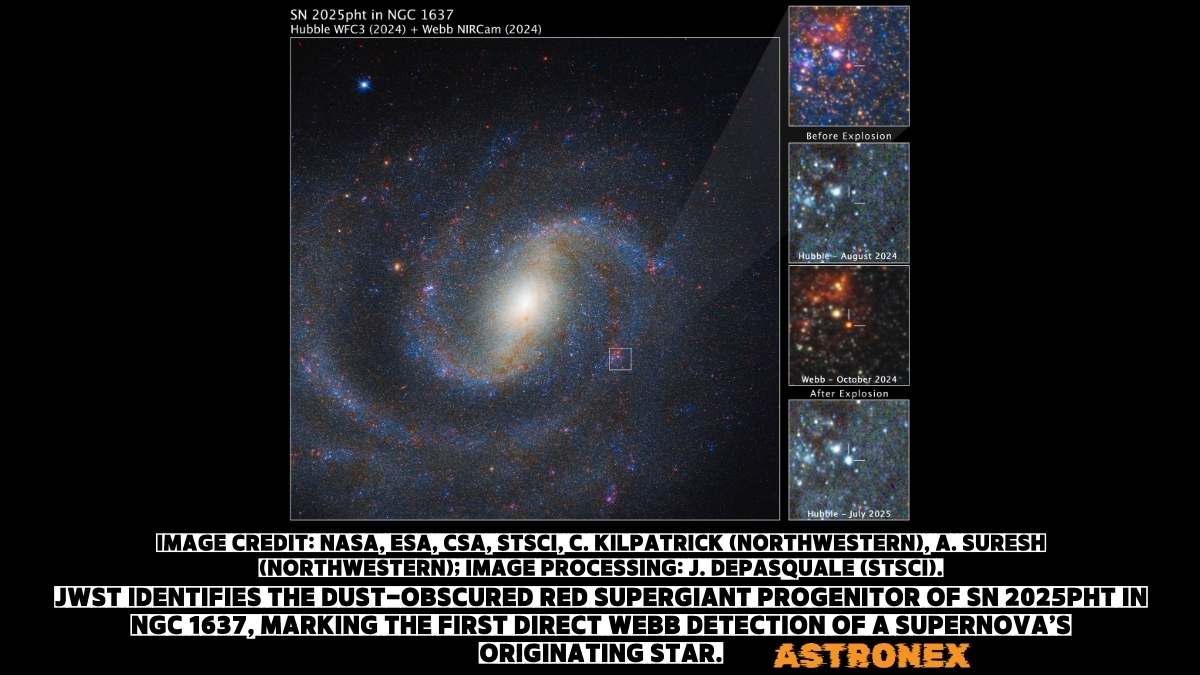
Astronomers have uncovered a key clue in understanding why some massive stars appear to vanish before exploding as supernovae. Using the James Webb Space Telescope, scientists identified the progenitor star of SN 2025pht, a red supergiant in the galaxy NGC 1637 that was heavily obscured by dust.
This detection, made possible by infrared observations, reveals how such stars can be hidden from visible-light telescopes, addressing a longstanding puzzle in stellar astronomy.
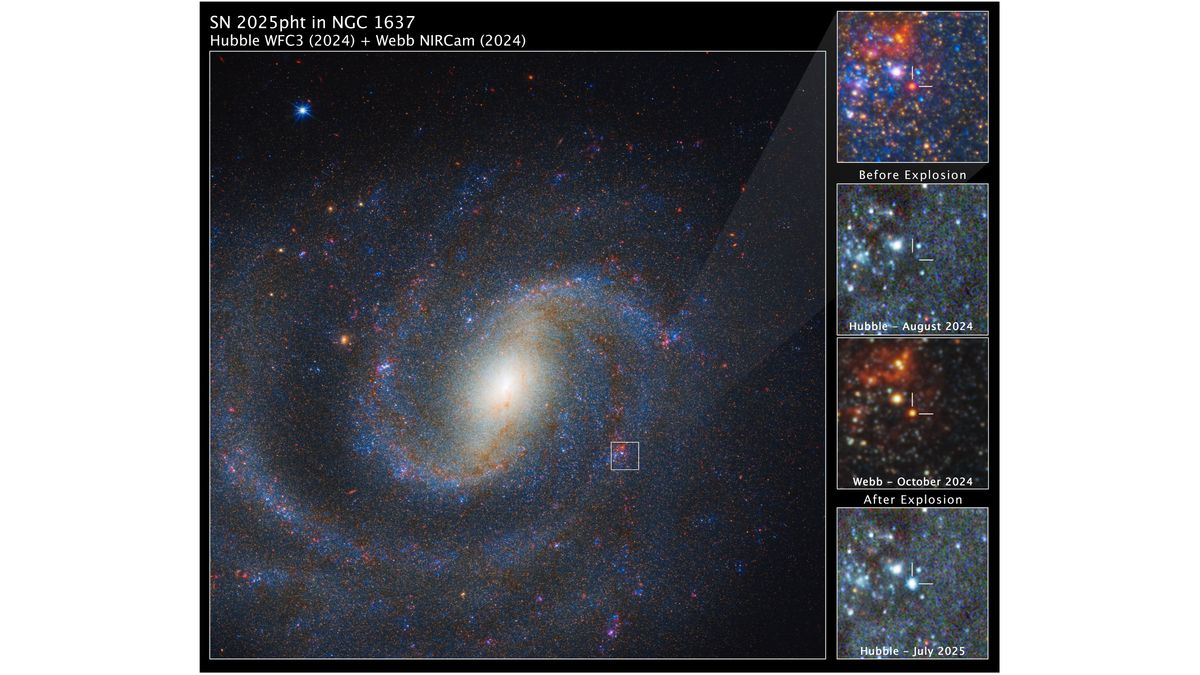
The supernova SN 2025pht was first spotted on June 29, 2025, in NGC 1637, a spiral galaxy roughly 39 million light-years from Earth. Pre-explosion images from JWST in 2024 showed a bright infrared source at the exact site, later confirmed by post-explosion data from the Hubble Space Telescope. This marks the first time JWST has pinpointed a supernova’s originating star, providing direct evidence of its dusty environment. The results were published in The Astrophysical Journal Letters (Kilpatrick et al., 2025).
What could this mean for our knowledge of how massive stars end their lives?
What Is a Red Supergiant Star?
Red supergiant stars form the final evolutionary phase for stars with initial masses ranging from about 8 to 30 times that of the Sun. These stars swell to enormous sizes, with radii up to 1,000 times the Sun’s radius (about 696,000 km), as they burn through heavier elements in their cores. Their surfaces cool to temperatures between 3,000 and 4,000 Kelvin (where Kelvin is the absolute temperature scale, starting at -273°C for zero), giving them a reddish hue in visible light.
These massive stars play a vital role in galactic chemistry by forging elements like carbon, oxygen, and iron through nuclear fusion. When their cores can no longer sustain fusion, they collapse, triggering a Type II supernova that scatters these elements across space. Red supergiants often expel material via stellar winds at speeds up to 50 km/s (kilometers per second), creating shells of gas and dust that can extend thousands of astronomical units (one AU equals 150 million km, the Earth-Sun distance).
For the JWST supernova progenitor of SN 2025pht, modeling shows an initial mass around 15 solar masses and a luminosity of 100,000 times the Sun’s (log(L/Lsun) = 5.0, where Lsun is the Sun’s luminosity of 3.8 x 10^26 watts). According to the peer-reviewed study on SN 2025pht, this star exhibited an effective temperature of 3,030 Kelvin and was surrounded by a dense dust shell. For scale, if this star replaced the Sun, its surface would extend beyond Jupiter’s orbit.
- Red supergiants have short lifespans, typically a few million years, compared to the Sun’s 10 billion years.
- Their mass loss rates can reach 10^-4 solar masses per year, equivalent to shedding Earth’s mass every few decades.
- Observations indicate variability in brightness over years, linked to pulsations or dust formation.
To illustrate size variations, consider a diagram showing radius comparisons with solar system planets; uncertainties in mass estimates range from 12 to 18 solar masses due to model dependencies.
How Did JWST Detect the JWST Supernova Progenitor?
The James Webb Space Telescope employed its Near-Infrared Camera (NIRCam) and Mid-Infrared Instrument (MIRI) to capture the JWST supernova progenitor in NGC 1637 during observations on February 5, 2024, and October 8, 2024. These instruments observe wavelengths from 0.6 to 28 microns (a micron is 10^-6 meters), penetrating dust that absorbs shorter visible light.
Alignment of these pre-explosion JWST images with a Hubble Space Telescope post-explosion image from July 31, 2025, achieved precision within 0.030 arcseconds (an arcsecond is 1/3600 of a degree). This confirmed the progenitor’s location with a low chance coincidence probability of about 4 percent. The star appeared bright in infrared bands, with magnitudes like 22.12 in F150W (1.5 microns) and 21.25 in F770W (7.7 microns).
Dust re-emission in the infrared allowed detection, as the carbon-rich dust absorbed optical light but glowed at longer wavelengths. The study found the spectral energy distribution favored graphite dust models, with optical extinction of 5.3 magnitudes (a magnitude is a logarithmic brightness scale, where 5 magnitudes mean 100 times dimmer).
This capability sets JWST apart, enabling views into dusty regions where previous surveys missed progenitors. For example, while visible surveys detect only unobscured stars, JWST can identify those with up to 10 magnitudes of extinction.
- NIRCam filters covered 1.3 to 4.4 microns, showing the star’s near-infrared glow.
- MIRI at 7.7 microns constrained dust temperature to about 790 Kelvin.
- Data processing involved mosaicking and photometry with tools like dolphot.
If magnitudes vary slightly across epochs, they range by 0.05 to 0.19, indicating minor variability.

What Role Does Carbon-Rich Dust Play in Hiding Red Supergiants?
Carbon-rich dust forms when carbon-bearing material becomes incorporated into the star’s circumstellar environment during advanced evolutionary stages. In massive red supergiants, enhanced late-stage mass loss and internal mixing processes can enrich the surrounding material with carbon, which then condenses into grains such as graphite in the cooler outer regions. These grains, typically ranging from 0.005 to 0.25 microns in size, efficiently absorb visible light and produce high extinction values.
In the case of the missing red supergiant for SN 2025pht, the dust created an optical depth of 6.7 (optical depth measures how much light is blocked), leading to 5.3 magnitudes of visual extinction. JWST data showed the dust was graphite-dominated, unusual for red supergiants where silicate dust (silicon-oxygen compounds) is more common.
As reported in NASA’s JWST supernova progenitor discovery, the graphite-dominated dust model indicates carbon-rich circumstellar material surrounding the star. While the precise carbon-to-oxygen ratio is not directly measured, the spectral energy distribution strongly favors carbonaceous grains over silicates. The dust shell likely formed during enhanced mass loss in the final stages of the star’s life, obscuring it in optical bands.
The wavelength-dependent absorption of carbonaceous grains causes stronger attenuation at shorter (optical) wavelengths, while thermal re-emission dominates in the infrared. Models predict dust masses around 10^-4 solar masses, though uncertainties arise from assumptions about grain composition, geometry, and size distribution.
- Graphite dust absorbs across ultraviolet to infrared, re-emitting at mid-infrared wavelengths.
- It can reduce visible brightness by factors of thousands in extreme cases.
- Spectral fits rejected silicate models at over 3 sigma confidence (sigma measures statistical significance).
For complex extinction curves, refer to a figure plotting wavelength versus flux to visualize the dust’s impact.
Why Couldn’t the Hubble Space Telescope See the Progenitor?
The Hubble Space Telescope focuses on ultraviolet and visible wavelengths from 0.1 to 2.5 microns, where carbon-rich dust scatters and absorbs light heavily, making the progenitor undetectable in pre-explosion images. Archival Hubble data from 1994 to 2024 showed upper limits fainter than 24.87 magnitudes in F606W (0.6 microns), consistent with high extinction.
Post-explosion, Hubble’s Wide Field Camera 3 captured SN 2025pht on July 31, 2025, in F336W at 19.06 magnitudes, confirming the event’s position. The dust’s preference for shorter wavelengths caused the star to appear invisible optically, while JWST’s infrared view revealed it.
This highlights a limitation in optical surveys for dusty environments, contributing to the missing red supergiant issue. These observations underscore the importance of infrared astronomy for identifying dust-obscured stellar progenitors.
- Hubble’s resolution is 0.05 arcseconds per pixel, ideal for sharp images but not dust penetration.
- Pre-explosion stacks combined multiple epochs for deeper limits.
What Is SN 2025pht and Why Is It Important?
SN 2025pht is a Type II-P supernova, characterized by a plateau in its light curve lasting about 100 days due to hydrogen recombination in the ejecta. Discovered on June 29, 2025, at coordinates matching the progenitor, it exhibited hydrogen lines with expansion velocities of 6,800 km/s.
Its significance lies in providing the first JWST-confirmed progenitor, a red supergiant with unusual carbon-rich dust. The explosion energy is estimated at 10^51 ergs (1 erg = 10^-7 joules), typical for core-collapse events.
Spectra from Keck Observatory showed minimal line-of-sight extinction, with equivalent width less than 0.02 magnitudes in color excess.
This event refines supernova rates, about one per century in galaxies like the Milky Way.
What Galaxy Is NGC 1637 and What Makes It Special?
NGC 1637 is a barred spiral galaxy in Eridanus, with a diameter of approximately 45,000 light-years and a redshift of 0.002392 (indicating recession velocity). Its distance is 12.03 ± 0.39 megaparsecs (1 megaparsec = 3.26 million light-years), or about 39.2 million light-years.
It hosts active star formation in its arms and previously saw SN 1999em. The galaxy’s relative proximity and low inclination (face-on view) make it ideal for detailed studies.
JWST images highlight infrared dust lanes, revealing hidden structures.
- Arm pitch angle around 20 degrees.
- Mass about 10 billion solar masses.
How Does This Discovery Solve the Mystery of the Missing Red Supergiant?
The mystery involves fewer detected red supergiant progenitors than expected, particularly those with luminosities above log(L/Lsun) = 5.2. JWST’s finding shows that dust obscuration, with extinctions up to 5.3 magnitudes, hides these stars in optical surveys.
For SN 2025pht, the carbon-rich dust explains the non-detection in Hubble, suggesting many “missing” progenitors are simply veiled. This reduces the need to invoke alternative explanations, such as failed supernovae leading directly to black hole formation, to account for the apparent deficit of high-luminosity progenitors.
Progenitors in this class are expected to fall within the 8–30 solar mass range, though precise limits depend on stellar evolution modeling assumptions.
This advance, per the study, enhances future JWST surveys.
In summary, JWST’s identification of the dusty red supergiant progenitor for SN 2025pht illuminates why some massive stars seem absent before exploding. It emphasizes infrared astronomy’s power in revealing obscured cosmic events. Future JWST observations may determine whether similar dust-enshrouded progenitors are common in nearby galaxies.
(Kilpatrick et al., 2025) (NASA, 2026)
Sources
Kilpatrick, C. D., Suresh, A., Andrews, J. E., Rest, A., Foley, R. J., & Coulter, D. A. (2025). The Type II SN 2025pht in NGC 1637: A Red Supergiant with Carbon-rich Circumstellar Dust as the First JWST Detection of a Supernova Progenitor Star. The Astrophysical Journal Letters, 992(1), L10. https://arxiv.org/abs/2508.10994
NASA. (2026, February 23). NASA’s Webb Telescope Locates Former Star That Exploded as Supernova. NASA Science. https://science.nasa.gov/missions/webb/nasas-webb-telescope-locates-former-star-that-exploded-as-supernova
📌 Frequently Asked Questions
What is the red supergiant problem in astronomy?
The red supergiant problem refers to the scarcity of observed high-luminosity red supergiant progenitors for Type II supernovae, despite models predicting them. JWST’s detection suggests dust obscuration is a major factor.
When was SN 2025pht discovered?
SN 2025pht was discovered on June 29, 2025, by the All-Sky Automated Survey for Supernovae. It occurred in NGC 1637, with light traveling 39 million years to Earth.
How does dust hide supernova progenitors?
Dust absorbs visible light, making stars appear dim or invisible in optical telescopes. Infrared observations like JWST’s detect the re-emitted heat, revealing hidden stars.
What type of supernova is SN 2025pht?
SN 2025pht is a Type II-P supernova, showing a brightness plateau and hydrogen lines in its spectrum. It results from a red supergiant’s core collapse.
Why is JWST better for detecting progenitors?
JWST’s infrared instruments penetrate dust that blocks visible light, allowing detection of obscured stars. This contrasts with Hubble’s optical focus.
What is the distance to NGC 1637?
NGC 1637 is 12 megaparsecs away, or about 39 million light-years. This measurement uses Cepheid variable stars for accuracy.
Is the progenitor of SN 2025pht unusually dusty?
Modeling indicates 5.3 magnitudes of visual extinction under graphite dust assumptions, placing it among the most heavily obscured confirmed red supergiant progenitors identified to date. Researchers described it as one of the reddest and most dust-enshrouded progenitors yet observed.
How massive was the progenitor star?
The progenitor had an initial mass of around 15 solar masses, with luminosity 100,000 times the Sun’s. Models place it in the 12-18 solar mass range.
What dust type surrounds the progenitor?
The dust is graphite-rich, indicating carbon dominance. This differs from common silicate dust in other red supergiants.
Are there plans for more JWST progenitor searches?
Yes, JWST’s capabilities will expand surveys for dusty progenitors, potentially resolving discrepancies in stellar evolution models.