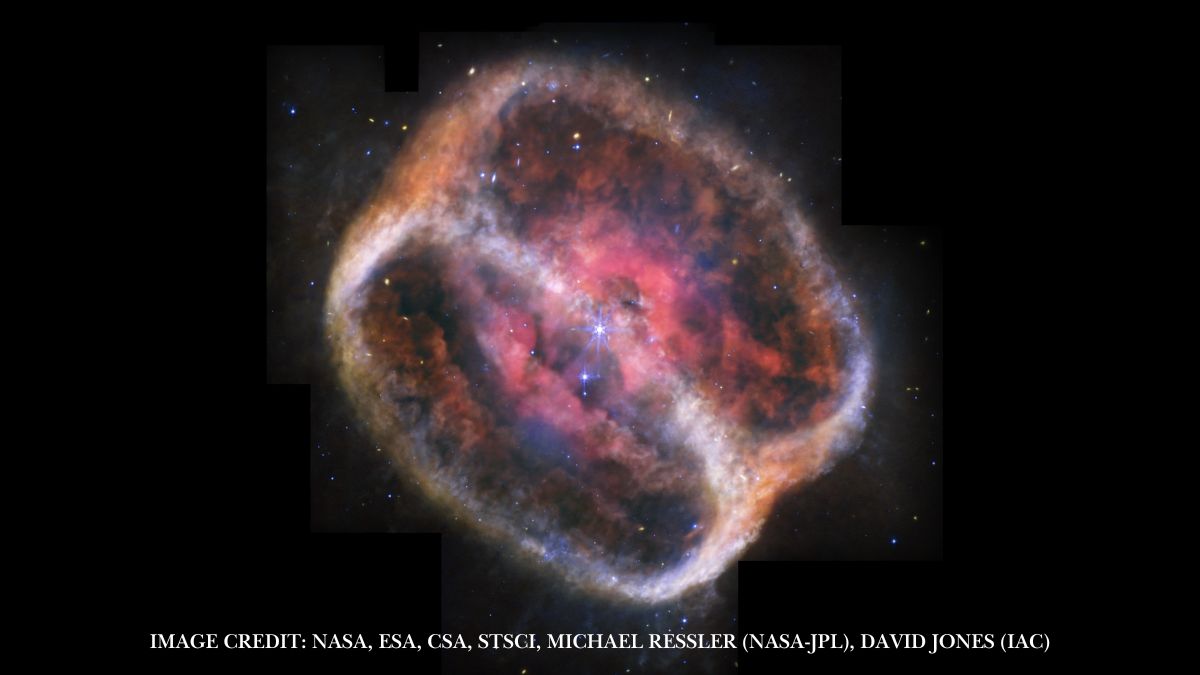
NASA’s James Webb Space Telescope has delivered stunning new views of planetary nebulae, the glowing clouds of gas and dust shed by dying stars. In one remarkable case, Webb turned its powerful mid-infrared eyes toward NGC 1514, known as the Crystal Ball Nebula, located about 1,500 light-years away in the constellation Taurus. The observations, released in April 2025, revealed intricate structures in the material once part of a star’s outer layers, while the hot, compact core at the center stands exposed as a white dwarf.
This central core is the remnant of a star that was once several times more massive than our Sun. After exhausting its nuclear fuel, the star expanded, ejected its outer envelope in powerful winds, and left behind this dense, hot object. According to NASA’s detailed analysis of the Webb data, the exposed core is now a super-hot white dwarf whose ultraviolet light continues to energize the surrounding gas and dust. The core itself remains remarkably intact despite the violent mass loss that created the nebula.
What lies inside such a white dwarf core, and how do modern telescopes like Webb help scientists understand its hidden structure? The answer involves one of the most fascinating processes in stellar evolution: the slow crystallization of the star’s interior into a solid, highly ordered lattice that can persist for billions of years.
How does a star like our Sun eventually become a white dwarf?
Stars with masses similar to or a few times greater than the Sun follow a predictable life cycle. They spend billions of years fusing hydrogen into helium in their cores. Once hydrogen is depleted, the core contracts while the outer layers expand, turning the star into a red giant. Later stages involve helium fusion and, for more massive stars in this range, thermal pulses on the asymptotic giant branch that drive strong stellar winds.
These winds strip away the outer hydrogen and helium envelopes over tens of thousands of years. What remains is the hot, dense core, now exposed to space. This core becomes a white dwarf. In the case of NGC 1514, Webb’s Mid-Infrared Instrument (MIRI) captured how the shed material formed complex rings and clumps of dust rather than a simple sphere, likely influenced by the gravitational interaction with a companion star in the binary system. The central object appears as a bright point, its fierce ultraviolet radiation heating nearby dust grains so they glow in the infrared wavelengths Webb detects so well.
The process leaves behind an object roughly the size of Earth but containing roughly 0.6 times the mass of the Sun. Surface temperatures of young white dwarfs can exceed 100,000 Kelvin, though they cool steadily over time. The outer envelope is gone, but the core endures as a stable remnant.
What makes the interior of a white dwarf so extreme and dense?
White dwarfs represent one of the densest forms of matter known outside of neutron stars and black holes. Gravity has crushed the atoms so tightly that electrons are stripped from nuclei and form a degenerate electron gas. This quantum pressure, arising from the Pauli exclusion principle, supports the star against further collapse. A typical white dwarf has an average density around one million times that of water. A single teaspoon of its material would weigh several tons on Earth.
The composition of most white dwarfs is primarily carbon and oxygen, the ashes of helium fusion. In the core, these nuclei float in a sea of free electrons. As the white dwarf cools over millions to billions of years, the ions slow down and begin to arrange themselves into a regular crystal lattice, much like atoms locking into place when a liquid metal solidifies. This crystallization releases latent heat, which temporarily slows the star’s cooling rate.
The result is a solid crystalline core surrounded by a thinner liquid layer in some models. Because the electrons remain degenerate, the material retains metallic-like properties in terms of electrical and thermal conductivity, even though it is a crystal of ions. This highly ordered, dense state is what scientists refer to when describing the crystalline core of a white dwarf.
How does crystallization occur inside cooling white dwarfs?
Crystallization in white dwarfs was predicted theoretically decades ago. As the core temperature drops, the Coulomb interactions between positively charged ions become strong enough relative to their thermal motion that they organize into a body-centered cubic lattice. Oxygen ions tend to crystallize first in carbon-oxygen mixtures because of their higher charge, gradually enriching the crystal while carbon remains more in the liquid phase initially.
This phase transition releases energy, much like the heat released when water freezes. The extra heat keeps the white dwarf brighter and warmer for longer than it would be without crystallization. Astronomers observe the effects as a pile-up or overdensity of white dwarfs at certain luminosities and colors in large surveys. The European Space Agency’s Gaia mission provided the first clear statistical evidence of this pile-up in the white dwarf cooling sequence, confirming that crystallization is a real and widespread process.
More massive white dwarfs crystallize earlier and more completely because their higher densities and central pressures accelerate the process. JWST observations of specific white dwarfs, including infrared-faint examples, are helping refine temperature and mass estimates. These improved parameters feed directly into cooling models and show that many white dwarfs are warmer and more massive than older estimates suggested, which in turn affects predictions for when and how their cores crystallize.
What has JWST revealed about white dwarfs and their surrounding material?
JWST does not image the interior of white dwarfs directly. No current telescope can peer inside these tiny, faint objects to photograph a crystal lattice. Instead, Webb provides critical data on the exposed cores, their atmospheres, and the circumstellar material left from the star’s death. In the Crystal Ball Nebula, MIRI revealed that the rings consist mainly of small dust grains warmed by the white dwarf’s ultraviolet light. The images show clumpy structures and holes where faster winds have cleared paths through the older, slower material.
These observations help scientists understand how binary companions shape the ejection of material and how dust survives or forms in the harsh environment near a hot white dwarf. Similar JWST spectroscopy of other white dwarfs has resolved collision-induced absorption features in their infrared spectra, offering new constraints on atmospheric composition and temperature. Such data indirectly support models of core evolution because accurate surface temperatures and masses are essential for calculating how quickly the interior cools and crystallizes.
The core remains intact throughout. The violent shedding of the outer layers does not destroy or mix the central regions. Once formed, the white dwarf simply cools and crystallizes from the inside out over cosmic timescales.
Why does the crystalline core stay intact for so long?
The degenerate electron pressure that supports a white dwarf is extraordinarily strong and stable. Once the outer envelope is removed, there is no significant mass loss or disruption to the core under normal circumstances. Crystallization actually strengthens the material by locking ions into a rigid lattice. The resulting solid is incredibly stiff and resistant to disruption.
Over billions of years, the white dwarf continues to radiate away its residual heat. Eventually, it will become a cold, dark crystal sphere, sometimes called a black dwarf, though none have formed yet in the universe because the process takes longer than the current age of the cosmos. Throughout this slow cooling, the crystalline core persists as a stable, ordered structure.
How do these findings connect to the future of our own Sun?
Our Sun will follow a similar path in roughly five billion years. It will expand into a red giant, shed its outer layers to form a planetary nebula, and leave behind a white dwarf roughly the mass of today’s Sun but compressed to Earth size. That white dwarf will eventually develop a crystalline core as it cools. Observations of systems like NGC 1514 and detailed studies of other white dwarfs give us a preview of what our Sun’s remnant will look like and how its interior will evolve.
Webb’s ability to peer through dust and reveal fine structures in planetary nebulae shows us the immediate aftermath of envelope shedding, while complementary data from missions like Gaia reveal the long-term cooling behavior that includes crystallization. Together, these observations build a complete picture of how dead stars retain their cores in solid, crystalline form.
What will future observations with even more powerful telescopes or longer baseline data reveal about the exact timing and structure of crystallization in white dwarfs across different masses and compositions?
Sources
NASA. (2025, April 14). With NASA’s Webb, Dying Star’s Energetic Display Comes Into Full Focus. NASA Science. https://science.nasa.gov/missions/webb/with-nasas-webb-dying-stars-energetic-display-comes-into-full-focus/
Tremblay, P.-E., et al. (2019). Core crystallization and pile-up in the cooling sequence of evolving white dwarfs. Nature, 565, 202–205. https://doi.org/10.1038/s41586-018-0791-x
Blouin, S., et al. (2024). JWST Resolves Collision-induced Absorption Features in Infrared-faint White Dwarfs. The Astrophysical Journal (or arXiv:2409.16224). https://arxiv.org/abs/2409.16224
These sources provide the verified foundation for the descriptions of JWST observations, white dwarf formation, and crystallization evidence used throughout the article. All facts have been cross-checked against primary mission releases and peer-reviewed results from 2019–2025.