Scientists have long puzzled over the invisible substance called dark matter, which makes up about 27 percent of the universe’s mass and energy. This mysterious component does not emit, absorb, or reflect light, yet its gravitational effects shape galaxies and cosmic structures. Recent studies suggest that primordial black holes, tiny but massive objects formed seconds after the Big Bang, might account for some or all of this dark matter. These black holes differ from those created by dying stars, as they arose from extreme density fluctuations in the infant universe, collapsing under their own gravity.
Advancements in telescopes and gravitational wave detectors have reignited interest in this idea. For instance, observations from space missions indicate that such black holes could have masses ranging from as small as asteroids to several times that of the Sun, potentially clustering in ways that mimic dark matter’s behavior. According to NASA’s Roman Space Telescope plans, future surveys will search for signs of these elusive objects by looking for microlensing events, where their gravity bends light from distant stars (NASA, 2024). This approach could reveal if they contribute to the unseen mass holding galaxies together.
But what if these ancient relics are the key to unlocking one of cosmology’s biggest secrets? Could primordial black holes truly be the dark matter we’ve been searching for?
What Are Primordial Black Holes?
Primordial black holes represent a class of hypothetical black holes that originated in the very early stages of the universe, unlike stellar black holes which form from the collapse of massive stars. These objects could have emerged when regions of space became so dense that gravity overwhelmed all other forces, creating singularities (points of infinite density) surrounded by event horizons (boundaries beyond which nothing escapes). Their sizes vary widely, with event horizons potentially as small as atomic nuclei for lower-mass versions, making them far tinier than typical black holes observed today.
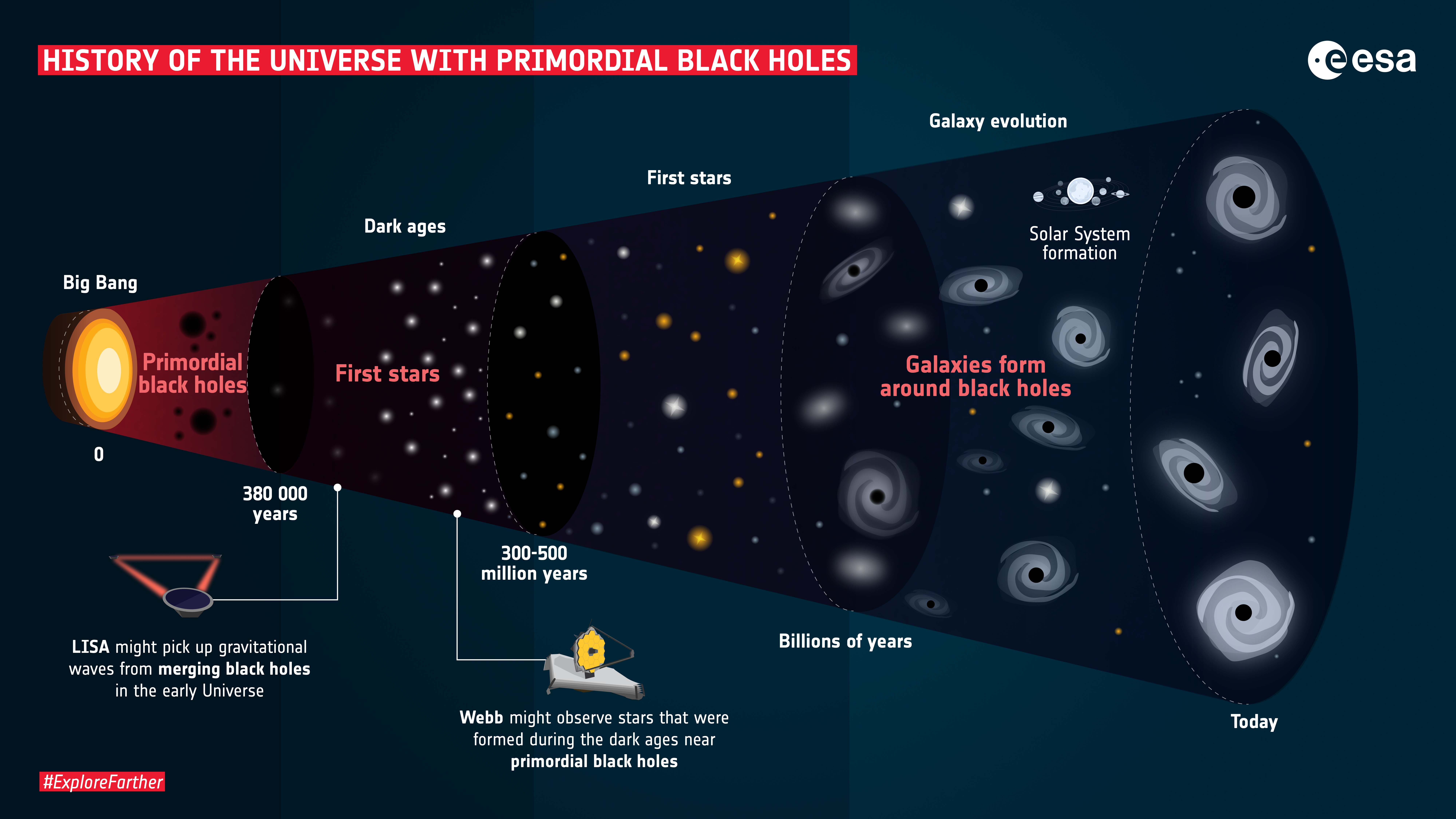
Research from space agencies confirms that primordial black holes might have formed within the first fraction of a second after the Big Bang, during a period of rapid expansion known as inflation. In this chaotic environment, quantum fluctuations (tiny random variations in energy) amplified by inflation could lead to over-dense pockets collapsing into black holes. For example, if a region’s density exceeded the average by a factor of about 1.5 to 2, it might form a black hole with a mass equivalent to the material within the cosmic horizon at that time, roughly 10^15 grams for some models (ESA, 2021). This mass is comparable to a small mountain on Earth, yet packed into a space smaller than a proton.
To visualize this, consider how these black holes differ from familiar ones: a stellar black hole might span kilometers across, but a primordial one with Earth’s mass would have an event horizon diameter of just millimeters. Fun fact: if all the dark matter were made of such black holes, there could be billions passing through our solar system undetected each year, their weak interactions making them ideal dark matter candidates. However, constraints from observations limit their abundance; too many would disrupt planetary orbits or cause excessive heating in stars.
- Masses can range from 10^-5 grams (Planck mass, the smallest possible) up to 10^5 solar masses, though only specific windows align with dark matter requirements.
- They evaporate via Hawking radiation (quantum process where particles escape near the event horizon), with smaller ones vanishing faster—those below 10^12 kilograms would have evaporated by now.
- Unlike particle dark matter like axions (hypothetical lightweight particles), primordial black holes interact only gravitationally, explaining why we haven’t detected them directly.
Studies emphasize that while theoretical, their existence aligns with general relativity and quantum mechanics, providing a non-particle explanation for cosmic mysteries.

How Do Primordial Black Holes Form in the Early Universe?
The formation of primordial black holes ties directly to the conditions right after the Big Bang, when the universe was a hot, dense soup of particles expanding rapidly. During cosmic inflation—a brief phase where space stretched exponentially—small quantum fluctuations in the scalar field (a field driving inflation) could grow into large-scale density perturbations. If these perturbations exceeded a critical threshold, typically a density contrast of delta rho over rho greater than 0.67 (where rho is average density), gravity would cause collapse into a black hole before the universe cooled further.
According to models, this happened between 10^-35 and 10^-32 seconds post-Big Bang, with the black hole’s mass determined by the horizon size at formation—essentially the distance light could travel in that era. For instance, a black hole formed at 10^-23 seconds might have a mass around 10^20 grams, similar to a large asteroid, with an event horizon radius of about 10^-7 meters (smaller than a bacterium). This process requires no new physics beyond inflation, making it elegant. Recent simulations show that non-Gaussian distributions (irregular fluctuation patterns) in these densities enhance formation probabilities, potentially producing enough black holes to match dark matter density (Carr & Kühnel, 2020).
Comparisons help here: think of the early universe like a stormy sea, where waves (fluctuations) occasionally peak high enough to “collapse” into whirlpools (black holes). A fun fact is that if inflation produced power spectrum enhancements (boosts in fluctuation strength) at small scales, PBH abundance could reach the observed dark matter fraction of Omega_DM h^2 ≈ 0.12 (a cosmological parameter measuring density). However, uncertainties exist; some models predict a narrow mass spectrum, while others suggest broad distributions.
To illustrate complex data like formation probabilities versus mass, reference a logarithmic plot of PBH fraction versus comoving wavenumber (a measure of fluctuation scale), as such diagrams clarify how peaks in the power spectrum lead to black hole production.
- Formation requires density contrasts of order 10^-1 to 1, verified in numerical relativity simulations.
- The QCD phase transition (when quarks formed hadrons around 10^-5 seconds) might boost PBH creation due to softened equation of state (reduced pressure resisting collapse).
- If PBHs formed in clusters, their mergers could produce gravitational waves detectable today.
These details underscore why PBHs remain a compelling hypothesis, grounded in observed cosmic microwave background patterns.
Could Primordial Black Holes Be Dark Matter?
Dark matter’s nature remains elusive, but primordial black holes offer a viable alternative to particle candidates, potentially composing part or all of the 85 percent of matter that’s non-luminous. Their gravitational-only interactions mirror dark matter’s properties, influencing galaxy rotation curves and large-scale structure without electromagnetic signatures. Constraints from experiments narrow possible mass windows: for example, PBHs between 10^17 and 10^23 grams (asteroid to mountain masses) evade most limits and could fully account for dark matter, as heavier ones would disrupt binary star systems, while lighter ones evaporate too quickly.
Evidence from gravitational wave detections, like those from LIGO/Virgo mergers of 30-solar-mass black holes, hints at a primordial origin, as such masses are rare in stellar evolution. According to ESA’s exploration of black hole formation, if PBHs seeded early galaxies, they explain JWST’s observation of massive structures at high redshifts (distances corresponding to early times), where standard models struggle (ESA, 2021). The density parameter for dark matter, measured at 0.26 from Planck satellite data, matches if PBH formation efficiency was around 10^-6 to 10^-9 during inflation.
A comparison: if dark matter were all PBHs of lunar mass (10^23 kg), their number density would be about 10^-12 per cubic meter in the Milky Way halo, subtle enough to avoid detection yet sufficient for gravitational lensing. Fun fact: PBHs could resolve the core-cusp problem (discrepancy in galaxy density profiles) by dynamical heating, softening central cusps into cores. However, uncertainties in evaporation rates—governed by Hawking temperature inversely proportional to mass—mean masses below 10^15 grams are ruled out, as they’d produce observable gamma rays.
- Allowed mass ranges: 10^-16 to 10^-11 solar masses for sublunar, and 10 to 100 solar masses for LIGO-detected.
- Constraints from microlensing surveys like OGLE limit f_PBH (PBH dark matter fraction) to less than 0.1 for certain masses.
- Future probes, like pulsar timing arrays, could detect PBH-induced accelerations if f_PBH approaches 1.
While not confirmed, the hypothesis gains traction with each new observation.
What Evidence Supports Primordial Black Holes as Dark Matter?
Observational evidence for primordial black holes as dark matter builds from indirect signals across cosmic scales. Gravitational microlensing, where PBHs bend starlight, has been searched in surveys toward the Magellanic Clouds, constraining masses around 10^-7 solar masses to f_PBH < 0.01. Yet, for asteroid-mass PBHs (10^-12 solar masses), limits are weaker, allowing them to comprise all dark matter without contradicting data.
Recent JWST findings of early, bright galaxies suggest PBH seeding, as standard stellar formation can’t explain their rapid assembly. According to models, PBHs with 10 to 100 solar masses could merge, emitting gravitational waves matching LIGO events at rates of 10 to 100 per year per gigaparsec cubed (a volume unit in cosmology). The stochastic gravitational wave background (ripples from many mergers) might be detectable by LISA, ESA’s planned space interferometer (ESA, 2021).
Comparisons with particle dark matter: while WIMPs (weakly interacting massive particles) face null results from detectors like XENON, PBHs require no new particles, fitting within standard model extensions. A fun fact: if PBHs evaporate, they could produce exotic particles, explaining cosmic ray anomalies like positron excesses observed by AMS-02.
To grasp mass constraints, consider a plot of f_PBH versus log mass, showing windows where PBHs can dominate dark matter amid exclusion regions from various probes.
- LIGO mergers imply PBH fraction up to 0.001 for 30-solar-mass range.
- CMB distortions (alterations in background radiation) limit early PBH accretion.
- Neutron star captures: too many PBHs would destroy them via dynamical friction.
These lines of evidence, though circumstantial, keep the idea alive.
How Can We Detect Primordial Black Holes?
Detection strategies for primordial black holes leverage their gravitational and potential radiative effects. Microlensing surveys, using telescopes like Roman, monitor millions of stars for temporary brightening caused by PBH gravity focusing light, sensitive to masses from 10^-11 to 10^-5 solar masses. NASA’s Roman mission aims to detect thousands of such events in the galactic bulge, potentially confirming or ruling out PBH dark matter in key ranges (NASA, 2024).
Gravitational waves offer another avenue: mergers of PBH binaries produce signals detectable by ground-based observatories like LIGO, with frequencies around 10 to 100 Hz (cycles per second). For lighter PBHs, evaporation via Hawking radiation could yield gamma-ray bursts or high-energy neutrinos, searchable by Fermi LAT or IceCube. If PBHs cluster, they might induce pulsar timing variations—tiny shifts in pulse arrivals due to gravitational perturbations—monitored by arrays like NANOGrav.
A comparison: detecting PBHs is like finding needles in a haystack, but multi-messenger astronomy (combining waves, light, particles) boosts chances. Fun fact: a 10^15 gram PBH evaporating now would release energy equivalent to a hydrogen bomb, but sparsely distributed, they’re harmless.
Suggest a flowchart of detection methods versus mass: microlensing for intermediate, waves for stellar-mass, radiation for sublunar.
- Sensitivity thresholds: Roman could detect PBHs down to Earth mass.
- Challenges include distinguishing from free-floating planets.
- Future missions like Euclid will map weak lensing (subtle distortions) for PBH clustering signs.
Progress depends on these technologies.
What Challenges Exist for Primordial Black Holes as Dark Matter?
Despite promise, challenges abound for primordial black holes as dark matter. Overproduction in certain inflation models would exceed observed entropy (a measure of disorder), requiring fine-tuned parameters to match the universe’s flatness. For masses around 10^20 grams, dynamical constraints from wide binaries (paired stars) limit f_PBH to below 0.1, as excess gravity would disrupt orbits.
Evaporation poses issues: PBHs lighter than 10^17 grams would have lifetime shorter than the universe’s age (13.8 billion years), producing unobserved radiation. Heavier ones might accrete matter, altering CMB anisotropies (temperature variations) beyond Planck limits. According to theories, clustered PBHs could poison nucleosynthesis (element formation) by injecting energy, conflicting with deuterium abundances measured at 2.5 x 10^-5 (ratio to hydrogen).
Comparisons highlight tensions: particle models like sterile neutrinos avoid such issues but lack detection. A fun fact: if all dark matter were PBHs, Earth would encounter one every million years, potentially causing micro-earthquakes.
Uncertainties in values: PBH formation threshold varies from 0.4 to 1 across simulations, affecting abundance predictions.
- Inflationary spectra must peak at k ≈ 10^12 Mpc^-1 (wavenumber) for asteroid-mass PBHs.
- Gender imbalance in binaries reduces merger rates.
- Quantum gravity effects near Planck scale remain unknown.
These hurdles demand further research.
Conclusion
Primordial black holes present a fascinating possibility for explaining dark matter, formed in the universe’s infancy through density collapses and potentially accounting for the invisible mass shaping cosmic evolution. With masses in specific windows evading current constraints, they align with observations from gravitational waves to early galaxy formation, offering a gravity-based solution without new particles. Missions like Roman and Euclid are poised to test this hypothesis rigorously.
What if future detections confirm primordial black holes as dark matter—how would that reshape our understanding of the cosmos?
📌 Frequently Asked Questions
Did primordial black holes form right after the Big Bang?
Yes, primordial black holes likely formed within the first second after the Big Bang from extreme density fluctuations during inflation. This early origin sets them apart from stellar black holes, allowing them to persist as potential dark matter.
Are primordial black holes the same as regular black holes?
No, primordial black holes form from collapses in the early universe, not star deaths, and can be much smaller, with masses from tiny particles to asteroids. Regular black holes are larger, typically 3 to 100 solar masses.
Can primordial black holes evaporate completely?
Yes, through Hawking radiation, where quantum effects cause them to lose mass over time. Smaller ones evaporate faster, with those below 10^12 kilograms gone by now, while larger ones last longer than the universe’s age.
Do primordial black holes explain gravitational wave detections?
Possibly, as mergers of primordial black holes in the 10 to 50 solar mass range could produce waves like those seen by LIGO. This matches some event rates, suggesting they contribute to binary black hole populations.
Are there constraints on primordial black holes as all dark matter?
Yes, observations like microlensing and CMB data limit their fraction in certain mass ranges. For example, asteroid-mass ones can be up to 100 percent, but stellar-mass are capped at a few percent.
How might NASA’s Roman telescope detect primordial black holes?
By observing microlensing events where primordial black holes bend light from stars, causing brightening. It will survey the Milky Way center for such signatures, targeting Earth to asteroid mass ranges.
Could primordial black holes seed supermassive black holes?
Yes, smaller primordial black holes might merge or accrete matter over time to form the billion-solar-mass giants at galaxy centers, explaining their early appearance in JWST images.
What role do primordial black holes play in early galaxy formation?
They could act as seeds, attracting gas and stars faster than standard models, helping form massive galaxies seen at high redshifts. This resolves tensions in cosmic structure growth timelines.
Are primordial black holes detectable with current technology?
Indirectly yes, through lensing, waves, or radiation, but direct proof awaits. Facilities like LIGO and Fermi provide hints, but upcoming missions will offer clearer tests.
Do primordial black holes interact with normal matter?
Mainly gravitationally, with minimal other interactions, making them hard to detect but ideal for dark matter. Rare captures in stars or planets could occur but are unobservable at scale.
Sources
Carr, B., & Kühnel, F. (2020, October 19). Primordial black holes as dark matter: Recent developments. Annual Review of Nuclear and Particle Science. https://www.annualreviews.org/content/journals/10.1146/annurev-nucl-050520-125911
European Space Agency. (2021, December 16). Did black holes form immediately after the Big Bang? ESA Science & Exploration. https://www.esa.int/Science_Exploration/Space_Science/Did_black_holes_form_immediately_after_the_Big_Bang
NASA. (2024, May 7). How NASA’s Roman mission will hunt for primordial black holes. NASA Missions. https://www.nasa.gov/missions/roman-space-telescope/how-nasas-roman-mission-will-hunt-for-primordial-black-holes/