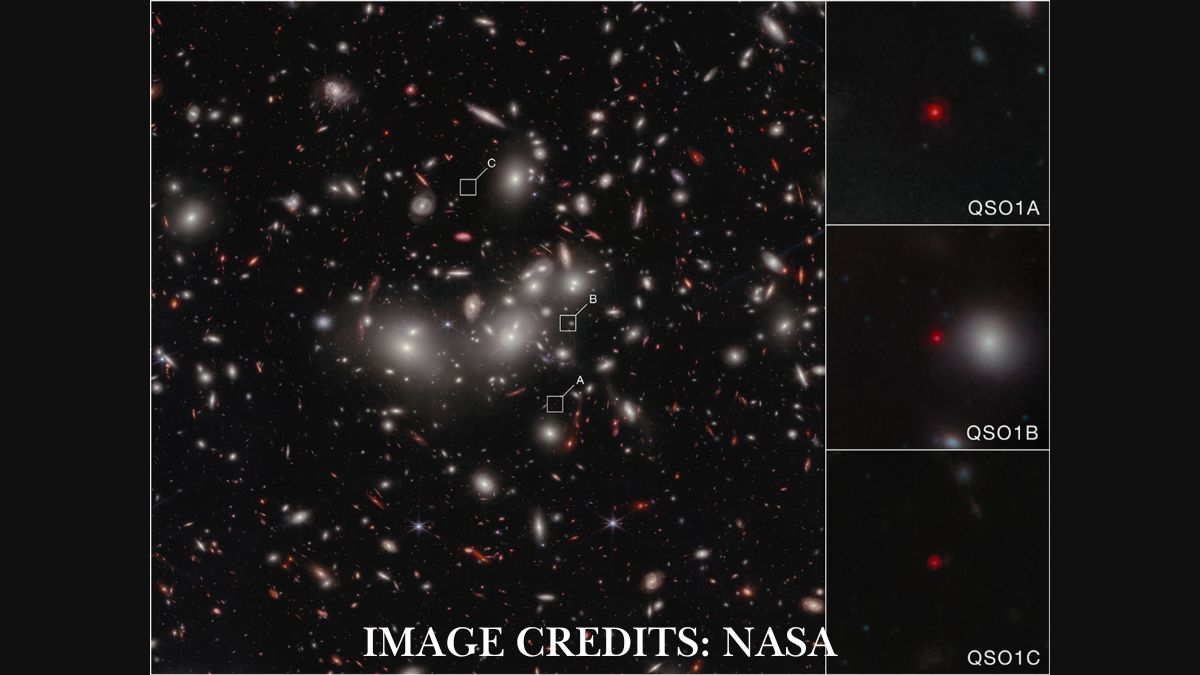
Scientists using NASA’s James Webb Space Telescope have made a stunning discovery that challenges long-held ideas about how the universe’s first giant black holes and galaxies came into being. They identified a supermassive black hole in a tiny, distant system called Abell2744-QSO1, or QSO1 for short. This black hole already weighed about 50 million times the mass of our Sun when the universe was only around 700 million years old. Its light has traveled more than 13 billion years to reach us.
The host “galaxy” around it is remarkably small — only about 1,300 light-years across — and contains very little in the way of stars. Instead, it is mostly made of pristine hydrogen and helium gas with almost no heavier elements. The black hole makes up at least two-thirds of the total mass of the entire system. This is thousands of times higher than the usual ratio seen in galaxies today, where the central black hole is just a tiny fraction of the host galaxy’s mass.
According to NASA’s recent Webb findings, this object provides the first direct measurement of a black hole’s mass in the first billion years after the Big Bang. The results suggest the black hole was already enormous from the start and may have predated the buildup of a substantial stellar galaxy around it. This raises a fascinating question: how did such a massive black hole exist and dominate so early, when there was so little time for normal growth processes to operate?
What exactly did the James Webb Space Telescope discover about this ancient black hole?
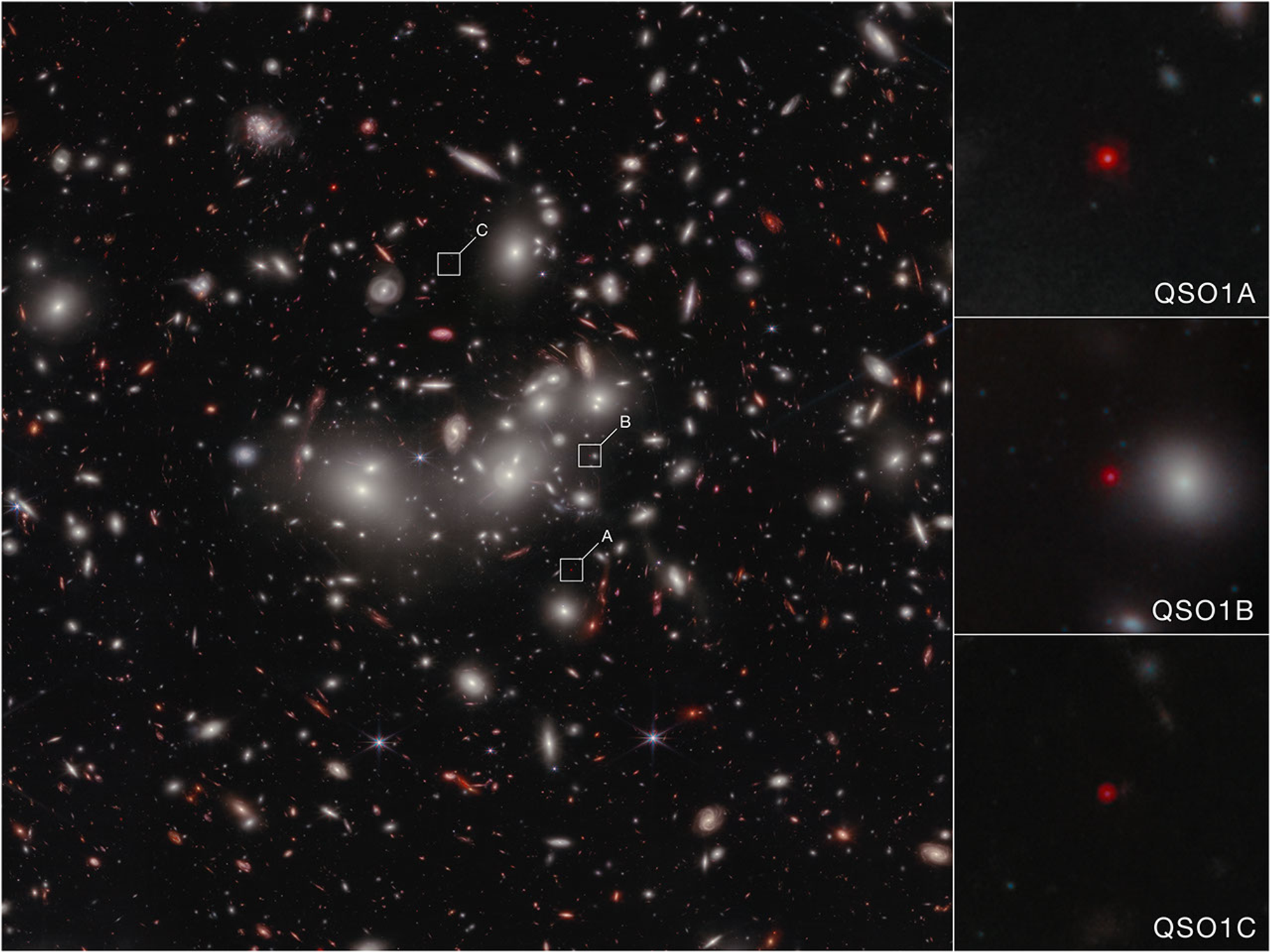
The object is a classic example of a “Little Red Dot,” a class of compact, red-colored sources that Webb has found in large numbers in the early universe. QSO1 sits behind the massive galaxy cluster Abell 2744, also known as Pandora’s Cluster. The cluster’s gravity acts like a natural magnifying glass, bending and amplifying the light from the distant system so it appears three times in the sky.
Webb’s Near Infrared Camera (NIRCam) captured clear images of these magnified views. Follow-up observations with the Near Infrared Spectrograph (NIRSpec) and its integral field unit allowed scientists to map the motion of gas swirling around the center. The gas shows perfect Keplerian rotation — meaning it orbits faster when closer to the center, exactly as planets orbit the Sun. This pattern can only be explained if almost all the mass is concentrated in a single central point: the black hole itself.
For comparison, the supermassive black hole at the center of our own Milky Way galaxy has a mass of about 4 million solar masses and sits inside a galaxy with hundreds of billions of stars. In QSO1, the black hole is more than 10 times heavier, yet the surrounding structure is tiny and has barely begun forming stars. This extreme imbalance is what makes the discovery so important.
How did Webb directly measure the mass of this early black hole?
Previous estimates of black hole masses in the distant universe relied on indirect methods that assume the same relationships observed in nearby galaxies hold true everywhere. Webb’s observations of QSO1 changed that by providing the first direct dynamical measurement.
Astronomers tracked the speed of hydrogen gas clouds orbiting the black hole at different distances from the center. Because the motion follows Kepler’s laws of orbital motion (the same rules that govern planets in our solar system), they could calculate the central mass needed to keep the gas in orbit. The result: approximately 50 million solar masses. This matches earlier indirect estimates of around 40 million solar masses and confirms those methods work even in the early universe.
The velocity map shows no sign of a large, extended distribution of stars that would be expected in a normal galaxy. Instead, the data strongly favor a single central point mass. This direct evidence removes much of the previous uncertainty and proves the black hole really is this massive.
Why does this discovery suggest the black hole formed or grew before its host galaxy?
In the standard picture, galaxies form first from collapsing clouds of gas. Stars form inside them, and some of those stars eventually collapse into black holes that then grow over time by swallowing gas and merging with other black holes. The black hole and the galaxy’s central bulge are expected to grow together, maintaining a relatively stable mass ratio.
QSO1 breaks this sequence. The black hole already dominates the mass budget while the surrounding material remains mostly gas with very few stars and very low levels of heavy elements (less than 0.5 percent of the Sun’s metallicity). Scientists describe it as a “naked” black hole or one that has predated stellar processes. The system appears to be caught in an early phase where the black hole is already huge and may be in the process of building a galaxy around itself.
This supports the idea that at least some supermassive black holes in the early universe grew faster than, or formed ahead of, their host galaxies’ stellar components. It is consistent with theoretical “heavy seed” models in which black holes begin with tens of thousands or more solar masses rather than growing slowly from the remnants of the first stars.
What makes the host galaxy of this black hole so unusual?
The host is extremely compact at just 1,300 light-years across — tiny compared with the Milky Way’s 100,000-light-year diameter. It contains almost no stars yet and is chemically primitive, consisting almost entirely of hydrogen and helium. This near-pristine composition indicates that few generations of stars have lived and died there to produce heavier elements.
Because the black hole accounts for the vast majority of the system’s mass, there is very little room left for a normal stellar population. Upper limits on the stellar mass are extremely low. The object is essentially a supermassive black hole surrounded by a small reservoir of gas that has not yet turned into many stars. This environment is very different from the mature galaxies we see nearby.
How does this finding challenge our understanding of black hole and galaxy formation?
The discovery forces a major rethink of early cosmic history. If black holes this massive existed when the universe was only 700 million years old, and if they already outweighed their host galaxies by such a large factor, then either they formed through unusual channels or they grew at unexpectedly high rates.
Possible explanations include direct collapse of massive gas clouds into heavy black hole seeds or even primordial black holes formed in the first moments after the Big Bang. Both ideas have been discussed theoretically but lacked strong observational support until now. The clean Keplerian rotation and low stellar content provide some of the clearest evidence yet that at least one such object existed.
The finding also aligns with other Webb results showing that black holes in the early universe often appear overmassive relative to their galaxies. Together, these observations suggest that in the first few hundred million years, black holes could grow faster than the galaxies hosting them, reversing the usual order of assembly.
What role did gravitational lensing play in this discovery?
Without the natural magnifying effect of Abell 2744, QSO1 would be extremely faint and difficult to study in detail. The cluster’s gravity bends spacetime and focuses light from the background object, making it appear brighter and larger. This lensing effect allowed Webb to obtain high-quality spectra and spatially resolved maps of gas motion that would otherwise be impossible at such a great distance.
The triple imaging also provides multiple views of the same system from slightly different angles, helping confirm the measurements. Gravitational lensing has become one of Webb’s most powerful tools for studying the earliest objects in the universe.
Could this black hole be evidence of a primordial or direct-collapse seed?
The combination of its large mass, minimal stellar host, and chemically primitive surroundings fits well with models of heavy black hole seeds. A primordial black hole formed in the first second after the Big Bang or a black hole created by the direct collapse of a giant gas cloud could reach tens of millions of solar masses relatively quickly without needing a large galaxy to feed it first.
While the data cannot yet distinguish between these possibilities, they rule out slow growth from ordinary stellar-mass black holes in the available time. QSO1 may represent a rare, caught-in-the-act example of one of these early massive seeds beginning to build its galactic home.
How will future observations help us understand these early black holes better?
Webb will continue observing more Little Red Dots and similar objects to see how common this extreme mass ratio is. Future missions and upgraded instruments may one day measure even earlier examples or detect the signatures of the very first star formation around these black holes. Each new data point helps astronomers piece together whether most early black holes formed this way or whether QSO1 is an unusual but revealing case.
The discovery of this ancient black hole that already outweighed its tiny host galaxy shows that the early universe was more dynamic and surprising than many models predicted. It opens a new window into the processes that shaped the first giant black holes and the galaxies that eventually grew around them.
Conclusion
The James Webb Space Telescope has revealed a supermassive black hole that was already enormous when the universe was still in its infancy, dominating a tiny, gas-rich system with almost no stars yet formed. This finding demonstrates that at least some black holes grew faster or assembled earlier than their host galaxies, forcing scientists to revise theories of cosmic structure formation. What other surprises about the universe’s first billion years will Webb and future telescopes uncover as they peer deeper into cosmic dawn?
Sources
Juodžbalis, I., Marconcini, C., D’Eugenio, F., Maiolino, R., et al. (2026). A direct black-hole mass measurement in a little red dot at high redshift. Nature. https://www.nature.com/articles/s41586-026-10579-4
Maiolino, R., Übler, H., D’Eugenio, F., et al. (2026). A black hole in a near-pristine galaxy 700 million years after the Big Bang. Monthly Notices of the Royal Astronomical Society.
NASA. (2026, May 27). NASA’s Webb Reveals Black Hole That Formed Before Its Galaxy. NASA Science. https://science.nasa.gov/missions/webb/nasas-webb-reveals-black-hole-that-formed-before-its-galaxy/