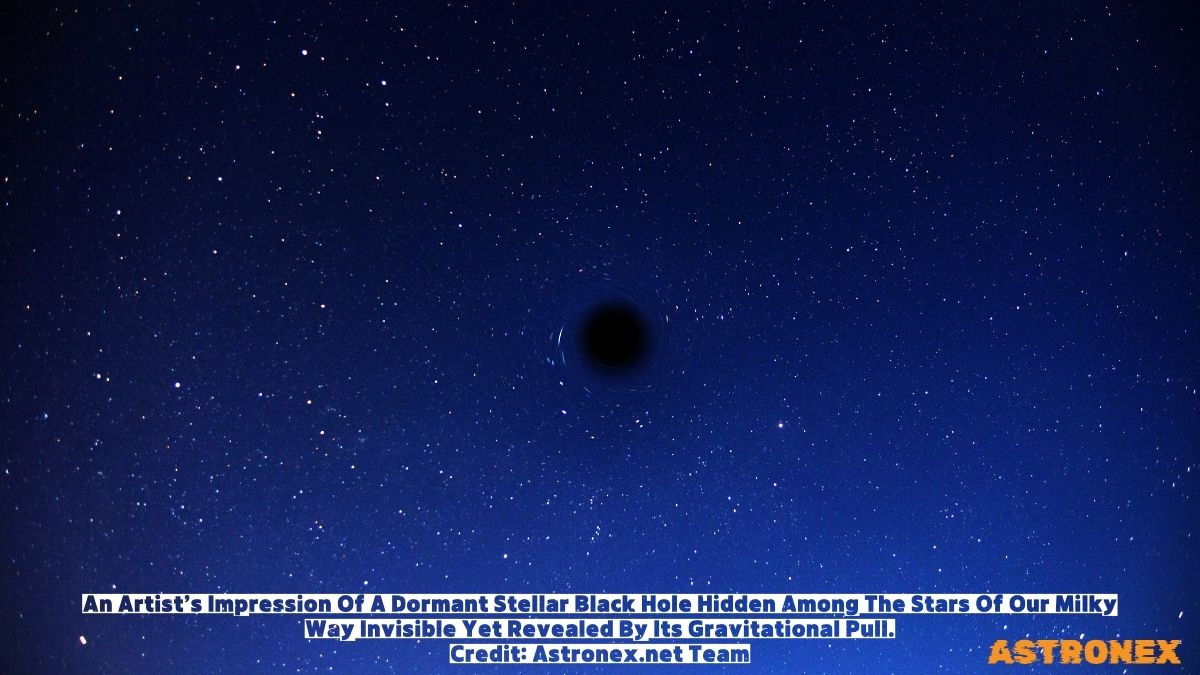
Astronomers have identified the heaviest stellar black hole known in the Milky Way galaxy. The object, designated Gaia BH3, has a mass of about 33 times that of the Sun. This discovery markedly exceeds the previous record held by the black hole in Cygnus X-1, which has a mass of roughly 21 solar masses.
Gaia BH3 lies approximately 2000 light-years from Earth in the constellation Aquila. It is the second-closest known black hole to our solar system. The black hole remains dormant, showing no active accretion from its companion star, which explains why it evaded detection until now.
The discovery originated from data collected by the European Space Agency’s Gaia mission. Astronomers noticed an anomalous wobbling motion in the orbit of a companion star caused by the gravitational pull of an unseen massive object. This astrometric signal indicated the presence of a high-mass companion.
Follow-up observations with ground-based telescopes confirmed the nature of Gaia BH3. Spectroscopic data from the Ultraviolet and Visual Echelle Spectrograph on the European Southern Observatory’s Very Large Telescope, along with measurements from the HERMES spectrograph at the Mercator Telescope and the SOPHIE instrument at the Observatoire de Haute-Provence, provided precise radial velocity measurements. These data allowed researchers to derive the black hole’s mass with high accuracy.
The companion star is a metal-poor giant, with chemical composition reflecting low abundances of elements heavier than helium. This low metallicity suggests that the progenitor star, which collapsed to form the black hole, experienced reduced mass loss through stellar winds. Such conditions appear favorable for the formation of more massive black holes.
Pasquale Panuzzo, a member of the Gaia collaboration from the Observatoire de Paris, PSL University, noted the unexpected nature of the find. “No one was expecting to find a high-mass black hole lurking nearby, undetected so far. This is the kind of discovery you make once in your research life,” he said, as reported in the ESO announcement.
Elisabetta Caffau, also from the Observatoire de Paris, PSL University, emphasized the significance of the result. “We took the exceptional step of publishing this paper based on preliminary data ahead of the forthcoming Gaia release because of the unique nature of the discovery.”
The findings, detailed in a study published in Astronomy & Astrophysics, highlight Gaia BH3 as the heaviest stellar black hole confirmed in the Milky Way to date.
This detection demonstrates the power of astrometric surveys in uncovering quiescent high-mass black holes. It adds a critical data point to understanding black hole mass distribution in our galaxy.
References
European Southern Observatory. (2024, April 16). Most massive stellar black hole in our galaxy found. https://www.eso.org/public/news/eso2408/
Gaia Collaboration, Panuzzo, P., Caffau, E., et al. (2024). Discovery of a dormant 33 solar-mass black hole in pre-release Gaia astrometry. Astronomy & Astrophysics, 686, L2. https://doi.org/10.1051/0004-6361/202449763