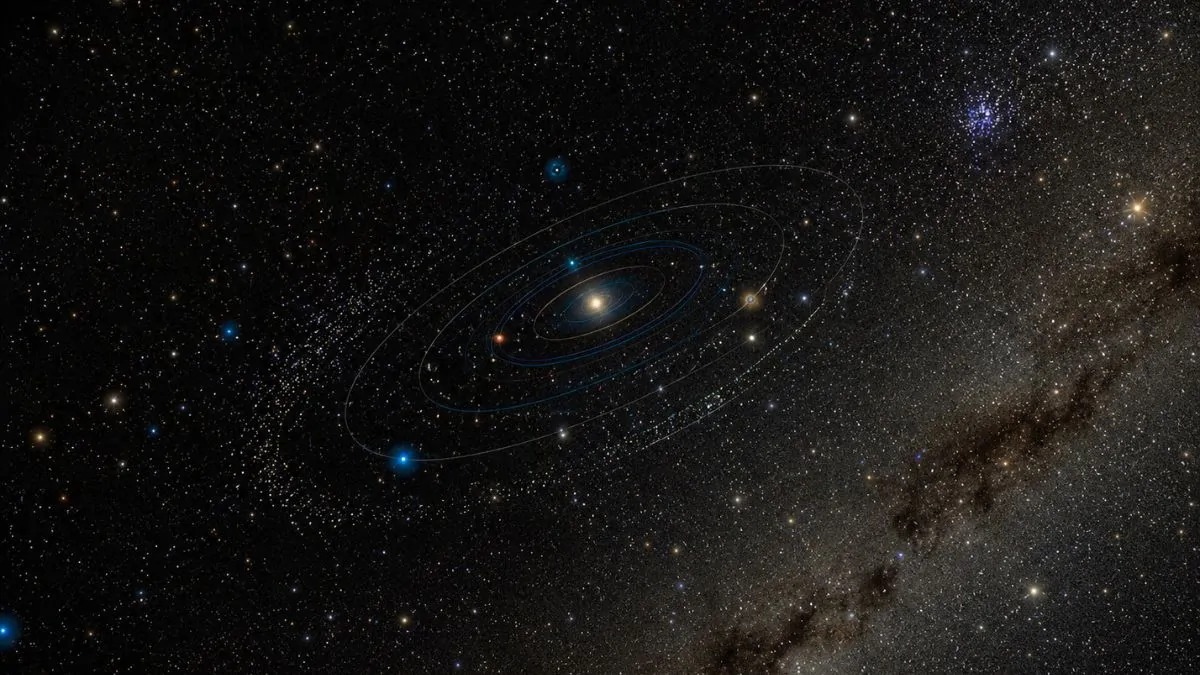
In early April 2026, scientists shared exciting news from the NSF–DOE Vera C. Rubin Observatory in Chile. Using preliminary test data collected during optimization surveys in the summer of 2025, researchers identified more than 11,000 asteroids that had never been recorded before. These findings, later confirmed and shared with the global community through the International Astronomical Union’s Minor Planet Center, represent the largest single batch of new asteroid discoveries submitted in recent times and come well before the observatory’s main scientific program even begins.
The discoveries include 33 previously unknown near-Earth objects and roughly 380 trans-Neptunian objects, which are icy bodies orbiting far beyond Neptune. The data also helped refine the paths of more than 80,000 already known asteroids. This early success, achieved with engineering-quality observations spanning about one and a half months and roughly one million individual measurements, offers a clear preview of the observatory’s enormous potential.
What does this rapid haul of new Solar System members tell us about the hidden population of asteroids and distant icy worlds, and how will it shape our view of planetary neighborhoods in the years to come?
What is the Vera C. Rubin Observatory and why was it built?
The NSF–DOE Vera C. Rubin Observatory is a state-of-the-art ground-based facility located on Cerro Pachón in Chile. It features an 8.4-meter Simonyi Survey Telescope paired with the largest digital camera ever constructed for astronomy, containing 3.2 billion pixels. This combination allows the telescope to photograph large areas of the southern sky quickly and in great detail. The project is jointly funded by the U.S. National Science Foundation and the U.S. Department of Energy’s Office of Science, with operations led by NSF NOIRLab and SLAC National Accelerator Laboratory.
Astronomers designed the observatory to carry out the Legacy Survey of Space and Time, or LSST, a ten-year program that will repeatedly scan the sky. By taking images every few nights, the survey will create a dynamic movie of the changing universe. Even during its early testing and optimization phases, the facility has already shown it can detect faint, fast-moving objects that earlier surveys often missed. This capability comes from the telescope’s wide field of view, high sensitivity (about six times better than many current searches), and advanced software pipelines developed to track moving targets across multiple images.
How did the Rubin Observatory discover more than 11,000 new asteroids in early test runs?
During roughly six weeks of early optimization surveys in summer 2025, the observatory collected data that revealed over 11,000 previously unknown asteroids. Teams at the University of Washington’s DiRAC Institute processed the observations with specially built software capable of identifying faint moving objects among millions of stars and galaxies. The detections were then submitted to the Minor Planet Center, which verified the orbits and officially recognized the new finds.
This single submission included observations of more than 80,000 already catalogued asteroids as well, allowing scientists to improve orbital calculations for many objects that had been “lost” because their paths were uncertain. The total number of asteroids discovered by Rubin across all early phases now stands at approximately 12,700. What once required years or even decades of targeted observations can now happen in weeks thanks to the telescope’s speed and the power of its detection algorithms. According to the official announcement from NOIRLab, this early result is just the beginning of what the full survey will deliver.
What are near-Earth objects and how do the new discoveries support planetary defense?
Near-Earth objects, or NEOs, are asteroids and comets whose orbits bring them within 1.3 astronomical units of the Sun at their closest approach to Earth’s orbit. One astronomical unit equals the average Earth-Sun distance of about 150 million kilometers. The early Rubin data added 33 new NEOs to the known population. None of these newly found objects currently pose any threat to Earth, and the largest is roughly 500 meters across.
These finds matter because they demonstrate how the observatory can spot small, faint objects that might otherwise remain undetected until they pass close by. During its full ten-year survey, Rubin is expected to discover nearly 90,000 additional NEOs. This will raise the fraction of known mid-sized NEOs (larger than 140 meters) from the current roughly 40 percent to about 70 percent. Early and precise detection gives planetary defense teams more time to study any object that might one day require closer monitoring or, in the distant future, deflection planning. The rapid confirmation process through the Minor Planet Center ensures the entire scientific community can access and refine the data immediately.
Why are the newly discovered distant trans-Neptunian objects especially exciting?
Trans-Neptunian objects, or TNOs, are icy bodies that orbit the Sun beyond the planet Neptune. The early Rubin observations added roughly 380 new TNOs, nearly doubling the rate at which such distant objects have been found in recent decades. Among them are two objects with provisional designations 2025 LS 2 and 2025 MX 348. These travel on extremely elongated orbits that carry them out to distances around 1,000 times farther from the Sun than Earth at their farthest points, placing them among the roughly 30 most distant minor planets known.
Studying these far-flung icy worlds helps scientists reconstruct the early history of the Solar System, including how the giant planets migrated and shaped the outer regions. Some TNOs may also offer clues about whether an undiscovered large planet still exists in the distant outskirts. Because these objects are so faint and slow-moving, they are extremely difficult to find with traditional methods. Rubin’s wide, deep, and repeated imaging, combined with new algorithms that sift through billions of possible combinations, makes such discoveries routine. The quick growth in the known TNO population from just a short test period already shows how the observatory will transform our map of the Solar System’s outermost reaches.
When will the full Legacy Survey of Space and Time begin and what results can we expect?
The main Legacy Survey of Space and Time is scheduled to begin later in 2026 and will run for ten years. During the early years of the survey, Rubin is projected to discover as many new asteroids every two to three nights as it found in the entire summer 2025 test period. Over the full decade, the observatory should roughly triple the total number of known asteroids and increase the known population of trans-Neptunian objects by nearly a factor of ten.
These numbers come directly from projections in the official early-data release. The repeated imaging strategy will also allow scientists to determine colors, rotation rates, and shapes for vast numbers of objects, revealing details about their composition and collisional history. Interactive tools such as the Rubin Orbitviewer already let anyone explore the growing catalog in three dimensions using real data. The survey’s combination of depth, speed, and sky coverage will create the most complete census of Solar System small bodies ever assembled.
How does the observatory’s technology enable these record-setting asteroid finds?
The Rubin Observatory’s power comes from several linked advances working together. Its 8.4-meter mirror gathers large amounts of light, while the 3.2-gigapixel camera captures an enormous patch of sky in a single exposure. The telescope returns to the same areas of sky frequently, producing sequences of images that reveal which points of light are moving against the fixed background of stars. Specialized software, developed specifically for Rubin’s observing pattern, automatically detects these moving sources even when they are faint or travel quickly across the detector.
This setup gives Rubin roughly six times the sensitivity of many previous asteroid searches. The same system that found thousands of new objects in test data will, during the full survey, monitor the sky systematically and catch objects that change brightness or position rapidly. Scientists note that the unique cadence of observations required entirely new data-processing methods, and those methods have already proven successful with real early data.
The early success of the NSF–DOE Vera C. Rubin Observatory shows that even before its main survey starts, it is already rewriting our inventory of the Solar System. With more than 11,000 new asteroids, dozens of near-Earth objects, and hundreds of distant icy bodies identified in just weeks of test observations, the facility has delivered a powerful demonstration of what lies ahead. As the ten-year Legacy Survey of Space and Time gets underway later in 2026, the steady stream of new discoveries will help scientists piece together the history of our planetary system and strengthen our ability to monitor objects that pass near Earth. What other long-hidden members of our Solar System will this remarkable observatory bring into the light over the next decade?
Sources
NOIRLab. (2026, April 2). Early Data from NSF–DOE Vera C. Rubin Observatory Reveals Over 11,000 New Asteroids. NOIRLab. https://noirlab.edu/public/news/noirlab2608/
University of Washington. (2026, April 2). Early data from Rubin Observatory reveals over 11,000 new asteroids. UW News. https://www.washington.edu/news/2026/04/02/rubin-observatory-11000-new-asteroids/