Astronomers around the world recently studied an extraordinary cosmic explosion that lasted far longer than any similar burst recorded in decades. Detected on July 2 2025 this gamma ray burst known as GRB 250702B released energy on a scale hard to imagine and pointed to a rare close encounter between a star and a middleweight black hole. Multiple space missions and ground telescopes captured the event in different types of light revealing details about how gravity from an invisible compact object can pull apart and consume stellar material over an extended period.
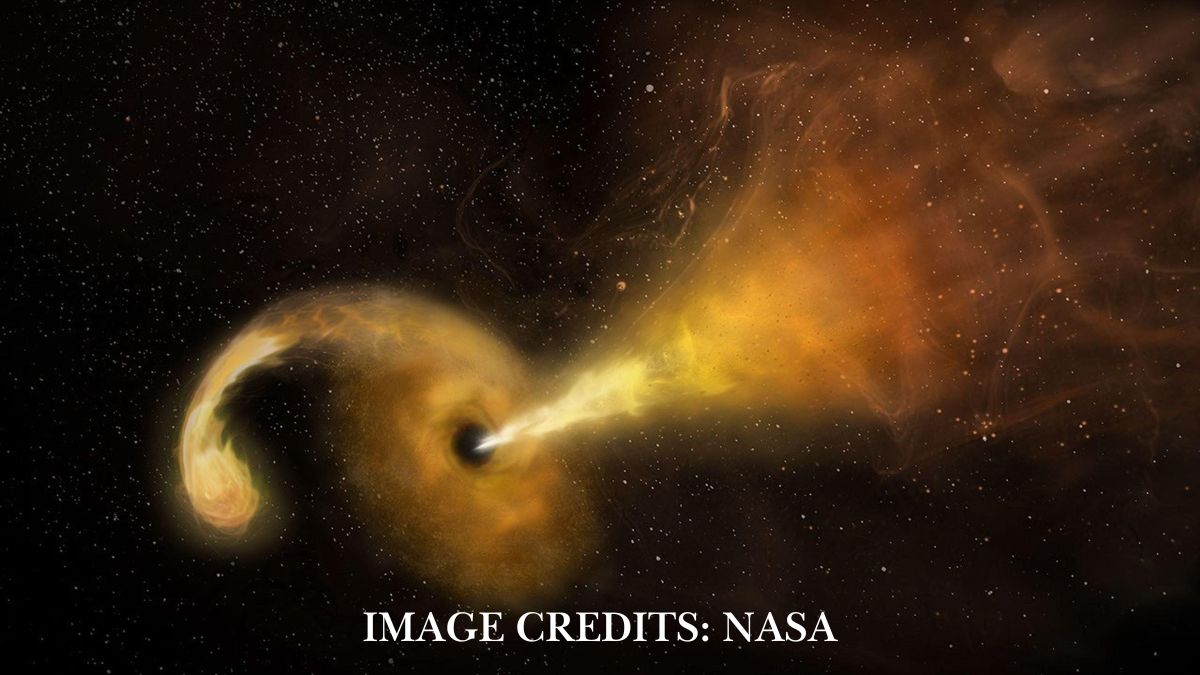
In one leading scientific model the black hole involved had a mass of several thousand times the mass of the Sun. Its event horizon the boundary beyond which nothing can escape measured only a few times wider than the diameter of Earth. The star in this scenario was already unusual. It had lost most of its outer hydrogen rich layers leaving a compact dense core composed mainly of helium. This made the star much smaller than the Sun even though its total mass was comparable. As the black hole approached it continued to pull gas from the star creating a swirling disk of hot material that powered the prolonged bright emission across many wavelengths.
This combination of a long lasting burst a possible intermediate mass black hole and a star missing its outer hydrogen envelope offers a unique window into processes that are usually hidden from view. What can such a record setting observation reveal about how these middleweight black holes grow and how they reshape the stars that wander too close?
What exactly is an intermediate mass black hole?
Intermediate mass black holes occupy a size range between the smaller stellar mass black holes and the enormous supermassive black holes found at the centers of most large galaxies. Stellar mass black holes typically weigh between a few and about one hundred times the mass of the Sun and form when massive stars collapse at the end of their lives. Supermassive black holes can reach millions or even billions of solar masses and influence entire galaxies through their gravity and energy output. Intermediate mass black holes with masses of roughly one thousand to one hundred thousand times the mass of the Sun have long been difficult to confirm because they rarely produce bright signals unless they interact directly with nearby gas or stars.
According to NASA scientists analyzing GRB 250702B one plausible explanation involves an intermediate mass black hole of a few thousand solar masses whose event horizon spans only a few Earth diameters. This size makes close encounters with stars necessary for noticeable effects since the region where tidal forces become strong enough to disrupt a star lies closer to the black hole than it would for a much larger supermassive object. Detecting these middleweight black holes usually requires catching them in the act of pulling material from a passing star or merging with one. Without such an interaction they remain nearly invisible to telescopes.
How can the gravity of a black hole strip outer layers from a star?
When a star passes close enough to a black hole the difference in gravitational pull between the near side and the far side of the star creates strong stretching forces. These tidal forces can overcome the star own self gravity and begin to pull material away from its outer regions. In a full tidal disruption event the entire star can be torn into streams of gas that later fall back and form a bright accretion disk around the black hole. In other cases the encounter is partial and only the outermost layers are removed while a remnant core continues on a new orbit.
In the event studied by NASA the star had already lost most of its hydrogen rich outer atmosphere before the final encounter leaving a helium core. As the black hole drew nearer it pulled additional gas from this exposed core. The pulled material spiraled inward forming an accretion disk a flattened rotating structure of hot gas where friction and magnetic processes heat the material to extremely high temperatures. This disk then radiated energy across X ray optical and other wavelengths while some material was launched outward in powerful jets. The process effectively continued the stripping that had begun earlier in the star life turning what remained into fuel for the black hole.
Why did this particular star arrive with its hydrogen layers already removed?
Stars do not always reach a black hole with their original outer envelopes intact. Many stars exist in binary systems where a companion can strip away the hydrogen rich outer layers through gravitational interaction or mass transfer over millions of years. The result is a smaller denser object known as a helium star or stripped envelope star. These objects have cores where hydrogen fusion has already converted much of the original fuel into helium and the outer hydrogen has been removed exposing that helium layer.
The star involved in the 2025 event fits this description. It was much smaller than the Sun yet carried a comparable mass because its hydrogen atmosphere had been stripped away down to the dense helium core. When such a compact helium star later encounters an intermediate mass black hole the interaction differs from a standard main sequence star disruption. The smaller size means the star must pass even closer to experience strong tidal forces and the chemical composition of the material falling onto the black hole reflects the helium rich layers rather than hydrogen dominated outer material. This difference can influence the observed light signatures and the way the accretion disk evolves.
How did multiple telescopes work together to reveal the full story?
No single observatory can capture every aspect of a distant high energy event. Gamma ray detectors on NASA Fermi Gamma ray Space Telescope first triggered on the burst and recorded its unusually long duration of at least seven hours in gamma rays. Other instruments on NASA Swift Neil Gehrels Swift Observatory NASA Wind mission and even sensors on NASA Psyche spacecraft and China Einstein Probe added timing and spectral information across gamma ray and X ray bands. Follow up observations with NASA Hubble Space Telescope and James Webb Space Telescope provided precise location data and details about the distant host galaxy roughly eight billion light years away.
X ray telescopes including NASA Chandra X ray Observatory and NuSTAR detected flares lasting up to two days after the initial burst showing that the black hole continued accreting material for an extended time. Ground based telescopes such as Keck Gemini and the European Southern Observatory Very Large Telescope supplied optical and near infrared spectra that helped confirm the distance and properties of the host galaxy. Combining these datasets across wavelengths allowed scientists to rule out simpler explanations and build a consistent picture of prolonged accretion powered by stellar material falling toward the black hole. Without this coordinated effort many key details would have remained hidden.
What makes the energy release and duration of this event so exceptional?
Typical gamma ray bursts last from fractions of a second to a few minutes and are usually linked to the collapse of massive stars or mergers of compact objects. GRB 250702B stood out because its gamma ray emission persisted for at least seven hours with additional activity continuing over several days. The total energy output reached levels equivalent to a thousand Suns shining continuously for ten billion years. Such sustained power requires a long lived source of fresh material feeding the central black hole rather than a single brief explosion.
In the intermediate mass black hole scenario the prolonged feeding comes from the gradual return of stellar debris to the accretion disk after the initial close passage. X ray flares observed days later indicate that the disk remained active and continued launching material outward. This behavior differs from standard short bursts and suggests the black hole kept accreting at a high rate for far longer than models of ordinary stellar collapse events predict. The combination of extreme duration extreme energy and multi wavelength flares makes this event a valuable laboratory for testing how intermediate mass black holes consume stars and how the resulting disks and jets evolve over time.
What does this discovery suggest about the hidden population of intermediate mass black holes?
Intermediate mass black holes are often called the missing link in black hole evolution because they bridge the gap between stellar mass and supermassive varieties. They may form in dense star clusters through repeated mergers or grow by accreting gas and stars over cosmic time. Finding clear signs of one in action helps confirm that such objects exist and can influence their surroundings even if they spend most of their lives in a quiet state. Each new detection adds a data point to estimates of how common these black holes are and how they contribute to the growth of larger black holes in galaxy centers.
The 2025 observations also highlight the value of wide field monitors and rapid follow up networks. Without the initial gamma ray trigger and the subsequent multi wavelength campaign the subtle signatures of an intermediate mass black hole might have gone unnoticed. As new telescopes come online and data analysis techniques improve astronomers expect to catch more of these rare events. Each one brings fresh constraints on black hole masses accretion physics and the lives of stars that venture too close to these invisible gravitational traps.
In summary the detailed study of GRB 250702B has provided one of the clearest recent examples of an intermediate mass black hole interacting with a star that had already lost its outer hydrogen layers. The coordinated observations across many missions turned a record breaking gamma ray burst into a rich source of information about tidal forces accretion disks and the behavior of middleweight black holes. As technology advances and more events are captured what new surprises about these hidden cosmic engines and the stars they encounter will come to light?
Sources
NASA. (2025, December 8). Black Hole Eats Star: NASA Missions Discover Record-Setting Blast. NASA Science. https://science.nasa.gov/science-research/black-hole-eats-star/
Additional supporting details were drawn from peer reviewed papers referenced within the NASA report including works published in The Astrophysical Journal Letters in late 2025.