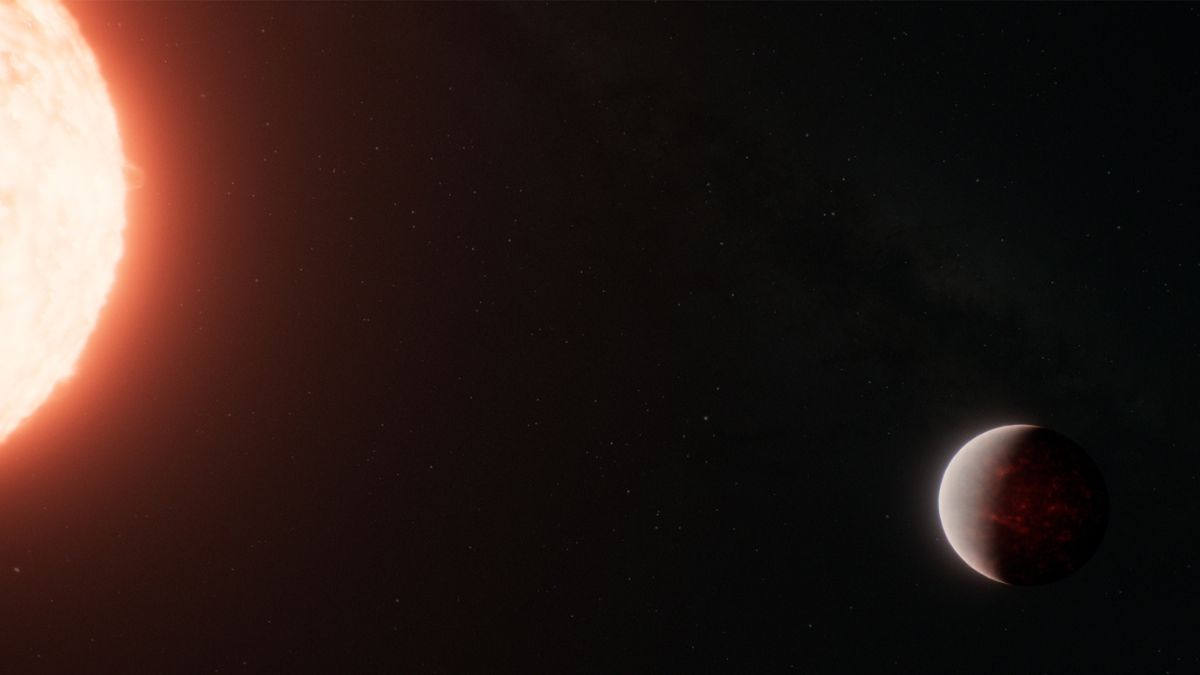
The James Webb Space Telescope continues to deliver stunning revelations about worlds beyond our solar system. In December 2025, a team of astronomers announced findings from JWST observations that provide the clearest evidence to date of a substantial atmosphere surrounding a rocky exoplanet. This planet, TOI-561 b, is a super-Earth (a class of planets larger than Earth but smaller than Neptune, typically 1.2 to 2 times Earth’s radius) scorching under the intense heat of its host star. With a dayside temperature reaching about 3,200 degrees Fahrenheit (1,800 degrees Celsius), far hotter than any place on Earth, TOI-561 b orbits so close to its star that one side forever faces the blazing light while the other remains in perpetual darkness. According to NASA’s latest JWST exoplanet atmosphere study, these observations not only confirm the planet’s low density of 4.3 plus or minus 0.4 grams per cubic centimeter but also reveal a thick layer of gases hovering above what scientists believe is a global ocean of molten rock.
This discovery stands out because TOI-561 b circles its star in less than 11 hours, completing an orbit in a blink compared to Earth’s leisurely 365 days. The host star itself is remarkable: twice as old as our Sun at around 10 billion years and unusually low in iron, residing in the Milky Way’s thick disk region, a stable area far from the galactic center’s chaos. Despite the relentless stellar radiation, which should strip away any atmosphere, JWST data shows this rocky world clings to a volatile-rich envelope (gases and vapors that easily change between liquid, solid, and gas states). Researchers describe it as a “wet lava ball,” highlighting its magma ocean infused with volatiles like water vapor that cycle between the surface and the sky. These insights come from nearly 38 hours of continuous monitoring in May 2024, using JWST’s Near-Infrared Spectrograph to capture the planet’s glow across different wavelengths.
What makes this finding especially thrilling is how it upends expectations for planets in such extreme environments. Previous studies suggested that small, rocky worlds this close to their stars end up as barren rocks, their atmospheres boiled away long ago. Yet TOI-561 b defies that fate, offering a glimpse into how early universe planets might have formed and evolved. As lead researcher Johanna Teske from Carnegie Science noted, this planet’s composition points to a different chemical birthplace than our own solar system. With each new detail emerging from JWST, we edge closer to understanding if such worlds could harbor the building blocks of life or simply serve as cosmic laboratories for extreme geology. But how exactly did scientists peer through the heat haze to uncover this atmospheric mystery?
What is TOI-561 b and Why Does It Matter for Rocky Exoplanet Studies?
TOI-561 b earned its name from the Transiting Exoplanet Survey Satellite (TESS), which first spotted it in 2020 as part of a survey hunting for planets that dim their star’s light during passes. This super-Earth has a radius about 1.4 times that of Earth, translating to a diameter of roughly 18,000 kilometers if we scale up our home planet’s 12,742 kilometers. Its mass, inferred from radial velocity measurements (techniques that detect a star’s wobble due to planetary gravity), gives it that puzzling low density, suggesting it is not purely rocky like expected but laced with lighter materials. Orbiting at a scant 0.013 astronomical units from its star, about one-fortieth the Earth-Sun distance or less than one million miles, TOI-561 b experiences gravitational tides strong enough to lock one face in eternal day. This tidal locking creates wild contrasts: the dayside bakes while the nightside might cool enough for volatiles to condense, much like temperature swings on Mercury but amplified a thousandfold.
The planet’s host star, TOI-561, is a K7 dwarf slightly smaller and cooler than the Sun, with a radius of 0.7 solar radii and surface temperature around 4,500 Kelvin. At 10 billion years old, it formed when the universe was half its current age, in a metal-poor environment (astronomers use “metal” for elements heavier than hydrogen and helium) that shaped TOI-561 b’s unusual makeup. Fun fact: if you could stand on the nightside, the sky might shimmer with silicate clouds (tiny particles of silicon dioxide, like sand in the air, reflecting light), carried by ferocious winds up to thousands of kilometers per hour. These winds, driven by the steep temperature gradient, redistribute heat and gases, preventing the dayside from reaching the bare-rock extreme of 4,900 degrees Fahrenheit (2,700 degrees Celsius). According to the peer-reviewed analysis in The Astrophysical Journal Letters, such dynamics make TOI-561 b a prime target for studying how atmospheres persist on rocky exoplanets under stellar assault.
Why does TOI-561 b matter? It bridges a gap in exoplanet science, where gas giants dominate headlines but rocky worlds like this one hint at Earth’s siblings. Over 5,000 exoplanets confirmed since 1995, only a handful of rocky ones have atmospheric hints, and none as robust as this. For comparison, Venus, our hottest neighbor at 864 degrees Fahrenheit (462 degrees Celsius), has a runaway greenhouse effect from carbon dioxide; TOI-561 b takes that to extremes with potential water vapor cycling through its magma ocean. Researchers suggest visualizing this with a cross-section diagram: a glowing orange core of molten silicates topped by swirling vapors, heat escaping via atmospheric convection (rising hot air currents, like a boiling pot). This setup challenges models predicting atmosphere loss via hydrodynamic escape (gases heated and flung into space by stellar winds). In short, TOI-561 b shows rocky exoplanets can be dynamic, volatile havens even in hellish orbits, reshaping how we hunt for habitable zones far from stars.
How Did JWST Uncover the Atmosphere on This Rocky Exoplanet?
The James Webb Space Telescope, launched in 2021, excels at peering into the infrared glow of warm objects, perfect for exoplanet atmospheres that emit heat as light. For TOI-561 b, the team employed secondary eclipse photometry (measuring the drop in combined star-planet brightness when the planet slips behind its star, isolating planetary emission). Observations spanned May 2024 under program 3860, totaling over 37 hours across nearly four orbits, using the NIRSpec instrument to scan wavelengths from 3 to 5 microns. This range captures molecular fingerprints: water vapor absorbs at specific bands, while silicates might show broader haze signals. The data revealed the planet’s dayside brighter than a bare rock model at 5-sigma confidence (a statistical threshold meaning less than one in 3.5 million chance of error), proving an atmosphere cools the surface by absorbing and re-radiating energy.
Processing this data involved comparing observed spectra (light split into rainbow-like patterns revealing composition) against theoretical models. Bare-rock simulations, assuming pure silicate surfaces, predicted uniform brightness, but reality showed dips indicating gas absorption. Co-author Anjali Piette from the University of Birmingham explained that without a thick envelope, the planet would reflect more shortwave light and emit hotter infrared, yet measurements clocked in 1,700 degrees cooler. To engage readers, consider this analogy: it’s like viewing a campfire through smoke; the haze softens the glow and tints the colors. JWST’s precision, with photon noise below 0.1 percent per pixel, allowed detection of subtle features, such as potential sodium lines from vaporized rock. Fun fact: the total data volume exceeded 10 gigabytes, processed via custom pipelines at the Space Telescope Science Institute, highlighting JWST’s role in turning raw telescope time into cosmic insights.
These methods build on prior JWST successes, like the tentative atmosphere on TRAPPIST-1 e in 2023, but TOI-561 b’s signal is stronger due to its brightness and short orbit. Uncertainties linger in mass estimates, with a 10 percent error margin from ground-based spectroscopy, but density calculations hold firm. For visualization, imagine a phase curve plot (tracking brightness over an orbit) dipping during eclipse, as detailed in the study’s figures. This technique not only confirms atmospheres but maps heat transport, showing winds ferry energy to the dark side at efficiencies rivaling Earth’s jet streams. Overall, JWST’s toolkit transforms rocky exoplanet atmospheres from speculation to science, with TOI-561 b as a flagship case.
Why Is TOI-561 b Described as a “Wet Lava Ball”?
The nickname “wet lava ball” captures TOI-561 b’s essence: a sphere of molten rock enriched with volatiles, where magma and atmosphere interact like a simmering stew. Co-author Tim Lichtenberg from the University of Groningen coined it to evoke a planet far more watery and gassy than Earth, despite its blistering heat. The magma ocean, likely kilometers deep, dissolves volatiles like water and carbon dioxide, outgassing them into the air as the surface boils. This creates a feedback loop: gases escape upward, cool slightly, and rain back as vapor or droplets, sustaining the envelope against stellar erosion. Density measurements at 4.3 grams per cubic centimeter, versus Earth’s 5.5, imply 10 to 20 percent of the mass is volatiles, equivalent to hundreds of Earth oceans submerged in lava.
Comparisons help: Earth’s mantle holds water at a few hundred parts per million, but TOI-561 b’s could reach thousands, per equilibrium models balancing dissolution and degassing rates. At 1,800 degrees Celsius, silicates melt into a viscous fluid (think honey heated to flow like water), bubbling volatiles that form clouds of quartz particles, potentially visible as glittering hazes. Fun fact: if condensed, these vapors might cover the planet in a steam layer thicker than all Earth’s atmosphere combined, weighing billions of tons. According to NASA’s TOI-561 b mission update, the low dayside temperature points to this volatile richness, as dry models overpredict heat by 900 degrees Celsius.

This “wet” nature stems from formation in the galaxy’s thick disk, where alpha elements (oxygen, magnesium, silicon) abound but iron is scarce, favoring volatile trapping during accretion (planet-building from dust and gas). Unlike barren hot Jupiters, TOI-561 b retains its envelope through magnetic fields or rapid replenishment from the ocean. To picture it, reference artist concepts from the study: a crimson orb with vapor plumes arcing from day to night. Such worlds may represent “super-Venuses,” where greenhouse effects run wild but volatiles endure. The term “wet lava ball” thus simplifies a complex system, inviting curiosity about whether similar planets dotted the young universe, influencing galaxy-wide chemistry.
What Makes the Atmosphere of TOI-561 b So Mysterious?
TOI-561 b’s atmosphere baffles scientists with its resilience and composition, defying models that predict swift evaporation for ultra-short period planets (orbits under one day). Spectral data hint at water vapor dominance, absorbing infrared at 2.7 and 6.3 microns, but overlapping signals from carbon monoxide or dioxide cloud exact ratios. The envelope’s thickness, estimated at 100 to 1,000 kilometers (taller than Mount Everest stacked 100 times), traps heat via the greenhouse effect (gases like a blanket, warming the surface), yet cools the top enough for cloud formation. Winds, modeled at Mach 10 speeds (ten times sound’s 343 meters per second on Earth), mix gases equatorially, equalizing temperatures unlike the stark divides on tidally locked models.
Mystery deepens with potential disequilibrium chemistry: lightning from vapor storms or volcanic outgassing could produce exotic molecules, undetectable yet in current data. Co-author Nicole Wallack from Carnegie Science notes the iron-poor star implies a carbon-rich atmosphere, perhaps with methane traces, altering cloud reflectivity. Fun fact: silicate rains might pelt the nightside, eroding rock into fine dust that feeds atmospheric haze, a process unseen in our system. The ApJL paper on TOI-561 b flags uncertainty in volatile inventory, with escape rates balancing input at 10^28 molecules per second, comparable to Io’s sulfur plumes but scaled up.
Comparatively, it’s unlike LHS 1140 b’s potential water world or 55 Cancri e’s carbon atmosphere; TOI-561 b blends magma volatility with rocky solidity. Observational limits, like NIRSpec’s wavelength cutoff, leave ultraviolet signals unexplored, where hydrogen escape peaks. Suggest a transmission spectrum figure: light filtering through the edge-on atmosphere, dipping at vapor bands. This enigma drives follow-up: future JWST cycles could map nightside emissions, revealing condensation zones. Ultimately, the mystery underscores atmospheres as living systems, evolving with their host stars and offering clues to planetary diversity.
How Does This JWST Discovery Reshape Rocky Exoplanet Atmosphere Research?
TOI-561 b’s atmosphere signals a paradigm shift, proving small rocky planets can hoard gases against odds once deemed impossible. Prior theories, rooted in 2010s simulations, forecasted hydrodynamic blow-off for planets inward of 0.05 AU, yet here volatiles thrive, implying efficient recycling or formation with oversized envelopes. This expands habitable zone concepts: while too hot for liquid water, such worlds test biosignature proxies like disequilibrium gases (oxygen-methane mixes hinting at life). For the 40 percent of confirmed exoplanets that are super-Earths, TOI-561 b suggests many hide atmospheres, boosting yields for missions like ARIEL (ESA’s 2029 launcher for atmospheric surveys).
Implications ripple to solar system analogs: it mirrors early Earth’s magma ocean phase, 4.5 billion years ago, when volatiles outgassed to form our air. Density puzzles resolve with 5 to 15 percent water by mass, per revised models, challenging core-mantle differentiation (layering by density, like oil and water). Fun fact: at 10 billion years old, TOI-561 b outlives the Sun’s future red giant phase, offering longevity lessons for enduring atmospheres. Researchers like Lichtenberg predict this inspires alpha-element focused surveys, targeting thick-disk stars for volatile-rich rocks.
Broader impacts include refining planet formation: in metal-poor nurseries, planetesimals (building blocks) trap more ice, surviving to adulthood. Visualization aid: a timeline graphic from bare rock to veiled world, tracing volatile evolution. With JWST’s 20-year lifespan, expect dozens more like this, populating databases for machine learning composition predictions. This discovery, (Teske et al., 2025), not only validates JWST’s exoplanet prowess but ignites quests for the universe’s hidden breathers.
In summary, the James Webb Space Telescope’s glimpse of TOI-561 b’s thick, volatile-laden atmosphere atop a churning magma ocean redefines rocky exoplanets as vibrant, enduring entities. From its scorching dayside cooled by gaseous veils to windsweaving silicates across twilight zones, this “wet lava ball” exemplifies nature’s ingenuity in extreme climes. Backed by precise infrared spectra and equilibrium models, the findings affirm that atmospheres can shield even the most battered worlds, broadening our cosmic neighborhood’s potential for geological drama. As we decode more spectral whispers, TOI-561 b stands as a beacon for resilient habitability frontiers.
What hidden volatiles might future telescopes reveal on worlds like TOI-561 b, and could they whisper of life’s improbable sparks?
References
NASA. (2025, December 11). NASA’s Webb detects thick atmosphere around broiling lava world. NASA Science. https://science.nasa.gov/missions/webb/nasas-webb-detects-thick-atmosphere-around-broiling-lava-world/
Teske, J. K., Wallack, N. L., Piette, A. A. A., Dang, L., Lichtenberg, T., Plotnykov, M., Pierrehumbert, R. T., Postolec, E., Boucher, S., McGinty, A., Peng, B., Valencia, D., & Hammond, M. (2025). A thick volatile atmosphere on the ultrahot super-Earth TOI-561 b. The Astrophysical Journal Letters, 969(2), L28. https://doi.org/10.3847/2041-8213/ae0a4c