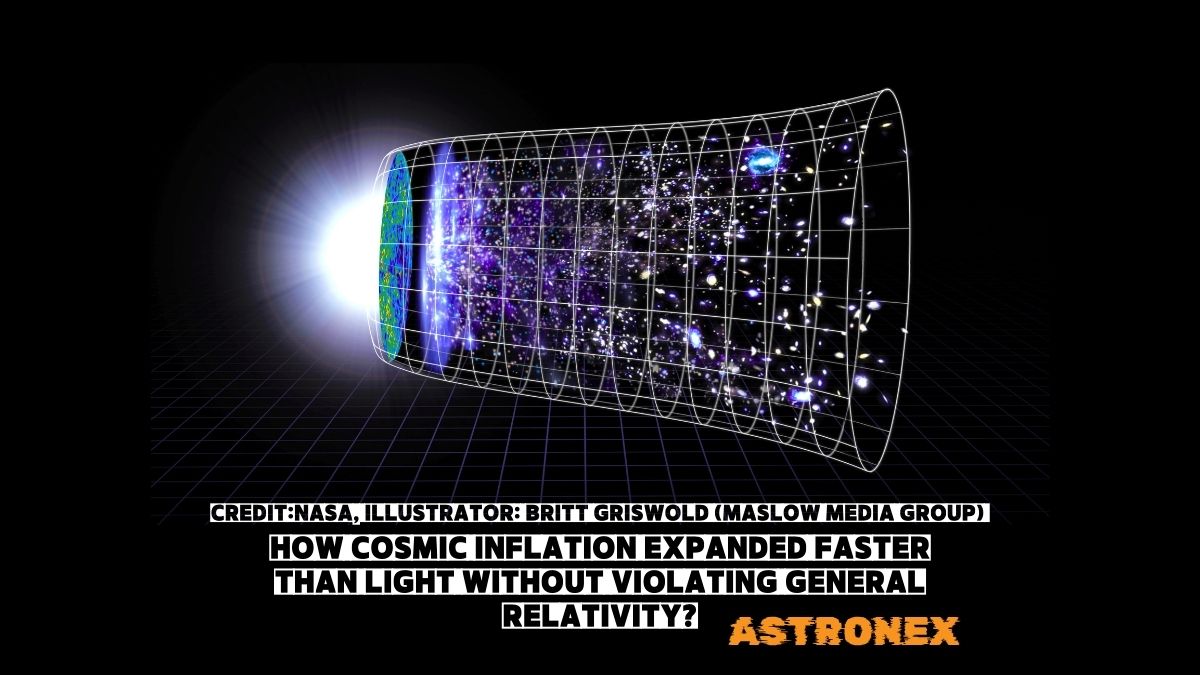
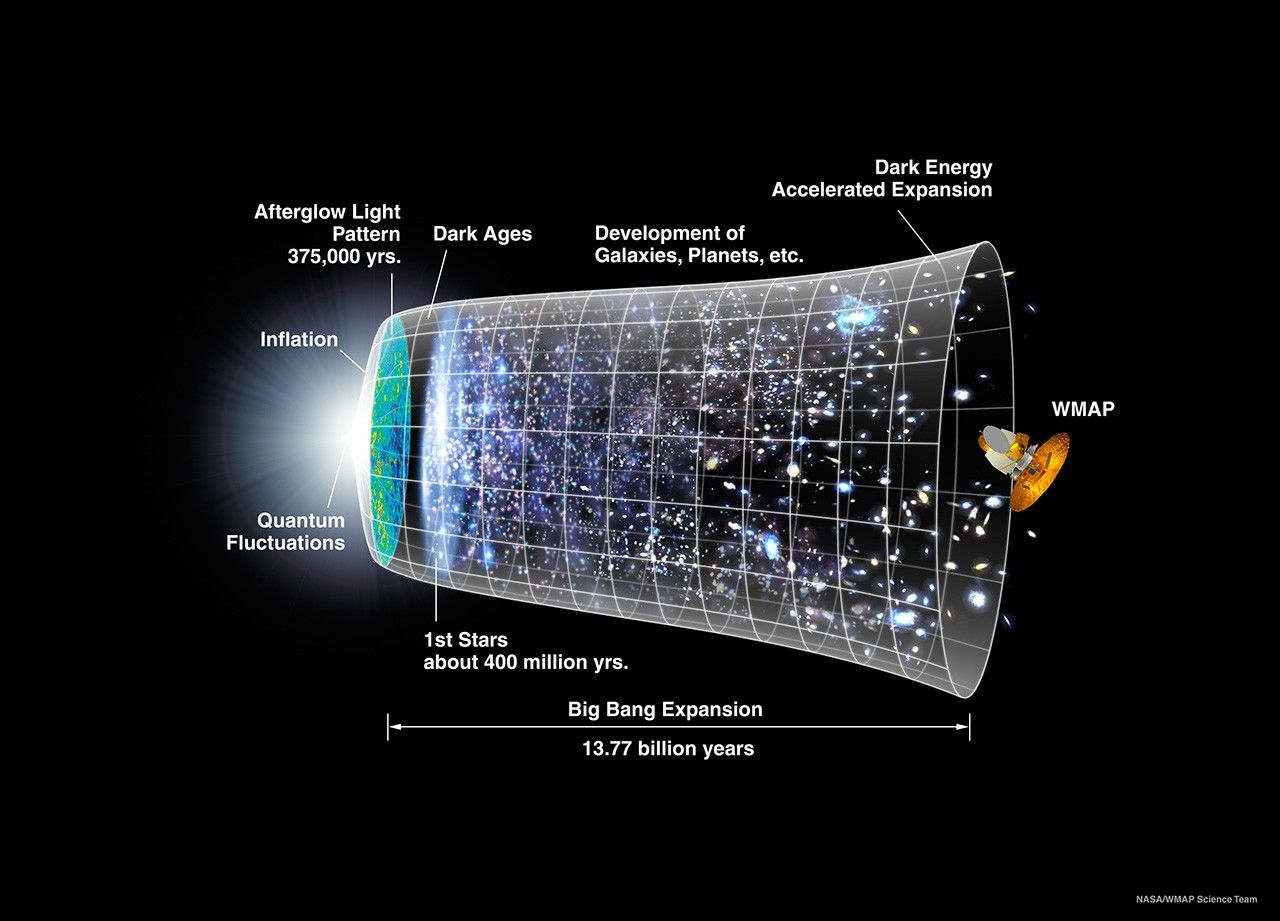
The concept of cosmic inflation postulates that the universe underwent a phase of extremely rapid, exponential expansion during its earliest moments, roughly between 10-36 and 10-32 seconds after the Big Bang. During this epoch, the spatial dimensions of the universe increased by a factor of at least 1026, essentially taking a microscopic patch of space and stretching it to a macroscopic scale.
The primary answer to how this expansion proceeded faster than light without violating physics lies in the fundamental distinction between the motion of objects through space and the expansion of space itself. General Relativity dictates that no information or massive object can travel through a local region of spacetime faster than the speed of light, denoted as c. However, General Relativity imposes no such limit on the dynamic evolution of the metric of spacetime. During inflation, space itself expanded at a rate such that the distance between two points increased faster than light could traverse the gap between them. This is not a violation of causality because the two points were not moving relative to their local surroundings; rather, the “fabric” of space between them was being created and stretched.
The Mechanism of Repulsive Gravity
To understand what drove this expansion, one must look to the energy content of the early universe. In classical physics, gravity is purely attractive; mass attracts mass. However, in General Relativity, the gravitational field is sourced not just by mass density, but by the energy-momentum tensor, which includes both energy density and pressure.
Inflation is driven by a hypothetical scalar field, often termed the “inflaton,” which dominated the energy density of the early universe. Unlike normal matter or radiation, which dilutes as space expands, the inflaton field maintained a nearly constant energy density while in a “false vacuum” state. This unique state possesses a high negative pressure. According to the Friedmann equations derived from General Relativity, if the pressure P is negative and satisfies the condition P < -1/3 ρc2 (where ρ is density), the resulting gravity is repulsive rather than attractive.
The equation of state for the vacuum energy driving inflation is approximately w ≈ -1, leading to a pressure P ≈ -ρc2. When this negative pressure is inserted into the gravitational field equations, it results in a repulsive force that drives the scale factor of the universe, a(t), to grow exponentially:
Here, H represents the Hubble parameter, which remains nearly constant during inflation. This exponential growth mechanism explains how the universe could expand by such a colossal magnitude in a fraction of a second.
Superluminal Recession vs. Local Velocity
The confusion regarding “faster than light” expansion arises from conflating recession velocity with peculiar velocity. Peculiar velocity refers to an object’s motion through space relative to the cosmic rest frame (e.g., a galaxy moving toward a cluster due to gravitational attraction). Special Relativity constrains this velocity to be less than c.
Recession velocity, however, is a measure of how the proper distance between two comoving points changes as the universe expands. It is defined by Hubble’s Law:
Where v is the recession velocity and d is the proper distance. If the distance d is sufficiently large, the recession velocity v will exceed c. This occurs even in the present-day universe for galaxies beyond the Hubble sphere. During inflation, the Hubble parameter H was enormous, meaning that even points separated by sub-atomic distances were swept apart at superluminal speeds relative to each other. Because the space locally around any observer is always locally flat (Minkowskian) and obeying Special Relativity, no local physical law is broken. No signal overtakes a light beam moving through the same region of space.
The Horizon Problem and Observational Evidence
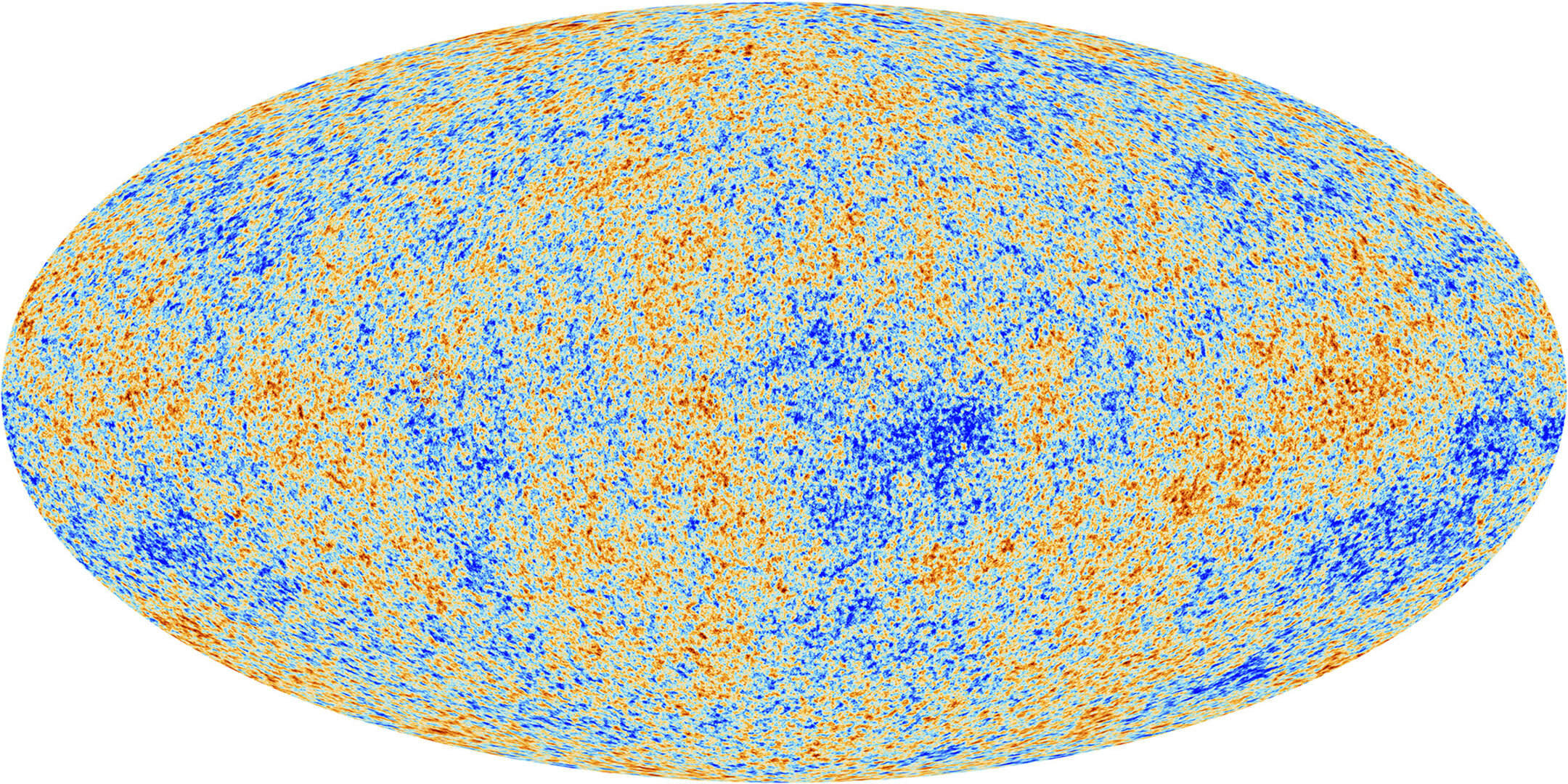
One of the strongest arguments for inflation is its resolution of the “Horizon Problem.” When astronomers observe the Cosmic Microwave Background (CMB), they see a temperature distribution that is uniform to within one part in 100,000 across the entire sky. In a standard Big Bang model without inflation, regions of the sky separated by more than a few degrees would never have been in causal contact; light would not have had enough time to travel between them to equalize their temperatures before the CMB was emitted.
Inflation solves this by proposing that the entire observable universe originated from a single, causally connected microscopic patch. Before inflation began, this patch was small enough for light to traverse it, allowing thermal equilibrium to be established. The inflationary expansion then stretched this homogenized patch to a size larger than the observable universe. Consequently, the uniformity we observe in the CMB today is the result of that pre-inflationary equilibrium.
The End of Inflation and Reheating
Inflation must eventually end for the universe to evolve into the state we observe today. This conclusion is achieved through a process known as “reheating.” The inflaton field acts like a ball rolling down a potential energy hill. As long as the ball rolls slowly (the “slow-roll” phase), inflation continues. Eventually, the field reaches the bottom of its potential well and begins to oscillate around its minimum energy state.
During these oscillations, the massive potential energy stored in the inflaton field decays into standard model particles, such as quarks, electrons, and photons. This injection of energy creates the hot, dense “fireball” traditionally associated with the Big Bang. At this point, the repulsive gravity ceases, the universe becomes dominated by radiation, and the expansion rate begins to decelerate in accordance with standard orbital dynamics and gravity.
📌 Frequently Asked Questions
Does cosmic inflation violate Einstein’s theory of Special Relativity?
No. Special Relativity prohibits objects from moving through space faster than light. Inflation involves the expansion of space itself, which is governed by General Relativity and is not restricted by the speed of light limit.
Is there direct proof that inflation happened?
While there is no direct observation of the inflation epoch, strong indirect evidence exists. This includes the uniformity of the Cosmic Microwave Background, the flat geometry of the universe, and the specific pattern of density fluctuations (scale-invariant spectrum) observed in the cosmos.
Did the entire universe inflate, or just our part?
It is hypothesized that inflation occurred everywhere in our local patch of the universe. However, in some theories known as “Eternal Inflation,” inflation may stop in some regions (like ours) while continuing eternally in others, creating a “multiverse.”
How long did cosmic inflation last?
The inflationary epoch was incredibly brief. It is estimated to have lasted from approximately 10-36 seconds to roughly 10-32 seconds after the Big Bang, yet it expanded the universe by a massive factor.
What is the difference between Dark Energy and Inflation?
Both involve repulsive gravity causing accelerated expansion. Inflation happened at very high energy scales in the extremely early universe and ended quickly. Dark Energy is a much weaker phenomenon currently causing the universe’s expansion to accelerate again today.