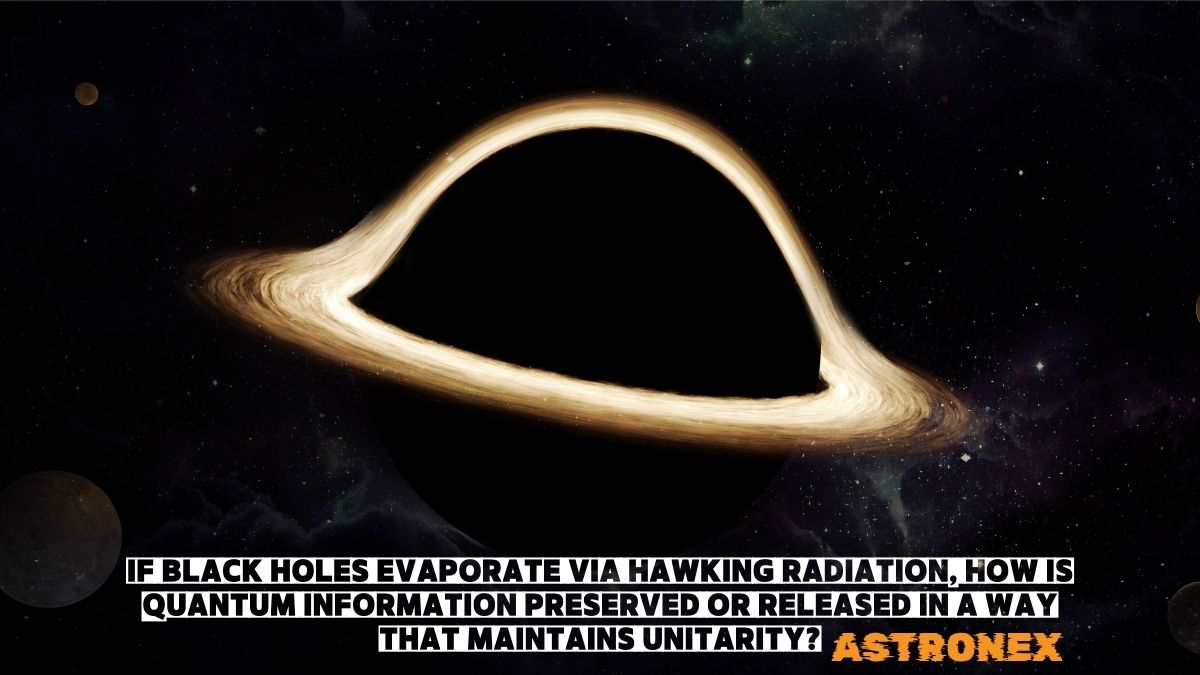
The preservation of quantum information during black hole evaporation is achieved through the principle of unitarity, which dictates that the complete quantum state of an isolated system must evolve deterministically and remain reversible. While Hawking radiation originally appeared to be purely thermal and devoid of information regarding the matter that formed the black hole, modern theoretical frameworks such as the holographic principle and the Page curve suggest that information is encoded in the complex quantum correlations, or entanglement, between the emitted radiation and the interior states of the black hole. A broad consensus in high-energy theoretical physics suggests that as a black hole evaporates, information is not lost but is gradually transferred to the outgoing radiation field, although a complete description of the microscopic mechanism requires a finalized theory of quantum gravity.
Hawking radiation is a theoretical process arising from the effects of quantum field theory in curved spacetime. Near the event horizon, virtual particle pairs are constantly generated through vacuum fluctuations. In a strong gravitational field, one member of a pair may cross the event horizon while the other escapes to infinity. The particle that falls into the black hole is mathematically described as possessing negative energy relative to an observer at infinity, which reduces the total mass of the black hole. The escaping particle becomes real and constitutes the Hawking radiation. The temperature of this radiation is inversely proportional to the mass of the black hole, as defined by the equation:
In this expression, M represents the mass of the black hole, G is the gravitational constant, ℏ is the reduced Planck constant, c is the speed of light, and kB is the Boltzmann constant. Because this radiation initially seemed to depend only on the macroscopic properties of the black hole, such as mass, charge, and angular momentum, it appeared to lead to the irreversible loss of the specific quantum states of the infalling matter.

The conflict between general relativity and quantum mechanics in this context is known as the black hole information paradox. According to the no-hair theorem in general relativity, black holes are characterized by only 3 observable parameters, which implies that all other information about the matter that formed the black hole is inaccessible. However, quantum mechanics requires that the evolution of a physical system follows a unitary operator, ensuring that the initial state can always be reconstructed from the final state. If Hawking radiation were truly thermal, the final state of an evaporated black hole would be a mixed state, even if it began as a pure state. This would violate the fundamental laws of quantum physics by destroying information and breaking the time-reversal symmetry of the universe.
The holographic principle offers a potential resolution by suggesting that the information within a volume of space can be described by a theory operating on the boundary of that region. In the context of black holes, the information of the 3-dimensional interior is thought to be encoded on the 2-dimensional surface of the event horizon. This concept is rigorously explored in the Anti-de Sitter/Conformal Field Theory (AdS/CFT) correspondence. In this duality, a gravitational system in a specific spacetime (AdS) is mathematically equivalent to a quantum field theory on its boundary. Because the boundary theory is inherently unitary, the evaporation of the black hole in the interior must also be a unitary process, meaning information is preserved and eventually released.
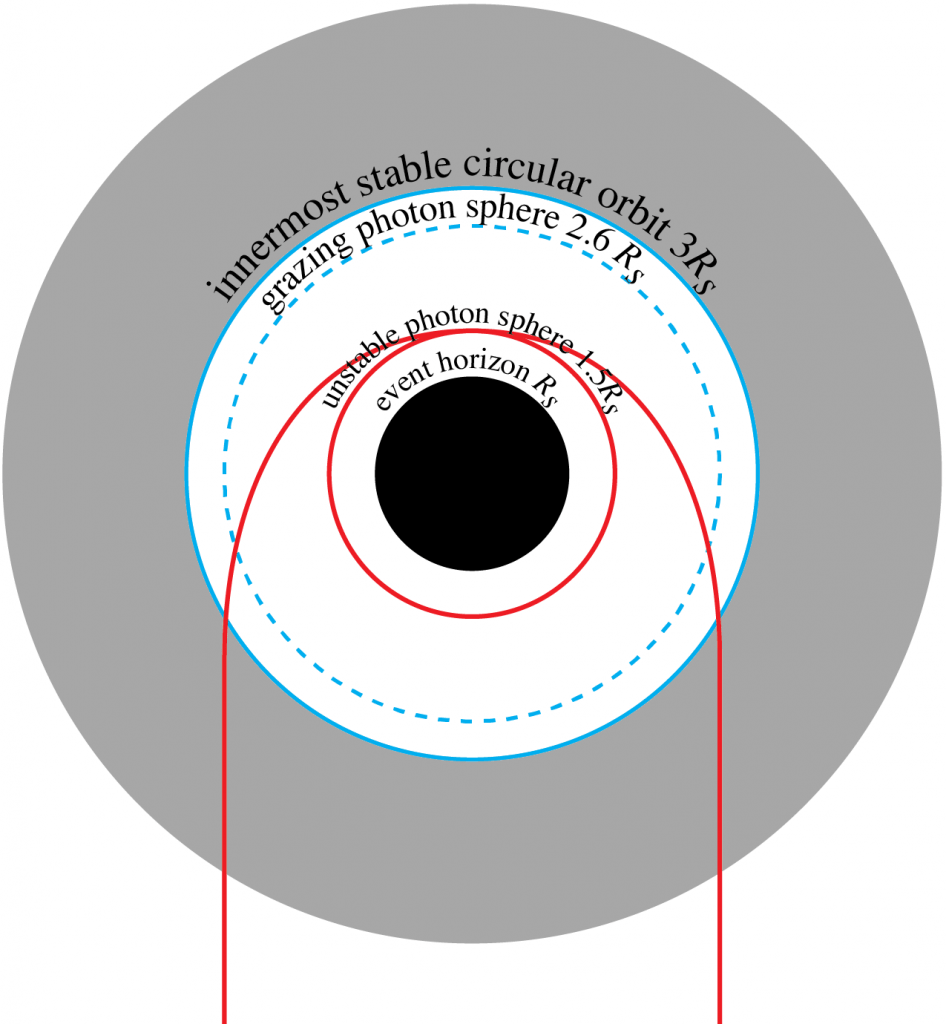
The release of information is quantified by the Page curve, named after physicist Don Page. The Page curve tracks the entanglement entropy between the black hole and the emitted radiation over time. Initially, as the black hole radiates, the entanglement entropy increases because the radiation is entangled with the interior. However, Page calculated that if information is preserved, the entropy must reach a maximum when the black hole has lost approximately half of its original entropy—a point known as the Page time—and then decrease toward 0 as the black hole finishes evaporating. This decrease signifies that later Hawking radiation becomes increasingly correlated with earlier radiation, eventually carrying the encoded information out of the black hole system.
Recent advancements in the 2010s and 2020s involving gravitational path integrals and islands have provided a more precise mechanism for this transfer. Researchers discovered that when calculating the entropy of Hawking radiation, one must include contributions from islands, which are regions of the black hole interior that effectively belong to the radiation system at late times. This suggests that the interior of the black hole is holographically linked to the radiation outside. As the black hole shrinks, the quantum extremal surfaces that define these regions shift, allowing the information once trapped inside to be mathematically part of the external radiation. Further mathematical details of the Page curve and quantum extremal surfaces remain an active area of theoretical research.
📌 Frequently Asked Questions
What is the black hole information paradox?
The paradox is a conflict between general relativity and quantum mechanics regarding the fate of information. While general relativity suggests information entering a black hole is lost to the outside world, quantum mechanics requires that information must be preserved to maintain the laws of physics.
Does Hawking radiation mean black holes eventually disappear?
Yes, black holes lose mass as they emit Hawking radiation over extremely long periods. If a black hole does not gain more mass from its surroundings than it loses through radiation, it will eventually evaporate completely, leaving behind only the radiation it emitted.
Can information truly be lost in the universe?
In mainstream quantum physics, information is never truly destroyed because physical processes must be reversible. If information were lost, the sum of all probabilities in a system would no longer equal 1, which would invalidate the fundamental mathematical structure of quantum theory.
What is the holographic principle in simple terms?
The holographic principle suggests that all the information contained within a 3D volume can be represented on its 2D boundary. In black hole physics, this means the details of everything that falls inside are stored on the surface of the event horizon.
How long does it take for a black hole to evaporate?
The evaporation time depends on the mass of the black hole, with larger black holes taking much longer. A black hole with the mass of the Sun would take approximately 1067 years to evaporate, which is significantly longer than the current age of the universe.