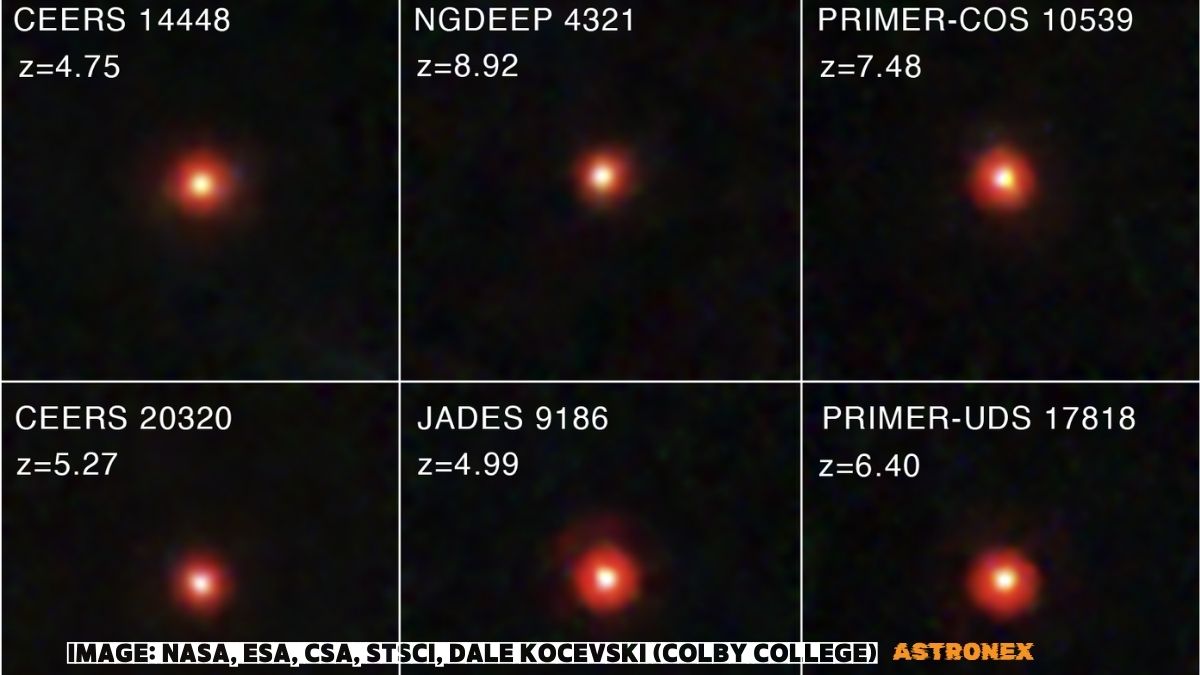
James Webb Space Telescope (JWST) has observed a high-redshift object that may represent a black hole star. This unusual JWST discovery comes from a class of compact, red objects called little red dots that scientists first spotted in 2022. These objects shine from the early universe and show signs of supermassive black holes growing at surprising speeds. Researchers now think some little red dots could be something entirely new: a black hole wrapped in a thick envelope of hot gas that acts like a giant star. The term ‘black hole star’ is a theoretical model and not yet a formally recognized class of astrophysical objects.
The James Webb Space Telescope observation has excited astronomers because it helps explain one of the biggest puzzles in cosmology. How did supermassive black holes form so quickly after the Big Bang? These little red dot objects appear as tiny red points in JWST images, but their light carries clues about an era when the universe was less than one billion years old. The discovery points to a possible new stage in black hole evolution that was not fully anticipated in earlier models.
What makes this finding particularly important is that it may refine current models of early galaxy formation. Could these objects be the missing link between the first stars and the giant black holes we see today?
What Are Little Red Dots Discovered by the James Webb Space Telescope?
Little red dots are a brand-new class of objects that the James Webb Space Telescope spotted in deep space surveys. They look like small, bright red points in infrared images and were first noticed in December 2022, just months after JWST began full science operations. Astronomers have now found hundreds of them, with a 2025 study identifying a sample of 341 such objects. These objects are extremely compact and appear only in the early universe, mostly between 500 million and 1.5 billion years after the Big Bang.
According to NASA’s detailed analysis of JWST data, these little red dots show a striking red color because of dust and the stretching of light over billions of years, known as cosmological redshift. Many of them are so small on the sky that they look almost like stars, yet they are actually distant galaxies or galaxy-like structures. Spectroscopic analyses of JWST data suggest that about 70 percent of them show gas moving at speeds of around 1,000 kilometers per second, which is roughly 2 million miles per hour. This fast motion is widely interpreted as evidence of material swirling around a central supermassive black hole.
What sets these objects apart is their high density and unusual brightness. They are not like the galaxies we see nearby today. Instead, they pack a lot of energy into a very small space, which puzzled scientists at first. Some researchers call them high-redshift galaxy candidates because their light has traveled for more than 11 billion years to reach us.
How Do Little Red Dots Connect to Early Universe Black Holes?
The connection between little red dots and early universe black holes became clear when JWST used its Near-Infrared Spectrograph to study their light in detail. Spectra from these objects show broad emission lines from hydrogen and helium gas that is highly ionized and moving very quickly. This pattern matches what happens when gas falls toward a supermassive black hole and heats up in an accretion disk.
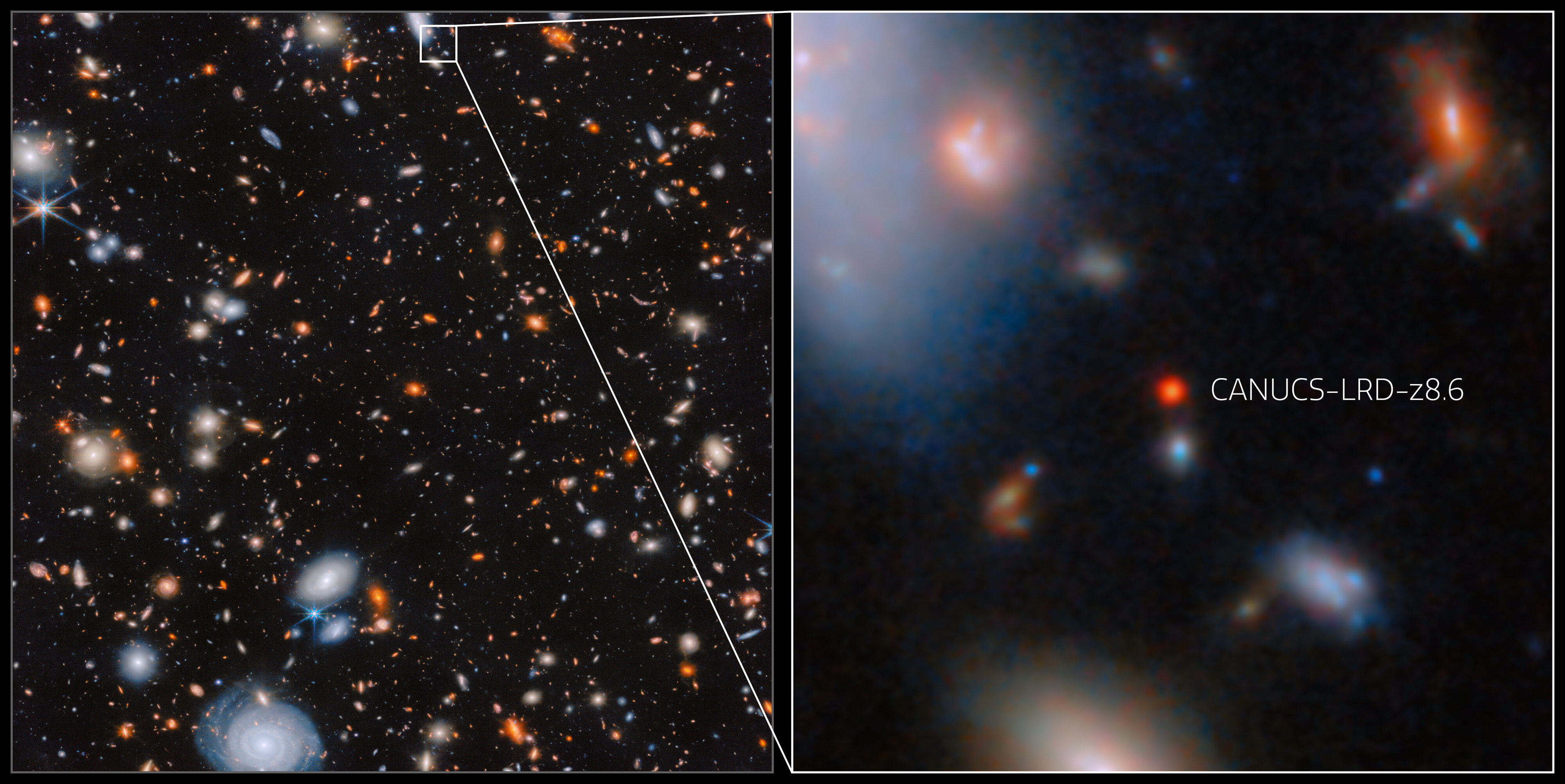
One standout example is the object called CANUCS-LRD-z8.6. This little red dot sits in the galaxy cluster MACS J1149.5+2223 and comes from a time when the universe was only 570 million years old. According to the European Space Agency’s report on JWST findings, the black hole inside it is unusually large compared to the small amount of stars in its host galaxy. The gas around it is spinning rapidly around the central black hole, and the object has very few heavy elements, showing it is still in an early stage of growth.
These supermassive black hole envelope features may help explain why the little red dots look so red and compact. The dust and gas hide much of the ultraviolet light from the black hole, letting mostly red and infrared light escape. This rate of early black hole growth appears faster than many earlier theoretical models predicted, which is why scientists describe it as an unusual JWST discovery.
What Exactly Is a Black Hole Star?
A black hole star is a new idea that explains some of the little red dots. It is not a normal star powered by nuclear fusion. Instead, it is a giant ball of hot gas, many times larger than our Sun, with a supermassive black hole at its center. The black hole pulls in gas rapidly and releases huge amounts of energy that heats the surrounding envelope, making the whole object shine like a star. The concept is related to earlier theoretical ideas known as quasi-stars, proposed in the 2000s to explain rapid black hole growth.
Researchers proposed this model after studying extreme little red dots with JWST. The light from these objects matches what you would expect from a single, very cold and dense gas sphere rather than many separate stars. The black hole inside provides the power source, turning gravitational energy into light and heat. This idea comes from a 2025 study published in the journal Astronomy & Astrophysics.
The concept may help address a long-standing problem. Normal galaxies at that early time should not be as bright or massive as the little red dots appeared. But if the light comes mostly from the black hole star’s envelope, the actual stellar mass can be much smaller, fitting standard models of early galaxy formation mystery.
Why Is the Object Called “The Cliff” a Key Piece of Evidence?
One little red dot stands out as the most extreme example and earned the nickname “The Cliff.” Discovered during the RUBIES survey with nearly 60 hours of JWST time in 2024, this object has a spectrum with a very steep “cliff-like” feature called a Balmer break. Its light took 11.9 billion years to reach us, and it comes from when the universe was about 1.8 billion years old.
The spectrum of The Cliff does not fit normal galaxy models or simple dust-obscured black holes. Instead, it closely matches models of a black hole surrounded by a thick, turbulent envelope of hydrogen gas. The gas is heated by the accreting black hole, just like a star’s atmosphere is heated by its core. This makes The Cliff one of the strongest candidates so far for a potential black hole star.
Astronomers say this object could represent the infancy stage of supermassive black holes. It shows how they might grow very quickly in dense gas clouds before the surrounding galaxy fully forms.

How Does This Discovery Help Solve the Early Galaxy Formation Mystery?
For years, JWST data showed that some early galaxies seemed too big and too bright for their age, sometimes called “universe breakers.” The little red dots and the black hole star idea offer a simple fix. Much of the extra light comes from the black hole’s accretion, not from billions of stars. This means the actual galaxies are smaller and fit standard theories.
The peak number of little red dots appears around 600 million years after the Big Bang and drops quickly after 1.5 billion years. This timeline suggests these objects represent a short-lived phase when black holes grew fast inside dense gas cocoons. After this phase, the black holes settle into the centers of normal galaxies.
Scientists continue to study these objects with more JWST time. Future observations will check for X-ray and radio signals that could confirm how much energy comes from the black hole versus stars. This research is helping answer one of the biggest questions in astronomy: how supermassive black holes reached millions or billions of solar masses so soon after the Big Bang.
What Are the Main Challenges in Studying These Objects?
Little red dots are faint and sit at the edge of what even JWST can detect. Their high redshift means all their ultraviolet light shifts into the infrared, where the telescope excels but still needs long exposure times. Many objects blend with other galaxies in crowded fields, making clean spectra hard to get.
Another challenge is distinguishing whether the light comes mostly from a black hole or from intense star formation. Some little red dots may be a mix of both. Astronomers use stacking techniques, combining many objects to see average properties, and compare with computer models to separate the signals.
Despite these difficulties, the James Webb Space Telescope observation continues to deliver new surprises. Each new spectrum adds pieces to the puzzle of early universe black holes and little red dot objects.
How Could Black Hole Stars Change Our View of the Universe?
If confirmed, black hole stars would be a whole new type of cosmic object. They would show that black holes can power structures that look like giant stars before galaxies fully develop. This phase could explain the rapid growth of the first quasars, which are the brightest objects in the early universe.
The idea also links back to theoretical work from 20 years ago about quasi-stars. JWST has now given us real candidates to test those old models. Future telescopes, such as the next generation of extremely large ground-based observatories, will study these objects in even greater detail.
These findings suggest the early universe may have been more dynamic than previously modeled. Such objects may have been more common in the early universe than previously assumed.
Conclusion
The James Webb Space Telescope has opened a new window on the early universe by revealing little red dot objects that may actually be black hole stars. These compact, red sources host rapidly growing supermassive black holes wrapped in thick gas envelopes. They help explain the fast appearance of massive black holes and resolve tensions in early galaxy formation models. While many questions remain, this research is refining our understanding of how the first supermassive black holes formed.
What other surprises might the James Webb Space Telescope uncover as it continues to peer deeper into the infant universe?
Sources
European Space Agency. (2025, November 19). Webb spots greedy supermassive black hole in early Universe. ESA Science. https://www.esa.int/Science_Exploration/Space_Science/Webb/Webb_spots_greedy_supermassive_black_hole_in_early_Universe
Kocevski, D., et al. (2025). Newfound Galaxy Class May Indicate Early Black Hole Growth, Webb Finds. NASA Science. https://science.nasa.gov/missions/webb/newfound-galaxy-class-may-indicate-early-black-hole-growth-webb-finds/
Wang, B., et al. (2025). Black hole stars as an explanation for the James Webb Space Telescope’s little red dots. Astronomy & Astrophysics. https://doi.org/10.1051/0004-6361/202554681
📌 Frequently Asked Questions
What are little red dots discovered by JWST?
Little red dots are small, very red objects seen in the early universe by the James Webb Space Telescope. They appear compact and bright in infrared light and many show signs of active black holes inside them. Scientists found hundreds of these objects between 500 million and 1.5 billion years after the Big Bang.
Are little red dots actually black holes?
Not exactly. Most little red dots seem to be galaxies or galaxy-like structures that contain growing supermassive black holes. Some may be a special type called black hole stars, where the black hole is surrounded by a huge envelope of gas that makes the whole thing look like one giant object.
How far away are JWST little red dots?
These objects are extremely distant. Their light has traveled more than 11 billion years to reach us. For example, one famous little red dot called The Cliff has a redshift that means we see it as it was when the universe was only about 1.8 billion years old.
Can a black hole act like a star?
In the black hole star model, yes. A supermassive black hole can heat a thick shell of gas around it so much that the object shines like a star. The energy comes from matter falling into the black hole instead of nuclear fusion.
What is the redshift of JWST little red dots?
Redshifts for these objects usually range from about 4 to 9. Higher numbers mean we look farther back in time. Some reach z=8.6, showing the universe at only 570 million years old.
Why are little red dots important for black hole research?
They give direct evidence of supermassive black holes growing very early. This helps solve how black holes reached huge sizes so quickly after the Big Bang and tests ideas about heavy black hole seeds.
Did JWST find new galaxies or something else?
JWST found what look like galaxies but many are now thought to be powered mainly by black holes. The little red dots may represent a short phase in black hole and galaxy evolution.
How do black hole stars differ from normal stars?
Normal stars shine from fusion in their cores. Black hole stars shine from energy released as gas falls toward a central black hole. They are much larger and powered by gravity instead of nuclear reactions.
Will we see more black hole stars with future telescopes?
Yes. Larger telescopes and longer JWST observations will study these objects in more detail. They may confirm whether black hole stars are common in the early universe.
What mystery do little red dots solve in cosmology?
They help explain why some early galaxies appeared too massive. If much of the light comes from black hole accretion rather than stars, the galaxies fit standard formation models much better.