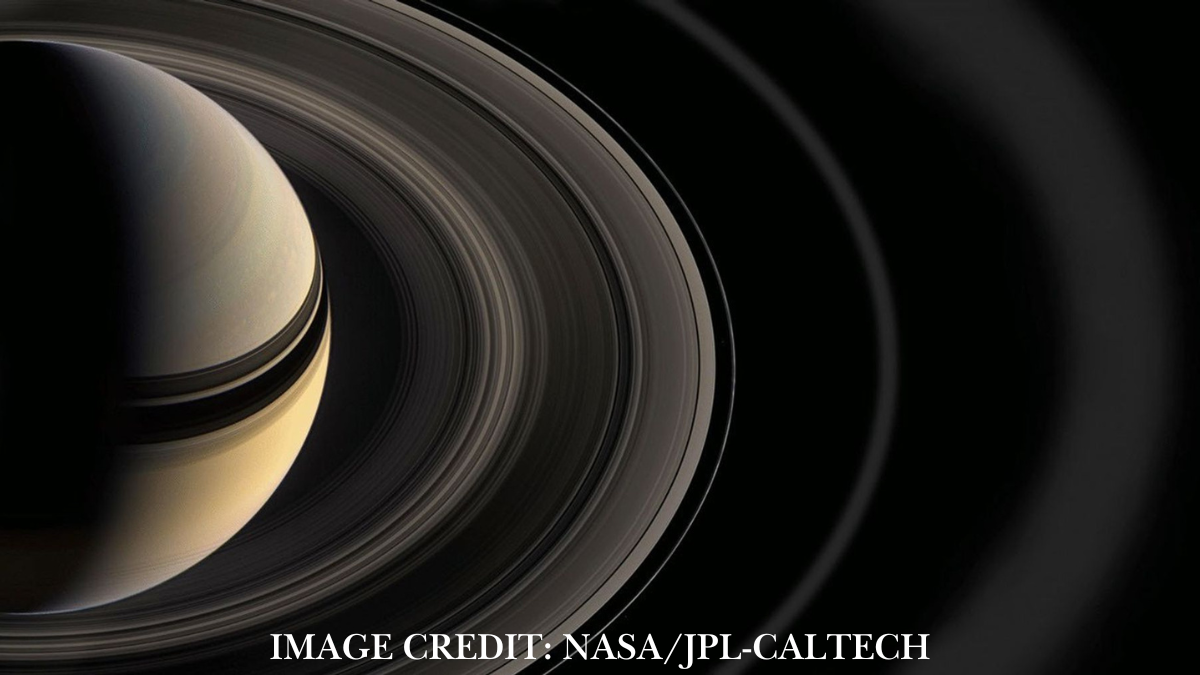
Saturn stands out as one of the most beautiful planets in our solar system, wrapped in bright rings and swirling cloud bands. For decades, however, its internal spin rate remained one of the most stubborn puzzles in planetary science. Spacecraft measurements produced conflicting numbers, and the planet appeared to speed up or slow down over time in ways that should not happen to a giant world. Recent data from the James Webb Space Telescope have now clarified why earlier readings gave such confusing results and have revealed the real processes at work high above Saturn’s clouds.
Gas giants like Saturn have no solid surface that observers can track. Their atmospheres feature strong winds that move at different speeds from the deeper interior. In addition, Saturn’s magnetic field lines up almost perfectly with its rotation axis. This alignment means the usual radio signals used to clock a planet’s spin behave differently than they do on Jupiter. As a result, scientists had to rely on indirect clues, and those clues sometimes pointed in different directions. The James Webb Space Telescope’s sharp infrared eyes finally allowed researchers to watch the upper atmosphere and glowing auroras in unprecedented detail, showing that the apparent changes in rotation were not changes in the planet’s actual spin at all.
These new observations close a long chapter of uncertainty while opening fresh questions about how atmospheres and magnetic environments interact on giant planets. What exactly made Saturn’s true internal rotation so difficult to measure for so many years, and how did the latest space telescope data finally bring the pieces together?
What makes measuring Saturn’s true rotation rate so challenging?
Saturn is a fluid world made mostly of hydrogen and helium. Without a solid crust or fixed landmarks, there is no easy way to watch one full turn. Cloud features in the upper atmosphere move with powerful jet streams, so tracking them from Earth or spacecraft gives only the speed of the winds, not the rotation of the planet’s deeper layers.
Scientists therefore turned to other signals. Radio waves called Saturn Kilometric Radiation, or SKR, come from electrons spiraling along magnetic field lines. On most planets these waves repeat at a steady rate tied to the planet’s spin. Saturn’s nearly perfect alignment between its magnetic field and rotation axis weakens this connection. Small shifts in the upper atmosphere can alter where and how the radio signals are produced, making the apparent period drift even when the planet itself keeps spinning at a constant rate.
Gravity measurements and vibrations traveling through the planet offer another route. These methods sense the deep interior more directly. Yet collecting enough high-quality data required a spacecraft to fly close to Saturn for many years and then dive between the planet and its rings. Only then could researchers separate the true bulk rotation from the confusing effects of winds and magnetic currents higher up. The combination of these difficulties explains why simple answers stayed out of reach for so long.
How did Voyager and Cassini measurements differ and create the puzzle?
Early flybys gave the first radio-based estimates. Voyager 1 and Voyager 2, passing Saturn in 1980 and 1981, recorded a rotation period of 10 hours, 39 minutes, and 24 seconds, with an uncertainty of about 7 seconds.
When NASA’s Cassini spacecraft arrived in 2004, its radio instruments measured a noticeably longer period: 10 hours, 45 minutes, and 45 seconds, plus or minus 36 seconds. Even more puzzling, the measured period continued to shift slowly during Cassini’s 13-year mission. A planet cannot change its overall spin speed by minutes over just a few years; angular momentum is conserved. The mismatch between Voyager and Cassini numbers, and the continued drift seen by Cassini, told researchers that the radio signals were not giving a clean readout of the planet’s interior rotation.
What is Saturn’s accepted internal rotation period today?
In 2019, scientists announced a more reliable value using an entirely different technique. They studied tiny waves and ripples in Saturn’s rings that are caused by vibrations inside the planet itself. The rings act like a giant seismograph, picking up the gravitational tugs from Saturn’s oscillating interior. This ring seismology method yielded a rotation period of 10 hours, 33 minutes, and 38 seconds.
This figure comes from the deep interior and matches other clues from the planet’s shape and gravity field. It is now widely regarded as the best current estimate of Saturn’s true bulk rotation rate. The older radio measurements were not wrong; they were simply measuring something else—the behavior of the upper atmosphere and its connection to the magnetosphere.
How did the James Webb Space Telescope help solve Saturn’s rotation mystery?
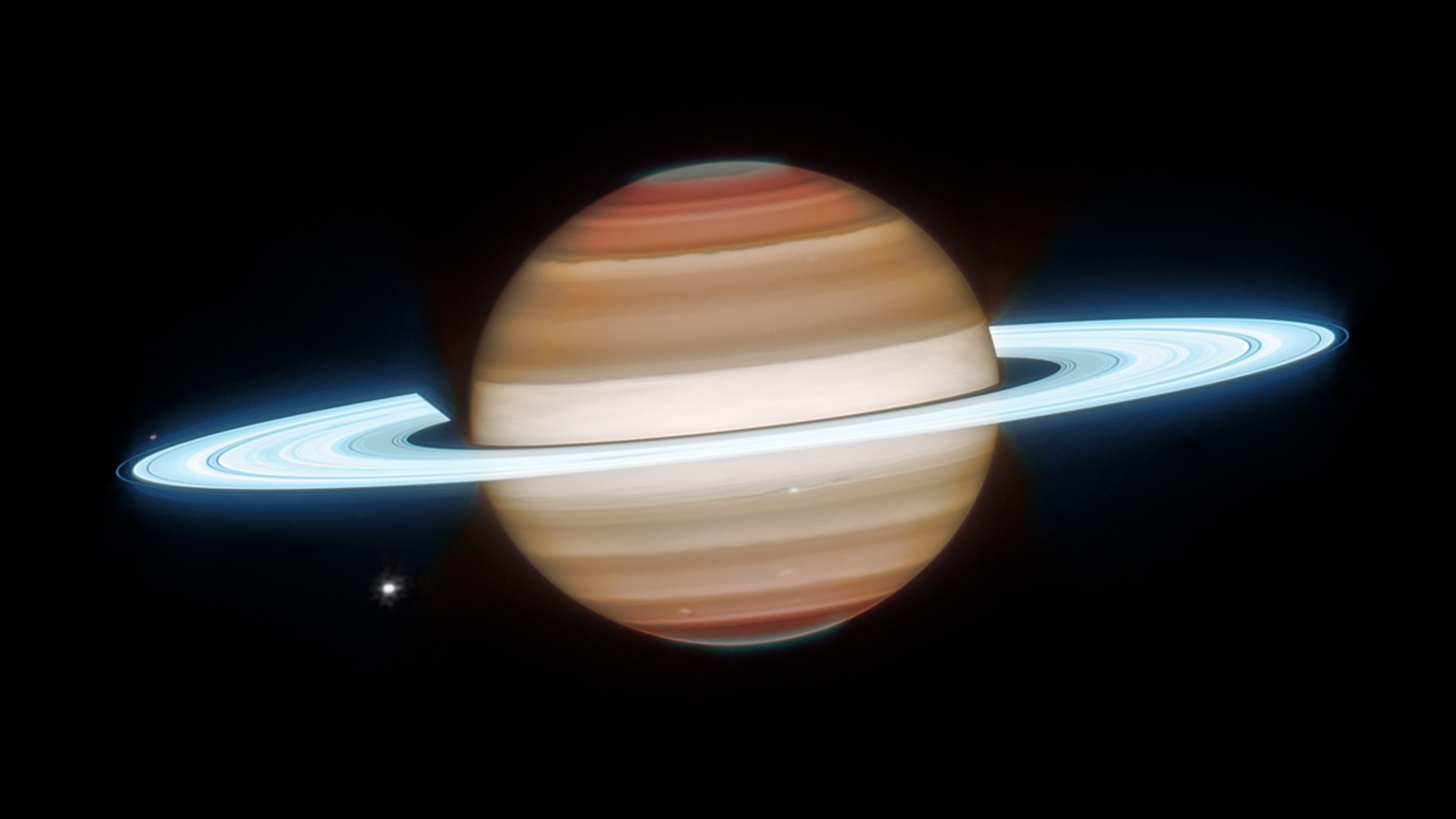
In late 2024, researchers used the James Webb Space Telescope’s NIRSpec instrument to observe Saturn’s northern auroral region continuously for a full Saturnian day. The telescope mapped infrared light from H₃⁺, a molecular ion that acts as a sensitive thermometer in the upper atmosphere. These maps achieved spatial resolution better than 500 kilometers per pixel, roughly ten times sharper than earlier observations from ground-based telescopes.
The data showed clear temperature differences across the auroral zone, with values ranging from about 380 to 450 kelvin. More importantly, the temperature pattern was slightly offset from the main auroral emission. This offset drives strong neutral winds in the upper atmosphere. Those winds, in turn, generate electric currents that flow along magnetic field lines and help sustain the aurora. The entire system forms a closed feedback loop.
What is the self-sustaining auroral heat pump on Saturn?
The newly mapped temperatures and winds reveal a “planetary heat pump.” Energy deposited by charged particles in the aurora heats patches of the upper atmosphere. The resulting temperature differences create winds. These winds move electrically charged particles, producing currents that flow out into space and back into the atmosphere. The currents then energize more particles, which keep the aurora glowing and the heating going.
Because this loop sits in the upper atmosphere, it can shift the locations where radio signals are generated without changing the planet’s overall spin. Earlier spacecraft had measured the drifting radio period; the James Webb Space Telescope showed why the drift occurs. The planet’s true interior rotation stays steady, while the atmospheric “pump” creates the illusion of variability in the signals used to track it.
Why do different measurement methods give different answers for Saturn?
Visual cloud tracking follows fast-moving jets in the weather layer and can suggest rotation periods that vary with latitude. Radio SKR measurements sense conditions in the magnetosphere and upper atmosphere, where the heat-pump currents operate. Ring seismology and gravity data sense the deeper, more stable interior.
Each technique is valid for what it measures, but only the interior methods reveal the planet’s fundamental spin. The James Webb Space Telescope observations finally connected the dots between the drifting radio signals and the atmospheric dynamics that cause them. Scientists now understand that Saturn’s apparent rotation changes were never changes in the planet’s actual day length.
Conclusion
Saturn’s true rotation rate stayed hidden for decades because the most convenient measurement tools were sensitive to shifting conditions in the upper atmosphere rather than the steady spin of the deep interior. Voyager and Cassini radio data captured real but misleading variations. Ring seismology later supplied a stable interior value of 10 hours, 33 minutes, and 38 seconds. The James Webb Space Telescope’s detailed auroral maps then explained the mechanism: a self-sustaining heat pump powered by Saturn’s own northern lights creates winds and currents that modulate the signals used to track rotation.
The mystery is solved, yet the discovery raises new questions. How common are such atmosphere-magnetosphere feedback loops on other giant planets, and what might they tell us about worlds beyond our solar system? Continued observations will help answer these questions and deepen our understanding of how gas giants work.
Sources
NASA. (2004, June 28). Scientists find that Saturn’s rotation period is a puzzle. NASA Jet Propulsion Laboratory. https://www.jpl.nasa.gov/news/scientists-find-that-saturns-rotation-period-is-a-puzzle/
NASA. (2019, January 18). Scientists finally know what time it is on Saturn. NASA Jet Propulsion Laboratory. https://www.jpl.nasa.gov/news/scientists-finally-know-what-time-it-is-on-saturn/
Stallard, T. S., Moore, L., Melin, H., Smith, C. G. A., Agiwal, O., Chowdhury, M. N., … & Caggiano, J. A. (2026). JWST/NIRSpec reveals the atmospheric driver of Saturn’s variable magnetospheric rotation rate. Journal of Geophysical Research: Space Physics, 131(3). https://doi.org/10.1029/2025JA034578
Northumbria University. (2026, March 27). Scientists solve decades-long mystery about why Saturn appears to change its spin. EurekAlert! https://www.eurekalert.org/news-releases/1121699