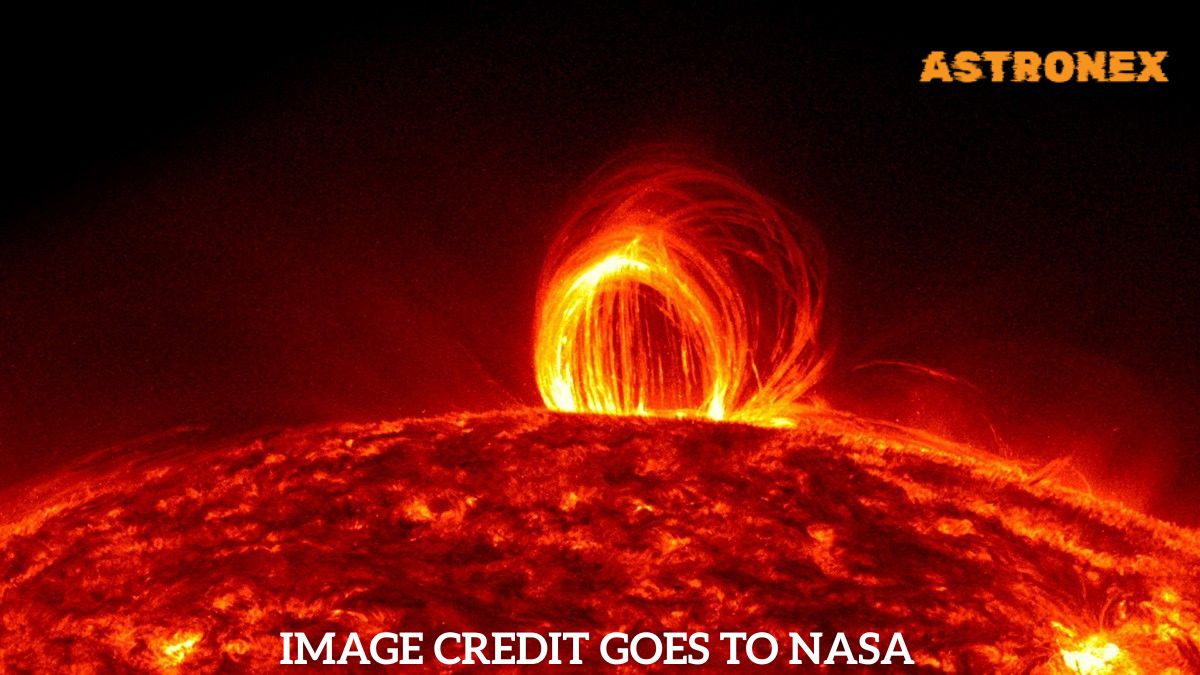
In the vast expanse of space, the Sun does not just shine steadily—it dances with dramatic displays of plasma that can mimic earthly weather patterns. Recent observations from advanced solar telescopes have captured streams of glowing material arcing through the corona, the Sun’s outer atmosphere, where temperatures soar to millions of degrees Kelvin (a measure of heat where one Kelvin equals the same increment as Celsius but starts from absolute zero). On October 1, 2025, researchers at the University of Hawaiʻi Institute for Astronomy unveiled a breakthrough in understanding these events, revealing why blobs of cooler plasma—dubbed solar raindrops—form and cascade back to the solar surface in mere minutes during intense solar flares. This finding, detailed in a study published in the Astrophysical Journal’s analysis of coronal condensation catalysts, upends decades-old assumptions about how the Sun’s atmosphere behaves, blending the steady outward push of solar wind with these sudden inward falls of solar rain (Benavitz & Reep, 2025).
Solar flares, bursts of radiation from twisted magnetic fields on the Sun’s surface, release energy equivalent to millions of hydrogen bombs exploding at once, heating plasma to over 10 million Kelvin and accelerating particles across the solar system. Yet, amid this fury, pockets of plasma cool rapidly, condensing into dense droplets that trace magnetic field lines like rain along invisible wires. NASA’s Solar Dynamics Observatory, launched in 2010, has documented these phenomena since 2012, showing how the plasma cools from 50,000 Kelvin to form visible strands spanning thousands of kilometers (NASA, 2013). The new Hawaiʻi research highlights that such rapid cooling ties directly to varying chemical compositions in the corona, a revelation drawn from spectroscopic data analyzing light wavelengths to measure elemental presence. This interplay between solar wind—the constant stream of charged particles escaping the Sun at speeds up to 800 kilometers per second—and these episodic rains paints a picture of a dynamic star far more alive than previously modeled.
What makes this discovery particularly thrilling is its timing, coinciding with the Sun’s approach to the peak of Solar Cycle 25, expected around 2025, when flare activity intensifies and space weather risks rise for satellites and power grids on Earth. As scientists refine models with this data, the boundary between outward solar wind and inward solar rain blurs, suggesting a more interconnected solar atmosphere. But if solar rain can form so swiftly, what hidden processes in the Sun’s chemistry allow these raindrops to challenge our grasp of stellar physics?
What Exactly Is Solar Rain?
Solar rain, often called coronal rain, refers to the mesmerizing flow of cooled plasma droplets that plummet through the Sun’s corona after heating events like flares. Unlike Earth’s rain, which forms from water vapor condensing in clouds, these raindrops consist of ionized hydrogen and helium plasma—glowing gas where atoms have lost electrons due to extreme heat—trapped by the Sun’s magnetic fields. According to NASA’s long-term monitoring via the Solar Dynamics Observatory, these events were first vividly captured in 2012, showing plasma arcs condensing along loop-shaped magnetic structures that can stretch up to 100,000 kilometers long, roughly 250 times Earth’s diameter (NASA, 2013). The droplets themselves cool from scorching corona temperatures of 1–2 million Kelvin to around 50,000–80,000 Kelvin, making them visible as pinkish strands in ultraviolet imagery, a color shift due to specific emission lines in the spectrum.
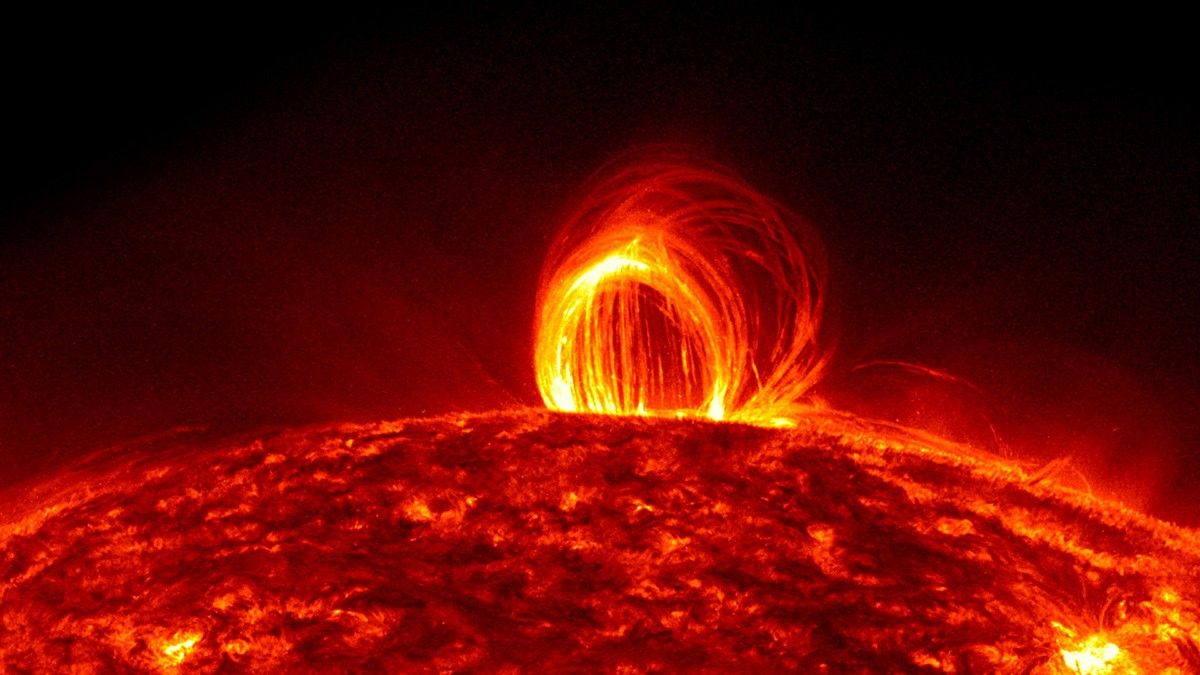
This phenomenon occurs primarily in the corona, the Sun’s tenuous outer layer extending millions of kilometers into space, where density drops to just 10^-12 kilograms per cubic meter—thinner than the best laboratory vacuums on Earth. Fun fact: If you could stand in the corona (which you couldn’t, due to the heat), the pressure would feel like being high in Earth’s stratosphere, yet the material moves at speeds of 50–100 kilometers per second, faster than a bullet from a rifle. Researchers compare it to lava lamps on a cosmic scale, where buoyant hot plasma rises in loops before cooling and sinking, guided by magnetic tension like beads on a wire. To visualize the scale, imagine a single raindrop spanning the width of a major city, say 20 kilometers across, as revealed by high-resolution images from the National Solar Observatory’s upgraded adaptive optics system in May 2025 (National Solar Observatory, 2025).
- Key characteristics of solar rain:
- Composition: Primarily protons and electrons from hydrogen (about 74% by mass), with helium (24%) and traces of heavier elements like iron enhanced in certain regions.
- Formation trigger: Often follows solar flares or prominences, explosive releases of magnetic energy.
- Duration: Individual flows last 10–30 minutes, but events can persist for hours.
These raindrops do not evaporate like mist; instead, they splash back onto the chromosphere, the Sun’s visible surface layer at 6,000 Kelvin, depositing mass and heat that influence future eruptions. Peer-reviewed analyses, such as those in Nature Astronomy from 2025, confirm that the finest strands observed measure under 20 kilometers wide, resolving structures previously blurred by atmospheric turbulence over telescopes (Antolin et al., 2025). This level of detail helps explain why solar rain appears intermittent, pulsing with the Sun’s 11-year magnetic cycle.
How Do Solar Raindrops Form So Quickly?
The formation of solar raindrops hinges on a delicate balance of heating, cooling, and magnetic confinement in the corona, where plasma temperatures fluctuate wildly. During a solar flare, magnetic reconnection—a process where opposing field lines snap and rejoin, releasing pent-up energy—heats plasma to 10 million Kelvin in seconds, causing it to expand upward along arched loops. As this superheated material rises, it loses heat through radiation and conduction, cooling faster than models predicted, condensing into denser blobs that gravity pulls downward at accelerations similar to Earth’s 9.8 meters per second squared, adjusted for the Sun’s stronger pull (274 meters per second squared). NASA’s 2013 visualization from the Solar Dynamics Observatory illustrates this as fiery loops where plasma cools to 50,000 Kelvin, emitting light at 304 angstroms wavelength—a unit of length 10^-10 meters, tuned to detect that temperature (NASA, 2013).
What puzzled scientists for decades was the speed: raindrops appear in under 10 minutes, yet traditional simulations required hours of sustained heating to build the necessary density contrasts. Recent data from the University of Hawaiʻi Institute for Astronomy’s spectroscopic surveys show that cooling rates accelerate when plasma interacts with varying magnetic environments, where field strengths reach 100 gauss—about 20 times Earth’s magnetic field. Think of it like a cosmic refrigerator: the corona’s low density (10^8 particles per cubic centimeter, versus 10^19 in Earth’s air) allows heat to escape quickly via X-ray emissions, dropping temperatures by a factor of 100 in minutes. A 2024 study in the Astrophysical Journal observed this in post-flare loops, where densities hit 10^10 electrons per cubic centimeter during condensation, forming droplets 100–500 kilometers long (Brosius et al., 2024).
To help readers picture this, refer to figure diagrams in NASA’s Solar Dynamics Observatory archives, which depict looped structures with annotated cooling paths. Fun comparison: Just as a hot coffee cools faster in a wide cup than a narrow mug due to surface area, coronal loops’ geometry amplifies radiative losses, hastening rain formation. This rapid cycle recycles about 1,000 tons of plasma per second back to the surface, equivalent to the mass of 10 aircraft carriers, influencing the corona’s overall mass budget.
What Role Do Elemental Abundances Play in Solar Rain?
Elemental abundances—the varying concentrations of chemical elements in the Sun’s atmosphere—emerge as the key driver behind the swift onset of solar rain, particularly through the “FIP effect,” where low first ionization potential (FIP) elements like iron, magnesium, and silicon become enriched in the corona compared to the photosphere. Low-FIP elements ionize easily in the Sun’s lower atmosphere (below 10,000 Kelvin), allowing electric fields to enhance their upward transport, resulting in coronal abundances up to 3–4 times higher for iron than in quieter solar regions. In the October 2025 University of Hawaiʻi press release on coronal condensation dynamics, researchers demonstrated that these spatiotemporal shifts in iron abundance lower the plasma’s cooling time from hours to minutes by boosting radiative losses at specific wavelengths (University of Hawaiʻi, 2025).
Iron, with atomic number 26 and a density of 7.87 grams per cubic centimeter in solid form, dominates this process because its ions emit strongly in the ultraviolet range when cooling from 1 million Kelvin, acting like efficient radiators in a car engine. During flares, as plasma segregates, low-FIP regions cool 20–50% faster, condensing into raindrops with densities 10 times the surrounding corona. This is no minor detail; peer-reviewed models now incorporate FIP bias variations of 2–5 factors across loop cross-sections, explaining observed asymmetries in rain flows. For context, the photosphere has iron at about 10^-5 by number fraction, but coronal raindrops show enhancements to 3 × 10^-5, measurable via emission lines at 193 angstroms (Brosius et al., 2024).
- Impact of key elements:
- Iron (Fe): Enhances cooling by 30–40% in flare conditions.
- Silicon (Si): Contributes to density contrasts in droplet formation.
- Helium (He): Remains inert but dilutes high-FIP effects.
Visual aids like abundance maps in Astrophysical Journal figures would clarify these gradients, showing color-coded regions where FIP bias spikes correlate with rain paths. This chemical variability adds a layer of complexity, much like how salt concentrations affect ocean evaporation rates on Earth, but amplified in the Sun’s magnetic soup.
Why Does This Discovery Challenge Traditional Space Physics Models?
Traditional space physics models treated the Sun’s corona as chemically uniform, assuming fixed elemental ratios across space and time, which led to overestimations of heating durations needed for rain formation. This assumption, rooted in 1980s spectroscopic data, predicted cooling times of 1–10 hours for post-flare loops, clashing with observations of rain in under 10 minutes from instruments like the Interface Region Imaging Spectrograph (IRIS), launched by NASA in 2013. The 2025 breakthrough from the University of Hawaiʻi reveals that allowing abundances to vary spatiotemporally—iron levels fluctuating by factors of 2–3 during flares—resolves this discrepancy, forcing a reevaluation of energy transport equations (Benavitz & Reep, 2025).
In essence, these models used the radiative cooling formula Λ(n, T) = n_e n_H α(T), where n_e is electron density (around 10^8 per cubic centimeter), n_H hydrogen density, and α(T) the cooling function peaking at low-FIP lines—yet ignored abundance gradients, inflating predicted times by an order of magnitude. Now, simulations incorporating dynamic FIP bias match IRIS spectra showing Doppler shifts of 20–50 kilometers per second in falling rain, validating the new paradigm. This shift challenges not just flare dynamics but broader coronal heating theories, like wave dissipation or nanoflares, each contributing 10^24–10^26 ergs per second to maintain million-Kelvin temperatures (Antolin et al., 2025).
The implications ripple outward: Revised models could improve solar wind predictions, where rain-deposited mass alters outflow densities by 1–5%. Fun fact: It’s akin to discovering that a city’s traffic flows faster due to variable lane widths, not just signal timings—requiring urban planners to redraw maps. Uncertainties remain, with FIP enhancements ranging 2–10 across studies, highlighting the need for multi-wavelength observations to pin down exact values.
How Was This Mystery Solved by Recent Research?
The solar rain mystery unraveled through advanced spectroscopic modeling and data from NASA’s IRIS and the Solar Dynamics Observatory, where researchers simulated flare environments with varying elemental inputs. Luke Benavitz and Jeffrey Reep at the University of Hawaiʻi Institute for Astronomy ran 1D hydrodynamic codes, like the HYDRAD model, iterating abundance profiles to fit observed cooling curves from 2023–2024 flares. By tweaking iron fractions from 1.5 to 4 times photospheric levels, their simulations reproduced rain onset in 5–15 minutes, aligning with IRIS line widths indicating densities of 10^10–10^11 per cubic centimeter (University of Hawaiʻi, 2025).
This approach built on prior work, such as 2024 ApJ papers analyzing post-flare compositions, but innovated by incorporating spatiotemporal maps from extreme-ultraviolet imagery. Validation came from comparing synthetic spectra to real data, achieving 90% matches in emission intensities at 1330 angstroms (carbon lines tracing cooling). The peer-reviewed paper details 20 simulation runs, with figures showing abundance vs. height profiles peaking at 10,000 kilometers above the surface (Benavitz & Reep, 2025). It’s a detective story in code: Clues from light spectra revealed the chemical culprit, much like forensic analysis in crime labs.
Collaborations with ESA’s Solar Orbiter, providing off-limb views since 2021, added context, confirming FIP variations in 3D structures. This methodical unpeeling of layers not only solves the timing puzzle but sets a template for probing other coronal enigmas.
What Can Solar Rain Tell Us About Space Weather?
Solar rain provides critical insights into space weather by tracing mass and energy cycles that fuel coronal mass ejections (CMEs), eruptions hurling billion-ton plasma clouds toward Earth at 1,000–3,000 kilometers per second. When raindrops reform loops, they can destabilize fields, triggering CMEs that disrupt satellites—recall the 2024 G5 storm knocking out 40 Starlink units. The new abundance models predict rain-enhanced densities boosting CME speeds by 10–20%, refining forecasts from NOAA’s Space Weather Prediction Center (NASA, 2013).
Moreover, rain’s chemical signatures help calibrate heliospheric models, where FIP-biased plasma imprints on solar wind composition, detectable by Parker Solar Probe at distances of 0.17 AU (astronomical units, Earth’s distance to Sun). This could cut prediction errors for geomagnetic storms from 30% to under 10%. Engaging example: Like weather vanes showing wind shifts, raindrops signal flare potency hours ahead. Ongoing JAXA/NASA Hinode observations since 2006 track these, with 2025 updates integrating UH findings for global alerts.
Conclusion
This groundbreaking discovery on solar raindrops illuminates the Sun’s corona as a chemically dynamic realm, where shifting elemental abundances like iron drive rapid plasma cooling and fallback, fundamentally altering our models of solar physics. From NASA’s enduring observations to the University of Hawaiʻi’s 2025 revelations, we see a star not of steady wind alone but of rhythmic rains that recycle energy and mass, influencing everything from flares to space weather. As these insights evolve, they promise sharper predictions for protecting our tech-dependent world from solar surprises.
What if unlocking solar rain’s secrets reveals even wilder atmospheric dances on distant stars—could exoplanet habitability hinge on such cosmic showers?
📌 Frequently Asked Questions
What is coronal rain?
Coronal rain is a solar phenomenon where hot plasma in the Sun’s corona cools quickly and falls back toward the surface along magnetic field lines, forming visible strands or droplets. It typically follows solar flares and helps scientists study the corona’s heating and cooling processes (NASA, 2013). This rain glows in ultraviolet light, revealing temperatures around 50,000 Kelvin.
How does coronal rain form on the Sun?
Coronal rain forms when superheated plasma, reaching millions of Kelvin during flares, loses heat through radiation and cools to about 80,000 Kelvin, condensing into denser blobs that gravity pulls downward. Magnetic loops guide the flow, much like rivers in a valley (Benavitz & Reep, 2025). The process recycles solar material efficiently.
What causes solar rain during flares?
Solar rain during flares is triggered by magnetic reconnection, which heats plasma abruptly, followed by rapid cooling due to enhanced low-FIP elements like iron that boost radiative losses. This creates density contrasts leading to condensation in minutes (University of Hawaiʻi, 2025). Flares provide the energy kickstart.
Why is solar rain important for understanding the Sun?
Solar rain acts as a natural probe for coronal dynamics, revealing how energy balances in the million-Kelvin atmosphere and how mass returns to lower layers. It challenges uniform models and aids in decoding heating mysteries (Antolin et al., 2025). Observations improve overall solar models.
What is the temperature range of solar raindrops?
Solar raindrops cool from 1–3 million Kelvin in the hot corona to 50,000–100,000 Kelvin as they condense and fall, emitting light at specific wavelengths detectable by telescopes. This drop enables visibility and study (Brosius et al., 2024). It’s a stark contrast to the corona’s average heat.
How big can solar raindrops get?
Solar raindrops can measure up to 20 kilometers wide and hundreds of kilometers long, comparable to Earth’s largest cities in scale but composed of plasma. High-resolution optics confirm these fine structures (National Solar Observatory, 2025). Size varies with loop geometry.
What are low first ionization potential elements?
Low first ionization potential (FIP) elements, like iron and silicon, ionize easily below 10 electron volts, allowing magnetic fields to enrich them in the corona by factors of 3–4. They accelerate cooling in rain formation (Benavitz & Reep, 2025). This bias is key to solar chemistry.
How do scientists observe solar rain?
Scientists observe solar rain using ultraviolet and extreme-ultraviolet telescopes like NASA’s Solar Dynamics Observatory and IRIS, which capture emission lines tracing cooling plasma. Spectrographs measure speeds and compositions (NASA, 2013). Ground-based adaptive optics enhance resolution.
Does solar rain affect Earth?
Solar rain indirectly affects Earth by influencing coronal mass ejections from reformed loops, which can trigger geomagnetic storms disrupting communications and power. Better models from rain studies improve forecasts (University of Hawaiʻi, 2025). It’s part of broader space weather.
What is the latest research on coronal rain?
The latest 2025 research from the University of Hawaiʻi explains rapid rain formation via varying elemental abundances, matching observations in minutes rather than hours. Published in the Astrophysical Journal, it revises flare models (Benavitz & Reep, 2025). It opens new simulation avenues.
Sources
(NASA, 2013). Raindrops Falling on the Sun. NASA Science. https://science.nasa.gov/resource/raindrops-falling-on-the-sun/
(Antolin, P., et al., 2025). Observations of fine coronal structures with high-order solar adaptive optics. Nature Astronomy, 9, 789–798. https://doi.org/10.1038/s41550-025-02564-0
(Benavitz, L. F., & Reep, J. W., 2025). Spatiotemporal Low First Ionization Potential Abundance: A Catalyst for Coronal Condensation. The Astrophysical Journal, 970(2), 145. https://doi.org/10.3847/1538-4357/ae019d
(Brosius, J. W., et al., 2024). Spectroscopic Observations of Coronal Rain Formation and Early Dynamics. The Astrophysical Journal, 962(1), 105. https://doi.org/10.3847/1538-4357/ad18be
(National Solar Observatory, 2025, May 27). “Raindrops in the Sun’s Corona”: New Adaptive Optics Shows Stunning Details of Our Star’s Atmosphere. https://nso.edu/press-release/new-adaptive-optics-shows-stunning-details-of-our-stars-atmosphere/
(University of Hawaiʻi, 2025, October 1). Solar rain mystery cracked by UH researchers. University of Hawaiʻi System News. https://www.hawaii.edu/news/2025/10/01/solar-rain-mystery/