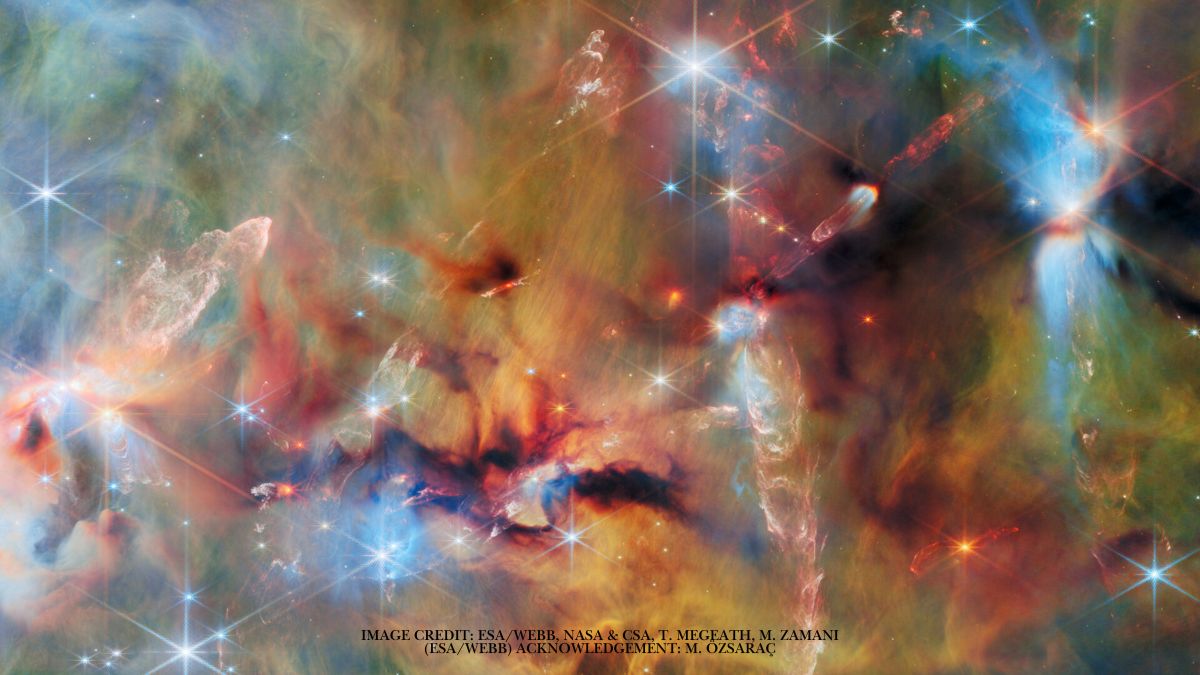
A massive cloud of cold hydrogen gas sits in deep space. It looks completely dark to human eyes. Inside this thick cosmic dust, gravity is pulling material together to build something entirely new. For decades, astronomers could only guess what was happening inside these stellar nurseries. The dust simply blocked visible light. We knew stars were forming, but the exact sequence of events remained hidden behind a wall of soot.
Now, the James Webb Space Telescope is changing the rules. Its massive primary mirror collects infrared light that easily passes right through the dust. By looking at different regions of space, astronomers are piecing together the complete life cycle of a baby star. We are seeing everything from the first dark clumps of gas to fully formed planetary systems.
Honestly, the sheer amount of detail is staggering. Researchers are looking at protostars firing supersonic jets and young suns clearing out their leftover debris. How exactly does a cold cloud of gas transform into a blazing star system?
How does infrared light reveal hidden stars?
To understand how stars form, you have to look past the dust. Giant molecular clouds are filled with tiny particles of carbon and silicates. These particles absorb the short wavelengths of visible light. If you look at a star-forming region with a standard optical telescope, you just see a dark void.
Infrared light has longer wavelengths. These longer waves can slip past the dust particles without hitting them. The James Webb Space Telescope was built specifically to catch this light. Its primary mirror consists of 18 beryllium segments coated with a microscopically thin layer of gold. This gold coating makes the mirror incredibly efficient at reflecting infrared light. The entire mirror measures 6.5 meters across.
This size is a massive upgrade for astronomy. The previous premier infrared observatory was the Spitzer Space Telescope. Spitzer did amazing work, but it only had a 0.85-meter primary mirror. Webb offers roughly ten times the resolution. It uses two main instruments to map these stellar nurseries. The Near-Infrared Camera (NIRCam) detects wavelengths from 0.6 to 5 micrometers. The Mid-Infrared Instrument (MIRI) handles the longer wavelengths from 5 to 28 micrometers. Together, they give astronomers a crystal clear view into the darkest corners of the galaxy according to NASA’s James Webb Space Telescope mission overview.
What happens during the earliest phase of star birth?
Astronomers classify young stars using a system called the Lada protostellar classes. The story begins at Class 0. This is the very first stage of stellar formation. A dense pocket of gas inside a larger molecular cloud begins to collapse under its own weight.
At this point, there is no star at all. There is only a collapsing core of hydrogen molecules. As the gas falls inward, it compresses. Physics dictates that compressing a gas makes it heat up. The center of this dark cloud slowly becomes warmer than the freezing space around it. Gravity is winning the battle against the outward thermal pressure of the gas.
Because the core is still relatively cool, it does not give off visible light. It only glows in the mid-infrared. This is where Webb’s MIRI instrument shines. MIRI can detect the faint thermal signature of these Class 0 objects deep inside their thick dusty envelopes. The protostar is feeding greedily on the surrounding material and growing larger by the day.
Why do newborn protostars fire massive jets?
As the protostar gathers more mass, it graduates to the Class I stage. The central object is getting hotter and much more dense. However, the gas falling onto the star does not just drop straight down. It swirls around the star in a massive disk due to the conservation of angular momentum.
This swirling motion creates powerful magnetic fields. These fields act like a cosmic slingshot. They take some of the incoming gas and blast it out from the north and south poles of the protostar. These twin beams of matter are called Herbig-Haro objects. They are one of the most violent phenomena in stellar formation.
The jets shoot outward and slam into the surrounding gas cloud at incredible speeds. The collision usually happens at 100 to 400 kilometers per second (about 220,000 to 890,000 mph). The impact creates massive shockwaves that heat up the hydrogen molecules in the cloud. Webb’s NIRCam captures these shockwaves as bright glowing structures that look like colorful ribbons twisting through space. These jets are highly visible in ESA’s latest Webb observations of young star clusters.
How do protoplanetary disks build gas giants?
Eventually, the young star stops pulling in huge amounts of material from the wider cloud. It enters the Class II stage. At this point, the star is optically visible. Astronomers call a low-mass star in this phase a T Tauri star.
The T Tauri star is still surrounded by a thick swirling disk of leftover gas and dust. This is known as a protoplanetary disk. This disk is the exact place where planets are born. Gas giants like Jupiter finish most of their growth during this specific gas-rich phase. They sweep through the disk and swallow up huge amounts of hydrogen and helium.
Webb is completely transforming how we study these disks. Because the telescope can see specific chemical signatures in the infrared, it can map the exact locations of water ice, carbon dioxide, and organic molecules. Researchers are finding the chemical building blocks of life swirling right in the zones where new planets are taking shape. The official NIRCam instrument specifications show just how precisely the telescope can track these frozen molecules.
When does a young star finally clear its neighborhood?
The gas-rich disk does not last forever. The young star is hot and releases intense ultraviolet radiation. This radiation heats the gas in the disk and literally blows it away into deep space. Astronomers call this process photoevaporation.
Once photoevaporation removes the gas, the star enters the Class III stage. The removal of the gas is a critical turning point. It officially ends the growth of gas giant planets. Without any hydrogen left to eat, planets like Jupiter simply stop growing.
Here is the catch. The rocky material is left behind. Terrestrial planet formation does not stop when the gas disappears. Rocky planet accretion continues for tens of millions of years after the gas disk clears. Small rocks crash into each other, melting together to form larger bodies. Eventually, the central star gets hot enough to ignite core hydrogen fusion. For a Sun-like star, this ignition happens at around 15 million Kelvin. The star finally becomes a stable main-sequence star.
What do these observations tell us about our own solar system?
Looking at these distant stellar nurseries is like looking into a cosmic mirror. Our own Sun went through these exact same four stages roughly 4.6 billion years ago. We used to be a dark core, then a jet-firing protostar, and finally a T Tauri star surrounded by a dusty disk.
By observing thousands of young stars across the Milky Way, astronomers can figure out the exact conditions that created Earth. We can see how long the gas disks usually last. We can measure how much water is typically available for rocky planets. We can even see if nearby exploding stars disrupt the formation process.
Webb acts as a time machine. We cannot look back in time to see our own Sun forming. But we can look at different clouds to see different chapters of the same story playing out right now.
Conclusion
The James Webb Space Telescope has given astronomers a complete family album of stellar evolution. We no longer have to guess what happens behind the dark clouds of the Milky Way. We can track the entire process from a cold clump of dust to a bright new solar system.
The data from these observations will keep scientists busy for decades. As we map more of these stellar nurseries, what new surprises will we find hiding in the dust?
Sources
European Space Agency. (2026). Webb unveils young stars across every stage of formation. https://www.esa.int/ESA_Multimedia/Images/2026/06/Webb_unveils_young_stars_across_every_stage_of_formation
NASA. (2024). James Webb Space Telescope. https://science.nasa.gov/mission/webb/