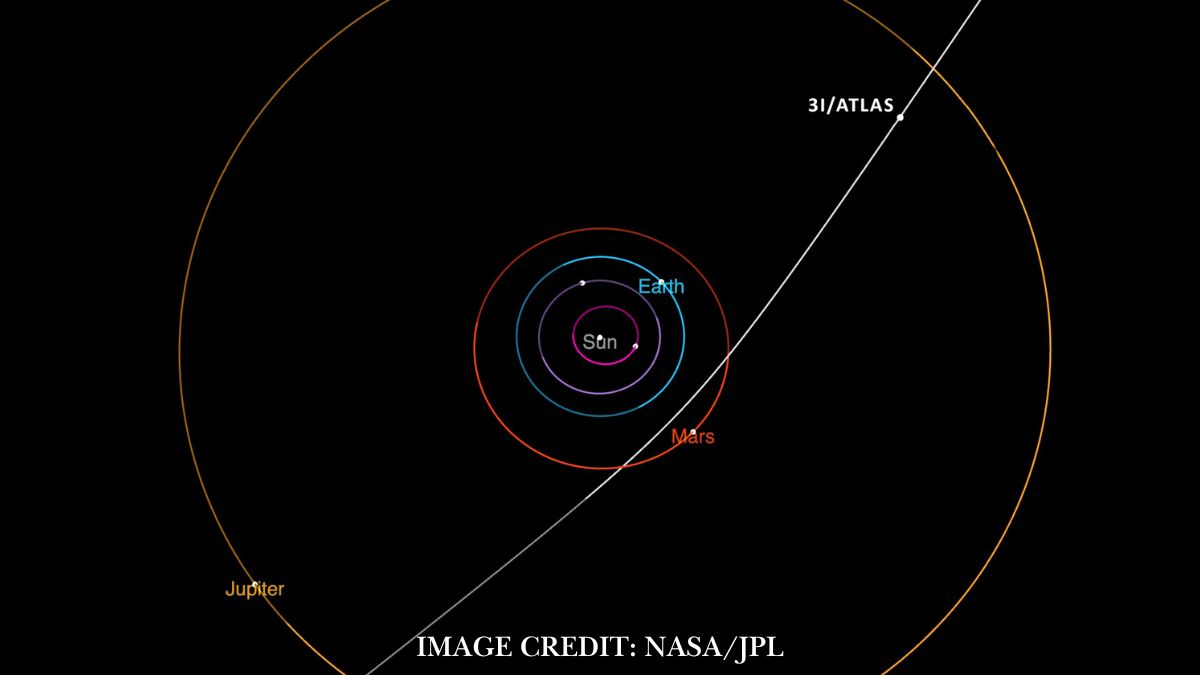
In the summer of 2025, astronomers made a remarkable discovery that added a new chapter to our understanding of objects traveling between the stars. The NASA-funded ATLAS survey telescope in Chile spotted a comet with a path unlike anything normally seen in our solar system. After careful tracking and analysis, scientists confirmed it as 3I/ATLAS, the third known interstellar comet to visit us. Its journey through our cosmic neighborhood has given researchers a rare chance to study material formed around another star.
Multiple NASA spacecraft and telescopes quickly joined the effort. The Hubble Space Telescope took clear images, while other missions gathered data on its movement and activity. These observations showed a comet with an icy core that releases gas and dust as it nears the Sun, just like familiar comets, yet with important differences in its chemistry and origin. The object follows an open, hyperbolic path, meaning it entered our solar system at high speed and will leave forever after one pass.
What exactly makes this interstellar visitor so different from the comets that formed alongside Earth and the other planets?
What is 3I/ATLAS and how was it first identified?
3I/ATLAS is the official name for the third confirmed interstellar comet detected passing through our solar system. The “3I” stands for the third interstellar object, while “ATLAS” honors the survey that found it. Astronomers first reported the object on July 1, 2025, after the ATLAS telescope in Rio Hurtado, Chile, captured images of a fuzzy, moving source. Pre-discovery images later showed it had already been visible in data from mid-June 2025.
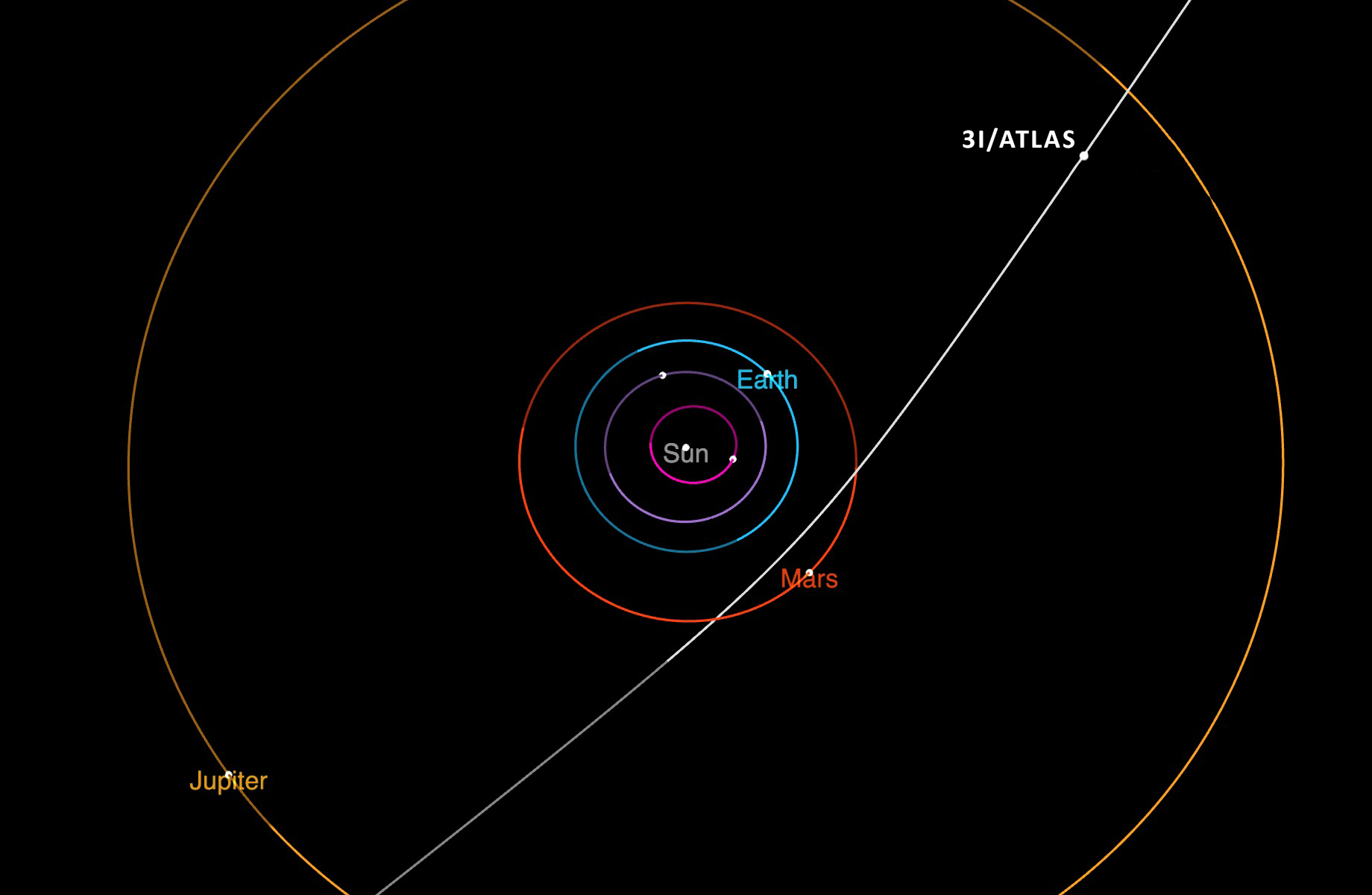
According to NASA’s official overview page on Comet 3I/ATLAS, the object was quickly recognized as interstellar because its orbit is hyperbolic. This means its path is not a closed ellipse or circle around the Sun. Instead, it came in from interstellar space, swung past the inner planets, and will continue outward on an escape trajectory. The comet approached from the direction of the constellation Sagittarius, near the center of our Milky Way galaxy. It was first spotted when it was still about 410 million miles (670 million kilometers) from the Sun, inside Jupiter’s orbit.
How does the hyperbolic path of 3I/ATLAS prove its interstellar origin?
A hyperbolic path is the key evidence that 3I/ATLAS did not form in our solar system. Objects born here follow elliptical orbits that keep them bound to the Sun’s gravity. In contrast, 3I/ATLAS moves fast enough to overcome the Sun’s pull completely. Its excess velocity confirms it arrived from outside and will depart permanently after this single visit.
NASA scientists measured its speed at discovery as roughly 137,000 miles per hour (221,000 kilometers per hour). By the time it reached its closest point to the Sun (perihelion) on October 30, 2025, the speed had increased to about 153,000 miles per hour (246,000 kilometers per hour). These high speeds are typical for interstellar objects that have traveled for millions or even billions of years through the space between stars before entering our neighborhood.
The comet passed inside the orbit of Mars but stayed far from Earth. Its closest approach to our planet occurred on December 19, 2025, at a safe distance of 1.8 astronomical units, or about 170 million miles (270 million kilometers). After swinging around the Sun, it continued outward and passed near Jupiter’s orbit in March 2026 before heading back into interstellar space.
What unusual chemical composition makes 3I/ATLAS different from solar system comets?
One of the most striking differences lies in the comet’s water ice. Observations with the Atacama Large Millimeter/submillimeter Array (ALMA) revealed an extremely high ratio of deuterium (a heavier form of hydrogen) to normal hydrogen in the water molecules. The measured D/H ratio exceeds 6.6 × 10⁻³. This value is more than 30 times higher than the typical ratios found in comets that formed in our own solar system and more than 40 times higher than the ratio in Earth’s oceans.
This high deuterium enrichment points to formation conditions that were much colder and less exposed to radiation than the environments where most solar system comets grew. In the cold outer regions of a distant protoplanetary disk, chemical reactions favor incorporating more deuterium into water ice. The finding suggests 3I/ATLAS carries a chemical fingerprint from a planetary system that formed under different physical conditions than our own.
Additional ALMA data showed unusually high levels of methanol compared with hydrogen cyanide in the coma. This further supports the idea that the comet’s ices preserve a record of cold, primitive chemistry from its birth system. Unlike many solar system comets that have been warmed and processed over billions of years near the Sun, 3I/ATLAS appears to have retained more of its original, unaltered material.
How large is the nucleus of 3I/ATLAS and what does it look like?
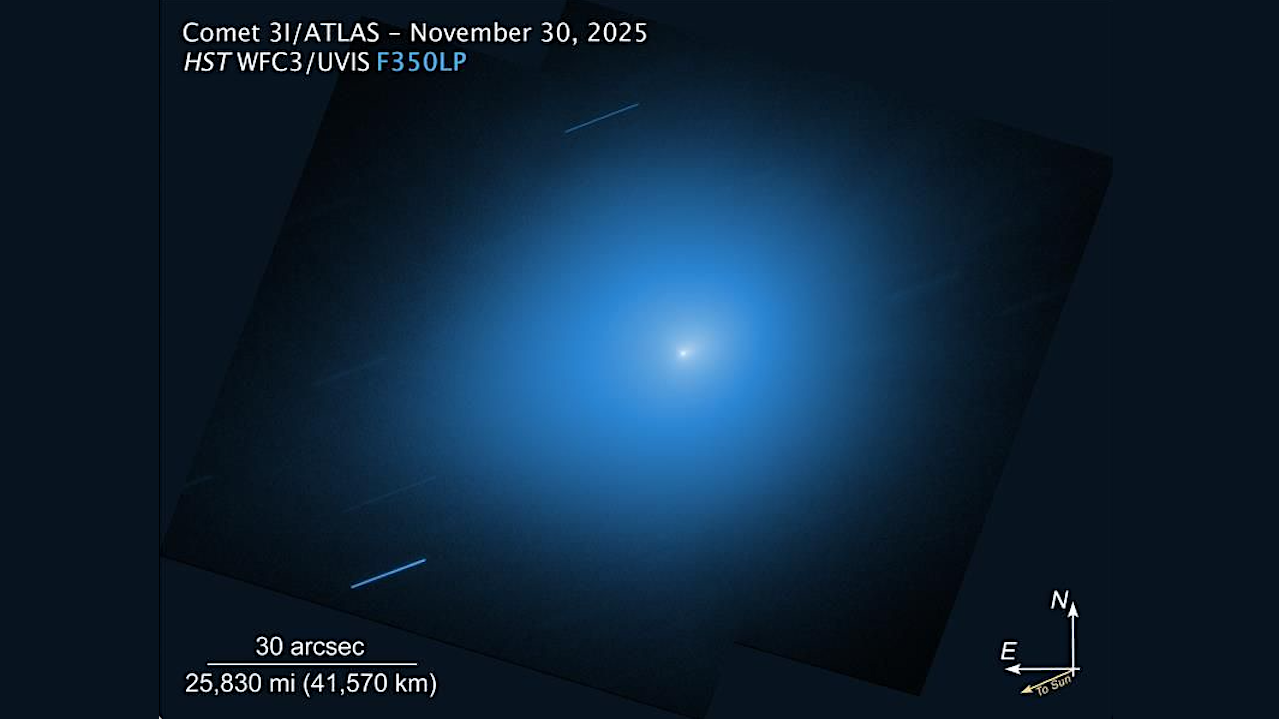
Hubble Space Telescope observations on August 20, 2025, provided the best size estimates so far. Astronomers determined that the solid, icy nucleus is no smaller than about 1,400 feet (440 meters) across and no larger than 3.5 miles (5.6 kilometers) in diameter. The wide range exists because the nucleus is surrounded by a bright coma of dust and gas that makes precise measurement difficult from Earth’s distance.
Images from Hubble show a teardrop-shaped cocoon of dust streaming away from the nucleus as sunlight heats the surface and causes ices to turn directly into gas. This outgassing creates the fuzzy appearance and tail that define a comet. Even after traveling vast distances through interstellar space, the nucleus remains active enough to produce a visible coma and tail when it approaches the Sun.
Which NASA spacecraft and telescopes studied this interstellar comet?
A remarkable number of NASA assets turned their instruments toward 3I/ATLAS, creating one of the most comprehensive observation campaigns for any interstellar object. The Hubble Space Telescope provided high-resolution images and size estimates. The James Webb Space Telescope observed it in August 2025 using its near-infrared instruments. SPHEREx detected infrared signatures of dust, water, organic molecules, and carbon dioxide in the coma.
Mars-orbiting spacecraft also contributed. The Mars Reconnaissance Orbiter’s HiRISE camera imaged the comet from about 18.6 million miles away in early October 2025. NASA’s MAVEN spacecraft recorded hydrogen atoms surrounding the comet and captured views of its coma. The Perseverance rover on the Martian surface even photographed the comet in the night sky.
Other missions including TESS, Swift, Psyche, Lucy, Parker Solar Probe, PUNCH, and Europa Clipper added valuable data at different wavelengths and distances. ESA’s Juice mission also observed the comet in November 2025. This multi-mission effort allowed scientists to track changes in activity, dust production, and gas composition as the comet moved through different regions of the solar system.
What path did 3I/ATLAS follow past Jupiter in 2026 and what happens next?
After its closest approach to the Sun in late October 2025, 3I/ATLAS continued outward. It passed approximately 0.358 astronomical units (about 53.6 million kilometers) from Jupiter in mid-March 2026. This relatively close passage by Jupiter’s orbit gave scientists another opportunity to study the comet from varying angles before it left the inner solar system for good.
Because its trajectory is hyperbolic, 3I/ATLAS will not return. It will continue gaining distance from the Sun and eventually re-enter the cold, dark interstellar medium. In roughly 8,000 years it will reach the outer edge of our Oort cloud region and then drift onward for potentially millions of years until it encounters another star system.
What can we learn from studying this rare interstellar visitor?
Every interstellar object gives us a direct sample of material from another star system without needing to travel there. The extreme deuterium enrichment in 3I/ATLAS’s water suggests that cold, outer-disk chemistry can produce comets with very different isotopic signatures than those in our solar system. The high methanol content adds another clue about the organic inventory available during planet formation elsewhere.
By comparing 3I/ATLAS with the two previous interstellar objects — 1I/ʻOumuamua and 2I/Borisov — scientists can begin to understand the diversity of planetesimals ejected from other systems. Continued analysis of the rich dataset collected by Hubble, ALMA, and multiple spacecraft will help refine models of how comets form and how often they are ejected into interstellar space.
As 3I/ATLAS fades from view on its way out of our solar system, it leaves behind a treasure trove of data. Future visitors may arrive with even more surprises, but this third interstellar comet has already shown that the building blocks of planets and comets around other stars can be chemically distinct from our own. What new secrets will the next interstellar object reveal when it arrives?
Sources
ALMA Observatory. (2026, April 23). ALMA reveals interstellar comet 3I/ATLAS formed in a far colder world than our own. ALMA Observatory. https://www.almaobservatory.org/en/press-releases/alma-reveals-interstellar-comet-3i-atlas-formed-in-a-far-colder-world-than-our-own/
NASA. (2026). Comet 3I/ATLAS. NASA Science. https://science.nasa.gov/solar-system/comets/3i-atlas/
NASA. (2026). Comet 3I/ATLAS facts and FAQs. NASA Science. https://science.nasa.gov/solar-system/comets/3i-atlas/3i-atlas-facts-and-faqs/
Salazar Manzano, L. E., Paneque-Carreño, T., et al. (2026). Water D/H in 3I/ATLAS as a probe of formation conditions in another planetary system. Nature Astronomy. https://doi.org/10.1038/s41550-026-02850-5
(Additional supporting data drawn from peer-reviewed analyses and mission updates published 2025–2026 by NASA, ALMA, and ESA-affiliated teams.)