Astronomers have recently identified a fascinating celestial object accompanying Earth on its journey around the Sun. This small asteroid, designated 2025 PN7, acts as a temporary companion in a special type of orbit that makes it appear to loop around our planet while actually following a path similar to Earth’s. Discovered through advanced telescope surveys, this finding highlights how dynamic our solar neighborhood is, with objects occasionally entering resonant orbits with Earth. Such discoveries remind us that Earth is not alone in its orbital path, as small asteroids can share the space for decades or even centuries before drifting away due to gravitational influences from other bodies.
The asteroid 2025 PN7 belongs to the Arjuna class of near-Earth objects, known for their Earth-like orbits with low eccentricity and inclination. This classification means it maintains a stable relationship with Earth without being bound by our gravity like the Moon. Researchers have confirmed its status through detailed orbital calculations, showing it has been in this configuration for about 60 years and will continue for another roughly 60 years. This makes 2025 PN7 the newest addition to a small group of known quasi-satellites, providing valuable insights into orbital mechanics and the distribution of asteroids near Earth.
What makes this discovery particularly intriguing is how it expands our understanding of Earth’s temporary companions in space. Could there be more such objects waiting to be found, and what do they tell us about the history of our solar system?
What Is Earth’s New Mini-Moon 2025 PN7?
Earth’s new mini-moon, 2025 PN7, is a small asteroid that shares an orbital resonance with our planet, making it a quasi-satellite. Unlike a true moon, it does not orbit Earth directly but follows a path around the Sun that keeps it close to us for extended periods. This asteroid is part of the Apollo group of near-Earth asteroids, characterized by orbits that cross Earth’s path. According to recent research on Arjuna asteroids (de la Fuente Marcos & de la Fuente Marcos, 2025), 2025 PN7 has an orbit with a semi-major axis of 1.003 AU (astronomical units, where 1 AU is the average Earth-Sun distance of about 149.6 million km), allowing it to stay in sync with Earth. This resonance creates the illusion from our perspective that the asteroid is circling the planet in a distant loop.
To make this easier to visualize, think of 2025 PN7 as a cosmic tag-along, similar to how a cyclist might ride alongside a car on a highway without being attached to it. The asteroid’s low eccentricity of 0.108 means its orbit is nearly circular, much like Earth’s, preventing it from swinging too far in or out. Its inclination of 1.98 degrees to the ecliptic plane (the plane of Earth’s orbit around the Sun) keeps it close to our orbital level. Fun fact: quasi-satellites like this can switch between different resonant states over time due to perturbations from planets like Venus or Jupiter. For instance, 2025 PN7 may transition to a horseshoe orbit in the future, where it would appear to trace a horseshoe shape relative to Earth.
The minimum orbit intersection distance (MOID) with Earth is 0.0024 AU, or about 359,000 km, which is roughly the distance to the Moon. This close approach potential classifies it as a near-Earth object, but it poses no collision risk in the foreseeable future. Researchers suggest referring to diagrams of co-orbital motion to better understand how such objects behave, as these visuals show the looping paths in a rotating frame of reference centered on Earth. In summary, 2025 PN7 represents a natural example of orbital dynamics at work, offering a window into how asteroids can become temporary companions without ever becoming true satellites.
How Was the Asteroid 2025 PN7 Discovered?
The asteroid 2025 PN7 was discovered on August 2, 2025, by the Pan-STARRS 1 telescope at Haleakala Observatory in Hawaii, a facility funded by NASA for surveying near-Earth objects. This detection came during routine sky scans designed to identify potentially hazardous asteroids. Following the initial sighting, additional observations were made using telescopes like the Canada-France-Hawaii Telescope and the University of Hawaii 88-inch telescope in late August. According to the Minor Planet Electronic Circular announcing 2025 PN7 (Minor Planet Center, 2025), the asteroid was confirmed through precise astrometric measurements, with magnitudes ranging from 20.87 to 22.27, indicating its faint appearance.
Archival searches revealed pre-discovery observations dating back to 2014, and further analysis showed it had been in its current orbital state for decades. The discovery process involved calculating the asteroid’s ephemeris (predicted positions over time) to link new and old data. For example, the mean anomaly was determined as 19.12581 degrees at the epoch of May 5, 2025, allowing astronomers to backtrack its path. This kind of work is crucial because small asteroids like 2025 PN7 are hard to spot due to their dimness, requiring sensitive instruments and software to distinguish them from background stars.
A fun fact is that Pan-STARRS has discovered thousands of asteroids, including other quasi-satellites, by taking wide-field images and using automated detection algorithms. The confirmation process included checking residuals in seconds of arc to ensure the orbital fit was accurate, with a quality code of 1 indicating a reliable orbit. If data is complex, such as tables of positional uncertainties, astronomers often use orbital diagrams to visualize the trajectory. Overall, this discovery underscores the importance of ongoing sky surveys in uncovering hidden companions in our solar system.
What Are the Orbital Characteristics of 2025 PN7?
The orbital characteristics of 2025 PN7 include a semi-major axis of 1.003 AU, which is very close to Earth’s 1 AU, enabling the 1:1 resonance. Its eccentricity of 0.1075069 means the orbit is slightly elliptical, with perihelion (closest to Sun) at 0.898 AU and aphelion (farthest) at 1.108 AU. The inclination is 1.97959 degrees, keeping it near the ecliptic plane. As detailed in the orbital elements from the JPL Small-Body Database for 2025 PN7 (NASA, 2025), the orbital period is 1.00 year, matching Earth’s to maintain the co-orbital configuration.
Comparisons help here: unlike comets with high eccentricity (often above 0.5), 2025 PN7’s low value keeps it stable. The argument of perihelion is 81.04237 degrees, and the longitude of the ascending node is 112.58068 degrees, parameters that define the orbit’s orientation in space. These values allow for close approaches, with the Earth MOID at 0.0024 AU, but calculations show no impacts for centuries. To visualize, imagine the orbit as a slightly tilted ring around the Sun, with Earth and the asteroid dancing in step.
Bullet points for key parameters:
- Semi-major axis: 1.003 AU (149.9 million km on average)
- Eccentricity: 0.108 (measure of orbit’s deviation from circle)
- Inclination: 1.98 degrees (angle to Earth’s orbital plane)
- Period: 365 days (synchronized with Earth)
- Absolute magnitude: 26.36 (indicating brightness and size)
If uncertainties exist, such as slight variations in MOID from different models, they are typically in the range of 0.0001 AU due to observational precision. Suggest referencing an orbital diagram from JPL to see the looping motion over time.
Why Is 2025 PN7 Considered a Quasi-Satellite?
2025 PN7 is considered a quasi-satellite because it maintains a 1:1 mean-motion resonance with Earth, where both complete one orbit around the Sun in the same time, but the asteroid librates (oscillates) around a point ahead or behind Earth. This creates the appearance of orbiting Earth from our viewpoint, though it’s gravitationally bound to the Sun. The research confirming this status notes that its low eccentricity and inclination allow for this stable resonance (de la Fuente Marcos & de la Fuente Marcos, 2025). Unlike true satellites, quasi-satellites can escape the resonance after some time due to perturbations.
For example, from Earth’s frame, 2025 PN7 appears to trace large loops, but in the solar frame, it’s a near-circular orbit similar to ours. Fun fact: the term “quasi-satellite” was coined for objects like this, distinguished from mini-moons that temporarily enter Earth’s gravity well. The stability comes from the asteroid’s position in the Arjuna dynamical class, a secondary asteroid belt near Earth’s orbit.
To explain technically, the mean motion n is 0.98116008 degrees per day, close to Earth’s, enabling the resonance. If data on resonance angles is complex, a figure showing the relative longitude versus time can illustrate the libration. In essence, 2025 PN7’s quasi-satellite nature makes it a natural probe for studying co-orbital dynamics without human intervention.

What Is the Size and Composition of 2025 PN7?
The size of 2025 PN7 is estimated at about 19 meters in diameter, based on its absolute magnitude of 26.4 and assuming a typical albedo (surface reflectivity) of 0.15 for rocky asteroids. This makes it the smallest known quasi-satellite, roughly the length of a school bus. The estimation uses the formula where diameter is calculated from brightness, as brighter objects of the same size appear larger. According to orbital data (NASA, 2025), this size places it in the category of small near-Earth objects, too dim for detailed spectroscopic analysis yet.
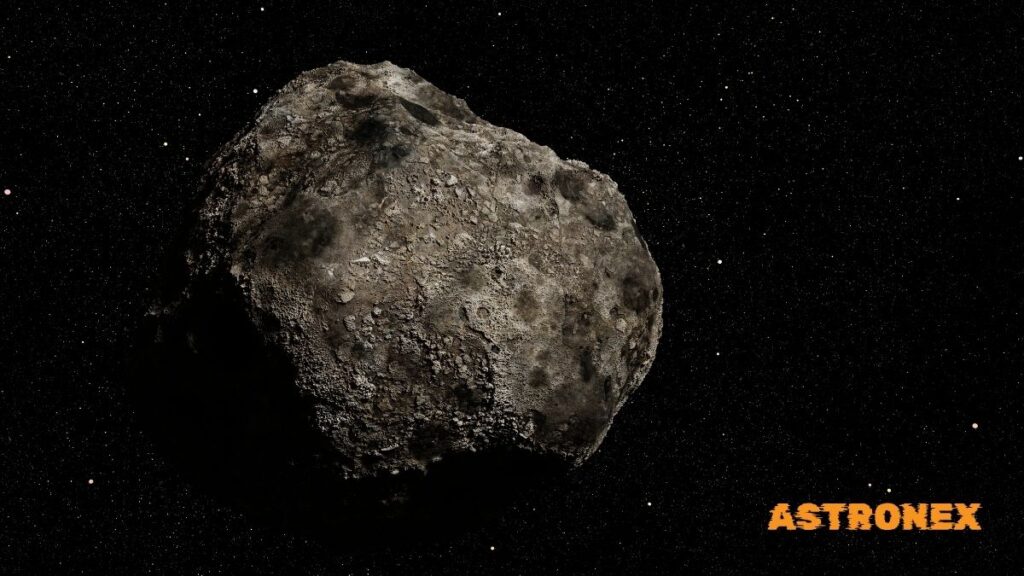
Composition is likely rocky, similar to other Apollo asteroids, potentially containing silicates and metals from the early solar system. Without direct samples, we infer this from its orbital class, which often includes S-type asteroids (siliceous, stony). Fun fact: if albedo varies, size could range from 15 to 25 meters, as darker surfaces make objects appear smaller for the same brightness. For visualization, think of it as a potato-shaped rock tumbling in space.
Bullet points for size estimation:
- Absolute magnitude (H): 26.4 (fainter than many asteroids)
- Assumed albedo: 0.15 (standard for rocky bodies)
- Diameter range: 18-20 m (with uncertainty due to unknown albedo)
- Mass estimate: Approximately 10,000 tons (based on density of 2 g/cm³)
If more data becomes available from future observations, it could refine these figures. Suggest a diagram comparing sizes of known quasi-moons to highlight 2025 PN7’s diminutiveness.
How Long Has 2025 PN7 Been Earth’s Companion and How Long Will It Stay?
2025 PN7 has been Earth’s quasi-satellite companion for approximately 60 years, with orbital simulations showing it entered this resonant state around 1965. It is expected to remain in this configuration for another 60 years or so, until around 2085, totaling about 120 years. This duration is shorter than some other quasi-satellites due to its smaller size and less stable orbit (de la Fuente Marcos & de la Fuente Marcos, 2025). Simulations using JPL’s Horizons system confirm this timeline, accounting for gravitational tugs from other planets.
For example, larger quasi-satellites like Kamo’oalewa have longer residency times, up to 381 years, because they are less affected by perturbations. Fun fact: over millennia, 2025 PN7 may return to a quasi-satellite state after periods in horseshoe or other resonances. The uncertainty in long-term predictions is about ±10 years due to chaos in multi-body systems.
To visualize, a chart of the asteroid’s relative longitude over time would show the libration amplitude increasing until escape. In short, 2025 PN7’s temporary stay offers a limited window for study.
Are There Other Quasi-Moons Like 2025 PN7?
Yes, there are other quasi-moons like 2025 PN7, with six confirmed before this discovery, bringing the total to seven. Examples include 469219 Kamo’oalewa (2016 HO3), which is larger at 40-100 meters and has been stable for centuries, and 2023 FW13, another recent find. These objects all share Arjuna-class orbits with low eccentricity and inclination (Minor Planet Center, 2025). Kamo’oalewa, for instance, has a semi-major axis of 1.001 AU, very similar to 2025 PN7.
Comparisons show 2025 PN7 is the smallest and least stable, with shorter residency. Fun fact: some quasi-moons, like 2013 LX28, have more inclined orbits at 9 degrees, making their loops taller. Bullet points for others:
- Kamo’oalewa: Size 50 m, stable for 300+ years
- Cardea (2004 GU9): 200 m, quasi-satellite for 2,500 years
- 2014 OL339: 150 m, switches resonances frequently
Suggest a table comparing semi-major axes and durations to see patterns. These companions help scientists model asteroid populations near Earth.
What Can We Learn From Studying 2025 PN7?
Studying 2025 PN7 can teach us about orbital resonances and the evolution of near-Earth asteroids, providing data on how small bodies migrate in the solar system. Its accessibility, with low delta-v for spacecraft (change in velocity needed for rendezvous), makes it a potential target for missions to collect samples or test deflection techniques. Research indicates it could reveal clues about the Arjuna belt’s origin, possibly from ancient collisions (NASA, 2025). For example, spectral analysis could determine if it’s primitive or differentiated material.
Additionally, it aids planetary defense by helping model close-approach predictions. Fun fact: quasi-satellites like this are natural labs for understanding chaos in orbits without lab setups. If complex, refer to simulation figures showing future paths. Overall, 2025 PN7 enhances our knowledge of Earth’s dynamic environment.
Is 2025 PN7 a Threat to Earth?
No, 2025 PN7 is not a threat to Earth, as its orbit keeps it at a safe distance with the closest approaches around 0.0024 AU, or over 350,000 km. Orbital projections show no impact risk for at least the next century, with MOID values stable (de la Fuente Marcos & de la Fuente Marcos, 2025). Its small size also means even a hypothetical impact would be minor, equivalent to a large meteor.
For comparison, larger asteroids like Apophis have closer MOIDs but are monitored closely. Fun fact: NASA’s NEO program tracks such objects to ensure safety. If needed, a risk assessment chart could show probability as zero. In conclusion, 2025 PN7 is a harmless companion.
Conclusion
In summary, the discovery of 2025 PN7 as Earth’s newest quasi-satellite highlights the ever-changing nature of our solar system’s near-Earth space. This small asteroid, with its synchronized orbit and temporary companionship, adds to our understanding of resonant dynamics and asteroid populations. Backed by precise observations and simulations, it serves as a reminder of the hidden objects sharing our path around the Sun. As research continues, 2025 PN7 could unlock more secrets about our cosmic neighborhood.
What other surprises might future surveys reveal about Earth’s temporary companions?
📌 Frequently Asked Questions
Is 2025 PN7 Earth’s second moon?
No, 2025 PN7 is not a second moon but a quasi-satellite asteroid that appears to orbit Earth due to resonance with our planet’s path around the Sun. It is bound to the Sun, not Earth’s gravity, and will eventually drift away after about 120 years total companionship.
How big is the asteroid 2025 PN7?
The asteroid 2025 PN7 is approximately 19 meters in diameter, making it the smallest known quasi-satellite. This size is estimated from its absolute magnitude and assumed albedo, comparable to a large truck, and too small to be visible without telescopes.
When was 2025 PN7 discovered?
2025 PN7 was discovered on August 2, 2025, by the Pan-STARRS 1 telescope in Hawaii. Pre-discovery images date back to 2014, and its quasi-satellite status was confirmed through orbital analysis published in September 2025.
Will 2025 PN7 hit Earth?
2025 PN7 will not hit Earth, as its minimum distance is over 350,000 km, and long-term simulations show no collision risk. It is monitored as a near-Earth object, but its stable resonance keeps it safe.
How long will 2025 PN7 stay near Earth?
2025 PN7 has been near Earth for about 60 years and is expected to remain for another 60 years, until around 2085. After that, gravitational perturbations may shift it to a different orbital state.
What is a quasi-moon or mini-moon?
A quasi-moon is an asteroid in a 1:1 orbital resonance with Earth, appearing to loop around us while orbiting the Sun. Mini-moons are temporary true satellites captured by Earth’s gravity for short periods, unlike quasi-moons which are longer-term companions.
Can I see 2025 PN7 with a telescope?
2025 PN7 is too faint, with a magnitude around 21-22, to see with small telescopes. Professional observatories with advanced equipment are needed to observe it, and it’s not visible to the naked eye.
What type of asteroid is 2025 PN7?
2025 PN7 is an Apollo-type near-Earth asteroid in the Arjuna class, known for Earth-like orbits. It is likely rocky, but detailed composition requires further study through spectroscopy.
Are there more quasi-moons around Earth?
Yes, there are six other known quasi-moons besides 2025 PN7, including Kamo’oalewa and 2023 FW13. Future surveys may find more, as they are small and hard to detect.
Why is 2025 PN7 important for science?
2025 PN7 helps scientists study orbital resonances and near-Earth asteroid dynamics. Its accessibility could make it a target for future missions to learn about solar system formation and planetary defense strategies.
Sources
de la Fuente Marcos, C., & de la Fuente Marcos, R. (2025, September 5). Meet Arjuna 2025 PN7, the newest quasi-satellite of Earth. Research Notes of the AAS. https://iopscience.iop.org/article/10.3847/2515-5172/ae028f
Minor Planet Center. (2025, August 29). MPEC 2025-Q232 : 2025 PN7. Minor Planet Center. https://minorplanetcenter.net/mpec/K25/K25QN2.html
NASA. (2025). 2025 PN7. JPL Small-Body Database. https://ssd.jpl.nasa.gov/tools/sbdb_lookup.html#/?sstr=2025+PN7