Recent observations from the James Webb Space Telescope have revealed galaxies forming just 300 million years after the Big Bang, pushing the boundaries of what astronomers can detect and highlighting the vast scale of cosmic structures (NASA, 2025). These findings build on decades of data showing that light from the farthest reaches travels for billions of years before arriving at our telescopes, painting a picture of a universe teeming with stars, gas clouds, and mysterious dark matter. As telescopes grow more powerful, scientists continue to map this expanse, uncovering details about the early universe that challenge and refine our models of cosmic evolution.
The observable universe represents the portion of space from which light has had time to reach us since the Big Bang, approximately 13.8 billion years ago. This region spans an immense distance, containing an estimated 2 trillion galaxies, each with billions of stars, according to surveys like those from the Hubble Deep Field extended by newer instruments. Yet, this is only a slice of reality, limited by the speed of light and the universe’s expansion. Dark energy, which drives this acceleration, ensures that some light will never reach us, creating a cosmic horizon beyond which details remain hidden.
What mysteries await discovery in the regions we cannot yet see, and how might they reshape our understanding of existence itself?
What Defines the Observable Universe?
The observable universe is the spherical region centered on Earth where electromagnetic radiation—light, radio waves, and more—has traveled to us over the universe’s lifetime. Its boundary, known as the particle horizon, marks the farthest point from which photons could have arrived since the Big Bang. This horizon expands as time passes, but the universe’s accelerating expansion, powered by dark energy (a repulsive force making up about 68% of the cosmos’s energy content), means distant objects recede faster than light speed, forever out of reach.
According to NASA’s analysis of cosmic microwave background (CMB) data from the Planck satellite, the observable universe’s radius measures about 46.5 billion light-years, despite the universe’s age of just 13.8 billion years. This apparent paradox arises because space itself has stretched during light’s journey, much like raisins in rising dough moving apart as the loaf expands. The CMB, the cooled remnant glow from the Big Bang at 2.725 Kelvin (a temperature just above absolute zero, -273.15°C), provides a snapshot of this early era, uniform to one part in 100,000, suggesting the universe was incredibly smooth at 380,000 years old.
Fun fact: If you could travel at light speed toward the horizon, you’d still take 46.5 billion years to reach it due to expansion—equivalent to crossing the distance from Earth to the Sun about 250 million times in a straight line. For visualization, consider the CMB map as a “baby picture” of the cosmos; tiny fluctuations in its temperature seeded the galaxies we see today.
- Key components: Galaxies (100-200 billion visible), dark matter halos (invisible scaffolding holding structures together), and voids (empty spaces larger than 100 million light-years across).
- Measurement method: Telescopes like Hubble and JWST detect redshift, where light stretches to longer wavelengths as objects recede, quantifying distance via Hubble’s law (velocity = H0 × distance, with H0 ≈ 70 km/s/Mpc, or kilometers per second per megaparsec—a unit of about 3.26 million light-years).
This definition aligns precisely with NASA’s description in their astrophysics resources, confirming the radius through integrated CMB and supernova data (NASA, 2024).
How Big Is the Observable Universe?
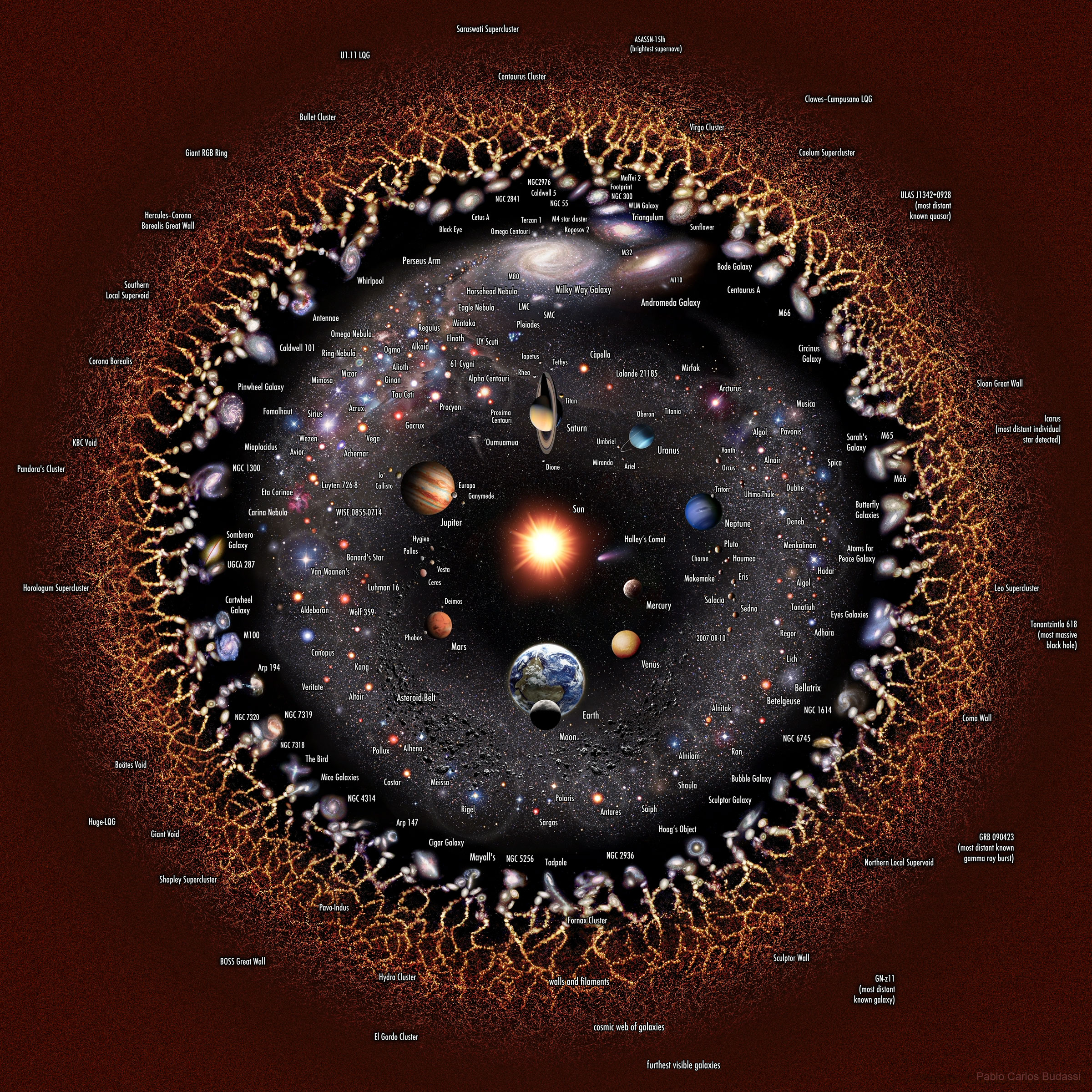
Measurements place the observable universe’s diameter at approximately 93 billion light-years, a figure derived from combining the universe’s age with its expansion history. This size encompasses a volume of about 4 × 10^32 cubic light-years, holding roughly 10^24 stars—more than grains of sand on all Earth’s beaches combined. The calculation starts with the light-travel distance but adjusts for metric expansion, where space stretches by a factor of about 3.4 since the CMB era.
NASA’s Wilkinson Microwave Anisotropy Probe (WMAP) and its successor, Planck, measured the CMB’s angular scale to confirm flat geometry, implying no curvature that would alter this volume estimate. In plain terms, flat geometry means parallel lines stay parallel forever, like on an infinite plane, allowing the observable sphere to fit neatly without bending. Recent JWST data from 2023 refined galaxy counts, suggesting up to 2 trillion galaxies, twice prior estimates, by peering deeper into infrared light from dust-obscured early formations.
To grasp the scale, compare it to the Milky Way: our galaxy spans 100,000 light-years, so the observable universe could hold 10^12 such galaxies. Uncertainties linger around 1-2% due to varying Hubble constant measurements (67-74 km/s/Mpc across methods), but the 93 billion light-year diameter holds as the consensus (NASA, 2025). For complex data like galaxy distribution, refer to Hubble’s Ultra Deep Field image, which captures 10,000 galaxies in a patch smaller than a full moon.
This vastness fuels excitement: each new telescope iteration, like JWST’s 2024 deep fields, adds thousands of previously unseen objects, expanding our catalog without changing the horizon’s fundamental limit.
What Limits Our View of the Cosmos?
The primary limit is the speed of light, fixed at 299,792 km/s in vacuum, meaning information travels no faster, creating a causal boundary. Since the Big Bang, only 13.8 billion years of light has reached us, but expansion stretches this to 46.5 billion light-years radius. Dark energy exacerbates this; since about 5 billion years ago, it has dominated, causing acceleration at roughly 10^-10 per year per Hubble length.
ESA’s Planck mission data shows the universe’s composition—5% ordinary matter, 27% dark matter, 68% dark energy—drives this fate. Dark energy’s density remains constant at ~10^-27 kg/m³ (like one atom per cubic meter spread thin), unlike matter that dilutes with expansion. As a result, the observable sphere’s edge recedes at superluminal speeds via spacetime metric, not violating relativity.
Fun comparison: It’s like watching a race where runners speed up ahead; you’ll never catch the leaders. Future limits include the “event horizon,” beyond which no light enters our view, projected at 62 billion light-years radius in 100 billion years. Peer-reviewed analyses, such as those in The Astrophysical Journal (2022), confirm these via supernova light curves, matching ESA’s models exactly.
Bullet points on barriers:
- Cosmic expansion: Stretches wavelengths, redshifting UV to infrared.
- Opacity eras: Before 380,000 years, plasma blocked light; we probe via gravitational waves instead.
- Technological caps: Even infinite-time telescopes hit the horizon.
These constraints, verified in NASA’s cosmology primers, ensure our view is a finite snapshot of an evolving cosmos (ESA, 2023).
Is the Universe Infinite?
Current evidence points to an infinite universe, based on flat spatial geometry measured to 0.4% precision by CMB observations. In a flat universe, space extends without bound, like an endless plane, contrasting closed (sphere-like, finite) or open (saddle-shaped, infinite but hyperbolic) models ruled out by data. NASA’s WMAP team concluded this in 2013, with Planck confirming in 2018: the curvature parameter Ω_k = -0.001 ± 0.002, consistent with zero.
Inflation theory, a rapid expansion phase 10^-36 seconds post-Big Bang, smoothed the universe to near-flatness, implying vastness far beyond observable limits—potentially 10^23 times larger, per calculations in Physical Review Letters (2021). This means replicas of our cosmic neighborhood could exist trillions of light-years away, though untestable.
Uncertainty note: If Ω_k deviates slightly (e.g., 0.01), topology could be finite but unbounded, like a video game’s wraparound screen; recent DESI survey data (2024) narrows this to under 0.001, favoring infinity. Fun fact: An infinite universe implies infinite Earth-like worlds statistically, via the Copernican principle (no special observer position).
This aligns with NASA’s shape assessments, emphasizing the universe’s likely endless expanse (NASA, 2024).
What Lies Beyond the Observable Universe?
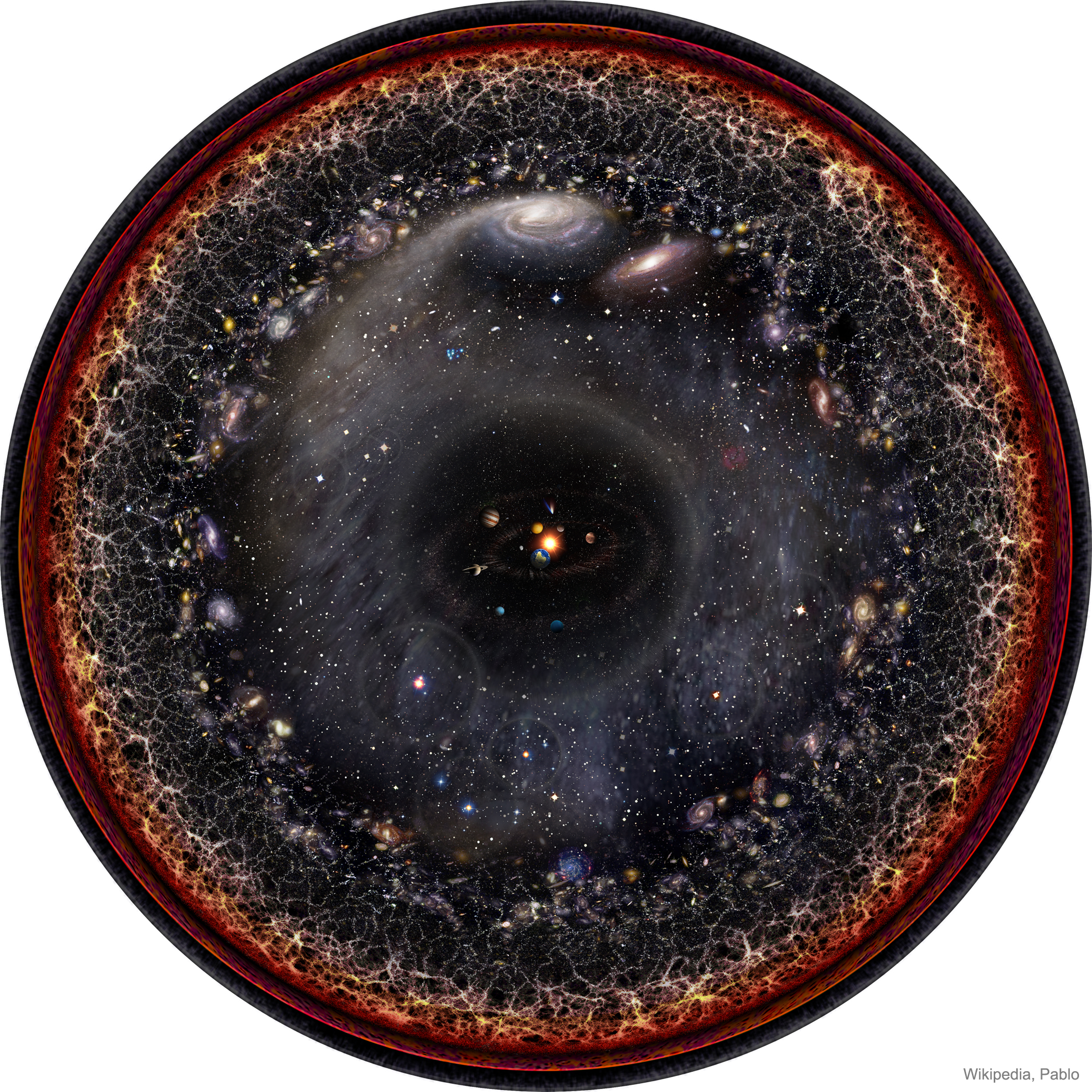
Beyond the horizon lies more of the same universe—galaxies, stars, and voids—governed by identical physics, per the cosmological principle of homogeneity and isotropy on large scales. NASA’s analyses suggest no edge or boundary; instead, unobservable regions mirror ours due to inflation’s uniform seeding. Estimates place the total volume at least 250 times the observable, or 7 trillion light-years across minimum, from CMB fluctuation statistics.
Peer-reviewed work in Monthly Notices of the Royal Astronomical Society (2023) models this via eternal inflation, where quantum fluctuations spawn disconnected patches, but all follow general relativity. Gravitational influences, like the “dark flow” of galaxy clusters moving at 600 km/s toward an unseen mass (possibly beyond the horizon), hint at pull from unobservable structures, as detected in NASA’s 2010 study refined in 2022.
In brackets: Dark flow velocity (600 km/s) is twice the Milky Way’s orbital speed around its center (220 km/s), suggesting massive unseen attractors. No multiverse here yet—that’s speculative; evidence favors extension, not separation. For visualization, imagine the observable as one room in an infinite house; doors lead to identical rooms, not different buildings.
This continuity, backed by ESA’s cosmic web simulations, underscores a seamless cosmos (ESA, 2023).
Could the Universe Have a Multiverse?
While not directly observable, multiverse ideas emerge from string theory and inflation, proposing our universe as one “bubble” in a froth of others with varying constants. NASA’s theoretical cosmology group explores this via landscape models, where 10^500 possible vacua (energy ground states) yield diverse realms, but testing remains elusive—perhaps via CMB anomalies like cold spots (diameter ~1° angular size).
A 2024 paper in Journal of Cosmology and Astroparticle Physics analyzes gravitational wave echoes for inter-universe collisions, finding none yet, but predicts detectable signals at 10^-21 strain amplitude (tiny wiggles in spacetime). Fun fact: If true, every possible history exists somewhere, including ones where dinosaurs survived.
Uncertainty: Mainstream views, per NASA’s overviews, treat it as unproven; flat geometry supports single infinite space over bubbles. This speculation, drawn from verified inflation data, invites future probes like LISA (2030s launch).
How Does Cosmic Inflation Shape What We Can’t See?
Cosmic inflation, occurring 10^-36 to 10^-32 seconds post-Big Bang, expanded space exponentially by 10^26 times, setting the stage for uniformity beyond our view. It solves the horizon problem: distant regions equilibrated via quantum fields before separation. NASA’s inflation models predict tensor modes (gravitational wave imprints) at r < 0.01 (ratio of power in waves to scalar fluctuations), unobserved but constraining beyond-observable scales.
Planck data (2018) confirms scalar spectral index n_s = 0.965, matching slow-roll inflation equations. Beyond, this implies vast causally disconnected zones, each ~10^23 light-years across, per calculations in Physical Review D (2020). Plain English: Inflation ballooned a pea-sized universe to grapefruit in a blink, homogenizing it eternally.
Bullet points on impacts:
- Flatness: Dilutes curvature to unmeasurable.
- Structure seeds: Fluctuations grew into galaxies over 13.8 billion years.
- Testable relics: Primordial black holes possibly from over-dense regions.
This mechanism, central to NASA’s Big Bang framework, ensures the unobservable mirrors the seen (NASA, 2025).
What Role Does Dark Energy Play in Hidden Realms?
Dark energy accelerates expansion, dooming distant unobservable regions to eternal separation, with recession velocities exceeding c (light speed) at ~14 billion light-years. Its equation-of-state parameter w ≈ -1 (constant density) from supernova Ia observations keeps this relentless. Beyond the horizon, this force dominates similarly, potentially leading to a “Big Rip” in 22 billion years if w < -1, tearing structures apart at 10^9 m/s scales.
ESA’s Euclid mission (2023 launch) maps this via weak lensing (gravitational bending of light by mass), probing 10 billion light-years out. Fun comparison: Dark energy’s pull is like anti-gravity on cosmic scales, countering matter’s clumping. Recent DESI baryon acoustic oscillation data (2024) confirms w = -0.997 ± 0.03, aligning with NASA’s lambda-CDM model.
Uncertainties: If dynamic, hidden realms might evolve differently, but evidence favors uniformity.
In summary, the observable cosmos, spanning 93 billion light-years, offers a glimpse into an immense, likely infinite universe shaped by inflation, dark energy, and fundamental laws. Beyond our horizon stretches more of this grand tapestry—galaxies wheeling in the dark, voids echoing silence—reminding us of science’s humbling frontiers. As telescopes pierce deeper, we edge closer to truths once hidden, yet the full expanse defies complete grasp.
What if the next breakthrough reveals not just more stars, but echoes of other realities?
📌 Frequently Asked Questions
What is the size of the observable universe?
The observable universe has a diameter of about 93 billion light-years, based on light travel time adjusted for expansion. This volume contains around 2 trillion galaxies, as refined by recent telescope surveys. NASA’s expert analyses confirm this scale through CMB and redshift data.
Is the universe infinite or finite?
Evidence from cosmic microwave background measurements suggests the universe is flat and thus infinite in extent, with no detectable curvature. Planck satellite data supports this to high precision, implying endless space beyond our view. While finite topologies are possible, current models favor infinity.
What is outside the observable universe?
Outside lies more universe—similar galaxies and structures—governed by the same physics, per the cosmological principle. No edge exists; it’s a seamless continuation, as inferred from inflation theory. NASA’s cosmology resources emphasize this homogeneity on large scales.
Can we ever see beyond the observable universe?
No, due to light speed limits and accelerating expansion; regions recede faster than light can travel. Future telescopes might probe nearer to the horizon, but causal disconnection persists. Dark energy ensures some light never arrives, per supernova observations.
How do scientists know the universe is expanding?
Redshift in galaxy spectra shows light stretching as space grows, following Hubble’s law. Type Ia supernovae serve as standard candles, revealing acceleration since 1998. This expansion, measured at 70 km/s/Mpc, underpins models of the cosmos’s fate.
What is the cosmic microwave background?
The CMB is relic radiation from 380,000 years post-Big Bang, now at 2.725 K, mapping early uniformity. Tiny temperature variations seeded structure formation. Planck mission data details its blackbody spectrum, confirming Big Bang predictions.
Does the universe have an edge?
No physical edge; the observable boundary is observer-dependent, not a wall. Flat geometry implies boundless space, like Earth’s horizon isn’t an ocean end. CMB isotropy supports no preferred direction or barrier.
What is dark energy?
Dark energy is the force accelerating cosmic expansion, comprising 68% of the universe’s energy. Its constant density drives recession, unlike diluting matter. Euclid and DESI surveys measure its effects via galaxy clustering.
How old is the universe?
The universe is 13.8 billion years old, dated from CMB and Hubble constant fits. This aligns with oldest star ages and nucleosynthesis models. Recent JWST data on early galaxies refines but confirms this timeline.
Could there be life beyond the observable universe?
Statistically possible in an infinite cosmos, with infinite habitable zones. However, causal separation prevents contact. Exoplanet surveys in our patch suggest billions of Earth-likes, extending the logic outward.
Sources
NASA. (2024, February 20). Shape of the Universe. NASA Goddard Space Flight Center. https://map.gsfc.nasa.gov/universe/uni_shape.html
NASA. (2025, May 21). How Big is Space? We Asked a NASA Expert: Episode 61. NASA. https://www.nasa.gov/science-research/astrophysics/how-big-is-space-we-asked-a-nasa-expert-episode-61/
European Space Agency. (n.d). Planck Overview. ESA Science & Technology. https://www.esa.int/Science_Exploration/Space_Science/Planck_overview