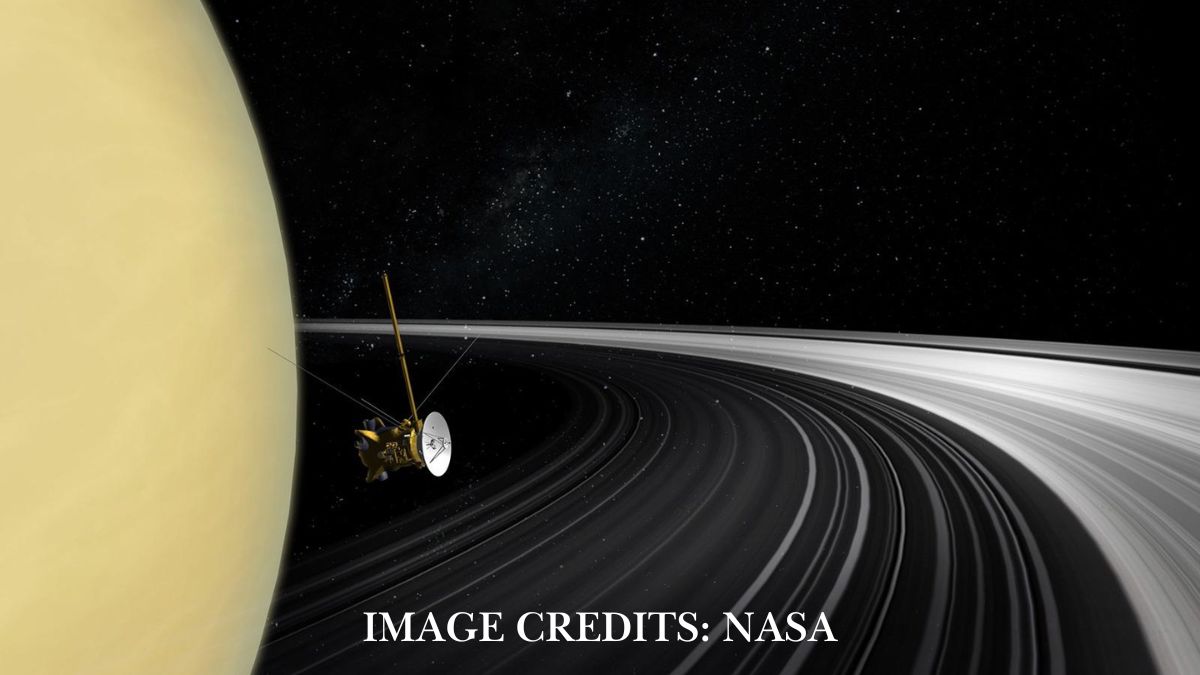
NASA’s Cassini spacecraft entered a new and daring chapter in April 2017 when it began a series of close passes through the narrow gap that lies between Saturn and the inner edge of its ring system. This final mission phase, called the Grand Finale, sent the probe through a region roughly 2000 kilometers wide where no spacecraft had traveled before. Instruments on board recorded electromagnetic signals from plasma waves in that space, and when those signals were shifted into audible frequencies the resulting audio contained clear whistling tones mixed with minimal crackling. The patterns stood out as unexpected and led researchers to examine the physical conditions in the gap more closely.
The Radio and Plasma Wave Science instrument captured these emissions during the first dive on April 26 2017. Conversion of the data into sound revealed whistling and squeaking features that came through with unusual clarity. At the same time the expected loud pops from dust particle strikes remained very low in number. This contrast between predicted and observed results created genuine puzzlement among the science team about the true nature of the environment so near the planet.
The findings raised a direct question that continues to draw attention. What processes shape plasma wave activity and particle conditions in the narrow space between Saturn and its rings?
What makes the gap between Saturn and its rings a special place for plasma studies?
The gap measures approximately 2000 kilometers across and sits between Saturn’s upper atmosphere and the innermost edge of the D ring. Cassini flew through this corridor 22 times during the Grand Finale, each pass lasting only minutes at closest approach yet providing data from a zone previously out of reach. The width gave the spacecraft enough clearance to operate safely while its instruments sampled the local plasma and magnetic environment at distances never achieved before.
Plasma fills most of the space around Saturn and consists of charged particles that respond collectively to electric and magnetic forces. Waves traveling through this plasma carry energy and information about distant disturbances such as changes in the solar wind or movements of charged material from the rings. In the gap these waves interact with Saturn’s strong magnetic field and with any sparse particles that may drift inward from the rings. The combination creates conditions different from those found farther out in the magnetosphere or inside the denser ring regions.
Scientists compare the gap environment to a quiet corridor between a busy highway and a calm shoreline. On one side lies the dense ring system that can supply or absorb material. On the other side lies Saturn’s atmosphere and its powerful magnetic bubble. The gap therefore acts as a transition zone where plasma waves can reveal how energy and particles move between these two very different regions. Data from the passes showed that this transition zone behaves in ways that models had not fully predicted.
How does the Radio and Plasma Wave Science instrument turn plasma signals into sound?
The Radio and Plasma Wave Science instrument uses long antennas to detect electric field variations caused by plasma waves and by tiny particle impacts. When a dust grain strikes the spacecraft or the antennas it vaporizes into a small cloud of charged particles that produces a brief voltage spike. These spikes and the continuous wave oscillations are recorded as digital data. Because the original frequencies lie in the radio range well above human hearing, researchers shift the entire data set downward in frequency by a large factor. The shifted signals then fall into the audible range and can be played through ordinary speakers or headphones.
This conversion process does not create sound that travels through space. Space itself contains no air to carry ordinary sound waves. Instead the method simply translates electromagnetic and plasma oscillations into a form people can hear, much as a radio receiver translates broadcast signals into music. The resulting audio preserves the timing, strength, and frequency structure of the original measurements so scientists can listen for patterns that might be hard to spot on a graph alone.
During ordinary ring plane crossings the audio contains many sharp pops and cracks from frequent dust impacts. In the gap crossing the same conversion produced far fewer pops yet allowed whistling tones from plasma waves to stand out clearly. The difference highlighted how the instrument could separate particle impact signatures from wave signatures and gave researchers a new way to study the gap environment.
What specific observations during the April 2017 gap crossing surprised the research team?
On April 26 2017 Cassini made its first dive through the gap. The Radio and Plasma Wave Science team had expected to record hundreds of particle impacts per second as the spacecraft crossed the ring plane. Instead the instrument registered only a few pings. When the data were converted to audio the usual loud crackling remained almost absent and the whistling tones of plasma waves became prominent. William Kurth, the instrument team lead, noted that the result felt disorienting because the team was not hearing what models had led them to expect.
The low number of impacts indicated that the gap contained far less dust than anticipated. Particles present appeared no larger than about one micron across, roughly the size of smoke particles. Ring scientists had predicted a higher dust level based on the idea that material constantly drifts inward from the main rings. The actual measurements showed the opposite, prompting the description of the region as surprisingly empty. This emptiness reduced the risk to the spacecraft and allowed later passes to proceed with the main antenna in its normal orientation rather than as a shield.
The clear detection of plasma wave whistles in the same data set added another layer of interest. These tones appeared consistently across multiple Grand Finale orbits and their exact generation mechanism required further analysis. The combination of an unexpectedly quiet dust environment and prominent wave signals created a scientific puzzle that the team addressed by comparing the gap data with measurements taken outside the gap and near the D ring on later passes.
What do plasma waves tell us about conditions close to Saturn?
Plasma waves arise when groups of charged particles in the ionized gas oscillate together under the influence of electric and magnetic fields. These oscillations can grow or dampen depending on the local density, temperature, and magnetic field strength. Near Saturn the planet’s rapid rotation and strong magnetic field organize the plasma into large scale structures. Waves detected in the gap likely form through instabilities where ring derived material interacts with the magnetosphere or where charged particles from Saturn’s upper atmosphere move outward.
The whistling tones recorded during the gap passes belong to a class of plasma waves that propagate along magnetic field lines. Their frequencies and waveforms carry information about the density and motion of electrons in the region. Because the gap lies so close to Saturn these waves can also reflect conditions in the planet’s ionosphere and the inner edge of the ring system. Continued study of the archived waveforms helps refine models of how Saturn’s magnetosphere exchanges energy with its rings and atmosphere.
Comparisons with similar wave activity at Earth show both similarities and differences. Earth’s auroral regions produce radio emissions that can be converted to sound in the same manner, yet Saturn’s version occurs in a much stronger magnetic field and involves material from the rings. The gap observations therefore add a unique data point for understanding how plasma wave generation scales with planetary size and ring presence across the solar system.
Why does the emptiness of the gap and the presence of these waves matter for future understanding?
The discovery that the gap is largely free of larger dust particles changed operational plans for the remaining Grand Finale dives and provided new constraints on ring evolution models. If material from the rings does not readily cross the gap in large quantities then scientists must identify the mechanisms that clear or trap dust in that narrow zone. Possible processes include electromagnetic forces that sweep small grains away or gravitational influences that keep the region relatively clean.
At the same time the persistent plasma wave signals indicate that the gap is not empty of activity. The waves represent ongoing exchanges of energy between Saturn’s magnetic field, charged particles, and any sparse neutral material. These exchanges may play a role in the slow transfer of mass from the rings toward the planet, a process sometimes called ring rain. Long term analysis of the wave data helps quantify how much material participates in such transfers and how the process varies over time.
Even years after Cassini ended its mission in September 2017 the measurements from the gap passes remain valuable. Researchers continue to develop improved computer models that incorporate the observed wave properties and dust levels. These models support planning for any future missions that might return to Saturn or study other ringed planets. The original surprise at the quiet yet wave rich environment has therefore evolved into a richer picture of dynamic balance in the gap region.
The plasma wave emissions recorded between Saturn and its rings during the Grand Finale stand as a clear example of how close up exploration can reveal unexpected details about familiar worlds. The converted audio, with its prominent whistles and limited crackling, captured the attention of scientists and the public alike because it differed so markedly from earlier expectations. The emptiness of the gap and the clarity of the wave signals together illustrate how much remains to be learned about the delicate interactions that shape planetary ring systems.
What other subtle signals might future spacecraft detect in the plasma environments around Saturn or other giant planets, and how might those signals reshape our picture of how rings and magnetospheres evolve together over billions of years?
Sources
NASA. (2017, April 30). Cassini Finds ‘The Big Empty’ Close to Saturn. NASA Science. https://science.nasa.gov/missions/cassini/cassini-finds-the-big-empty-close-to-saturn/
NASA Jet Propulsion Laboratory. (2017, May 1). The Sound of Science: Comparison of Cassini Ring Crossings. https://www.jpl.nasa.gov/images/pia21446-the-sound-of-science-comparison-of-cassini-ring-crossings/
NASA. (2017). Cassini Grand Finale Overview. NASA Science. https://science.nasa.gov/mission/cassini/grand-finale/overview/