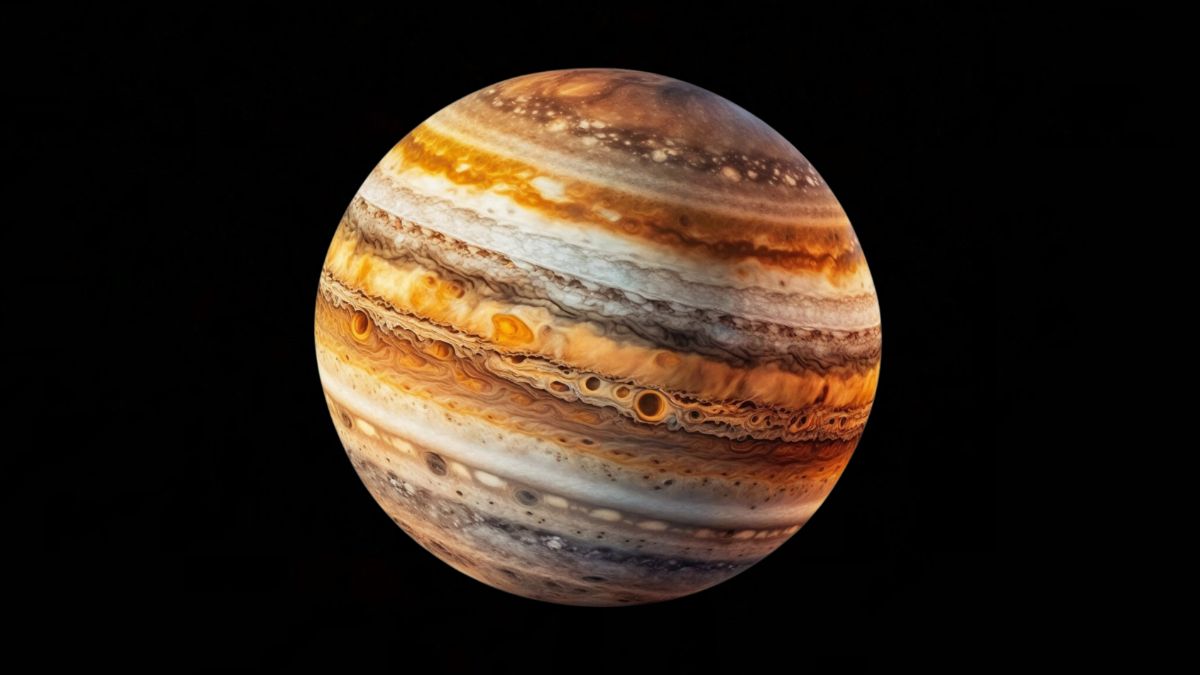
Jupiter, the largest planet in our solar system, has always captivated astronomers with its swirling clouds and massive storms. One of its most famous features, the Great Red Spot, is a gigantic anticyclone—a high-pressure storm system spinning counterclockwise—that has raged for centuries. Recent observations from space telescopes show this storm is not static; it’s evolving in surprising ways. As of July 2025, data from NASA’s Hubble Space Telescope indicates the Great Red Spot measures about 16,500 kilometers (10,250 miles) across, making it smaller than Earth’s diameter of 12,742 kilometers (7,918 miles). This shrinking has accelerated over the past decade, with the storm losing roughly 930 kilometers (580 miles) in width each year, according to ongoing monitoring programs.
Scientists are thrilled by these changes because they offer a window into the dynamic atmosphere of gas giant planets. The Great Red Spot’s winds whip around at speeds up to 432 kilometers per hour (268 miles per hour), faster than any hurricane on Earth. Comparisons to earthly weather help explain: imagine a storm larger than our planet persisting without land to disrupt it, fueled by Jupiter’s internal heat and rapid rotation. Fresh insights from missions like NASA’s Juno, which has been orbiting Jupiter since 2016, reveal the storm extends deep into the atmosphere, about 350 kilometers (217 miles) below the cloud tops. These findings, combined with Hubble’s high-resolution images, paint a picture of a storm in transition, challenging old assumptions about planetary weather.
But what forces are driving this transformation, and could this ancient storm eventually vanish? Let’s explore the science behind why Jupiter’s Great Red Spot is shrinking.
What Is Jupiter’s Great Red Spot?
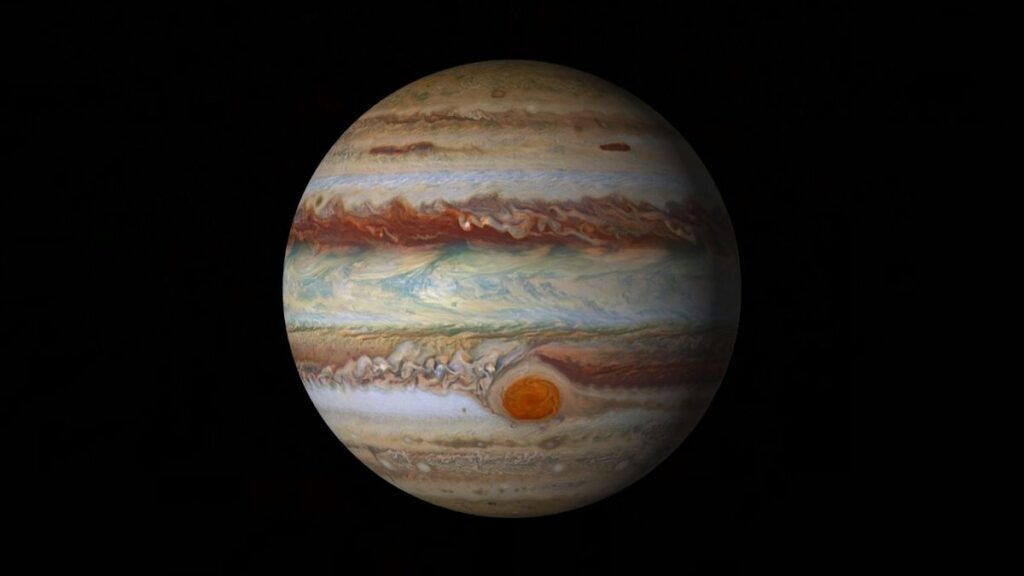
Jupiter’s Great Red Spot is a massive, persistent storm in the planet’s southern hemisphere, located about 22 degrees south of the equator. This anticyclone (a storm rotating opposite to cyclones on Earth, with high pressure at its center) has been observed for at least 190 years, though some evidence suggests it could be older. Unlike storms on Earth that last days or weeks, this one endures because Jupiter lacks a solid surface to create friction, allowing atmospheric eddies (swirling air currents) to spin freely. The spot’s reddish hue comes from chemicals like ammonium hydrosulfide and phosphine rising from deeper layers, reacting with sunlight to form colorful compounds—think of it like rust forming in the sky.
The storm’s structure is complex, with wind speeds reaching 432 kilometers per hour (268 miles per hour), creating a vortex that traps heat and moisture. According to NASA’s Hubble observations on the shrinking Great Red Spot, the spot sits atop Jupiter’s cloud belts, influenced by the planet’s fast rotation—Jupiter spins once every 10 hours, squashing it into an oblate shape (flattened at the poles). This rapid spin generates powerful jet streams, bands of wind flowing east or west, that confine the storm to its latitude. Fun fact: if you could stand inside it (which you couldn’t, due to crushing pressures), the winds would feel like a perpetual Category 5 hurricane, but with no rain—just ammonia ice crystals.
To visualize, picture the Great Red Spot as a colossal whirlpool in a sea of gas, deeper than Mount Everest is tall. Recent data shows its depth penetrates about 350 kilometers (217 miles) into Jupiter’s atmosphere, where pressures are 100 times Earth’s sea level. Bullet points highlight key traits:
- Color and Composition: Red from sulfur and phosphorus compounds; core temperature cooler than surroundings, about -160 degrees Celsius (-256 degrees Fahrenheit) at cloud tops.
- Rotation: Counterclockwise, completing a full turn every 4 to 6 Earth days.
- Stability Factors: Locked between two jet streams moving at 150 meters per second (335 miles per hour), preventing drift.
Experts compare it to Earth’s Antarctic ozone hole for persistence, but it’s more like a self-sustaining engine driven by Jupiter’s internal heat, radiating twice the energy it receives from the Sun. As we delve deeper, understanding its basics sets the stage for why it’s changing.
How Big Is Jupiter’s Great Red Spot Now?
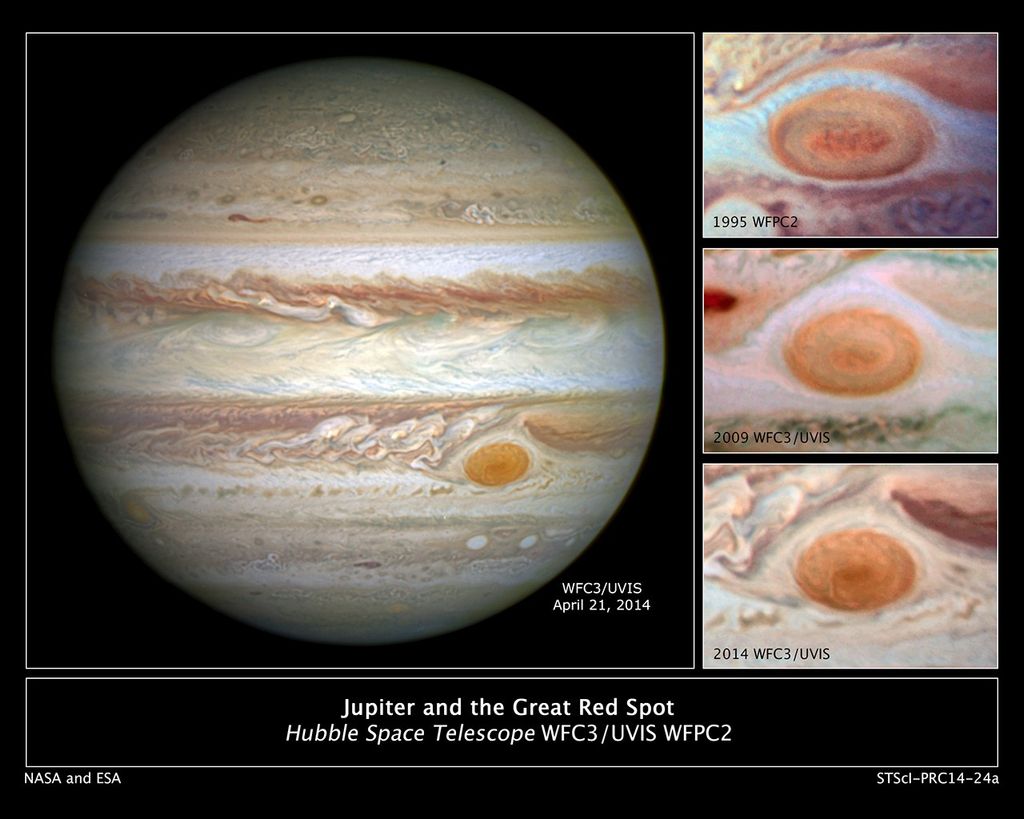
As of July 2025, Jupiter’s Great Red Spot spans approximately 16,500 kilometers (10,250 miles) in width, a significant reduction from its historical sizes. Back in the late 1800s, astronomers measured it at over 41,000 kilometers (25,500 miles) across—large enough to engulf three Earths. By the time NASA’s Voyager spacecraft flew by in 1979, it had slimmed to 23,300 kilometers (14,500 miles), and Hubble’s 2014 images pegged it at 16,500 kilometers (10,250 miles), showing a consistent downsizing trend. This makes it now roughly circular, unlike its former oval shape, with a height of about 12,000 kilometers (7,456 miles).
The shrinkage rate has quickened recently, losing around 930 kilometers (580 miles) per year since 2012, as noted in NASA’s analysis of Great Red Spot size changes. To put this in perspective, imagine a storm the size of the Pacific Ocean gradually contracting to the width of the Atlantic. Measurements come from cloud-tracking techniques, where scientists follow wind patterns using high-resolution images. For complex data like size variations over time, a line graph showing diameter from 1830 to 2025 would help visualize the steady decline, with spikes in shrinkage post-1970s.
Fun fact: despite shrinking horizontally, some studies suggest it’s growing taller, extending deeper into the atmosphere. Juno mission data from 2017-2024 reveals roots reaching 350 kilometers (217 miles) down, where hydrogen behaves like liquid metal under immense pressure (millions of times Earth’s atmosphere). This depth affects its stability, as deeper penetration taps into more energy sources.
- Historical Sizes:
- 1830s: 41,000 km (25,500 mi)
- 1979: 23,300 km (14,500 mi)
- 1995: 21,000 km (13,000 mi)
- 2024: 16,500 km (10,250 mi)
These figures underscore a dynamic feature, not a static one, influenced by Jupiter’s turbulent bands.
Why Is Jupiter’s Great Red Spot Shrinking?
The shrinking of Jupiter’s Great Red Spot stems from a reduction in smaller storms feeding it energy, according to recent simulations. A 2024 study using 3D models showed that the spot grows by merging with nearby vortices (smaller swirling storms), but fewer such events mean less “fuel.” Without these, the spot loses momentum, contracting like a deflating balloon. Winds at its edges erode the structure, with jet streams squeezing it tighter. As explained in Yale University’s research on Jupiter’s shrinking spot, a decline in small atmospheric disturbances since the 1970s correlates with the accelerated shrinkage.
Comparisons help: on Earth, hurricanes gain strength from warm ocean water; similarly, the Great Red Spot draws from Jupiter’s heat and moisture layers. But as fewer eddies form—possibly due to shifts in Jupiter’s global wind patterns—the spot starves. Fun fact: in lab experiments mimicking gas giant atmospheres, adding tiny vortices enlarges mock storms, mirroring the Yale findings.
Technical details include vorticity (a measure of spin, in units of per second), which decreases as the spot shrinks, from high values in the core to near zero at edges. Bullet points on causes:
- Fewer Mergers: Small storms (1,000-5,000 km across) merge less frequently.
- Jet Stream Pressure: Winds at 150 m/s (335 mph) compress the spot.
- Internal Dynamics: Heat loss reduces upwelling (rising gases).
A diagram of storm interactions would illustrate how vortices approach and integrate, explaining the size drop.
What Causes the Great Red Spot to Change Shape?
Recent Hubble data reveals the Great Red Spot oscillates in shape every 90 days, jiggling like gelatin due to interactions with surrounding jet streams. From December 2023 to March 2024 observations, the spot squeezes and bulges, with its longitude varying by 1 degree. This wobble arises from the spot “pushing” against northern and southern winds, causing elongation then contraction. As detailed in ESA’s close-up images of Jupiter’s Great Red Spot changes, brightness and color fluctuate too, with red intensifying during squeezes.
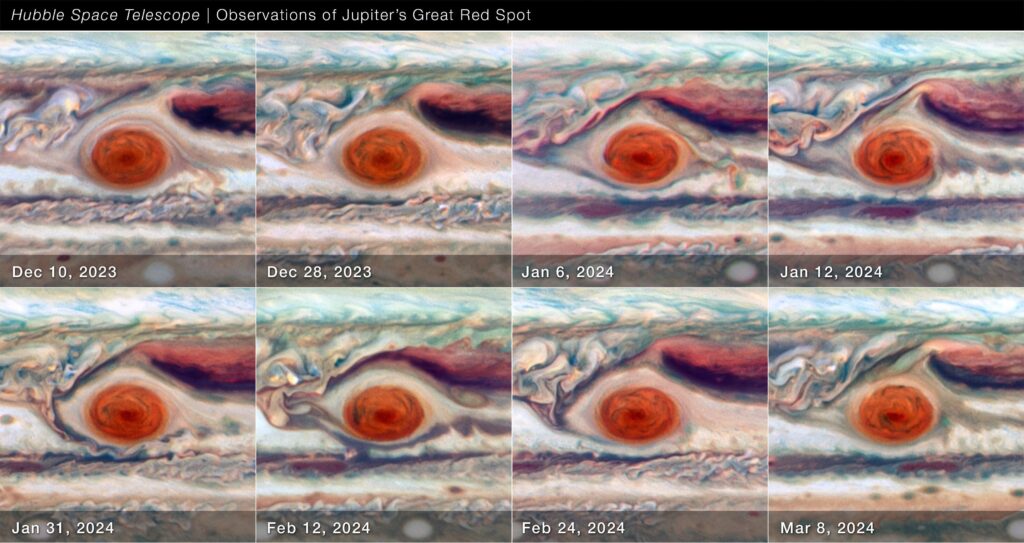
Think of it as a rubber band stretched and released; the jet streams act like confines, forcing periodic distortions. Fun fact: unlike Neptune’s drifting spots, Jupiter’s are latitude-locked, amplifying these oscillations.
- Oscillation Cycle: 90 days, amplitude ~1 degree longitude.
- Shape Metrics: From oval (aspect ratio 1.5:1) to near-circle.
- Brightness Variations: Up to 10% due to cloud thickness changes.
Suggest a time-lapse animation to show the jiggle over 90 days.
Will Jupiter’s Great Red Spot Disappear?
While shrinking, the Great Red Spot is unlikely to vanish soon; predictions suggest it will stabilize at a smaller size. Hubble’s OPAL program, running since 2014, forecasts the spot becoming more circular and steady, perhaps 10,000 kilometers (6,200 miles) across, as jet streams hold it in place. However, if small storm mergers cease entirely, gradual dissipation could occur over decades. Based on NASA’s Hubble study on the Great Red Spot’s behavior, the oscillation indicates ongoing adjustment, not imminent end.
Comparisons to faded spots on Saturn show possible fates, but Jupiter’s heat sustains it longer. Fun fact: a 1665 observation might be a different spot, per 2024 studies.
- Stabilization Factors: Jet streams prevent breakup.
- Timeline: Shrinkage slows post-2030.
- Worst Case: Fades like Oval BA in 2000s.
A chart projecting sizes to 2050 would aid visualization.
What Have Recent Space Missions Revealed About the Great Red Spot?
NASA’s Juno mission, orbiting since 2016, has uncovered the Great Red Spot’s depth and internal structure through gravity and microwave data. Flybys in 2017-2024 show it penetrates 350 kilometers (217 miles), with winds decreasing with depth. Hubble’s 2023-2024 images complement this, revealing surface oscillations. ESA’s JUICE, en route for 2031 arrival, will add ionosphere insights, but current data focuses on Juno and Hubble.
Fun fact: Juno’s images show “flakes” detaching, contributing to shrinkage.
- Juno Findings: Depth 350 km, wind speeds drop to 100 m/s below.
- Hubble Contributions: Oscillation cycle confirmed.
- Future Missions: JUICE to study magnetic interactions.
Conclusion
Jupiter’s Great Red Spot is shrinking due to fewer nourishing storms, shape-shifting from jet stream pressures, and evolving as revealed by missions like Juno and Hubble. This iconic anticyclone, once triple Earth’s size, now measures 16,500 kilometers across, offering lessons on atmospheric dynamics applicable to exoplanets. As it stabilizes, we gain deeper insights into gas giants.
Sources
European Space Agency (2024). Close-up of Jupiter’s Great Red Spot (December 2023 to March 2024). Retrieved from https://www.esa.int/ESA_Multimedia/Images/2024/10/Close-up_of_Jupiter_s_Great_Red_Spot_December_2023_to_March_2024
NASA (2014). Jupiter’s Great Red Spot is Shrinking. Retrieved from https://science.nasa.gov/science-research/planetary-science/15may_grs/
NASA (2018). Jupiter’s Great Red Spot Getting Taller as it Shrinks. Retrieved from https://science.nasa.gov/missions/hubble/jupiters-great-red-spot-getting-taller-as-it-shrinks-nasa-team-finds/
NASA (2024). NASA’s Hubble Watches Jupiter’s Great Red Spot Behave Like a Stress Ball. Retrieved from https://science.nasa.gov/missions/hubble/nasas-hubble-watches-jupiters-great-red-spot-behave-like-a-stress-ball/
Yale University (2024). A New Explanation for Jupiter’s Great, Shrinking ‘Spot’. Retrieved from https://news.yale.edu/2024/07/18/new-explanation-jupiters-great-shrinking-spot
📌 Frequently Asked Questions
How old is Jupiter’s Great Red Spot?
The Great Red Spot has been continuously observed since 1831, making it at least 194 years old as of 2025. A 2024 study suggests the current spot differs from one noted in 1665, implying it’s not over 360 years old but formed anew. According to detailed historical records on Jupiter’s Great Red Spot, its persistence stems from no surface friction.
What color is Jupiter’s Great Red Spot and why?
It’s reddish-orange due to chemicals like sulfur and phosphorus reacting with ultraviolet light. The hue varies, intensifying during oscillations. Fun fact: deeper reds indicate thicker clouds.
How fast are the winds in Jupiter’s Great Red Spot?
Winds reach 432 kilometers per hour (268 miles per hour), faster than Earth’s strongest hurricanes. Per NASA’s findings on Great Red Spot winds, speeds decrease with depth.
Is Jupiter’s Great Red Spot a hurricane?
Yes, it’s an anticyclonic storm similar to hurricanes but without water—fueled by ammonia and heat. It spins counterclockwise in the southern hemisphere.
How deep is Jupiter’s Great Red Spot?
It extends about 350 kilometers (217 miles) into the atmosphere, per Juno data. This depth (deeper than Earth’s oceans) taps planetary heat.
What missions have studied Jupiter’s Great Red Spot?
Voyager (1979), Hubble (ongoing), and Juno (2016-present) have provided key data. JUICE arrives in 2031.
Why is Jupiter’s Great Red Spot red?
From upwelling chemicals like ammonium hydrosulfide forming red compounds under sunlight. Variations occur with atmospheric mixing.
Has Jupiter’s Great Red Spot always been shrinking?
No, but consistent since the 1930s; accelerated post-2012. Historical sketches show fluctuations.
What would happen if the Great Red Spot disappears?
Jupiter’s atmosphere would lose a major feature, but other storms might form. It could signal wind pattern shifts.
Can we see Jupiter’s Great Red Spot from Earth?
Yes, with a telescope during oppositions. Apps track visibility; it’s prominent in amateur photos.
(NASA, 2024) for Hubble size data; (ESA, 2024) for oscillation images; (Yale University, 2024) for shrinking causes; (NASA, 2018) for depth; (NASA, 2014) for historical sizes.