The vast expanse of our solar system is traditionally marked by the eight major planets, and perhaps the disk of icy bodies known as the Kuiper Belt, a region extending just beyond Neptune. However, the true cosmological boundary of the Sun’s domain stretches far, far beyond these familiar locales, deep into a mysterious, frigid realm that defines the outermost frontier. This is the Oort Cloud, a colossal, theorized sphere of icy objects surrounding the entire planetary system like a gargantuan, thick bubble. Its existence, first proposed by Dutch astronomer Jan Oort in 1950, remains one of the greatest unconfirmed hypotheses in planetary science, yet it is supported by decades of careful observation of the long-period comets that appear to originate from this distant reservoir (NASA, 2025).
Scientists believe the Oort Cloud is composed of billions, perhaps even trillions, of icy planetesimals, some of which are larger than mountains. These ancient building blocks of the solar system drift along in a dynamic balance, so loosely bound by the Sun’s gravity that they are equally influenced by the slight, distant gravitational tides exerted by the entire Milky Way Galaxy and the occasional passage of a nearby star. This delicate gravitational tugging and shoving is what occasionally nudges one of these frozen relics out of its orbit and sends it on a long, slow fall toward the Sun, revealing itself to us as a brilliant, long-period comet. This mechanism is key to understanding the persistence of comets in an old solar system, and provides the strongest indirect evidence for the cloud’s presence (Universe Today, 2015).
Pinpointing the Oort Cloud’s characteristics—its size, its total mass, and the full extent of its composition—is paramount to understanding not just the history of our solar system, but also how stellar systems generally form and evolve. Because the objects are so small, dark, and far away, they cannot be observed directly with current imaging technology, leaving its true nature a profound mystery at the limit of our knowledge. This makes the Oort Cloud an ultimate destination for future solar system exploration concepts, but for now, we rely on theoretical models and the fleeting visitors it sends our way. What new discoveries about our solar system’s origin are waiting to be unlocked in this deep-space frontier?
What is the Oort Cloud and how far does it extend into space?
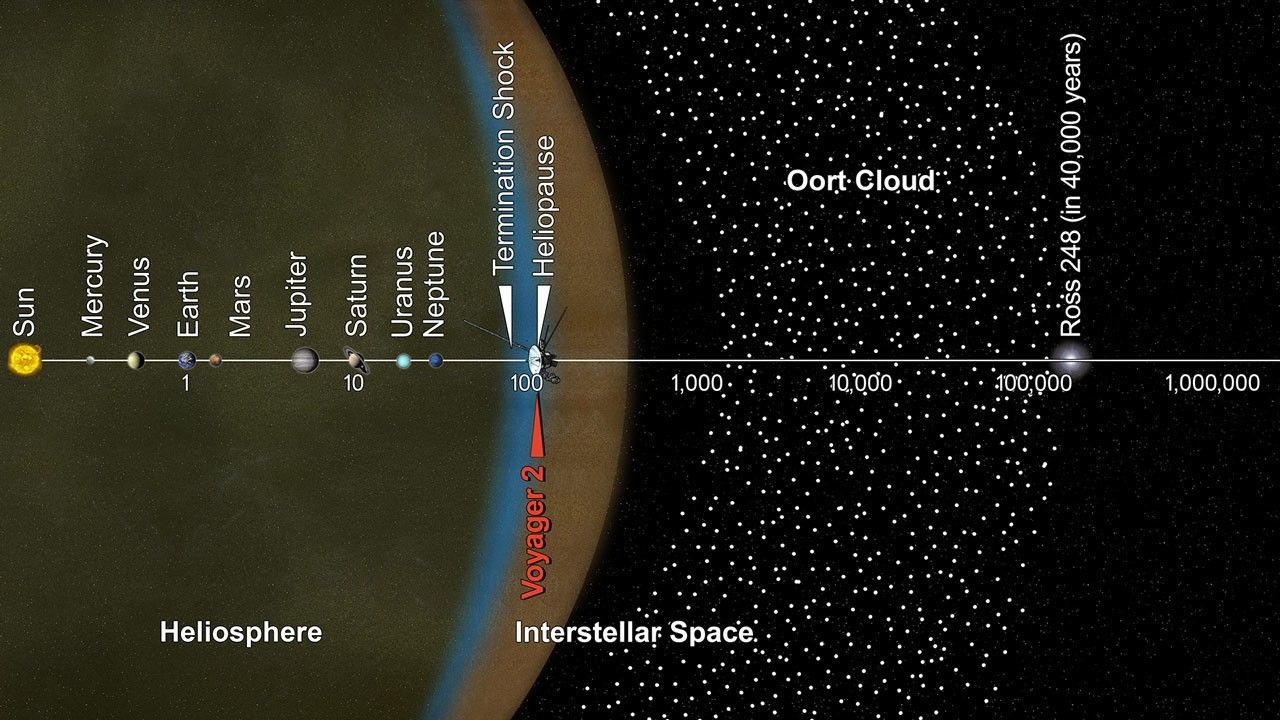
The Oort Cloud is defined as a theoretical, immense shell of icy debris that completely encases our Sun, the planets, the Kuiper Belt, and the heliosphere (the bubble of charged particles created by the solar wind). To comprehend its size, astronomers use the astronomical unit (AU), which is the average distance from the Earth to the Sun, approximately 150 million kilometers (93 million miles). For context, the planet Neptune orbits the Sun at about 30 AU. The Oort Cloud does not begin until well past the Kuiper Belt, with its theorized inner edge starting between 2,000 and 5,000 AU from the Sun (NASA, 2025). This inner part, often called the Hills Cloud, is believed to be a much denser, more disk-like region aligned with the plane of the planets, holding a vast, unquantified number of objects that have not yet been dramatically perturbed into the spherical outer region.
The outer boundary of the Oort Cloud is the point where the Sun’s gravitational influence yields to the general gravitational field of the Milky Way, effectively defining the gravitational edge of the solar system. This outer limit is estimated to be incredibly distant, extending as far as 100,000 AU—or about 1.58 light-years—away from the Sun (NASA Science Infographic, 2018). To put that scale into perspective, 100,000 AU is roughly one-quarter to one-half the distance to Proxima Centauri, the nearest known star to our Sun. This means that a large portion of the Oort Cloud exists in true interstellar space, a region where the sunlight is so faint that it would take approximately one and a half years for light to travel from the Sun to the cloud’s outer edge. The cloud’s objects are thus perpetually bathed in near-total darkness and extreme cold, coasting along in orbits that take millions of years to complete.
What kind of objects are found in the Oort Cloud?
The objects within the Oort Cloud are primarily icy planetesimals (small, solid objects that are the building blocks of planets) composed of frozen volatile compounds. These materials reflect the composition of the earliest, coldest regions of the protoplanetary disk from which the solar system was born 4.6 billion years ago. Spectral analysis of long-period comets, which are thought to be samples knocked loose from the Oort Cloud, indicates they are rich in water ice, but also contain methane (CH4), ethane (C2H6), carbon monoxide (CO), hydrogen cyanide (HCN), and ammonia (NH3) (Universe Today, 2015). This composition makes them time capsules, preserving primordial material that would have long since evaporated closer to the Sun.
In terms of quantity, the Oort Cloud is the most populated region of the solar system, with theoretical models suggesting it contains an immense population, possibly numbering in the trillions of icy bodies larger than 1 kilometer (0.62 miles) in diameter. The total mass of this huge swarm of objects is highly uncertain but is generally estimated to be equivalent to about five times the mass of Earth (Universe Today, 2015). Recent analysis also suggests that a small but significant percentage—perhaps one to two percent—of the objects could be asteroids (rocky bodies), which formed much closer to the Sun before being scattered outward. Furthermore, one of the most exciting theoretical mysteries is the hypothesis that a large fraction, possibly even the majority, of Oort Cloud objects did not form in the Sun’s local environment but are actually interstellar visitors, captured from the Oort clouds of the Sun’s sibling stars as they drifted apart from the initial stellar cluster (EarthSky, 2021). This suggests the Oort Cloud may be a giant galactic exchange point, holding material from multiple stars.
How did the Oort Cloud form in the early Solar System?
The prevailing and most robust scientific theory for the Oort Cloud’s formation is rooted in the early, chaotic gravitational ballet of the giant planets. The objects that populate the Oort Cloud did not coalesce at 50,000 AU; they were born much closer to the Sun in the protoplanetary disk, within the region stretching between approximately 15 AU and 35 AU, an area near the current orbits of the ice giants, Uranus and Neptune (Brasser et al., 2021). As the giant planets—primarily Jupiter and Saturn—reached their enormous final masses, their immense gravity acted like a giant slingshot, dynamically scattering the billions of leftover planetesimals in every direction. Some were ejected entirely out of the solar system, while others were flung into highly eccentric (oval-shaped) orbits that took them to the solar system’s distant borderlands.
Once these objects reached distances beyond approximately 2,000 AU, the primary gravitational force acting on them transitioned from the Sun’s direct influence to the gentle, constant tug of the surrounding Milky Way Galaxy. This galactic tidal force—the difference in the Milky Way’s gravity across the vast extent of the Oort Cloud—effectively ceased the objects’ random scattering and nudged them into the stable, almost-stationary, and highly inclined orbits that form the spherical Oort Cloud structure we hypothesize today (NASA, 2025). Numerical simulations of this complex, multi-stage process have shown that the cloud’s mass likely peaked around 800 million years after the solar system’s initial formation, when the rate of planetary accretion slowed, and the supply of new material began to be overtaken by the rate of object depletion from collision or ejection. This complex chronology explains why the inner Oort Cloud remains denser, as it is a less gravitationally disturbed region.
Can humans or spacecraft reach the Oort Cloud for exploration?
The exploration of the Oort Cloud presents one of the most significant engineering challenges in space science due to the immense distances involved. Currently, the most distant human-made object is NASA’s Voyager 1 spacecraft, which has been traveling since 1977 and officially crossed the boundary into interstellar space in August 2012, a region defined by the cessation of the solar wind’s influence (NASA Science Infographic, 2018). While this historic craft is moving toward the Oort Cloud, its velocity relative to the Sun is insufficient to cover the staggering distance in a practical timeframe. According to current projections, it will take Voyager 1 nearly 300 years to reach the inner edge of the Oort Cloud and approximately 30,000 years to fully pass through it and exit the Sun’s gravitational sphere of influence entirely.
Unfortunately, Voyager 1 will be silent long before it reaches this frontier, as its power source, a radioisotope thermoelectric generator (RTG), is expected to be depleted by the late 2020s. Furthermore, even if it were functional, direct imaging of Oort Cloud objects is considered impossible with current technology because the objects are small, dark, and reflect extremely little sunlight at such vast distances (Astronomy Magazine, 2021). Future exploration concepts would require entirely new propulsion technologies, such as advanced fusion rockets or solar-gravity assist maneuvers combined with enormous final speeds, to reach the inner Oort Cloud in decades, not millennia. Until such revolutionary technology is developed, the exploration of Oort Cloud mysteries must rely on observations of the comets it sends our way and the ongoing refinement of our theoretical models.
Conclusion
The Oort Cloud is far more than just a hypothetical border; it is the ultimate, vast reservoir of primordial material and the gravitational frontier of our solar system. Extending tens of thousands of astronomical units into true interstellar space, this spherical shell of icy planetesimals holds the key to the chaotic and energetic origins of our planetary system, preserving the original ingredients from 4.6 billion years ago. While its direct observation remains beyond our current technological grasp, the long-period comets it ejects offer invaluable, fleeting samples of its deep-space environment and composition, providing a continuous challenge to planetary scientists. The complex formation theories—involving the gravitational scattering by giant planets and the delicate stabilization by galactic tides—highlight the intricate and interwoven nature of forces acting across the Milky Way. As scientists continue to track its cometary visitors and develop future mission concepts, the ultimate question remains: when humanity finally possesses the technology to cross this enormous chasm, what new, fundamental truths about the origin of the planets and the universe will we unlock at the frozen edge of our solar system?
📌 Frequently Asked Questions
How many objects are in the Oort Cloud?
Scientists theorize the Oort Cloud contains trillions of icy bodies, with estimates suggesting the cloud includes hundreds of billions of objects larger than 1 kilometer (0.62 miles) in diameter (NASA, 2025). The sheer size of the cloud, which is more of a sphere than a disk, accounts for this colossal number of constituents.
What is the difference between the Oort Cloud and the Kuiper Belt?
The main difference is distance and shape: the Kuiper Belt is a disk-shaped region that begins just beyond Neptune’s orbit, between 30 AU and 50 AU, whereas the Oort Cloud is a spherical shell that is thousands of times farther away, starting between 2,000 AU and 5,000 AU (NASA, 2025). Both are reservoirs of trans-Neptunian objects.
Why is the Oort Cloud so difficult to observe directly?
The objects in the Oort Cloud are incredibly difficult to observe directly because they are small, dark, and are so distant that they only reflect a tiny amount of the Sun’s light (Astronomy Magazine, 2021). The light from the Sun that hits them has already traveled thousands of astronomical units, making them too faint for current telescopic imaging.
Is the Oort Cloud spherical or disk-shaped?
The Oort Cloud is theorized to be largely spherical, surrounding the Sun in all directions (NASA, 2025). However, it is believed to have two regions: a dense, disk-shaped Inner Oort Cloud (or Hills Cloud) and a massive, truly spherical Outer Oort Cloud that encloses the inner region.
Did Oort Cloud objects form near the Sun?
Yes, the widely accepted formation theory states that the icy planetesimals in the Oort Cloud formed much closer to the Sun—in the same region as the giant planets like Jupiter and Saturn—and were then scattered outward by the intense gravitational forces of those planets during the early solar system’s history (Brasser et al., 2021).
What is the Inner Oort Cloud (Hills Cloud)?
The Inner Oort Cloud, also known as the Hills Cloud, is the hypothesized, denser, and more disk-shaped region of the Oort Cloud extending from approximately 2,000 AU to 20,000 AU (Universe Today, 2015). It is thought to contain the bulk of the Oort Cloud’s mass and acts as a gravitational buffer that replenishes the outer cloud as its objects are perturbed.
How does the Oort Cloud replenish the supply of comets?
The cloud replenishes the supply of long-period comets when the gravitational pull of passing stars or the slight tidal forces of the Milky Way perturb the orbits of the icy objects (Britannica, 2025). This disturbance nudges an object onto an extremely long, inward-falling path toward the inner solar system, where the Sun’s heat causes it to become a visible comet.
What is the estimated total mass of the Oort Cloud?
Based on estimates from the size and composition of long-period comets, the total mass of the Oort Cloud is generally estimated to be equivalent to about five Earth masses (Universe Today, 2015). Older, higher estimates have been revised downward as scientific understanding of comet size distributions has improved.
Is the Oort Cloud truly the edge of our Solar System?
Yes, the outer boundary of the Oort Cloud, extending up to 100,000 AU or more, is considered the cosmographic boundary of the solar system (NASA, 2025). This marks the point where the Sun’s gravitational influence is surpassed by the gravitational forces of the surrounding Galaxy and nearby stars.
Has any spacecraft reached the Oort Cloud yet?
No human-made spacecraft has reached the Oort Cloud. NASA’s Voyager 1 is the most distant object, but it will take about 300 years to reach the inner edge of the Oort Cloud and 30,000 years to fly beyond it, long after the spacecraft ceases to transmit data (NASA Science Infographic, 2018).
Sources
NASA. (2018, December 10). Oort Cloud and Scale of the Solar System (Infographic). NASA Science. https://science.nasa.gov/resource/oort-cloud-and-scale-of-the-solar-system-infographic/
NASA. (2025, January 2). Oort Cloud: Facts. NASA Science. https://science.nasa.gov/solar-system/oort-cloud/facts/
Brasser, R., Schwamb, M. E., Greenstreet, S., & Briesemeister, B. L. (2021). The chronology of the formation of the Oort cloud. Astronomy & Astrophysics, 650, A120. https://arxiv.org/pdf/2105.12816