Astronomers have confirmed over 6,000 exoplanets beyond our solar system as of September 2025, a number that has grown rapidly thanks to advanced telescopes like NASA’s Transiting Exoplanet Survey Satellite (TESS) and the James Webb Space Telescope. These distant worlds come in all shapes, sizes, and compositions, challenging what we thought we knew about planet formation. Among them, bizarre exoplanets discovered in recent years stand out for their extreme conditions, from scorching surfaces hotter than stars to atmospheres that rain glass shards. According to NASA’s latest exoplanet milestone update, this surge in discoveries reveals a universe teeming with oddballs that push the boundaries of physics and chemistry.
These strange planets often orbit in unexpected ways or form under pressures and temperatures far beyond Earth’s experience. For instance, some hug their stars so tightly that their daysides glow with molten rock, while others drift alone through the void without a sun to warm them. Researchers from NASA and the European Space Agency use transit photometry (measuring dips in starlight as planets pass in front) and radial velocity (detecting wobbles in a star’s motion) to spot these anomalies. Recent finds, like ultra-low-density gas giants and lava-covered super-Earths, hint at diverse formation processes across the galaxy.
What turns a typical rocky world into a cosmic freak show, and could such extremes hold clues to life elsewhere?
What Is the Hottest Exoplanet Ever Discovered?
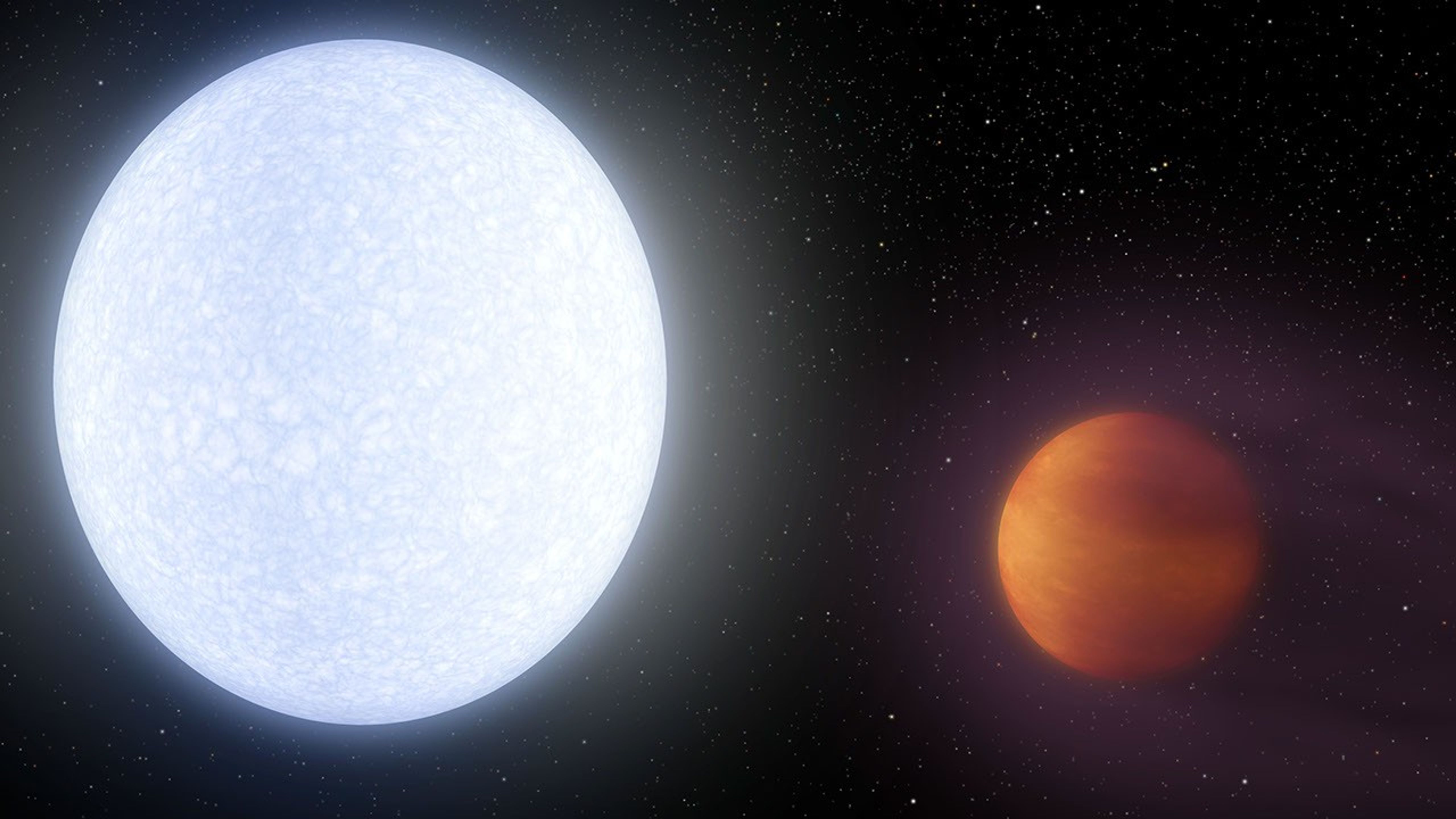
The title of hottest exoplanet goes to KELT-9b, a gas giant spotted in 2017 that reaches temperatures up to 4,300 Kelvin on its dayside, about twice as hot as iron’s melting point (1,538 Kelvin, the temperature where metals turn liquid). This world orbits a blue-white star 670 light-years away in the constellation Cygnus, completing a lap every 1.48 Earth days at a distance of just 0.034 astronomical units (AU, roughly the distance from Earth to Sun). Such proximity causes intense stellar radiation that strips away atmospheric molecules, leaving hydrogen and helium as the main gases. As explained in NASA’s overview of extreme exoplanets, this heat dissociates water vapor into hydrogen and oxygen, creating a hazy, ionized atmosphere like a perpetual solar flare.
KELT-9b’s host star, a hot A-type with a surface temperature of 9,700 Kelvin, bathes the planet in extreme ultraviolet light, making its dayside brighter than most stars we see from Earth. Fun fact: If you stood on this world (though you’d vaporize instantly), the sky would glow blue from scattered starlight, and iron clouds might condense on the cooler nightside before evaporating again. Compared to Jupiter, KELT-9b is slightly larger at 1.09 Jupiter radii but has a mass of 2.88 Jupiter masses, giving it a low density of 0.67 grams per cubic centimeter (g/cm³, lighter than water at 1 g/cm³). This fluffiness comes from its puffed-up atmosphere, expanded by heat like a balloon in an oven.
- Orbital speed: Around 2,600 km/h faster than any solar system planet, zipping at 160 km/s (think 360,000 mph).
- Atmospheric escape: Up to 200 tons of material lost per second, eroding the planet over billions of years.
- Discovery method: Ground-based KELT survey, confirmed by spectroscopy showing no methane due to high heat.
Scientists suggest such ultra-hot Jupiters form farther out and migrate inward, surviving stellar winds that would shred cooler worlds. A diagram of its temperature gradient, from 4,300 K dayside to 3,000 K nightside, helps visualize this divide, much like Earth’s day-night swing but amplified a thousandfold.
This extreme heat offers a lab for studying high-energy chemistry, where metals like titanium oxide (used in white paint) exist as vapor, potentially forming reflective clouds.
Can Planets Be Covered in Lava Oceans?
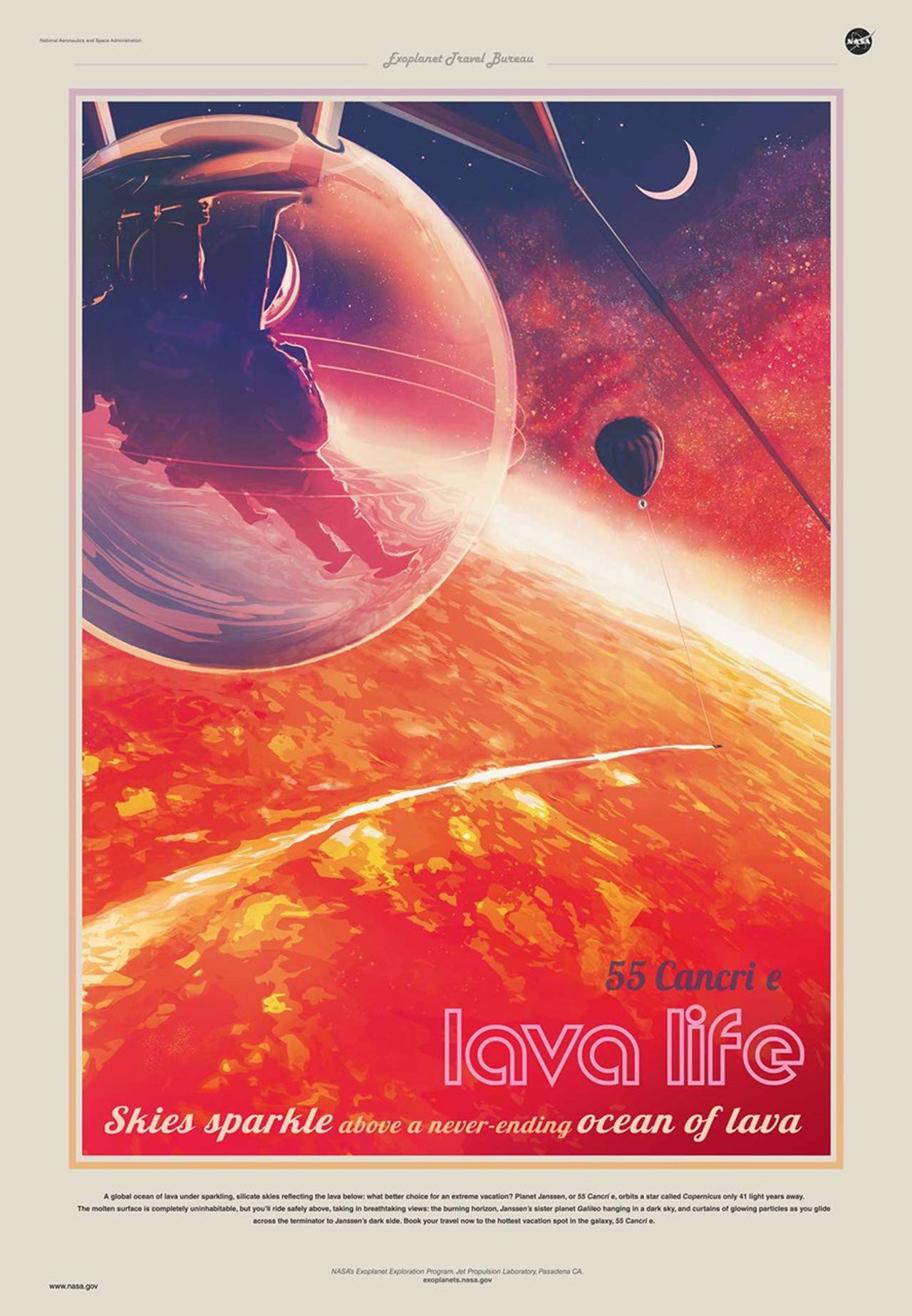
Yes, 55 Cancri e, discovered in 2004 but studied intensely in recent years, is a super-Earth blanketed in a global lava ocean due to surface temperatures exceeding 2,000 Kelvin (1,700°C, hot enough to melt most rocks). Located 41 light-years away in Cancer, this world is twice Earth’s radius (about 12,400 km diameter) and eight times its mass, yielding a rocky density of 5.9 g/cm³ (denser than Earth’s 5.5 g/cm³ from iron core compression). It orbits its dim K-type star every 18 hours at 0.015 AU, receiving 700 times the solar energy Earth gets, per NASA’s exoplanet profile.
The planet’s dayside likely features a magma sea hundreds of kilometers deep, with silicate rocks (like Earth’s crust) boiling into vapor that rains back as molten droplets. Nightside temperatures drop to 1,100 Kelvin, possibly solidifying into basalt-like rock, creating a tidally locked divide (one side always faces the star). Carbon-rich composition suggests up to one-third diamond under pressure, formed from graphite squeezed at 20 gigapascals (GPa, 200,000 times Earth’s air pressure). For context, that’s like stacking 200 Eiffel Towers on every square centimeter.
Fun fact: Volcanic outgassing could create a thick steam atmosphere, sparkling with sodium and potassium emissions visible in spectra. Bullet points highlight its extremes:
- Mass-radius relation: Challenges models, as it’s too dense for a water world but too light for pure iron.
- Day length: Matches orbit, so one “year” equals one endless day.
- Potential habitability: Zero, but studies its geophysics like Venus on steroids.
Recent James Webb observations in 2023 refined its heat map, showing uneven cooling (figure suggested: radial temperature plot). This lava world exemplifies how close orbits bake interiors, contrasting cool gas giants.
Such planets teach us about magma oceans in early solar systems, where Earth once boiled similarly.
What Are Rogue Planets Drifting Through Space?
Rogue planets, also called free-floating or orphan planets, wander interstellar space without orbiting any star, discovered via microlensing (gravity bending starlight like a lens). NASA’s 2025 exoplanet count includes dozens, like OGLE-2011-BLG-0265Lb from 2011 but with 2024 updates confirming more via James Webb. These worlds, estimated at billions in the Milky Way, form like normal planets but get ejected by gravitational tugs from sibling worlds or stellar flybys.
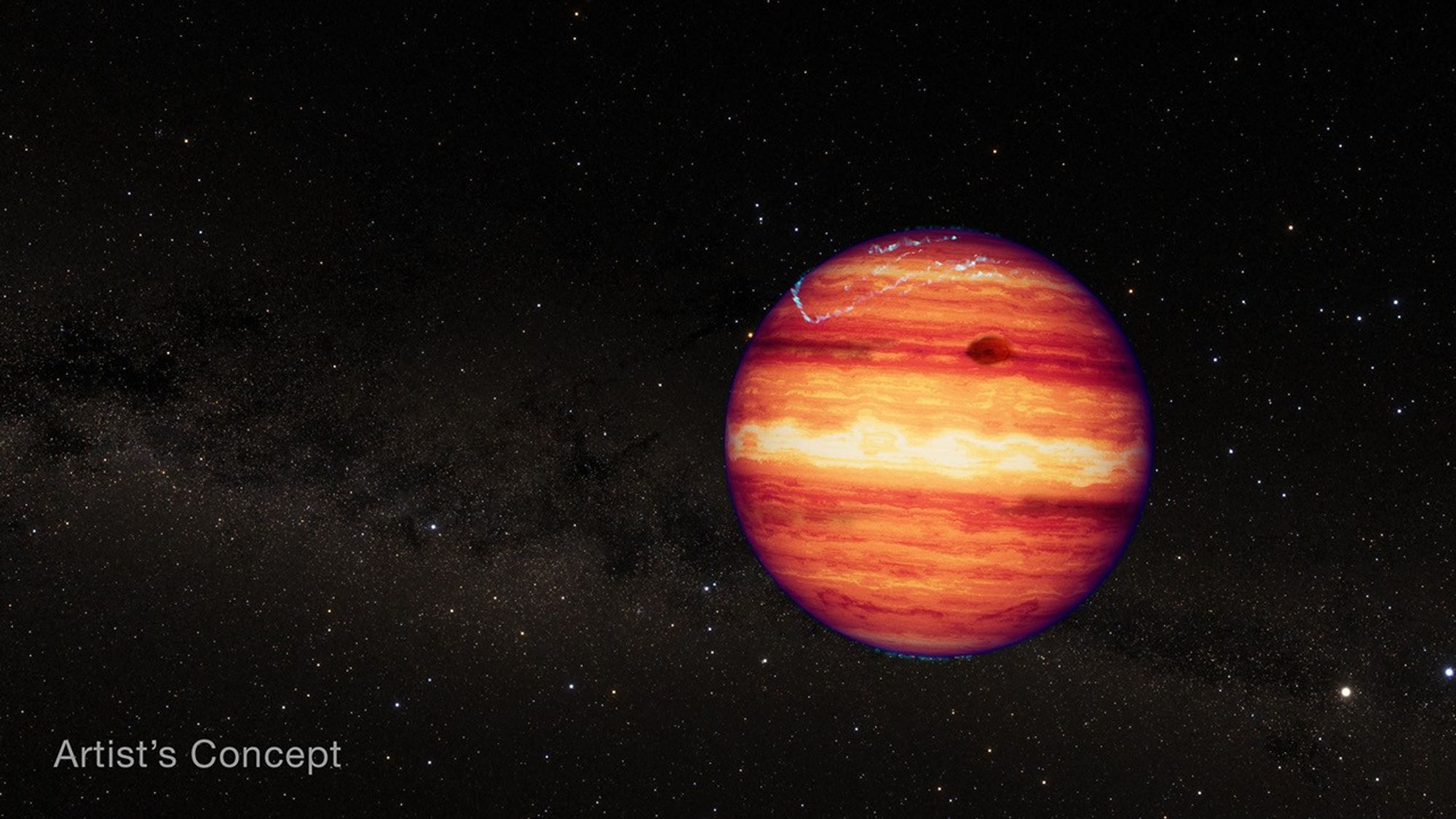
One example, SIMP J01365663+0933473 (SIMP-0136), a super-Jupiter 20 light-years away, has 12.7 Jupiter masses and a magnetic field 200 times Earth’s, generating auroras from internal heat (surface temp 1,000 Kelvin). Detected in 2016, recent Webb data in 2025 revealed complex atmospheres with ammonia clouds, per NASA’s Webb mission reports. Ranging from Earth-sized rocks to gas giants, rogues cool slowly, retaining heat from formation (contraction at 10^26 joules over eons).
Comparisons: Unlike bound planets, rogues endure eternal night, with surface gravity up to 100 m/s² (10 times Earth’s, crushing for humans). Fun fact: They might host subsurface oceans if icy, warmed by tidal flexing or radioactivity.
- Detection challenge: Only via rare alignments, yielding masses from 1-13 Jupiter masses.
- Abundance: Possibly twice as many as starred planets, per microlensing surveys.
- Temperature range: 50-1,000 Kelvin, depending on age and size.
A timeline figure of ejection scenarios aids understanding. These loners expand our view of dynamic planetary systems.
Rogue discoveries underscore the chaos of birth clusters, where most stars lose companions.
What Exoplanet Has the Lowest Density Like a Marshmallow?
TOI-3757 b, found in 2020 by TESS, boasts a density of just 0.27 g/cm³, akin to marshmallow (0.3 g/cm³), making it the puffiest around a red dwarf. This Saturn-sized world (9.9 Jupiter radii) has 0.89 Jupiter masses, orbiting every 25 days at 0.13 AU, 580 light-years in Indus. Low density arises from a hydrogen-helium envelope bloated by low gravity and mild heat (600 Kelvin), as detailed in NASA’s strange worlds catalog.
Unlike dense Neptunes (1.6 g/cm³), its extended atmosphere scatters light, dimming the transit signal. Formation likely involved slow accretion in a metal-poor disk, trapping light gases. Fun fact: Winds up to 1 km/s (twice Earth’s jet streams) mix layers, preventing core-mantle separation.
- Equilibrium temperature: 540 K, cool for giants but enough to expand gases.
- Eccentricity: Near-zero orbit, stable unlike wild migrators.
- Implications: Suggests diverse outcomes around M-dwarfs (red stars 10% Sun’s mass).
Density plots compare it to foam, visualizing fluffiness. This find probes envelope physics in low-mass systems.
Which Exoplanet Experiences Glass Rain?
HD 189733 b, a hot Jupiter 64 light-years in Vulpecula, features sideways glass rain from winds at 8,700 km/h (5,400 mph, seven times sound speed). Discovered in 2005, its cobalt-blue haze comes from silicate particles (glass droplets) condensing at 900 Kelvin, confirmed by Hubble spectra in 2013 and Webb in 2023. Orbiting every 2.2 days at 0.03 AU around a K-star, it has 1.14 Jupiter radii and 1.13 Jupiter masses (density 1.2 g/cm³).
Rain forms when vapor cools on the nightside, shattering into shards blown back dayside. Compared to Earth’s rain (drops at 10 m/s), this is a horizontal storm of razor-like silica. Per NASA’s atmospheric studies, sodium lines tint it blue, like a hazy ocean.
- Wind shear: Driven by 1,000 K day-night contrast.
- Evaporation: Losing 100-600 tons of atmosphere daily.
- Transit depth: 2.4% starlight drop, easy to spot.
Weather models (suggested figure: circulation diagram) mimic this hellish forecast.
What Is the Darkest Exoplanet Known to Science?
TrES-2 b, 750 light-years in Draco, reflects less than 1% of light, darker than coal (4% albedo), earning the “eternal night” moniker since 2006. This hot Jupiter (1.25 Jupiter radii, 1.25 Jupiter masses, density 1.5 g/cm³) orbits every 2.5 days at 0.03 AU, with 1,100 Kelvin heat absorbing light via alkali metals absorbing visible wavelengths. NASA’s Kepler refined its blackness in 2011, per extreme exoplanet data.
Its nightside glows faint red from heat (infrared emission), but visible light vanishes in thick clouds. Fun fact: Darker than asphalt runways, it challenges albedo theories.
- Absorption spectrum: Sodium, potassium block light.
- Temperature gradient: 1,500 K dayside to 1,000 K nightside.
- Comparison: Venus reflects 70%; TrES-2 b swallows almost all.
Albedo charts illustrate this void-like quality.
Conclusion
The bizarre exoplanets discovered, from KELT-9b’s stellar inferno to TrES-2 b’s light-devouring gloom, paint a universe far wilder than our solar backyard. These worlds, verified through NASA’s tireless surveys, reveal how gravity, heat, and chemistry sculpt extremes that test planetary models. As telescopes peer deeper, they promise more revelations about formation and potential hidden biospheres.
📌 Frequently Asked Questions
What is an exoplanet?
An exoplanet is any planet orbiting a star outside our solar system, ranging from rocky worlds to gas giants. Over 6,000 have been confirmed (NASA, 2025), detected mainly by watching stars dim during transits.
How many exoplanets have been discovered?
As of September 2025, NASA confirms 6,000 exoplanets, with thousands more candidates. The pace has quickened, doubling every few years thanks to missions like TESS (NASA, 2025).
What is a hot Jupiter?
A hot Jupiter is a gas giant like Jupiter but orbiting very close to its star, often in days, with temperatures over 1,000 Kelvin. Examples include KELT-9b, where heat alters chemistry (NASA, 2023).
Are there diamond planets?
Yes, like 55 Cancri e, high carbon and pressure may form diamond layers under lava oceans. Its density suggests up to 30% carbon (NASA, 2023).
What are rogue planets?
Rogue planets float freely without stars, ejected from systems. Billions may exist, some with internal heat for oceans (NASA, 2025).
Why are some exoplanets so hot?
Close orbits expose them to intense radiation, like KELT-9b at 4,300 Kelvin from its blue star. Migration theories explain this (Gaudi et al., 2017).
Can exoplanets have rings like Saturn?
Few confirmed, but J1407b has massive rings, 200 times Saturn’s. Dust disks around young worlds hint at more (NASA, 2023).
What makes an exoplanet habitable?
Liquid water potential in the habitable zone, plus stable atmospheres. Bizarre ones like lava worlds are inhospitable (NASA, 2025).
How do we detect exoplanets?
Mainly transit (light dips) and radial velocity (star wobbles), with direct imaging for young giants. Microlensing spots rogues (NASA, 2023).
Will we find alien life on exoplanets?
No confirmed yet, but biosignatures like oxygen in atmospheres are targets for James Webb. Odds rise with 6,000+ worlds (NASA, 2025).
Sources
Gaudi, B. S., Stassun, K. G., Collins, K. A., Beatty, T. G., Penev, K., Siverd, R. J., … & Pepper, J. (2017). A giant planet undergoing extreme-ultraviolet irradiation by its hot, massive-star host. Nature, 546(7659), 514–518. https://doi.org/10.1038/nature22392
NASA. (2023, September 20). Strange New Worlds. NASA Science. https://science.nasa.gov/exoplanets/immersive/strange-new-worlds/
NASA. (2025, September 17). NASA’s Tally of Planets Outside Our Solar System Reaches 6000. NASA. https://www.nasa.gov/universe/exoplanets/nasas-tally-of-planets-outside-our-solar-system-reaches-6000/