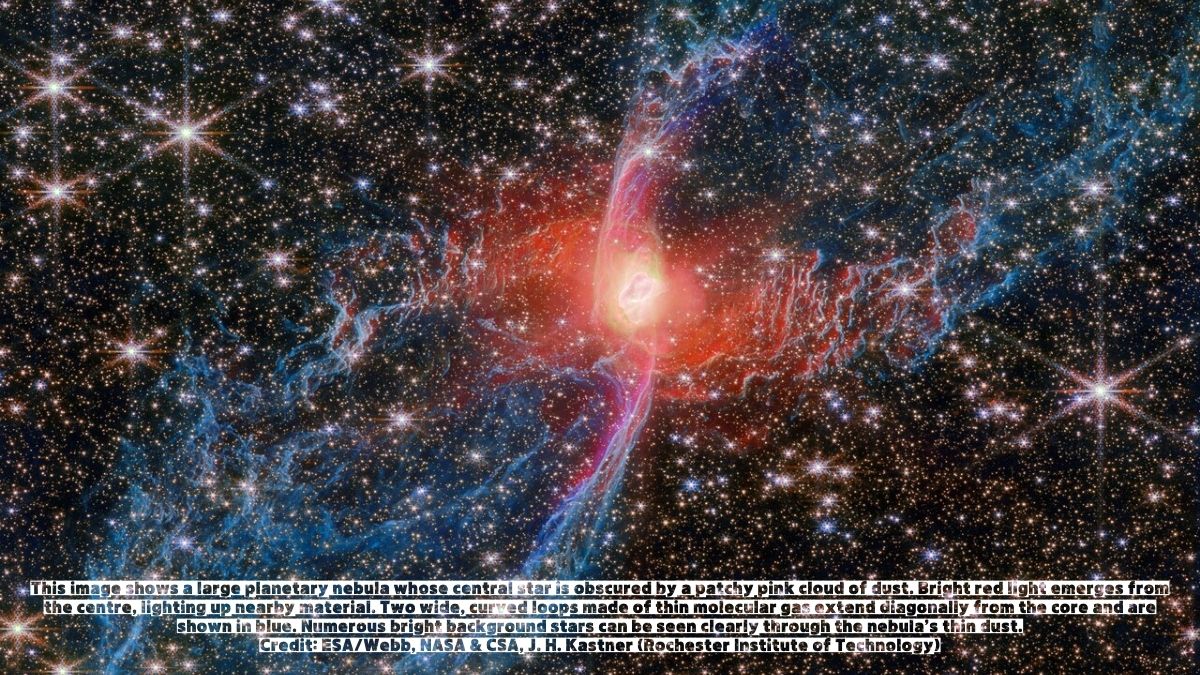
Astronomers have unveiled a new infrared image of the Red Spider Nebula from the James Webb Space Telescope, showcasing intricate structures within this bipolar planetary nebula. Designated as NGC 6537, the object lies approximately 1.5 kiloparsecs away in the constellation Sagittarius. The observation highlights the nebula’s central star, surrounded by a dense dust shroud, with expansive lobes extending outward in a symmetrical pattern.
The image, captured using Webb’s Near-Infrared Camera, reveals features invisible in previous optical views from the Hubble Space Telescope. Bright red emissions dominate the core, indicating hot dust, while blue traces outline molecular hydrogen in the lobes. This fresh perspective emphasizes the dynamic processes shaping the nebula, including jets and outflows from the dying central star.
The data stem from a collaborative effort combining Webb observations with those from Chandra X-ray Observatory and Atacama Large Millimeter/submillimeter Array, aimed at probing the formation of such asymmetric structures in planetary nebulae.
In the heart of the nebula, the central star appears enshrouded in a blotchy pink cloud of dust, radiating intense red light that illuminates surrounding material. This dust likely forms a disc orbiting the star, contributing to the observed infrared glow. Though only one star is directly visible, researchers infer the presence of a companion star, which could account for the nebula’s narrow waist and broad outflows, akin to patterns seen in other bipolar nebulae.
Webb’s sensitive detectors have uncovered the full extent of the nebula’s lobes, each spanning about three light-years. These bubble-like enclosures, traced by emissions from molecular hydrogen at 2.12 micrometers, result from thousands of years of gas ejection. The lobes display closed structures, with rippling walls sculpted by ongoing interactions.
A prominent elongated purple S-shape cuts through the core, marking emissions from ionized iron at 1.64 micrometers. This feature signifies a fast-moving jet erupting from near the central star, colliding with previously expelled material. Such collisions create twisted knots and sharp-rimmed formations, evidence of precessing outflows over time.
The observations align with models of planetary nebula evolution, where a Sun-like star sheds its outer layers after its red giant phase, exposing a hot core that ionizes the ejecta. In this case, the central star’s ultraviolet radiation drives the ionization, while binary interactions enhance the shaping.
According to the lead researcher Joel Kastner from Rochester Institute of Technology, the image provides crucial insights into the nebula’s origins. As detailed in the study, “We present James Webb Space Telescope near-infrared Br-alpha, H2, [Fe II], and PAH imaging of the molecule-rich, high-excitation bipolar planetary nebula NGC 6537, complemented by new ALMA and Chandra observations and archival HST images.” This multi-wavelength approach confirms the role of jets in forming the observed morphology.
Further analysis shows point-symmetric shocks along the lobe walls, indicating the outflow direction has shifted during the nebula’s development. The core region exhibits a compact ionized torus, encircled by a molecular one, supporting the binary star hypothesis.
The NASA Red Spider Nebula image also captures thousands of background stars, visible through the thin dust layers, adding context to the nebula’s environment. Complementary X-ray data from Chandra reveal hot plasma in the core, consistent with shock-heated gas from the jets.
Co-investigator Paula Moraga Baez noted the enhanced clarity in infrared, allowing precise measurements of the central star’s photosphere, which remains detectable despite the dust. The team’s work, published in a peer-reviewed paper, integrates these findings to model the nebula’s evolution.
Archival Hubble images, when compared via a slider tool, underscore Webb’s superiority in penetrating dust and resolving fine details. The combined dataset suggests the nebula’s age is around 10,000 years, based on expansion rates derived from the lobe sizes.
This discovery advances our understanding of how stellar winds and binary companions sculpt planetary nebulae, offering a template for similar objects.
In summary, the James Webb Space Telescope’s view of the Red Spider Nebula illuminates the complex interplay of stellar ejection, ionization, and jets, providing a clearer picture of this cosmic structure’s formation.
References
Kastner, J. H., Moraga Baez, P., Balick, B., Montez, R., Gieser, C., Matsuura, M., Nordhaus, J., & Santander-Garcia, M. (2025). JWST/NIRCam imaging of the bipolar planetary nebula NGC 6537: The (infra)red spider, revealed. The Astrophysical Journal, 964(1), Article 12. https://doi.org/10.3847/1538-4357/ae0706
European Space Agency. (2025). The Red Spider Nebula, caught by Webb [Image release]. Retrieved from https://esawebb.org/images/potm2510a/