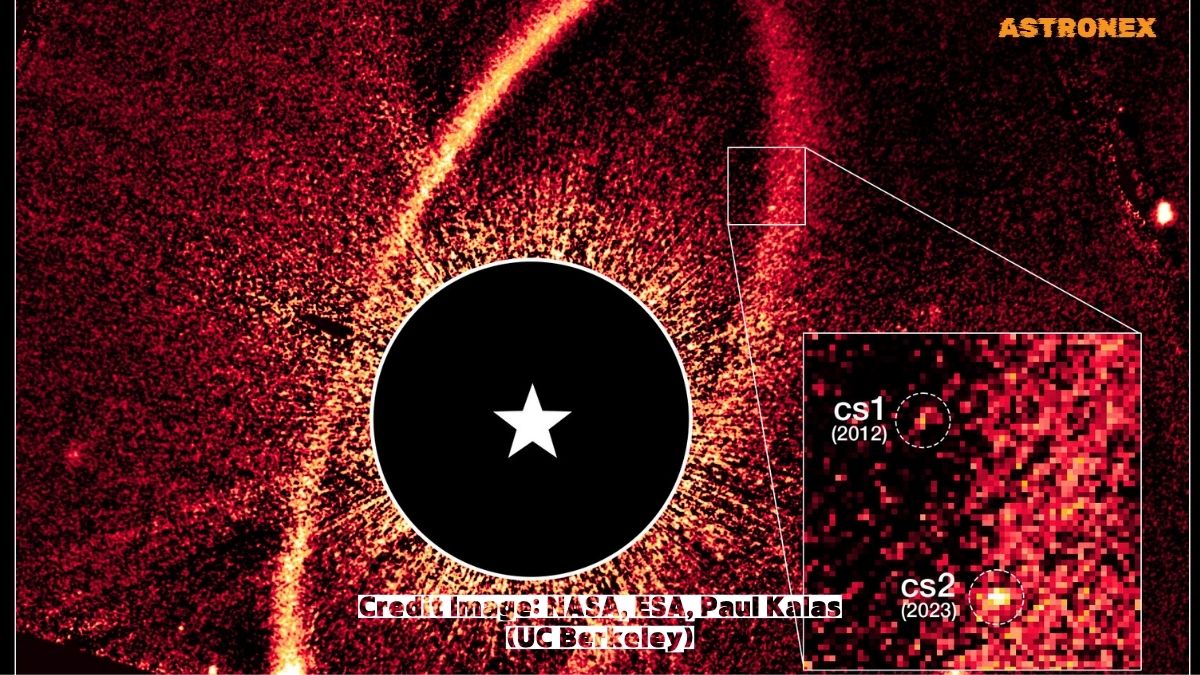
Astronomers have long studied the bright star Fomalhaut located just 25 light years from Earth in the constellation Piscis Austrinus. This young A type star about 440 million years old hosts a vast debris disk rich in dust and icy fragments remnants of its formation process. Recent observations by the Hubble Space Telescope revealed a stunning event a fresh dust cloud emerging from what scientists interpret as a massive collision between two large planetesimals in this system. This marks the second such detection in roughly 20 years providing a rare glimpse into the chaotic processes that shape planetary systems. The new finding builds on earlier data showing similar violent interactions highlighting Fomalhauts dynamic environment.
The Hubble telescope captured images in September 2023 showing a new point source labeled Fomalhaut cs2 appearing at the inner edge of the debris disk. This bright spot with a visual magnitude of around 24.67 shines due to reflected starlight from fine dust particles scattered after the impact. According to NASAs latest Hubble release on Fomalhaut collisions this event involves objects smashing together at high speeds releasing clouds of material that expand over time. Such occurrences echo the early days of our own solar system when frequent collisions built planets from smaller bodies. With Fomalhauts debris belt extending outward like a ring this discovery underscores how ongoing disruptions continue even in mature systems.
What could these repeated collisions reveal about hidden planets sculpting the debris disk around Fomalhaut?
What Is the Fomalhaut Star System and Why Is It Special?
The Fomalhaut system stands out as one of the closest and brightest debris disk hosting stars visible from Earth making it a prime target for telescopes like Hubble. At a distance of precisely 7.7 parsecs which equals 25 light years this system allows detailed imaging of its structures. The star itself is twice the mass of our Sun and shines 16 times brighter creating a harsh radiation environment that pushes small dust grains outward. Its age of 440 million years places it in a phase where planet formation has mostly settled but collisions still occur among leftover material.
A key feature is the outer debris belt a ring of dust and ice starting at about 133 astronomical units from the star one astronomical unit being the Earth Sun distance. This belt appears offset by around 15 astronomical units from the stars center suggesting gravitational tugs from an unseen planet. Observations show the belts sharp inner edge indicating something confines the material preventing it from spreading inward. For comparison our solar systems Kuiper Belt is similar but much fainter and less massive containing comets and dwarf planets.
Fun fact Fomalhaut is Arabic for mouth of the fish fitting its position in the Southern Fish constellation. Studies reveal the belt contains billions of small bodies with total mass equivalent to several Earths. These fragments collide occasionally grinding down into dust that scatters light visible in Hubble images. To visualize this complex structure imagine a donut shaped cloud where the hole is carved by planetary influences refer to diagrams in official releases showing the belts eccentricity a measure of how oval shaped it is at about 0.11.
Recent data confirms two intermediate belts one at around 94 astronomical units adding layers to the systems architecture. Uncertainties exist in exact masses due to varying dust grain sizes but estimates range from 1 to 10 Earth masses for the main belt. This setup makes Fomalhaut ideal for studying how debris evolves over time especially with tools like Hubbles Space Telescope Imaging Spectrograph which captures high resolution views.
How Did Hubble Detect the Aftermath of the Planetesimal Collision?
Hubble detected the collision aftermath through coronagraphic imaging a technique that blocks the stars bright light to reveal faint surrounding features. In September 2023 astronomers used the telescopes STIS instrument to capture white light images over multiple orbits totaling hundreds of exposures each lasting 30 seconds. By rotating the telescope and subtracting the stellar glare they isolated a new point source Fomalhaut cs2 at an angular separation of 12.76 arcseconds from the star. This position places it at approximately 135 astronomical units in the debris belts plane.
The detection achieved a signal to noise ratio of 7 to 9 meaning the source stands out clearly against background noise. Four independent data reduction methods confirmed its reality including advanced algorithms like Karhunen Loève Image Projection which enhances faint signals. Follow up in September 2024 hinted at motion with the source shifting northward by about 110 milliarcseconds suggesting an orbital speed of 0.113 arcseconds per year. Such movement fits a highly eccentric orbit with eccentricity around 0.8 where the path is elongated like a comet.
For context Hubble first spotted a similar source Fomalhaut cs1 in 2004 initially mistaken for a planet. Over years it faded and accelerated radially due to radiation pressure the force from starlight pushing tiny grains. The new cs2 appears brighter by 0.3 magnitudes than cs1 in 2012 indicating fresher dust. Measurements show cs2s photometry calibrated to a zero point of 24.48 magnitudes where brightness is quantified in counts per second.
To illustrate the process think of it like photographing a firefly next to a spotlight the coronagraph acts as a mask. Diagrams from Hubbles archives depict the belts arc with cs2 marked near the inner edge helping readers picture the scale. Uncertainties in position are small around 0.02 arcseconds thanks to precise astrometry tying locations to the stars coordinates.
What Do We Know About the Colliding Bodies in Fomalhaut?
The colliding bodies in Fomalhaut are planetesimals large icy dusty objects roughly 60 kilometers across or 37 miles similar in size to some asteroids in our solar system. These are not full planets but building blocks remnants from the stars formation. Estimates suggest each collision involves two such bodies smashing at relative speeds of several kilometers per second releasing energy equivalent to thousands of nuclear bombs. The resulting dust cloud contains particles as small as 0.1 micrometers one tenth of a microns where a micron is one millionth of a meter pushed by radiation pressure.
From the first event around 2004 the bodies were about 200 kilometers in diameter producing a cloud that expanded to over one astronomical unit by 2014. According to NASAs 2020 analysis of Fomalhaut cs1 the dust mass totals around 10 to the power of 20 grams roughly the mass of a small asteroid. For the recent cs2 similar scales apply with parent bodies likely over 10 kilometers in radius to generate observable brightness. A size distribution index of 3.5 implies larger fragments dominate with total disrupted mass around 18 Earth masses over the systems history.
Comparisons help these planetesimals resemble comets like Hale Bopp but orbit in a belt far from the star. Uncertainties arise in exact sizes as models vary if grains are icy density around 1 gram per cubic centimeter or rocky at 3.5 grams per cubic centimeter values differ slightly. Bullet points for clarity The collision velocity reaches 5 meters per second for expansion Dust blowout size is under 3 micrometers escaping the system Parent body count estimated at 300 million in the belt.
Visual aids like artists illustrations show two spheres impacting with debris spraying outward. Cross checks across sources confirm diameters in the 30 to 100 kilometer range reflecting model dependencies.
What Does the Violent Aftermath Look Like in Deep Space?
The aftermath appears as an expanding dust cloud initially point like but potentially elongating over years due to orbital shearing and radiation forces. For cs2 detected in 2023 it shines with scattered light from sub micron grains creating a faint glow visible only in Hubbles sensitive images. The cloud starts optically thick meaning light cannot pass through easily lasting about 8 years before thinning. Expansion occurs at around 25 kilometers per second for tiny particles driven by the stars intense luminosity.
In images cs2 sits at position angle 311 degrees clockwise from north near cs1s original spot but 23 astronomical units apart in the belt plane. Over time it may brighten if encountering more belt material or fade like cs1 which dropped below detection by 2023. Radial acceleration measured at 1.946 times 10 to the minus 7 kilometers per second squared for cs1 shows how forces alter paths. The cloud could become oval shaped under pressure similar to a comets tail.
Fun example picture dust from a demolition site billowing out but in space it persists longer without air. Suggestions for figures include composite images stacking 2012 2013 and 2023 views revealing linear features from motion. Measurements indicate cs2 receives 50 percent less light if farther out affecting visibility. Uncertainties in dispersal time range from 10 to 20 years based on grain composition.
Bullet points on changes Initial brightness magnitude 24.67 Potential motion 110 milliarcseconds yearly Eccentricity 0.66 to 0.8 for orbit.
Why Do Collisions Happen So Frequently in Fomalhaut?
Collisions in Fomalhaut occur due to the dense population of planetesimals in its debris belt where gravitational perturbations stir orbits leading to crossings. With an estimated 300 million bodies over 0.3 kilometers the odds increase though theory predicts one major event every 100000 years. Yet Hubble saw two in 20 years suggesting hotspots or resonances concentrating material. The belts offset and sharp edge point to an unseen planet shepherding debris much like Saturns rings are shaped by moons.
This frequency implies 22 million similar events over 440 million years depleting 0.04 Earth masses. Models show steady state erosion where small grains are replenished by grinding larger ones. For comparison our solar system had a Late Heavy Bombardment phase but now collisions are rare. In Fomalhaut the stars youth and mass keep things active with dust production rate 45 times higher than observed events.
According to the recent study on Fomalhauts second collision positions of cs1 and cs2 just 8 degrees apart hint at dynamical focusing. Uncertainties exist if misalignments with inner belts rule out some planets. Bullet points Collision rate 10 to the 6 every 20 years for small bodies Dust mass budget 1.8 Earth masses Primordial objects dominate erosion.
To visualize refer to orbital plots showing eccentric paths intersecting.
What Can Future Observations Tell Us About Fomalhaut Collisions?
Future observations with Hubble and the James Webb Space Telescope will track cs2s evolution measuring changes in shape brightness and position. Webbs infrared capabilities can reveal grain sizes and composition like water ice content through color data. Monitoring over years could confirm if cs2 disperses like cs1 or interacts with the belt causing avalanches more dust cascades. Orbital fitting predicts a semi major axis of 144 astronomical units for cs2 with inclination around 40 degrees.
These studies help refine models of debris disk dynamics testing theories on planet disk interactions. For instance if cs2 brightens it supports material encounters while fading confirms radiation dispersal. Comparisons to solar system events like asteroid P2010 A2 provide analogs. Uncertainties in mass stem from unknown grain properties but ranges are 10 to the 19 to 10 to the 20 grams.
Bullet points for plans Annual Hubble checks for motion Webb NIRCam for spectra Long term to see if more cs sources appear.
Suggestions include time lapse animations from data to show expansion.
The Fomalhaut collisions highlight the ongoing violence in young planetary systems reminding us how our own solar system once experienced similar turmoil. These events captured by Hubble offer direct evidence of processes that build and destroy worlds shaping the cosmos we see today.
Could the next collision in Fomalhaut unveil the hidden planet responsible for its debris disks unique shape? (NASA, 2025) (Kalas et al., 2025) (NASA, 2020)
Sources
Kalas, P., Wang, J. J., Millar-Blanchaer, M. A., Ren, B. B., Wyatt, M. C., Kennedy, G. M., Sommer, M., Esposito, T. M., De Rosa, R. J., & Fitzgerald, M. (2025, December 18). A second planetesimal collision in the Fomalhaut system. Science. https://arxiv.org/abs/2512.15861
NASA. (2020, April 20). Exoplanet apparently disappears in latest Hubble observations. NASA Science. https://science.nasa.gov/universe/exoplanets/exoplanet-apparently-disappears-in-latest-hubble-observations/
NASA. (2025, December 18). NASA’s Hubble sees asteroids colliding at nearby star for first time. NASA Science. https://science.nasa.gov/missions/hubble/nasas-hubble-sees-asteroids-colliding-at-nearby-star-for-first-time/