For centuries, humanity has gazed up at the night sky, wondering how the star-filled cosmos came to be. Among the greatest puzzles is the birth of worlds: how do vast, swirling clouds of gas and dust evolve into the diverse array of planets we see? Today, thanks to a new generation of sophisticated telescopes, scientists are no longer relying solely on theory. We are now capturing what can only be described as planetary formation in real-time, witnessing “baby planets” being constructed in distant stellar nurseries (NASA, 2025). This marks a revolutionary leap, transitioning the field of astronomy from discovery to detailed, step-by-step observation of how worlds are built.
This is a monumental achievement in space science, similar in excitement to a real-time space mission briefing. For the first time, researchers are moving beyond snapshots of fully formed exoplanets—worlds orbiting stars outside our Solar System—to directly image systems still in the throes of creation. These breakthrough observations, primarily involving the Atacama Large Millimeter/submillimeter Array (ALMA) and the James Webb Space Telescope (JWST), are giving us an unprecedented look into the cosmic construction zones where gas giants and rocky worlds are taking shape.
The data gathered from these “cosmic nurseries” are already challenging and refining long-held models of planetary growth. By studying these young systems, which are only a few million years old (a blink of an eye in cosmic time), we gain crucial insight into the turbulent conditions that shaped our own Earth and the gas giants of our Solar System billions of years ago. Observing these processes as they happen allows us to test our theories and, ultimately, determine how common Earth-like worlds might be in the vastness of the universe. But how exactly are these instruments managing to peer through the immense distances and dense dust to capture these celestial newborns?
How do scientists spot baby planets that are still growing?
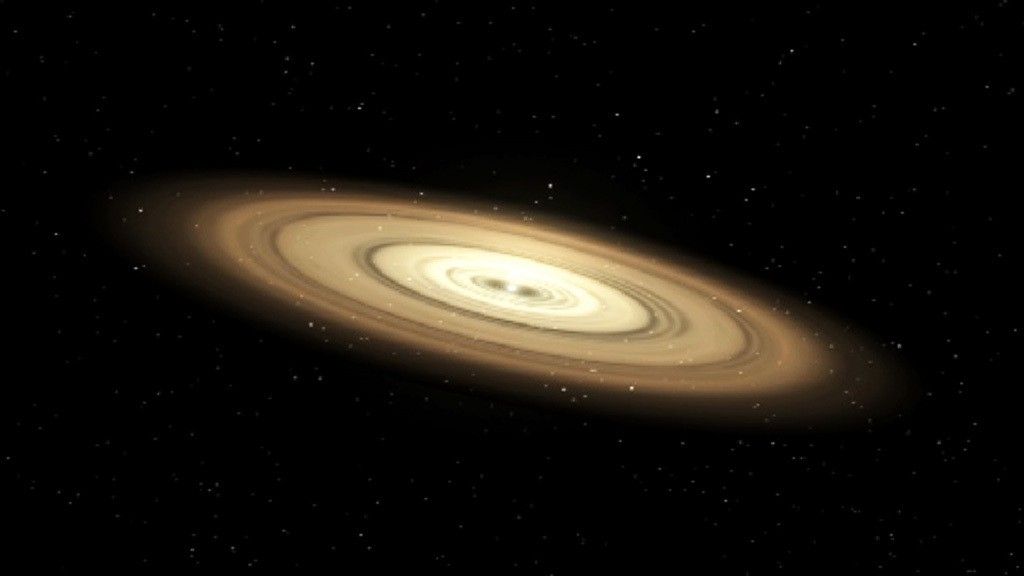
Scientists spot these emerging planets, known as protoplanets, by observing the effects they have on the vast, pancake-shaped cloud of material that encircles a young star—the protoplanetary disk. This disk, composed of gas and dust left over from the star’s formation, is where all the construction takes place. The challenge is that the young star at the center is often blindingly bright, and the tiny, still-forming planets are incredibly faint.
High-resolution facilities, such as the ALMA array in Chile, have been instrumental in solving this problem. ALMA is designed to detect millimeter and submillimeter wavelengths of light, which pass easily through the thick, obscuring dust that blocks visible light. The initial spectacular images from ALMA, like the 2014 observation of the disk around the young star HL Tau, revealed intricate structures, including distinct rings and gaps (ALMA, 2014). These gaps, often hundreds of Astronomical Units (AU) [one AU is the distance from the Earth to the Sun] wide, were immediately interpreted as signs of planets sweeping up material and carving out clear pathways in the disk, much like a snowplow clearing a circular road.
Furthermore, direct imaging instruments on telescopes like the European Southern Observatory’s (ESO) Very Large Telescope (VLT) and NASA’s James Webb Space Telescope (JWST) use a special tool called a coronagraph to block the blinding light of the central star. This technique has allowed researchers to directly photograph some of these newly formed giant planets, most famously the two planets orbiting the star PDS 70 (Keppler et al., 2018). PDS 70, a star approximately 370 light-years from Earth, has provided a “living laboratory” where two worlds, PDS 70 b and PDS 70 c, are visible within a large gap in the disk.

What is the PDS 70 system and why is it so important for planet formation research?
The PDS 70 system is arguably the most critical observation point for understanding planet formation today because it offers a direct, verifiable view of planets actively forming. The star itself is a young T Tauri star, estimated to be only about 5.4 million years old, a tiny fraction of our Sun’s age of 4.6 billion years (Müller et al., 2018). The system’s large, distinct circumstellar disk spans about 130 AU, with a massive gap stretching from about 20 AU to 70 AU from the star.
Within this gap reside the two known giant planets: PDS 70 b and PDS 70 c.
- PDS 70 b was the first to be definitively imaged in 2018. It orbits at a distance of about 20 AU, which is comparable to the distance between the Sun and Uranus in our Solar System. Its estimated mass is a few times that of Jupiter.
- PDS 70 c was discovered in 2019, orbiting farther out at 34 AU (NASA, 2019). It also has a mass of a few Jupiter equivalents.
The existence of these planets perfectly explains the large gap in the protoplanetary disk, as they are actively clearing their orbital paths. The sheer importance of PDS 70 c reached new heights with the 2019 detection by ALMA of a circumplanetary disk around it—a smaller disk of gas and dust encircling the planet itself (Isella et al., 2019). This is essentially a “moon-forming disk,” a crucial observation confirming the final stage of giant planet growth, where a planet not only collects material from the central star’s disk but also funnels that material into its own system of moons, much like Jupiter’s four largest moons are believed to have formed.

Are scientists watching new gas and dust being added to a planet?
Yes, scientists are directly watching the final accretion phase—the process of adding mass—onto these giant planets, which is a major breakthrough. For the PDS 70 system, observations in 2025 using instruments on the VLT and JWST have been key to measuring this phenomenon, known as accretion. This accretion of gas onto the planet’s surface causes it to glow brightly in specific wavelengths of light, particularly in the Hydrogen-alpha (Hα) spectral line (Wang et al., 2025).
Recent data suggests that PDS 70 b and PDS 70 c are still gathering gas from their surroundings, offering a rare direct observation of planets in their formative years (Blakely et al., 2025). The most recent studies show that the accretion rate, or the amount of material being added to the planets, is not constant. Observations over a nine-year period show a general fading trend for planet PDS 70 b, with its brightness decreasing by a factor of 4.6, suggesting a variable accretion rate. Conversely, planet PDS 70 c showed an increase in brightness by a factor of 2.3 between 2023 and 2024, indicating that its feeding cycle had intensified (Wang et al., 2025). This variability is an important discovery because it implies that planet formation is not a smooth, continuous process but rather a tumultuous series of stops and starts, which provides new, concrete data to refine our theoretical models of how gas giants assemble their massive atmospheres.
What are the two main models for how planets are born?
The current observations of baby planets are helping to distinguish between the two primary scientific models for the birth of gas giants. Both models begin with the initial protoplanetary disk of gas and dust.
- Core Accretion Model: This is the leading model, supported heavily by the PDS 70 observations. It proposes that the process starts with the gradual accumulation of tiny dust grains into larger and larger rocky bodies, forming a solid core (NASA, 2025). Once this core reaches a mass of about 10 Earth masses (M⊕), its gravity becomes powerful enough to rapidly capture a massive envelope of surrounding gas and hydrogen from the protoplanetary disk. This swift capture creates a gas giant, like Jupiter or Saturn. The PDS 70 system, with its massive cores and visible gas accretion, strongly aligns with this core accretion theory.
- Disk Instability Model: This model suggests that the planet formation process can sometimes skip the slow core-building phase. In a particularly massive and cold protoplanetary disk, a large region can collapse rapidly under its own immense gravity in just a few thousand years (Mayer et al., 2007). This sudden, massive collapse forms a giant planet very quickly. This mechanism helps explain the existence of giant planets that orbit their stars at extremely wide distances, far beyond the reach of the slower core accretion process.
The combination of ALMA’s stunning images of carved-out gaps and JWST’s detailed observations of gas accretion and circumplanetary disks is providing the most direct evidence yet that the Core Accretion Model is the dominant path for the formation of the giant planets we have observed so far (Blakely et al., 2025).
Conclusion
The era of merely cataloging distant, fully-grown exoplanets is giving way to a new age of direct observation. Scientists are now witnessing the very act of worlds being born, confirming theoretical models and providing concrete measurements of the violent, competitive process of planet growth. Observations of systems like PDS 70 have provided irrefutable proof of the core accretion process, where giant planets carve paths through their birth disks and gather the final gas layers that shape their immense size. These new findings not only illuminate the origin story of our own Solar System but also inform the search for life by revealing the underlying physics that dictates where, when, and how frequently planets emerge throughout the cosmos.
What crucial, yet undiscovered, details about the birth of rocky, Earth-sized worlds await our detection in these tumultuous cosmic nurseries?
📌 Frequently Asked Questions
What is a protoplanetary disk?
A protoplanetary disk is a vast, rotating disk of dense gas and dust that surrounds a newly formed, young star. This material is the leftover residue from the star’s formation, and it is the raw “cosmic construction material” from which planets are born, spinning around the central star for millions of years before dissipating.
How old are the baby planets being observed?
The youngest planet-forming systems currently being observed, such as PDS 70, are extremely young in astronomical terms, typically around 5 to 10 million years old (Müller et al., 2018). For comparison, our Sun is about 4.6 billion years old.
What is the difference between a protoplanet and an exoplanet?
A protoplanet is a planet that is still actively forming and gathering mass from its surrounding disk of gas and dust. An exoplanet is a fully formed planet that orbits a star outside our own Solar System. The planets in the PDS 70 system are currently both: they are confirmed exoplanets that are also still in the protoplanet stage of actively accreting material.
What is a circumplanetary disk?
A circumplanetary disk is a small, secondary disk of gas and dust that orbits a protoplanet, rather than the central star (Isella et al., 2019). This is the birthplace of the planet’s own moons, much like the main protoplanetary disk is the birthplace of the planets.
What telescope is best for spotting planet formation?
The most important instruments for studying planet formation are the Atacama Large Millimeter/submillimeter Array (ALMA) and the James Webb Space Telescope (JWST). ALMA provides high-resolution images of the dust in the outer disk, showing the gaps and rings carved by forming planets, while JWST can peer into the inner disk and use instruments like NIRISS to directly image the planets and measure their gas accretion rates (Blakely et al., 2025).
Does the Sun have a circumplanetary disk?
No, the Sun no longer has a circumplanetary disk. Our Solar System’s formative period ended billions of years ago. The planets and their moon systems are now fully formed, with any residual gas and dust having been blown away or incorporated into existing bodies.
How far away are the systems where planet formation is being witnessed?
One of the most famous systems, PDS 70, is located approximately 370 light-years from Earth in the constellation Centaurus (Keppler et al., 2018). Observing such details at this distance requires the immense power and high-resolution capabilities of our newest telescopes.
What is the minimum size for a rocky core to become a gas giant?
According to the core accretion model, a rocky core generally needs to reach a mass of about 10 Earth masses (M⊕) before its gravity becomes strong enough to trigger the rapid and runaway accretion of the vast quantities of gas required to form a massive gas giant (NASA, 2025).
What is the Hα emission line used for in planet research?
The Hα (Hydrogen-alpha) emission line is a specific wavelength of light (656.3 nanometers) emitted when hydrogen gas falls onto a massive object and is heated to extreme temperatures. In planet formation research, detecting this glow from a planet’s atmosphere is considered a smoking gun for current, active gas accretion, confirming that the planet is still growing (Wang et al., 2025).
How long does it take for a protoplanetary disk to disappear?
Protoplanetary disks typically survive for only a relatively short time. The gas and dust are either consumed by the star and forming planets or dispersed by the star’s intense radiation and stellar winds. The vast majority of these disks dissipate after a few million years, usually within 5 to 10 million years (Müller et al., 2018).
Sources
ALMA Partnership, Brogan, C. L., Hunter, T. R., Mangum, J. G., Oishi, M. S., & Remijan, A. J. (2014, November 6). ALMA Captures the Unexpected: Stunning Images Reveal Planetary Construction in HL Tau. ALMA Observatory. http://almaobservatory.org/en/press-releases/revolutionary-alma-image-reveals-planetary-genesis/
Blakely, D., Albert, L., Cugno, G., Doyon, R., Greenbaum, A., & Meyer, M. (2025, February 12). JWST Captures Unprecedented Glimpse of Planet Formation in the PDS 70 System. Exoplanètes UdeM. https://exoplanetes.umontreal.ca/en/jwst-captures-unprecedented-glimpse-of-planet-formation-in-the-pds-70-system/
Isella, A., Tobar, A., Benisty, M., & Teague, R. (2019, July 11). ‘Moon-forming’ Circumplanetary Disk Discovered in Distant Star System. National Radio Astronomy Observatory (NRAO). https://public.nrao.edu/news/2019-alma-circumplanetary/
Keppler, M., Müller, A., Endl, M., & The SPHERE Collaboration. (2018, July 2). First Confirmed Image of Newborn Planet Caught with ESO’s VLT. European Southern Observatory (ESO). https://www.eso.org/public/news/eso1821/
Müller, A., Keppler, M., Brandner, W., & The SPHERE Consortium. (2018). Orbital and atmospheric characterization of the planet within the gap of the PDS 70 transition disk. Astronomy & Astrophysics, 617, L2. https://www.mpia.de/news/science/2018-06-PDS70
NASA. (2019). PDS 70 c. NASA Science: Exoplanet Catalog. https://science.nasa.gov/exoplanet-catalog/pds-70-c/
NASA. (2025). NASA’s Tally of Planets Outside Our Solar System Reaches 6000. NASA Science. https://www.nasa.gov/universe/exoplanets/nasas-tally-of-planets-outside-our-solar-system-reaches-6000/