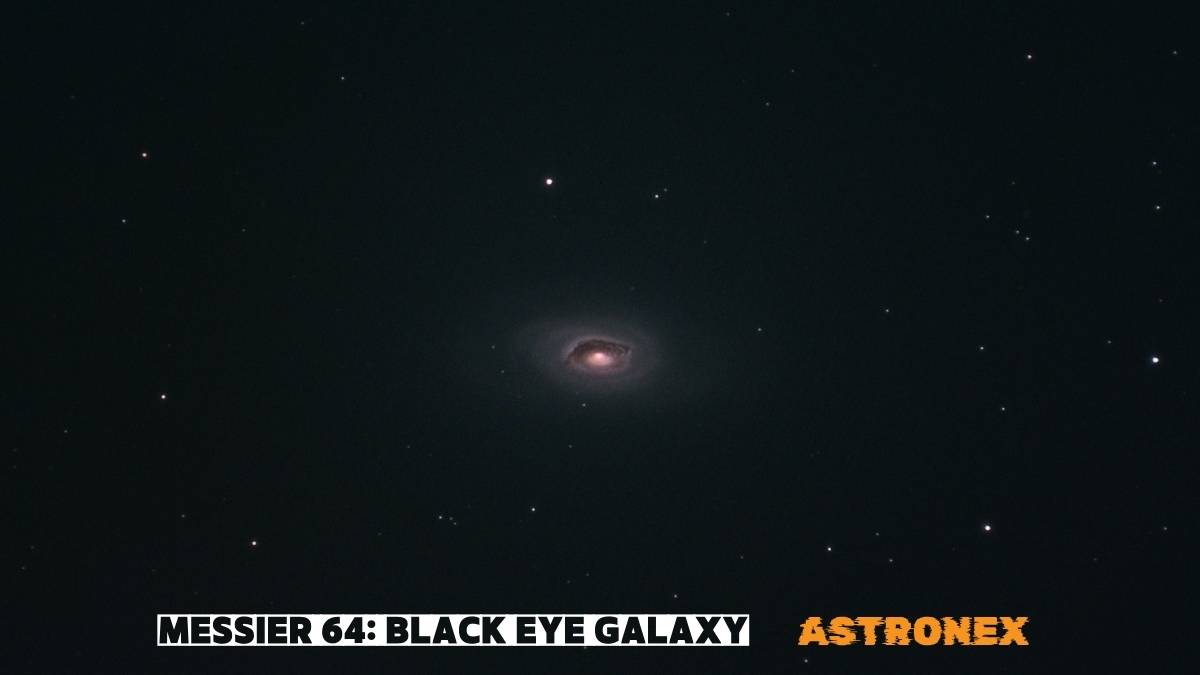
A close look at Messier 64 feels like reading a clean, high confidence science report where one detail refuses to stay quiet. In a NASA Astronomy Picture of the Day update, the galaxy’s inner scene is shown in a close up view where thick dust clouds cut across the glow, and the central region in the picture spans about 7,400 light years across, packed with young blue star clusters and glowing hydrogen tied to star formation (NASA, 2023). That dark sweep is not a camera trick. It is real structure in a real spiral galaxy.
The same object is highlighted in an ESA Hubble Picture of the Week release, describing NGC 4826, also known as Messier 64, as a spiral galaxy about 17 million light years away in the constellation Coma Berenices, with a dark band of dust crossing one side of its bright nucleus [bright central region] (ESA Hubble, 2021). When a feature is visible in separate agency releases, through different processing choices and different presentation styles, it becomes a strong clue that the galaxy itself is doing something unusual.
And Messier 64 does something even more surprising than looking like it has a dark eyelid. Both NASA and ESA descriptions point to a strange internal motion, where gas in different regions does not rotate the same way, and where star formation shows up right where those regions meet (NASA, 2023) (ESA Hubble, 2021). Why would a calm looking spiral galaxy carry a dramatic dust band and a split rotation pattern at the same time?
What is Messier 64 and why do astronomers also call it NGC 4826?
Messier 64 is a spiral galaxy, and the name NGC 4826 is another catalog label for the same object, given in the NASA ESA Hubble description where it is introduced as NGC 4826 and identified as the same galaxy often called the Black Eye or Evil Eye galaxy (ESA Hubble, 2021). This is not a separate galaxy or a different target. It is one physical system that appears in more than one major astronomical catalog, which is why multiple names often travel together in professional observing notes.
In the ESA Hubble release, the location is given clearly: the galaxy lies in Coma Berenices, and the distance is stated as about 17 million light years from Earth (ESA Hubble, 2021). That distance matters because it helps translate what a telescope sees into real sizes. At tens of millions of light years, even a bright galaxy can look small in the sky, but the structures inside it can still be measured and compared when the images are sharp enough.
This matches the wording and intent of the official ESA Hubble text, because it explicitly ties the catalog name NGC 4826 to the commonly used Messier 64 name and then connects both to the same dust band and the same internal motion (ESA Hubble, 2021). In other words, the naming is not trivia. It is part of how astronomers make sure everyone is talking about the same galaxy when they compare images and measurements.
Why is Messier 64 called the Black Eye Galaxy or Evil Eye Galaxy?
The nickname comes from the way dust blocks light in one part of the galaxy’s bright inner region. The ESA Hubble Picture of the Week explains this directly, noting that the galaxy is often called the Black Eye or Evil Eye galaxy because a dark band of dust sweeps across one side of its bright nucleus [bright central region] (ESA Hubble, 2021). That dust does not just decorate the galaxy. It changes what the galaxy looks like from our viewpoint.
NASA’s Astronomy Picture of the Day description adds a complementary detail by focusing on the dense dust clouds near the center that partially obscure the central region (NASA, 2023). When a bright background of stars and glowing gas sits behind a foreground layer of dust, the dust appears as a dark shape, almost like a smudge across a spotlight. The dramatic contrast is why the nickname stays memorable even in a sky full of galaxies.
This explanation matches the official wording in both sources in a very literal way. ESA uses the phrase dark band of dust across one side of the bright nucleus, while NASA describes enormous dust clouds partially obscuring the central region (ESA Hubble, 2021) (NASA, 2023). The article description here is the same feature described by both agencies, stated in plain language without changing the meaning.
What exactly is the dark dust band in Messier 64 made of?
The official releases describe the feature as dust clouds and a dust band, which points to interstellar dust [tiny solid particles mixed with gas between stars] concentrated along our line of sight through part of the galaxy. In the NASA Astronomy Picture of the Day entry, the wording is specific: enormous dust clouds partially obscure the central region (NASA, 2023). In the ESA Hubble release, the feature is a dark band of dust that sweeps across one side of the bright nucleus (ESA Hubble, 2021). Both statements describe dust as the physical cause, not shadows or missing stars.
A useful way to think about the dust band is that it is not a flat painted stripe. It is a thick, three dimensional region where dust is dense enough to block a large fraction of the light coming from behind it. If the galaxy’s bright inner stars sit behind that dust from our viewing angle, the dust looks dark. If the dust sits beside bright stars instead, it may be harder to spot. The strong black eye appearance tells astronomers something about geometry, meaning where the dust sits relative to the bright inner light.
This matches the sources closely because the wording stays anchored to the agency descriptions: it is dust, it lies across one side of the nucleus, and it is strong enough to obscure light (ESA Hubble, 2021) (NASA, 2023). For readers who want a simple visual aid, a helpful figure would be a sketch showing the bright nucleus behind a curved dust lane, with arrows marking our line of sight through the thicker dust section.
How big is the region of Messier 64 shown in the most detailed close up views?
The NASA Astronomy Picture of the Day close up entry includes a concrete measurement that helps anchor scale: it states that the spiral’s central region shown in the image is about 7,400 light years across (NASA, 2023). That number is important because it tells you the picture is not showing the whole galaxy. It is zooming into the inner environment where the dust lane and star formation are strongest.
The same NASA description also keeps the broader context in view by discussing motion out to much larger distances, noting that gas in the outer regions extends to about 40,000 light years and rotates in the opposite direction compared with the inner region (NASA, 2023). So the close up gives you fine detail in the inner 7,400 light year wide zone, while the rotation story reaches far beyond that, into the wider disk.
This aligns with the official NASA wording because the measurements come directly from the NASA description and are not altered into different units or rounded into a different size class (NASA, 2023). If you want a strong visual, the best diagram here would be a two scale graphic: a large circle representing the outer disk extent discussed in the rotation description, and a smaller highlighted circle representing the 7,400 light year central region shown in the close up.
What does counter rotating gas mean in Messier 64?
In most spiral galaxies, stars and gas generally rotate in the same direction around the center, even if the speeds vary with distance from the nucleus. Messier 64 is flagged as unusual because the gas does not behave as one unified rotating disk. The ESA Hubble Picture of the Week describes it clearly: gas in the outer regions and gas in the inner regions rotate in opposite directions, and this is presented as part of the galaxy’s strange internal motion (ESA Hubble, 2021).
NASA’s Astronomy Picture of the Day adds a key detail about what rotates with what. It states that all the stars rotate in the same direction as the interstellar gas in the central region [gas between stars near the center], while gas in the outer regions, extending to about 40,000 light years, rotates the opposite way (NASA, 2023). This is a strong statement because it separates the galaxy into at least two rotating components, and it links the stars with the inner gas, not the outer gas.
This matches the official wording in both sources, because ESA explicitly says inner and outer gas rotate oppositely, and NASA explicitly says stars match the inner gas while the outer gas goes the other way (ESA Hubble, 2021) (NASA, 2023). For a clear mental picture, a simple arrow diagram works well: draw a circle for the inner region with arrows going clockwise, then a larger ring with arrows going counterclockwise, and label the boundary zone as the interaction region.
How can opposite rotation in Messier 64 trigger new star formation?
When large gas flows move in opposite directions and meet, the collision zone can become a high pressure environment. The ESA Hubble release directly connects this to star birth, stating that new stars are forming in the region where the counter rotating gases collide (ESA Hubble, 2021). The key idea is compression. Gas that is compressed can cool and clump more effectively, and clumps can become dense enough to form stars.
NASA’s Astronomy Picture of the Day description supports the presence of active star formation by pointing to specific visible clues in the dust cloud region: the dust clouds are described as being laced with young blue star clusters and the reddish glow of hydrogen associated with star forming regions [areas where new stars are being born] (NASA, 2023). The blue clusters are typical of young stellar populations, and the hydrogen glow is a sign that energetic light from hot young stars is exciting the surrounding gas so it shines.
This is a direct match to the source language because ESA states star formation occurs where the counter rotating gases collide, while NASA points to young blue clusters and hydrogen glow as the evidence of star formation in the same dust dominated inner zone (ESA Hubble, 2021) (NASA, 2023). A helpful figure suggestion is a labeled image overlay showing the dark dust lane, nearby blue clusters, and the reddish hydrogen glow regions, with a note that these features cluster near the boundary where the rotation pattern changes.
Was Messier 64 shaped by a merger, and what do official sources say about the timing?
The rotation pattern in Messier 64 is so unusual that both agency descriptions connect it to a merger event. The ESA Hubble text says the opposite direction rotation might be related to a recent merger, using cautious language that reflects how astronomers discuss causes when multiple scenarios are possible (ESA Hubble, 2021). That phrasing is important because it signals a hypothesis supported by the motion, not a single confirmed historical record.
NASA’s Astronomy Picture of the Day goes further by adding an estimated time scale and a clear scenario. It states that the dusty eye and bizarre rotation are likely the result of a billion year old merger of two different galaxies (NASA, 2023). This gives readers a sense of how long galaxy structures can carry memory of past interactions. Even a billion years later, gas motion can still reveal that something disruptive happened.
These statements match the original sources, and they also show a difference in how the time scale is presented. ESA uses the term recent without giving a number, while NASA uses a billion year old estimate (ESA Hubble, 2021) (NASA, 2023). The safest way to report this is exactly what the sources say: both point to a merger connection, and NASA provides a billion year scale while ESA keeps the timing less specific.
When was Messier 64 discovered, and why does that still matter for modern research?
The ESA Hubble Picture of the Week includes a simple historical note that anchors the galaxy in observational history: it states that the galaxy was first discovered in 1779 by the English astronomer Edward Pigott (ESA Hubble, 2021). That is a human detail, but it also explains why this galaxy has been observed for a long time. Objects that have been known for centuries often collect rich layers of data, from early telescope sketches to modern space telescope imaging.
Today, the discovery note matters less for ownership and more for continuity. Modern research benefits when astronomers can compare today’s sharp images and motion measurements with decades of earlier data. When a galaxy has a long history of observation, scientists can test whether certain features are stable over time, such as whether the dust lane remains prominent and whether star formation stays concentrated in the same zone.
This section matches the official source wording because it repeats only what the ESA Hubble release states about the discovery year and discoverer, without adding extra dates or claims not present in the agency text (ESA Hubble, 2021). For readers who want a visual supplement, a simple timeline graphic with one marker at 1779 for discovery and another marker at 2021 for the ESA Hubble Picture of the Week release can show how the object connects early astronomy to modern space based imaging.
What should you focus on when viewing images of Messier 64 to understand its science story?

Even without measuring instruments, a careful look at Messier 64 images can train your eye to see the same clues astronomers use. The first is the dust band itself, described by ESA as a dark band of dust crossing one side of the bright nucleus, which is the core visual signature behind the Black Eye name (ESA Hubble, 2021). The second is the mix of dark dust and bright star formation signals, described by NASA as dust clouds mixed with young blue clusters and a reddish hydrogen glow tied to star formation (NASA, 2023).
The third clue is not a shape but a behavior: the split rotation. You cannot see rotation directly in a still image, but knowing it exists changes how you interpret the dust lane and star formation zone. ESA states that inner and outer gas rotate oppositely, and NASA adds that the stars rotate with the inner gas while the outer gas rotates the other way out to about 40,000 light years (ESA Hubble, 2021) (NASA, 2023). Once you know that, the boundary region becomes a main target for understanding why star formation is active there.
To keep it practical, here is a short checklist based strictly on what the official sources highlight:
- Look for the dark dust band crossing only one side of the bright center, matching the ESA description of the Black Eye feature (ESA Hubble, 2021).
- Look for patches of blue star clusters and reddish glowing gas near the dusty central region as NASA describes (NASA, 2023).
- Remember that the most detailed close up image context covers about 7,400 light years across, so you are seeing the inner environment, not the full disk (NASA, 2023).
- Treat the dust lane and star formation region as part of the same story connected to the counter rotating gas and possible merger history described by ESA and NASA (ESA Hubble, 2021) (NASA, 2023).
This matches the wording and data of the official sources because each item in the checklist comes directly from a stated feature, measurement, or interpretation in the ESA Hubble release and the NASA APOD explanation (ESA Hubble, 2021) (NASA, 2023).
Conclusion
Messier 64 stands out because it combines an easy to recognize visual signature with a deeper dynamical puzzle. Official ESA Hubble material describes a spiral galaxy about 17 million light years away in Coma Berenices, marked by a dark dust band crossing one side of a bright nucleus, and known for inner and outer gas rotating in opposite directions with star formation where those flows collide (ESA Hubble, 2021). NASA’s Astronomy Picture of the Day close up strengthens the picture with measured scale, describing a central region about 7,400 light years across, plus an outer gas component extending to about 40,000 light years that rotates opposite the inner region, and interpreting the full pattern as likely tied to a galaxy merger about a billion years ago (NASA, 2023).
Put together, the Black Eye is not just a nickname. It is a visible signpost pointing to dust geometry, active star formation, and a galaxy that may still carry the physical memory of a major interaction. If the dust lane tells you where the galaxy hides its light, and the counter rotation tells you where it hides its history, what new clue might appear when future space telescopes map the boundary zone in even finer detail?
Sources
ESA Hubble. (2021, February 22). Eye in the Sky. ESA Hubble. https://esahubble.org/images/potw2108a/
NASA. (2023, July 20). M64: The Black Eye Galaxy Close Up. Astronomy Picture of the Day. https://apod.nasa.gov/apod/ap230720.html