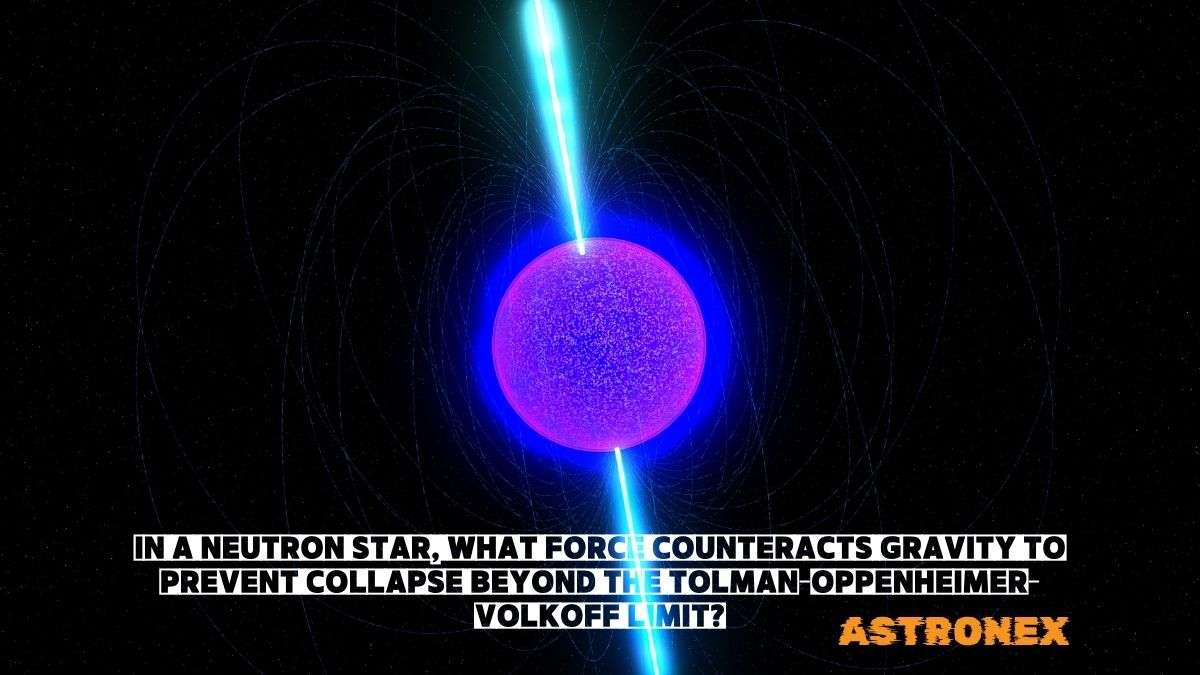
Neutron stars are supported against gravitational collapse primarily by the pressure gradient arising from neutron degeneracy pressure, a quantum mechanical effect stemming from the Pauli exclusion principle applied to neutrons, supplemented by short-range repulsive interactions between neutrons due to the strong nuclear force. This support mechanism maintains stability for neutron star masses up to the Tolman-Oppenheimer-Volkoff limit, estimated to lie between approximately 2 and 3 solar masses depending on the equation of state for ultradense matter. Beyond this mass limit, the pressure gradient is insufficient to counteract gravity, resulting in inevitable collapse to a black hole.
Neutron stars form as the remnants of massive stars, typically those with initial masses between 10 and 25 solar masses, following a core-collapse supernova explosion. During the supernova, the star’s iron core becomes unstable when it reaches about 1.4 solar masses, as nuclear fusion can no longer provide thermal pressure to oppose gravity. The core collapses rapidly, with protons and electrons combining via inverse beta decay to form neutrons and neutrinos. The neutrinos escape, carrying away energy, while the infalling material bounces off the dense proto-neutron star core, driving the supernova explosion that ejects the outer layers.
In ordinary stars, hydrostatic equilibrium is maintained by the gradient in thermal pressure balancing the inward gravitational force. However, in neutron stars, the extreme densities—reaching up to 10^17 kilograms per cubic meter in the core, comparable to atomic nuclei—render thermal pressure negligible. Instead, the primary support comes from degeneracy pressure, which arises because neutrons are fermions and obey the Pauli exclusion principle. This principle prohibits multiple neutrons from occupying the same quantum state, leading to a resistance against compression that is independent of temperature.
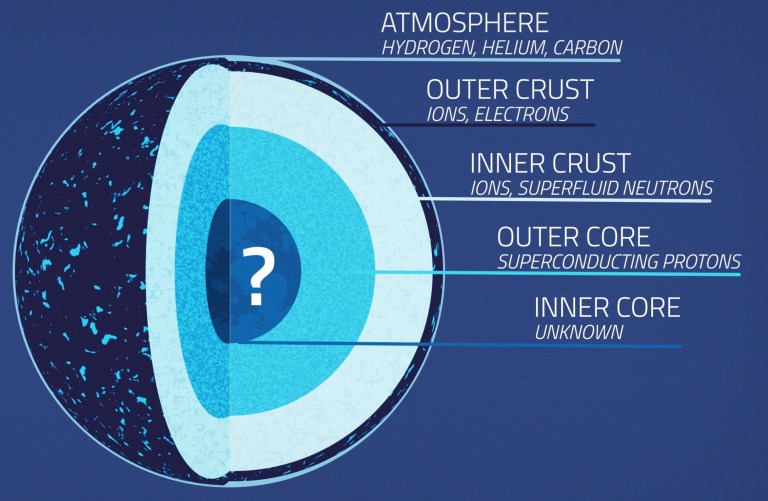
The internal structure of a neutron star consists of several distinct layers, determined by density and composition. The outermost layer is a thin atmosphere of ionized atoms, followed by a solid crust composed of iron nuclei in a lattice immersed in a sea of degenerate electrons. Deeper in, the crust transitions to a region where neutrons drip out of nuclei, forming a neutron-rich fluid. The core, which contains most of the mass, is primarily a superfluid of neutrons with a small fraction of protons and electrons, potentially including exotic phases at the highest densities.
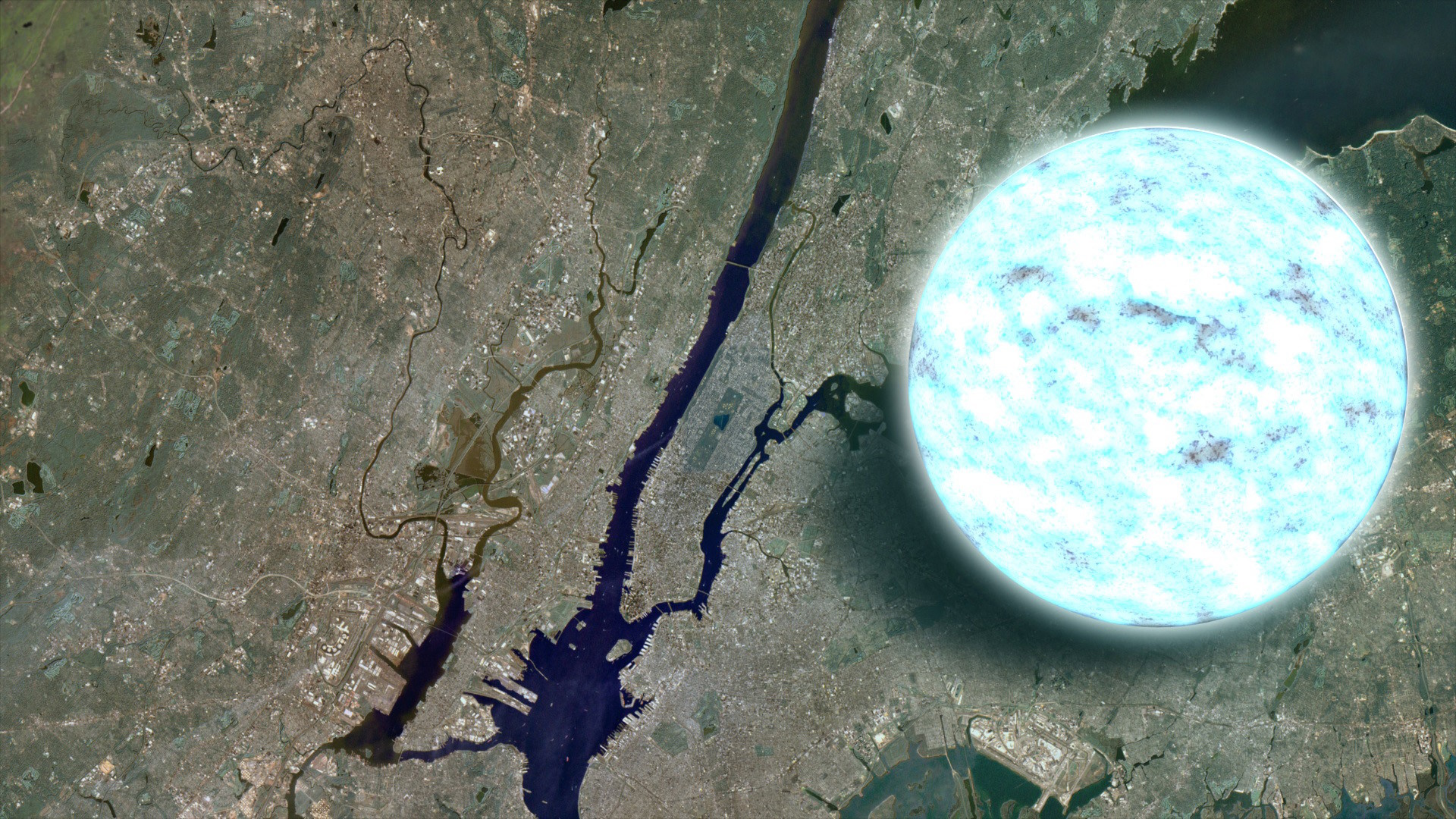
Neutron stars typically have masses between 1.2 and 2 solar masses, with radii of about 10 to 15 kilometers. This results in extraordinary densities, where a teaspoonful of neutron star material would weigh billions of tons on Earth. For comparison, the Sun has a radius of 696000 kilometers and a mass of 1 solar mass, while Earth has a radius of 6371 kilometers and a mass of about 3 times 10-6 solar masses.
The equilibrium configuration of a neutron star is described by the Tolman-Oppenheimer-Volkoff equation, which generalizes the Newtonian hydrostatic equilibrium equation to include effects from general relativity. The TOV equation is given by:
where P(r) is the pressure at radius , is the density, is the enclosed mass within , is the gravitational constant, and c is the speed of light. This equation accounts for relativistic corrections to gravity, energy density contributions from pressure, and the curvature of spacetime. A second equation relates the enclosed mass to density:
To solve these, an equation of state relating pressure to density is required, derived from nuclear physics models.
The exact value of the Tolman-Oppenheimer-Volkoff limit remains uncertain due to incomplete knowledge of the equation of state at supranuclear densities. Theoretical models incorporating realistic nuclear interactions predict limits ranging from 2.2 to 2.9 solar masses. Observations of neutron star masses provide constraints; the most massive confirmed neutron star, PSR J0952-0607, has a mass of 2.35 ± 0.17 solar masses, while others like PSR J0740+6620 measure 2.08 ± 0.07 solar masses. These measurements come from timing radio pulses in binary systems, where orbital dynamics reveal masses via general relativistic effects such as Shapiro delay.
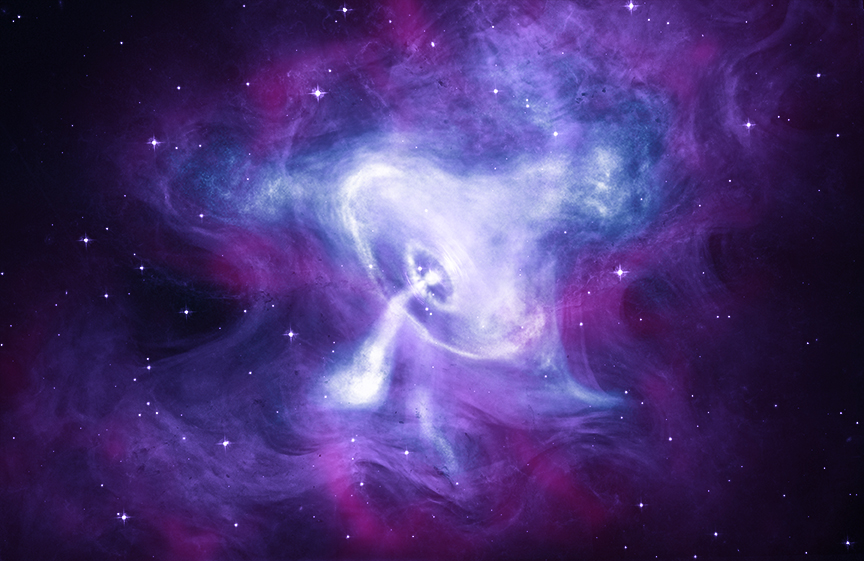
Observational evidence for neutron stars includes detections of pulsars, which are rapidly rotating neutron stars emitting beamed radiation, often observed in X-rays and radio wavelengths. Instruments like NASA’s Chandra X-ray Observatory have imaged remnants containing neutron stars, providing data on their emission properties and confirming theoretical predictions about their cooling and magnetic fields.
Beyond the Tolman-Oppenheimer-Volkoff limit, the star becomes unstable, and small perturbations can trigger collapse. The dependencies include the star’s rotation, which can slightly increase the maximum stable mass by providing centrifugal support, and magnetic fields, though their effects are minor for stability. If the mass exceeds the limit—potentially through accretion in a binary system or merger with another compact object—the core collapses on a dynamical timescale of milliseconds. Gravitational wave detections, such as GW170817 from a neutron star merger, offer insights into the equation of state and the transition to black holes.
Hypothetical exotic states, such as quark matter where neutrons dissolve into free quarks, may exist in the cores of the most massive neutron stars, potentially altering the limit slightly. However, whether such phases prevent collapse beyond the standard TOV limit or lead to distinct quark stars remains an open question, with no definitive observational evidence yet. In most models, exceeding the limit results in direct formation of a stellar-mass black hole, where gravity overwhelms all known pressures, leading to a singularity surrounded by an event horizon.
The implications extend to understanding stellar evolution, supernova mechanisms, and the population of compact objects in the universe. Neutron stars near the limit probe extreme physics, including potential violations of general relativity or new particles, though current data align with established theories. Limitations in modeling arise from uncertainties in nuclear interactions at high densities, which laboratory experiments like those at heavy-ion colliders aim to constrain, but extrapolations to neutron star conditions involve approximations.
📌 Frequently Asked Questions
What is the Tolman-Oppenheimer-Volkoff limit?
The Tolman-Oppenheimer-Volkoff limit is the theoretical maximum mass for a stable, non-rotating neutron star, beyond which gravitational collapse into a black hole occurs. It arises from solving the equations of hydrostatic equilibrium in general relativity using an equation of state for neutron matter. Current estimates place this limit between 2 and 3 solar masses, though the precise value depends on details of nuclear physics that are not fully resolved.
What prevents a neutron star from collapsing?
A neutron star is prevented from collapsing by the outward pressure gradient from neutron degeneracy pressure and repulsive strong nuclear forces between neutrons. These mechanisms balance the inward gravitational pull, maintaining hydrostatic equilibrium. If the mass remains below the Tolman-Oppenheimer-Volkoff limit, this balance holds; otherwise, collapse ensues.
How does a neutron star become a black hole?
A neutron star can become a black hole if its mass exceeds the Tolman-Oppenheimer-Volkoff limit, typically through accretion of material from a companion star or merger with another neutron star. When this happens, the supporting pressures are overwhelmed by gravity, leading to rapid collapse. The process forms an event horizon, with the original matter compressing into a singularity.
What is neutron degeneracy pressure?
Neutron degeneracy pressure is a quantum mechanical effect resulting from the Pauli exclusion principle, which prevents identical fermions like neutrons from occupying the same quantum state. In a neutron star, this creates a resistance to compression, providing support against gravity independent of temperature. It dominates in the core, where densities are extreme, and is analogous to electron degeneracy pressure in white dwarfs.
What is the maximum mass of a neutron star?
The maximum mass of a neutron star is constrained by the Tolman-Oppenheimer-Volkoff limit, estimated at 2 to 3 solar masses based on theoretical models and observations. The heaviest observed neutron stars have masses around 2.35 solar masses, supporting these estimates. Rotation can allow slightly higher masses, but exceeding the limit inevitably leads to black hole formation.