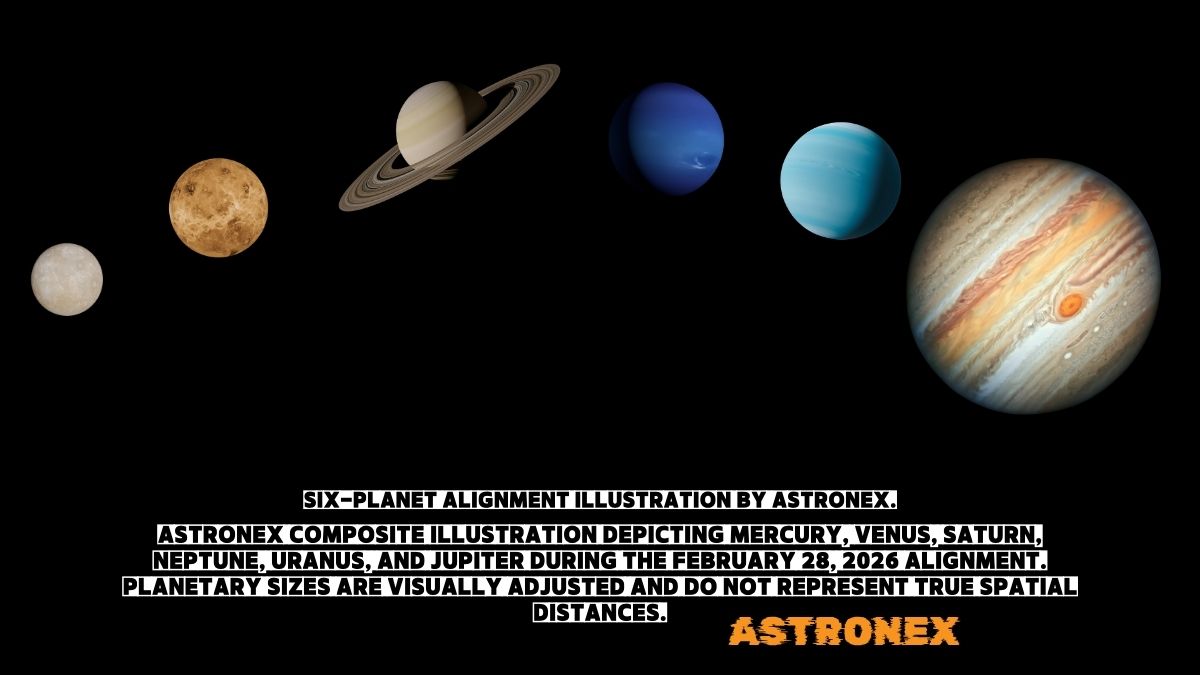
Skywatchers around the world are gearing up for an impressive celestial display as six planets from our solar system appear to line up in the evening sky. This event, known as a planetary parade, occurs when multiple planets are visible along the same general path across the sky, following the plane of the ecliptic (the apparent path the Sun takes through the stars). On February 28, 2026, Mercury, Venus, Saturn, Neptune, Uranus, and Jupiter will all be positioned in a way that allows observers on Earth to see them shortly after sunset, creating a sweeping arc from the western horizon to the southeast. According to NASA’s 2026 astronomical events overview, four of these planets can be spotted with the naked eye under clear conditions, while the other two require optical aids like binoculars or a telescope. This alignment highlights the dynamic nature of our solar system, where planetary orbits bring these worlds into visual harmony from our perspective.
The parade builds throughout February, with planets gradually shifting into position. Mid-month, Saturn sits low near the horizon, while Venus and Mercury rise higher in the west-southwest. Jupiter dominates higher up, and distant Uranus and Neptune join near Saturn. By the end of the month, the configuration peaks, offering an opportunity to witness such a broad spread of planetary bodies at once. Events like this remind us of the vast scales involved, with distances ranging from Mercury’s average 58 million kilometers (36 million miles) from the Sun to Neptune’s 4.5 billion kilometers (2.8 billion miles). But what makes this particular alignment stand out, and how can you make the most of it?
Have you ever wondered how often six planets come together in the night sky like this?
What Is a Planetary Alignment?
A planetary alignment happens when several planets appear close together in the sky from Earth’s viewpoint, often along the ecliptic plane. This isn’t a true physical lineup in space, as planets orbit the Sun at different speeds and distances, but an optical illusion caused by our position in the solar system. For the February 28, 2026 event, the six planets span a wide arc, not a tight cluster, making it a “large alignment” rather than a compact one. Such configurations occur because all planets orbit in roughly the same flat disk, so their paths overlap along our line of sight periodically due to orbital geometry, with visibility depending on planetary spacing and sky position.
To visualize this, think of the solar system as a racetrack where inner planets like Mercury lap the outer ones like Neptune. When Earth is positioned just right, we see them strung out like beads on a string. The ecliptic’s tilt means alignments are more visible in certain seasons, and this February parade favors the evening sky. Fun fact: Alignments involving six or more planets are less common than those with three or four and occur periodically due to orbital geometry, with visibility depending on sky position and planetary spacing. For complex setups, astronomers use software to predict positions, ensuring accurate forecasts.
In scientific terms, the angular separation (the apparent distance in degrees between celestial objects) between these planets will range from about 10 to 30 degrees across the sky on peak night. This spread makes it accessible but requires a clear, unobstructed view. Comparisons help: It’s like seeing a family of worlds posing for a group photo, each at their own distance but captured in one frame.
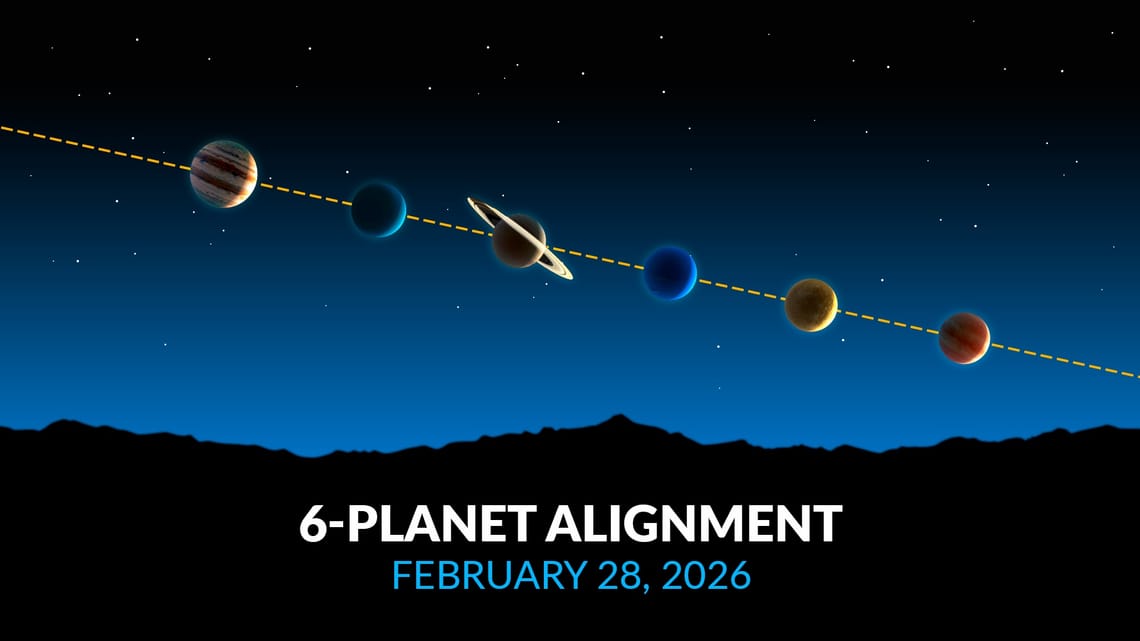
Which Planets Will Be Visible During the Six-Planet Alignment on February 28, 2026?
The lineup features Mercury, the innermost planet with an orbital period of 88 Earth days; Venus, often called Earth’s twin due to similar size but with a dense atmosphere; Saturn, famous for its rings spanning 282,000 kilometers (175,000 miles) in diameter; Neptune, the farthest ice giant at an average 30 astronomical units (AU, where 1 AU is 150 million kilometers or 93 million miles) from the Sun; Uranus, tilted on its side with a rotation axis nearly parallel to its orbit; and Jupiter, the largest planet with a mass 318 times Earth’s.
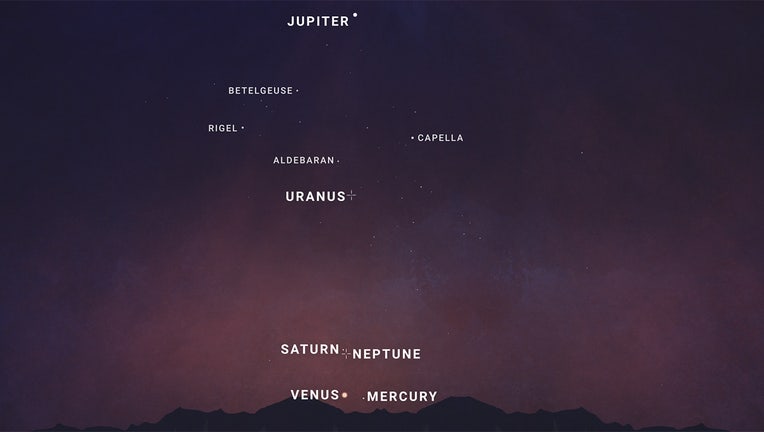
Starting from the west: Mercury and Venus hug the horizon, with Venus shining at magnitude -4.3 (a measure of brightness where lower numbers are brighter). Saturn and Neptune follow nearby, Saturn at magnitude 0.8 and Neptune dimmer at 7.9. Higher up, Uranus at magnitude 5.8 in the southwest, and Jupiter at -2.3 dominating the southeast. Each planet’s visibility depends on its distance and reflectivity (albedo, the fraction of sunlight reflected).
For example, Venus’s high albedo of 0.75 makes it outshine others, while Neptune’s 0.41 requires aids. This mix includes two terrestrial planets (Mercury, Venus), two gas giants (Jupiter, Saturn), and two ice giants (Uranus, Neptune), showcasing solar system diversity. Bullet points for quick reference:
- Mercury: Elusive, low in west.
- Venus: Brightest, easy spot.
- Saturn: Ringed, naked-eye.
- Neptune: Blue, telescope needed.
- Uranus: Greenish, binoculars help.
- Jupiter: Giant, prominent high.
How Can I View the Six-Planet Alignment?
Viewing requires a dark, clear site away from city lights, ideally with a western horizon free of obstacles like buildings or trees. Start 30 minutes after sunset to catch the low planets before they set. Use a star map app or chart to identify positions—Mercury near Venus low west, Saturn nearby, then scan up for Uranus, Neptune, and Jupiter. Weather plays a key role; check forecasts for cloud cover below 20%.
Binoculars (7×50 or similar, where 7 is magnification and 50 is lens diameter in mm) enhance dimmer planets, stabilizing them on a tripod for steady views. For Neptune and Uranus, a small telescope with at least 50mm aperture (lens size) reveals their disks, though colors may need higher power. Safety note: Never look at the Sun directly, even at twilight, to avoid eye damage.
Engaging tip: Compare brightness: Venus will be the brightest planet in the sky, though far dimmer than the Moon, while Jupiter’s four large moons (Io, Europa, Ganymede, Callisto) may be visible with binoculars under steady viewing conditions. If light pollution obscures the fainter planets, elevated locations with clear western horizons can improve visibility. The planets span well over 100 degrees of sky, requiring observers to scan from the western horizon toward the southeast.
When Is the Best Time to See the Planetary Parade in February 2026?
The peak is February 28, 2026, about 30-60 minutes after local sunset, when the sky darkens enough for planets to pop but before lower ones dip below the horizon. Sunset times vary: around 6:00 PM in mid-latitudes, so aim for 6:30 PM. The parade is visible mid-to-late February, but alignment tightens by month’s end. According to NASA’s February 2026 skywatching tips, mid-February sees Saturn lowering as Venus and Mercury rise, with optimal lineup late month.
Duration: Planets remain visible 1-2 hours post-sunset, but Mercury sets quickest, within 90 minutes. Moon phase matters—a waxing gibbous Moon on the 28th adds light but doesn’t overwhelm. For global viewers, northern hemisphere favors this evening event; southern sees similar but with adjusted horizons.
Tip: Set alarms for sunset, and use tools like theodolites or apps for precise timing. If missed, similar alignments occur, but this one’s scale is noteworthy.
What Makes This Alignment Rare?
Six-planet alignments are not annual events and occur periodically due to the differing orbital periods of the planets. Mercury’s 88-day orbit contrasts sharply with Neptune’s 165-year orbit, illustrating how orbital timing influences when such configurations become visible from Earth. This one excludes Mars and Earth, focusing on a specific subset. Rarity stems from including faint outer planets, visible only with aids, and the broad arc requiring good conditions.
Historically, similar events like the 2024 five-planet parade were tighter; this 2026 configuration spans a broader region of the sky. Large alignments involving six planets occur periodically due to the natural rhythms of planetary orbits. While ancient cultures sometimes interpreted such events as omens, modern astronomy explains them through well-understood orbital mechanics.
Uncertainty: Slight variations in predicted positions exist due to gravitational perturbations (small tugs from other bodies), but models are accurate within arcminutes (1/60th degree).
How Do Planetary Alignments Occur?
Alignments result from planets’ coplanar orbits around the Sun, with inclinations (tilts) under 7 degrees, so they appear near the ecliptic. Earth’s orbit defines this plane, and when planets’ longitudes (positions along orbit) cluster within 180 degrees, we see parades. Kepler’s laws govern speeds—inner planets move faster, overtaking outer ones.
For February 2026, synodic periods (time between alignments) align: Venus-Earth every 584 days, Jupiter every 399 days. This creates the visual effect. Diagram suggestion: A top-down solar system view shows planets’ positions on the 28th, with Earth as observer.
Comparisons: Like cars on a highway passing at different speeds, creating temporary groups.
What Equipment Do I Need to See All Six Planets?
Naked eye suffices for Venus, Jupiter, Saturn, and sometimes Mercury (magnitude -0.5 to 5.7, varying). For Uranus (magnitude 5.8) and Neptune (7.9), 10×50 binoculars reveal them as star-like points. A 4-inch telescope (100mm aperture) shows Uranus’s greenish hue and Neptune’s blue disk, about 2.2 arcseconds across (tiny angle).
Stabilize with tripods to reduce shake. Apps like Stellarium simulate views. No filters needed, but dark adaptation (20 minutes in dark) helps.
Bullet points:
- Naked eye: 4 planets.
- Binoculars: All 6 as points.
- Telescope: Details on giants.
Can I See the Alignment from My Location?
Visibility is global, but best from latitudes 30-60 degrees north or south, with clear western views. Urban areas need dark-sky sites; rural spots ideal. In urban areas with significant light pollution, fainter planets may be difficult to detect without optical aid.
Hemisphere differences: Northern sees higher Jupiter; equatorial equal. If cloudy, virtual observatories offer live streams.
What Other Astronomical Events Are Happening in 2026?
2026 features Jupiter at opposition January 10, appearing brightest at magnitude -2.8. Saturn-Moon conjunction January 23. Later, solar eclipses and meteor showers. This alignment fits a busy year.
Why Is the Ecliptic Important in Planetary Alignments?
The ecliptic is the Sun’s apparent path, defined by Earth’s orbit, with planets staying within 8 degrees of it due to formation from a spinning disk. This confines alignments to a band, aiding prediction. Zodiac constellations lie along it.
In 2026, planets trace this path post-sunset. Understanding helps appreciate solar system flatness.
Conclusion
The six-planet alignment peaking on February 28, 2026, reflects the coordinated motion of our solar system’s planetary orbits, with Mercury, Venus, Saturn, Neptune, Uranus, and Jupiter visible in a grand evening display. This event, backed by precise astronomical predictions, offers a chance to connect with the cosmos using simple tools or just your eyes. It underscores the predictability yet wonder of celestial mechanics.
What other sky events will you chase this year?
Sources
NASA. (2026, January 16). Most notable 2026 astronomical events: A year of watching the skies. NASA Blogs. https://www.nasa.gov/blogs/watch-the-skies/2026/01/16/most-notable-2026-astronomical-events-a-year-of-watching-the-skies
NASA. (2026, January 30). What’s up: February 2026 skywatching tips from NASA. NASA Science. https://science.nasa.gov/solar-system/whats-up-february-2026-skywatching-tips-from-nasa
📌 Frequently Asked Questions
What is a six-planet alignment?
A six-planet alignment is when six planets appear along the same arc in the sky from Earth, not physically lined up but visually due to orbits. It is a configuration that occurs periodically due to orbital geometry, with visibility depending on planetary spacing and sky position.
When does the six-planet alignment happen in 2026?
It peaks on February 28, 2026, after sunset, but is visible throughout late February as planets position themselves.
Which planets are in the February 2026 alignment?
Mercury, Venus, Saturn, Neptune, Uranus, and Jupiter participate, spanning from west to southeast.
Can I see the planetary alignment with the naked eye?
Yes, four planets, Mercury, Venus, Saturn, Jupiter, are visible without aids, but Uranus and Neptune need binoculars or telescopes.
What time should I look for the planet parade?
Look 30-60 minutes after local sunset on February 28 for the best view, before lower planets set.
Is the six-planet alignment rare?
Yes, large alignments involving six planets occur periodically due to orbital geometry, making this configuration particularly favorable for observers.
How do I find the planets in the sky?
Start low west for Mercury and Venus, then scan up for Saturn, Neptune, Uranus, and high for Jupiter using a star app.
Will the Moon interfere with viewing the alignment?
The Moon is waxing gibbous on February 28, adding light but not overwhelming the brighter planets.
Can I see the alignment from the southern hemisphere?
Yes, it’s visible worldwide, though the arc may appear differently based on latitude.
What equipment is best for seeing all six planets?
Naked eye for four, binoculars for Uranus, and a telescope for Neptune’s details.