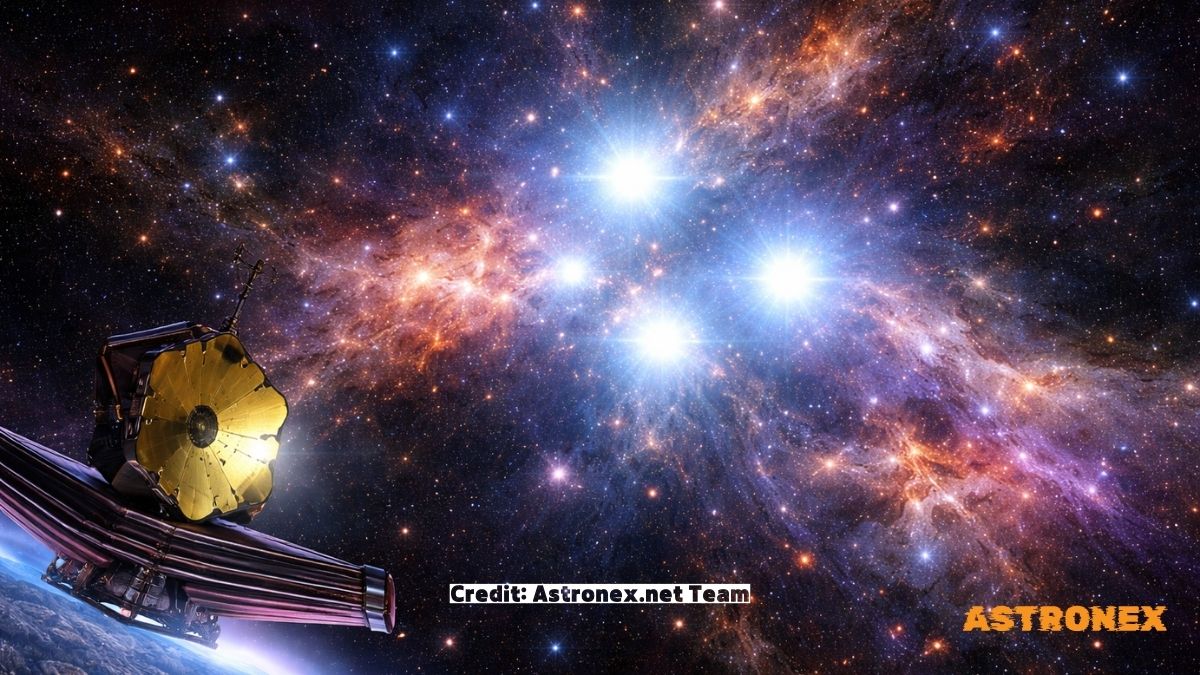
Astronomers have uncovered strong observational evidence for the existence of enormous primordial stars in the early universe through data from the James Webb Space Telescope. These monster stars, inferred to have masses between 1,000 and 10,000 times that of the Sun based on models, left behind distinct chemical signatures in a distant galaxy. The discovery provides insights into how supermassive black holes may have formed rapidly after the Big Bang.
The observations center on galaxy GS 3073 at a redshift of 5.55, corresponding to about one billion years after the Big Bang. Researchers detected an unusually high nitrogen-to-oxygen ratio of 0.46 in this galaxy. This chemical imbalance cannot be accounted for by ordinary stars or typical stellar explosions, suggesting instead the influence of these very massive primordial objects.
The evidence stems from detailed spectral analysis conducted by an international team led by researchers at the Center for Astrophysics, Harvard and Smithsonian. They examined the chemical composition of GS 3073, finding nitrogen enrichment that aligns with theoretical models of supermassive stars. In these models, during the helium-burning phase, carbon produced in the core leaks into a surrounding hydrogen shell. There, the carbon-nitrogen-oxygen cycle converts it into nitrogen, which convection then distributes throughout the star. Over millions of years, this nitrogen-rich material is ejected into space, altering the galaxy’s chemistry.
Dr. Devesh Nandal, a postdoctoral fellow at the Center for Astrophysics and lead author of the study, explained the significance. “Chemical abundances act like a cosmic fingerprint, and the pattern in GS 3073 is unlike anything ordinary stars can produce,” Nandal said. “Its extreme nitrogen matches only one kind of source we know of, primordial stars thousands of times more massive than our Sun. This tells us the first generation of stars included truly supermassive objects that helped shape the early galaxies and may have seeded today’s supermassive black holes.”
The team employed computer simulations to model the evolution of these stars, confirming that only those in the 1,000 to 10,000 solar mass range produce the observed nitrogen excess. Stars below this threshold do not generate enough of the element, while those above it evolve differently and lack the signature. The models encompassed phases from pre-main sequence to core collapse, showing how these brief-lived stars, predicted to last about 250,000 years, are expected to collapse directly into black holes without exploding. This process could allow them to seed massive black holes quickly, consistent with the presence of quasars in the young universe.
In GS 3073, the central black hole is actively feeding, and researchers suggest this could be consistent with a remnant of such a monster star. The galaxy’s spectrum, captured by Webb’s instruments, provided the high-resolution data necessary to measure these abundances accurately. Previous telescopes lacked the sensitivity to detect such faint signals from this epoch.
Dr. Daniel Whalen from the University of Portsmouth’s Institute of Cosmology and Gravitation highlighted the broader implications. “Our latest discovery helps solve a 20-year cosmic mystery,” Whalen noted. “With GS 3073, we have the first observational evidence that these monster stars existed. These cosmic giants would have burned brilliantly for a brief time before collapsing into massive black holes, leaving behind the chemical signatures we can detect billions of years later.”
The findings build on theoretical work predicting that such stars formed in rare turbulent gas streams during the cosmic Dark Ages. These conditions enabled gas clouds to collapse into supermassive stars rather than fragmenting into smaller ones. The nitrogen signature in GS 3073 is consistent with this scenario, offering a view into the universe’s first stellar generation.
Astronomers expect that ongoing observations with the James Webb Space Telescope, including those focused on monster stars in early galaxies, will uncover more systems with similar chemical patterns. This could further support the role of these primordial objects in enriching the early cosmos with heavier elements beyond hydrogen and helium.
The discovery highlights the capability of infrared observations to explore the universe’s infancy. By identifying these chemical fingerprints, scientists gain understanding of the mechanisms that transformed a simple, dark cosmos into one populated with galaxies and black holes.
In conclusion, the evidence from GS 3073 represents a significant step in comprehending the early universe’s stellar population. It suggests a pathway linking very massive primordial stars to the rapid formation of supermassive black holes, refining our models of cosmic evolution.
References
Nandal, D., Whalen, D. J., Woods, T. E., Meidt, S., Hirschmann, M., & Hartwig, T. (2025). 1000–10,000 M⊙ primordial stars created the nitrogen excess in GS 3073 at z = 5.55. The Astrophysical Journal Letters, 994(1), L11. https://doi.org/10.3847/2041-8213/ae1a63
Center for Astrophysics | Harvard & Smithsonian. (2025, November 12). Astronomers find first direct evidence of monster stars from cosmic dawn. https://www.cfa.harvard.edu/news/astronomers-find-first-direct-evidence-monster-stars-cosmic-dawn
Whalen, D. J. (2025, December 16). Monster stars from the cosmic dawn. EarthSky. https://earthsky.org/space/monster-stars-from-the-cosmic-dawn/