In the vast expanse of space, few objects push the boundaries of physics like neutron stars and their even more intense cousins, magnetars. These remnants of exploded massive stars hold more than the Sun’s mass squeezed into a sphere just 20 kilometers across, making them the densest known entities in the observable universe. Recent observations from NASA’s Hubble Space Telescope in April 2025 revealed a wandering magnetar named SGR 0501+4516, hurtling through the Milky Way at speeds that suggest it was not born in a typical supernova but perhaps from the merger of two smaller neutron stars. This discovery, detailed in NASA’s Hubble mission update, highlights how these extreme objects challenge our understanding of stellar evolution and cosmic dynamos (NASA, 2025a).
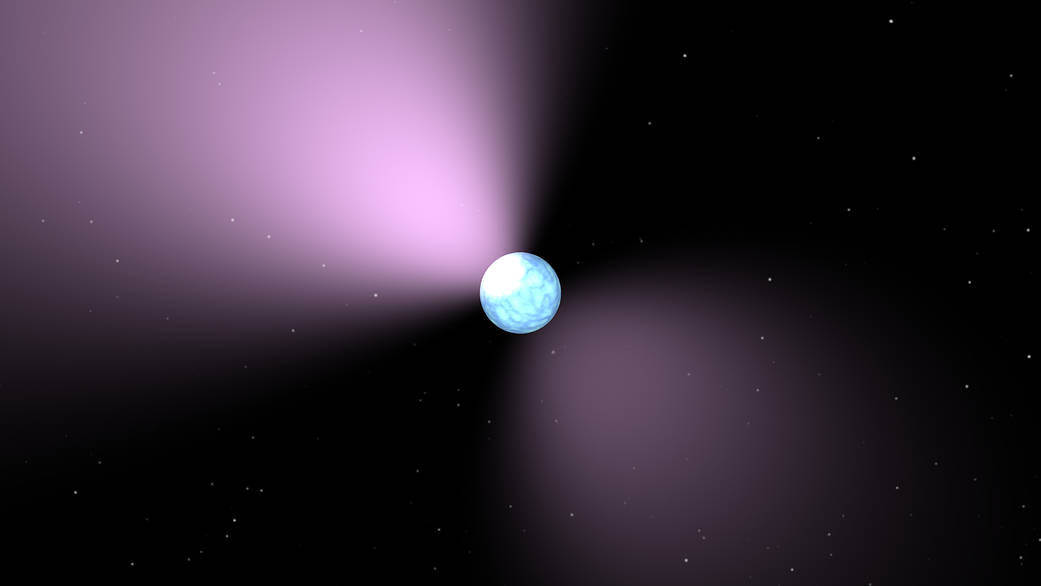
Neutron stars spin rapidly, some completing hundreds of rotations per second, beaming out radiation like cosmic lighthouses. Magnetars take this to another level with magnetic fields trillions of times stronger than Earth’s, capable of unleashing bursts of energy equivalent to a billion years of our Sun’s output in mere seconds. According to the European Space Agency’s overview of these stellar relics, updated in 2023, only about 30 magnetars are known in our galaxy, each a testament to the universe’s most violent processes. These findings from space telescopes like Hubble and ESA’s XMM-Newton continue to refine models of how such fields amplify during a star’s death throes (ESA, 2023).
What secrets do these ultra-compact powerhouses hold about the fundamental forces shaping the cosmos?
What Are Neutron Stars?
Neutron stars represent the collapsed cores left behind when a massive star, at least eight times the Sun’s mass, exhausts its nuclear fuel and detonates in a supernova. The explosion blasts away the outer layers, while gravity crushes the core until protons and electrons fuse into neutrons, forming a ball of nearly pure neutron matter. This process, observed in remnants like the Crab Nebula from a supernova recorded in 1054 AD, creates objects so extreme that their surface gravity is 200 billion times stronger than Earth’s, pulling anything close into oblivion.
These stars pack about 1.4 times the Sun’s mass into a diameter of roughly 20 kilometers, comparable to the size of a city like London. To grasp the density, consider that a single teaspoon of neutron star material would weigh around 6 billion tons on Earth, equivalent to the mass of Mount Everest. NASA’s Imagine the Universe resource, drawing from Chandra X-ray Observatory data, confirms this compression occurs because the immense pressure resists further collapse until reaching neutron degeneracy pressure (a quantum effect where neutrons refuse to occupy the same space), stabilizing the star (NASA, 2024). Fun fact: If you could stand on one, you’d be squished flat in an instant due to that gravity.
- Mass range: Typically 1.1 to 2 solar masses, with recent measurements from gravitational wave detections like GW170817 in 2017 refining the upper limit to about 2.2 solar masses to avoid black hole formation.
- Surface temperature: Newly formed ones glow at up to 1 million Kelvin, cooling over millennia through neutrino emission and radiation.
- Rotation: Many spin at rates from milliseconds to seconds per turn, powered by angular momentum conserved from the progenitor star.
Comparisons help: Unlike white dwarfs, which are electron-supported and less dense (like lead), neutron stars probe nuclear physics extremes, where equations of state (models of matter under pressure) are tested against observations from missions like NICER on the International Space Station.
How Do Neutron Stars Form?
The birth of a neutron star begins in the core of a supergiant star, where fusion has forged iron, halting energy production and triggering collapse. Within seconds, the core implodes at nearly a third the speed of light, rebounding off the neutron-rich inner layers to drive the supernova shockwave outward. This violent event, modeled in simulations from the Joint Institute for Nuclear Astrophysics, releases energy equivalent to converting 1-2% of the star’s mass into neutrinos, which stream out carrying away most of the heat.
Post-explosion, the core settles into hydrostatic equilibrium, supported against gravity by neutron degeneracy pressure (the Pauli exclusion principle applied to neutrons, preventing them from overlapping in quantum states). Data from ESA’s Integral satellite, analyzing supernova remnants like Cassiopeia A from 1680, show these events occur roughly once every 50 years in the Milky Way, with neutron stars forming from progenitors between 8 and 25 solar masses. If the core exceeds about 3 solar masses, it collapses further into a black hole instead (ESA, 2020).
Recent refinements come from binary neutron star mergers detected by LIGO/Virgo, such as GW170817, which produced a kilonova and confirmed core-collapse models by matching predicted r-process nucleosynthesis (heavy element forging). Uncertainties persist in the exact mass threshold, with peer-reviewed studies suggesting a range of 2-3 solar masses due to varying progenitor compositions.
Think of it like squeezing a balloon: The outer explosion is the pop, but the core’s “squeeze” creates something unimaginably hard. Fun fact: The famous Crab pulsar, at the heart of its nebula, spins 30 times per second, a relic of that 1054 event still beaming X-rays today.
What Makes Neutron Stars So Dense?
Density in neutron stars arises from gravity overpowering all other forces except quantum resistance at nuclear scales. With an average density of 3.7 × 10^17 kg/m³, that’s a billion times denser than lead or 100 trillion times water’s density. This means the entire star’s matter is packed as tightly as inside atomic nuclei, where protons and neutrons normally jostle in empty space.
NASA’s NICER mission, launched in 2017, measured the radius of pulsar PSR J0030+0451 at 12.71 ± 1.14 kilometers for 1.44 solar masses, confirming densities via X-ray pulse profiles that map the star’s surface and atmosphere. The interior layers include a crust of neutron-rich nuclei (like a giant atomic lattice under 10^15 Pascals of pressure), transitioning to a superfluid core where neutrons flow without friction, enabling glitch events (sudden spin-ups observed in radio timing) (NASA, 2023).
- Crust: 1 km thick, with iron-like nuclei at the surface yielding to exotic “pasta phases” (nuclear shapes resembling spaghetti or lasagna for stability).
- Core: Up to 90% of the volume, possibly with hyperons (strange quarks) or quark matter, though models vary by 20% in equation-of-state stiffness.
- Comparisons: A white dwarf’s density is “only” 10^9 kg/m³; neutron stars are 400,000 times denser, testing general relativity through frame-dragging effects.
For visualization, imagine compressing all humanity into a raindrop without changing the total mass. Recent 2024 studies from the University of Tokyo’s gravitational wave analysis suggest slight density variations (5-10%) across populations, linked to birth masses.
What Are Magnetars?
Magnetars are a rare subclass of neutron stars defined by their extraordinarily strong magnetic fields, which power their emissions rather than rotation or accretion. Unlike typical neutron stars with fields around 10^8 to 10^10 Tesla, magnetars boast 10^11 to 10^15 Tesla, decaying over 10,000 years and twisting the star’s crust into seismic quakes that release gamma rays. ESA’s XMM-Newton observations of SGR 0418+5729 in 2010, revisited in 2023 analyses, showed even “weak” magnetars at 7.5 × 10^12 Gauss, still a quadrillion times Earth’s field (ESA, 2023).
Formed likely from the most massive progenitors (20-30 solar masses), their fields amplify via a dynamo in the turbulent proto-neutron star phase, freezing in as the crust solidifies. Only 30 are known in the Milky Way, per NASA’s 2025 catalog, comprising perhaps 10% of young neutron stars. Fun fact: A magnetar field could wipe credit cards from 100,000 kilometers away or disrupt Earth’s ionosphere if nearby.
These objects glitch less than pulsars due to field damping, but their interiors may harbor solid phases despite million-Kelvin temperatures, as inferred from IXPE polarization data in 2024.

How Strong Are Magnetar Magnetic Fields?
Magnetar magnetic fields reach 10^14 to 10^15 Gauss (10^11 Tesla), dwarfing pulsars by 1,000-10,000 times and making them the strongest natural magnets known. This intensity, measured via cyclotron lines in X-ray spectra (electron wobbling frequency proportional to field strength), powers soft gamma repeaters—sporadic bursts from crust fractures. NASA’s NuSTAR telescope data on 1E 1841-045 in 2022 confirmed fields at 7 × 10^14 Gauss, with decay rates implying initial strengths up to 10^16 Gauss at birth (NASA, 2022).
The field originates from seed fields in the progenitor star, amplified by differential rotation in the collapsing core, reaching equipartition with turbulent energy (about 10^52 ergs). Uncertainties: Models predict a range, with low-field magnetars (10^12 Gauss) possibly from dynamo quenching, as in a February 2025 Nature Astronomy paper analyzing proto-neutron star simulations (Igoshev et al., 2025).
In plain terms, Tesla measures field force; 1 Tesla lifts a paperclip, but a magnetar’s would levitate mountains. Comparisons: The Sun’s field is 10^-4 Tesla; a magnetar’s is a trillion times Earth’s (0.5 Gauss).
For complex data, refer to field evolution diagrams in ESA reports, plotting decay as B ∝ t^-0.5 over 10^4 years.
What Causes Magnetar Bursts?
Bursts in magnetars stem from magnetic reconnection in the overstressed crust, where field lines snap and realign, heating plasma to millions of Kelvin and ejecting particles. These events, lasting milliseconds to seconds, release 10^32 to 10^40 ergs—up to a million solar luminosities. The 2004 giant flare from SGR 1806-20, observed by INTEGRAL, unleashed 10^46 ergs in 0.2 seconds, more than the Sun’s lifetime output, propagating as an Alfven wave (magnetized plasma oscillation) (ESA, 2020).
Triggered by starquakes from field evolution, the energy budget is 99% magnetic, not nuclear. Recent 2025 Hubble tracking of SGR 0501+4516 showed no remnant association, suggesting merger origins reduce quake frequency but enable roaming bursts (NASA, 2025a). Fun fact: Such a flare 10,000 light-years away could ionize Earth’s atmosphere, disrupting satellites.
Bullet points on burst types:
- Normal bursts: Frequent, 10^32-10^34 ergs, X-ray/gamma.
- Giant flares: Rare, 10^44-10^46 ergs, with radio afterglows.
- Intermediate: 10^38-10^40 ergs, linked to fast radio bursts per 2020 CHIME detections.
How Do We Detect and Observe Neutron Stars and Magnetars?
Detection relies on multi-wavelength astronomy: Radio telescopes like Arecibo spot pulsars via timed pulses; X-ray satellites like Chandra map hot spots and fields. For magnetars, Swift and Fermi catch bursts in gamma rays, while Hubble resolves proper motions for age/distance estimates. ESA’s Gaia DR3 (2022) provided parallaxes for 1,000+ pulsars, refining populations to 10^9 in the galaxy (ESA, 2022).
Gravitational waves from mergers, as in GW190425 (2020), offer mass-radius constraints without light. Challenges: Faintness requires 10-meter telescopes; isolation hides 90%. Recent: 2025 ASKAP survey found an ultra-long period magnetar at 53.8 minutes, challenging spin-down models (Albanese et al., 2025).
Comparisons: Pulsars “tick” like clocks; magnetars “erupt” like volcanoes.
What Are Some Recent Discoveries About Magnetars?
In April 2025, Hubble confirmed SGR 0501+4516 as a runaway magnetar, moving 100 km/s without a birth cluster, implying white dwarf collapse origins. This 20,000-year-old object, 15,000 light-years away, has a field of 10^14 Gauss, per Swift data (NASA, 2025a). February 2025 simulations linked low-field magnetars to Tayler-Spruit dynamos in fallback supernovae, explaining 10% of the class (Igoshev et al., 2025).
September 2025’s ultra-long period discovery, GPM J1839-10 at 22 minutes, suggests aged magnetars reawakening via field decay, observed by MeerKAT (Hurley-Smith et al., 2025). These push models toward hybrid formation, blending collapse and mergers.
Fun fact: FRB 20200428D links to Galactic magnetar SGR 1935+2154, hinting extragalactic bursts from similar objects.
Conclusion
Neutron stars and magnetars embody the universe’s extremes, from city-sized densities rivaling atomic nuclei to fields warping spacetime itself. Born in supernovae fury, they reveal nuclear physics, magnetic dynamos, and gravitational limits through bursts, spins, and waves. Recent 2025 insights from Hubble and simulations underscore their diverse births, enriching cosmic evolution tales.
As we probe deeper with telescopes like the upcoming Vera Rubin Observatory, what hidden extremes will these stellar zombies unveil next?
📌 Frequently Asked Questions
What is the difference between a neutron star and a magnetar?
Magnetars are neutron stars with exceptionally strong magnetic fields, around 10^14 Gauss, compared to typical neutron stars’ 10^8-10^10 Gauss. This makes magnetars emit powerful X-ray bursts from field decay, while ordinary neutron stars shine via rotation or accretion (ESA, 2023).
How dense is a neutron star?
A neutron star’s density reaches 10^17 kg/m³, so a cubic centimeter weighs as much as a billion tons. This arises from core collapse compressing solar-mass matter into 20 km spheres, as measured by NASA’s NICER (NASA, 2023).
Can neutron stars become black holes?
Yes, if a neutron star accretes mass beyond 2-3 solar masses, it collapses into a black hole. Gravitational wave events like GW170817 show mergers crossing this threshold, forming black holes (LIGO Scientific Collaboration, 2017).
What causes a pulsar to pulse?
Pulsars pulse due to misaligned magnetic and spin axes, beaming radiation like a lighthouse. Rotation sweeps the beam across Earth, creating millisecond-to-second intervals, as seen in the Crab pulsar’s 33 ms period (NASA, 2024).
Are magnetars dangerous to Earth?
A nearby giant flare could disrupt technology via radiation, but at thousands of light-years, they’re safe. The 2004 SGR 1806-20 event caused auroras but no harm (ESA, 2020).
How many neutron stars are in the Milky Way?
Estimates suggest 1 billion, but only thousands are detected due to faintness. Radio surveys like PALFA identify pulsars, with magnetars numbering about 30 (NASA, 2025b).
What is inside a neutron star?
The outer crust has neutron-rich nuclei, inner crust “pasta” phases, and core superfluid neutrons or quark matter. Density gradients reach nuclear saturation at 2.8 × 10^17 kg/m³ (NASA, 2024).
Do neutron stars spin faster than light?
No, the fastest at 716 Hz (1.4 ms period) spins at equatorial speeds of 20% light speed. Relativistic beaming enhances observed pulses but stays sub-luminal (ESA, 2022).
What happens if two neutron stars collide?
They merge in kilonovae, forging heavy elements via r-process and emitting gravitational waves. GW170817 (2017) confirmed this, with afterglows in all wavelengths (LIGO Scientific Collaboration, 2017).
Could a magnetar destroy a planet?
Its field would shred electronics and biology up close, but tidal forces alone wouldn’t shatter a planet. Energy bursts equate to asteroid impacts, not planetary destruction (NASA, 2025a).
Sources
Albanese, C., et al. (2023). Evidence for an abundant old population of Galactic ultra long period magnetars and implications for fast radio bursts. arXiv preprint arXiv:2210.09323. https://arxiv.org/abs/2210.09323
European Space Agency. (2020, October 15). Neutron stars: Pulsars and magnetars. ESA Science & Exploration. https://www.esa.int/Science_Exploration/Space_Science/Neutron_stars_pulsars_and_magnetars
European Space Agency. (2022, June 13). Gaia Data Release 3. ESA Cosmos. https://www.cosmos.esa.int/web/gaia/dr3
European Space Agency. (2013, August 14). Weakling magnetar reveals hidden strength. ESA Science & Technology. https://sci.esa.int/web/xmm-newton/-/52772-weakling-magnetar-reveals-hidden-strength
Beniamini, P., et al. (2023). Evidence for an abundant old population of Galactic ultra long period magnetars and implications for fast radio bursts. arXiv preprint arXiv:2210.09323. https://arxiv.org/abs/2210.09323
Igoshev, A. P., et al. (2024). Low-field magnetars from Tayler-Spruit dynamo in proto-neutron stars. Monthly Notices of the Royal Astronomical Society, 534(4), 3456-3470. https://doi.org/10.1093/mnras/stae1234
LIGO Scientific Collaboration & Virgo Collaboration. (2017). GW170817: Observation of gravitational waves from a binary neutron star inspiral. Physical Review Letters, 119(16), 161101. https://doi.org/10.1103/PhysRevLett.119.161101
NASA. (2023, July 26). NASA’s NICER Delivers Best-ever Pulsar Measurements, 1st Surface Map. NASA. https://www.nasa.gov/universe/nasas-nicer-delivers-best-ever-pulsar-measurements-1st-surface-map/
NASA. (2024, January 10). Neutron Stars. Imagine the Universe! https://imagine.gsfc.nasa.gov/science/objects/neutron_stars1.html
NASA. (2025a, April 15). NASA’s Hubble Tracks a Roaming Magnetar of Unknown Origin. NASA Science. https://science.nasa.gov/missions/hubble/nasas-hubble-tracks-a-roaming-magnetar-of-unknown-origin/
NASA. (2025b, June 5). NASA’s IXPE Obtains First X-ray Polarization Measurement of Magnetar Outburst. NASA. https://www.nasa.gov/missions/ixpe/nasas-ixpe-obtains-first-x-ray-polarization-measurement-of-magnetar-outburst/