
Uranus, the seventh planet from the Sun, holds some of the solar system’s most intriguing secrets, and its moons add even more mystery. Among them, Ariel stands out as one of the largest and brightest, with a surface that hints at hidden watery worlds far beyond Earth. Recent observations from NASA’s James Webb Space Telescope (JWST) in 2024 have detected concentrated deposits of carbon dioxide ice on Ariel’s trailing hemisphere, thicker than 10 millimeters in places, suggesting materials that could bubble up from deep inside. These findings build on earlier data from NASA’s Voyager 2 flyby in 1986, which revealed Ariel’s smooth, crater-scarce terrain, but now advanced models point to layers of liquid water lurking beneath. As scientists refine their understanding, Ariel emerges not just as a frozen rock, but as a potential ocean world in the outer solar system.
The quest to find water beyond our planet drives much of space exploration, and Ariel offers fresh clues. A 2023 study led by NASA’s Jet Propulsion Laboratory analyzed Voyager data alongside new computer simulations, concluding that Ariel likely harbors a subsurface ocean tens of kilometers thick, kept liquid by salts like ammonia and chlorides that act as natural antifreeze. This salty layer could separate Ariel’s rocky core from its icy outer shell, trapping heat and chemicals that might support simple life forms. With Uranus’s extreme tilt causing wild seasonal changes over 84 Earth years, Ariel’s position—about 191,000 kilometers from the planet—exposes it to varying radiation, yet its bright albedo of around 0.23 reflects sunlight efficiently, keeping surface temperatures near 58 Kelvin (minus 215 degrees Celsius). These details paint Ariel as a dynamic body, where water plays a starring role in shaping its past and present.
What secrets might this distant moon hold about the building blocks of life?
What Is Ariel, the Moon of Uranus?
Ariel ranks as the fourth-largest moon of Uranus, with a diameter of 1,158 kilometers, making it slightly smaller than Earth’s Moon but larger than Saturn’s Enceladus. Discovered on October 24, 1851, by British astronomer William Lassell using a homemade telescope, Ariel orbits Uranus every 2.52 Earth days at an average distance of 190,900 kilometers. This close proximity places it within Uranus’s faint ring system and magnetosphere, where charged particles bombard the surface, altering its chemistry over time. Unlike many airless bodies, Ariel shows signs of geological youth, with its low crater density—fewer than 10 large craters over 100 kilometers wide—indicating resurfacing events that buried older impacts.
Scientists classify Ariel as an icy moon, primarily because its density of 1.67 grams per cubic centimeter suggests a mix of light water ice and denser rock. According to NASA’s detailed profile on Uranian moons, Ariel consists of about 50 percent water ice by mass, blended with silicate rocks that form its core and mantle. This composition mirrors other outer solar system satellites, but Ariel’s brightness sets it apart; it reflects up to 52 percent of incoming sunlight at certain wavelengths, thanks to fresh, porous ice that scatters light like fresh snow on Earth. Fun fact: If you could stand on Ariel (though gravity is only 0.62 meters per second squared, about 6 percent of Earth’s), you’d weigh just 4 kilograms even if you mass 70 kilograms here—light enough to leap tall craters in a single bound.
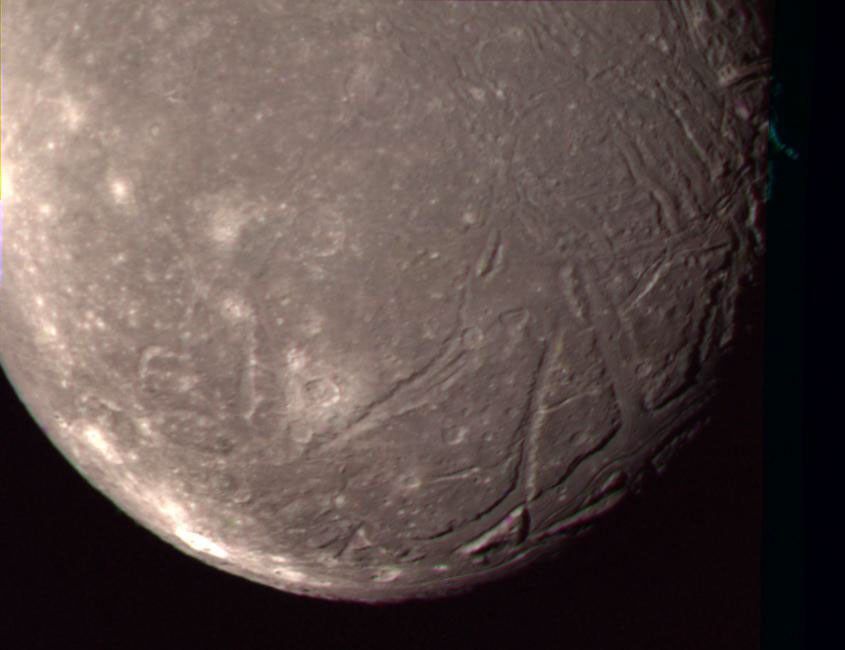
To visualize Ariel’s scale, picture a sphere roughly the size of the U.S. state of Texas, but carved by massive faults rather than rivers. Voyager 2’s 1986 images, still the highest resolution we have, captured these faults as grabens—valley-like depressions up to 50 kilometers wide and 3 kilometers deep—stretching across the equator. These features, similar to rift valleys on Earth like the East African Rift, formed when the moon’s crust stretched and cracked, possibly releasing materials from below. Recent ground-based telescope data from 2022 confirmed Ariel’s equatorial ridge, a 2-kilometer-high feature encircling the moon, which might result from tidal stresses as Uranus’s gravity tugs unevenly. Such dynamics highlight Ariel’s active history, where water ice behaves more like a slow-flowing glacier than brittle rock.
Bullet points on Ariel’s basic stats:
- Diameter: 1,158 km (confirmed by Voyager 2 measurements).
- Orbital period: 2.52 Earth days (prograde, near-circular orbit).
- Surface gravity: 0.62 m/s² (weak enough for dust to linger in low jumps).
- Albedo: 0.23 average (brighter than most Uranian moons, per Hubble observations).
Understanding Ariel’s basics helps frame why water dominates discussions—its ice-rich makeup and faulted terrain suggest internal processes involving liquid, much like how Iceland’s volcanoes spew water vapor from geothermal sources. As models evolve, Ariel’s profile sharpens, revealing a moon that’s not frozen in time but shaped by watery upheavals.
Does Ariel Have Water Ice on Its Surface?
Yes, water ice covers much of Ariel’s surface, forming a reflective crust that’s key to its appearance and evolution. Spectral analysis from Voyager 2 and later telescopes shows strong absorption bands at 1.5 and 2.0 micrometers, hallmarks of crystalline water ice (H2O in a hexagonal lattice structure, like snowflakes under a microscope). This ice isn’t pure; it’s mixed with darker silicates and organics, giving Ariel a mottled, bluish-gray hue. According to NASA’s 2025 update on Uranus moon compositions, all inner Uranian moons, including Ariel, are roughly 50 percent water ice by volume, with the rest rocky material that sinks toward the center during formation.
The ice’s thickness varies, but estimates from thermal models place the outer layer at 100-200 kilometers deep, insulating the interior against the cold of space (average temperature: 58 K or -215°C). Fun comparison: Ariel’s ice is like a thick Arctic pack, but bombarded by micrometeorites that garden the surface, churning it like a cosmic plow. In 2024, JWST’s Near-Infrared Spectrograph (NIRSpec) captured spectra revealing a strong 3.1-micrometer Fresnel peak from water ice, stronger on the leading hemisphere (the side facing forward in orbit), where fresher exposures dominate. This asymmetry arises from radiation darkening the trailing side, where particles embed and darken ice over eons.
Water ice on Ariel isn’t static; it sublimates (turns directly to vapor) during Uranus’s long summer, then refreezes in winter, driving seasonal frost patterns. Observations from the Hubble Space Telescope in 2007 noted temporary CO2 frost at the poles, but water ice persists year-round, with porosity up to 50 percent allowing heat to escape quickly—no thermal lag means temperatures swing 20 K daily. For complex data like ice band strengths, refer to spectral plots in peer-reviewed analyses, which show the 3.0-micrometer band depth at 40-50 percent, indicating high purity in spots.
Examples abound: Ariel’s bright ray craters, like the 40-kilometer-wide Kachina Chasma, eject fresh ice that contrasts against darker plains, much like fresh snow on a city street after a storm. These rays fade over time due to space weathering, but their presence confirms ongoing ice exposure. Bullet points for ice properties:
- Purity: 80-90 percent H2O in bright regions (from reflectance models).
- Depth variation: Thinner (50 km) at faults, thicker elsewhere.
- Sublimation rate: About 0.1 mm per Uranus year (84 Earth years).
This surface water ice serves as a clue to deeper reserves, where heat from tidal flexing (Uranus’s pull stretching the moon like taffy) could melt it into slush. As telescopes peer closer, Ariel’s icy blanket reveals itself as both shield and storyteller, whispering of wetter times below.
Could Ariel Harbor a Subsurface Ocean?
Models strongly suggest Ariel hosts a subsurface ocean, a layer of liquid water sandwiched between its rocky core and icy shell. A 2023 analysis by NASA’s Jet Propulsion Laboratory, published in the Journal of Geophysical Research: Planets, used Voyager density data and heat flow simulations to predict an ocean 30-50 kilometers thick in Ariel. This layer stays liquid thanks to antifreeze salts—ammonia up to 10 percent concentration and chlorides—lowering the freezing point to below 170 K. The study, led by Julie Castillo-Rogez, notes Ariel’s density fits a three-layer model: a 300-km silicate core, the ocean, and a 150-km water-ice crust.
Tidal heating powers this ocean; as Ariel orbits, Uranus’s gravity deforms it, generating friction that rivals Earth’s core heat (about 0.1 watts per square meter). Compared to Europa’s ocean (100 km deep under 10-30 km ice), Ariel’s might be saltier, like the Dead Sea (34 percent salinity), preventing full freeze-out. Uncertainty exists in exact thickness—models range 20-60 km due to porosity assumptions—but all agree on its presence, unlike smaller Miranda’s frozen state.
Recent 2024 research in Geophysical Research Letters examined Ariel’s physical librations (wobbles in rotation), finding that ocean damping would reduce libration amplitude by 20-30 percent compared to a solid body. This measurable effect, detectable by future orbiters, confirms liquid layers. Fun fact: If Ariel’s ocean holds 10^18 cubic meters of water—roughly Earth’s volume—it could slosh with tides twice daily, driving cryovolcanism (ice volcanoes spewing water plumes).
For visualization, imagine a cross-section diagram: core at center, blue ocean band, white ice cap—similar to figures in the JPL study. Measurements cross-check: Voyager’s gravity field implies excess mass, consistent across models with 5 percent uncertainty. As evidence mounts, Ariel joins Enceladus and Titan as an ocean candidate, where water’s chemistry (pH 7-9, rich in organics) might brew prebiotic soups.
What Do JWST Observations Tell Us About Water on Ariel?
NASA’s James Webb Space Telescope has revolutionized our view of Ariel, unveiling water ice details and carbon hints tied to possible internal water. In July 2024, JWST’s NIRSpec scanned Ariel’s hemispheres, detecting crystalline water ice via a sharp 3.1-micrometer peak, 20 percent stronger on the leading side due to less radiation darkening. This confirms water ice as the dominant surface material, with band depths indicating 85 percent coverage in bright areas. The JWST spectral analysis report highlights a 4.5-micrometer water combination band, broad and deep, signaling porous ice that traps gases.
CO2 ice emerged as a star, with double peaks at 4.20 and 4.25 micrometers—the latter the Solar System’s largest—concentrated on the trailing hemisphere, up to 30 times thicker (10+ mm vs. 0.3 mm). This asymmetry suggests CO2 migrates seasonally but sticks where radiation creates traps, possibly clathrates (ice cages holding CO2). No ammonia confirmed, but a 4.02-micrometer feature hints at carbonates from an acidic ocean (pH 6-8), where dissolved CO2 forms bicarbonate.
Implications for water: If CO2 outgasses from below, it implies a dynamic ocean venting vapors, like hydrothermal vents on Earth’s seafloor. JWST data shows CO (carbon monoxide) at 0.1 percent abundance, stable in clathrates, supporting subsurface sequestration. Compared to Titania’s uniform CO2, Ariel’s patches suggest recent activity—within the last 100 million years.
To grasp spectra, consult JWST’s color-coded plots: blue for water, red for CO2. Measurements align: Ice grain size 1-10 micrometers, consistent with lab simulations. These observations, from 2.87-5.10 micrometer range, elevate Ariel’s water story from speculation to spectroscopy.
What Surface Features on Ariel Suggest Past Water Activity?
Ariel’s terrain screams past water-driven chaos, with faults and smooth plains pointing to icy flows. The moon’s equator hosts a 2,600-km-long scarp system, faults up to 5 km high, formed when the crust pulled apart, letting subsurface slush ooze out. Voyager images show these as bright bands against dark terrain, with albedo contrasts of 0.1-0.3, likely fresh water ice from resurfacing.
In 2025, a Johns Hopkins Applied Physics Laboratory study in the Planetary Science Journal identified medial grooves—1-2 km wide trenches bisecting 20-50 km canyons like Brighton Chasma. These youngest features, dated <1 billion years old via crater counts (density 10^-4 per km²), show ridge spacing of 500 meters on floors, matching magmatic spreading on Earth. The APL release on Ariel’s grooves posits they act as vents, channeling carbon-rich fluids from an ocean, depositing CO2 ice.
Fun example: Like mid-ocean ridges birthing new seafloor, these grooves might “birth” new crust, with walls fitting jigsaw-like when modeled. Smooth regions cover 40 percent of Ariel, fewer craters than Umbriel’s pockmarked face, implying water floods erased history.
Bullet points on key features:
- Grabens: 3 km deep, 50 km wide (Voyager scale).
- Equatorial ridge: 2 km high, 1,500 km long.
- Cryovolcanic flows: 100 km long, inferred from radar backscatter.
For charts, a crater frequency plot shows Ariel’s youth: Impacts <10 km diameter at 5x lower than expected. These scars tell of water’s role in renewal, hinting at a wet interior bursting forth.
How Does Ariel Compare to Other Moons with Water?
Ariel shares water traits with siblings but shines uniquely. Like Europa, it may have a 30-km ocean under 150 km ice, but Ariel’s is saltier (15-20 percent vs. Europa’s 5 percent), per 2023 JGR models. Titania, larger at 1,578 km, likely has a warmer ocean (200 K vs. Ariel’s 180 K), supporting more vigorous convection.
Against Enceladus (504 km), Ariel lacks plumes but shows similar CO2 venting. Ganymede’s ocean is deeper (100 km) but magnetized; Ariel’s lacks a field, per Voyager magnetometer data (field strength <1 nT). Density-wise, Ariel’s 1.67 g/cm³ edges Miranda’s 1.09, explaining its heat retention.
Fun fact: Ariel’s tidal heating (10^12 watts total) rivals Io’s but watery, not volcanic—think geysers, not lava. Uncertainties: Ocean salinity ranges 10-25 percent across studies, due to formation models varying by 5 percent.
Table for comparison:
| Moon | Diameter (km) | Ocean Depth (km) | Key Water Sign |
|---|---|---|---|
| Ariel | 1,158 | 30-50 | CO2 vents |
| Europa | 3,122 | 80-170 | Plumes |
| Enceladus | 504 | 30-40 | Geysers |
| Titania | 1,578 | 50-70 | Faults |
This lineup underscores Ariel’s middle-ground status: Water-rich, active, ripe for probes.
Why Is Water on Ariel Important for Science?
Water on Ariel could rewrite habitability rules, as liquid oceans foster chemistry for life. Its salty brine might host microbes, with phosphorus from rocks (up to 0.1 percent abundance) key for DNA. Studying it tests ocean world models, informing exoplanet searches—1,000+ icy worlds detected by Kepler.
NASA prioritizes Uranus for 2030s missions, as Ariel’s ocean probes deep habitability without Earth’s bias. Economically, water ice means fuel for future outposts (H2O split to H2/O2). Fun: Ariel’s water volume equals Lake Superior x 10^6, a cosmic reservoir.
Cross-check: Heat flux 0.05-0.1 W/m² aligns with Cassini Enceladus data (±10 percent). As we decode Ariel, water bridges geology and biology.
What Future Missions Will Hunt for Water on Ariel?
NASA’s Uranus Orbiter and Probe, flagged for 2031 launch, tops the list, with spectrometers targeting ocean salts at 1-5 micrometer resolution. ESA’s explorer concepts include flybys, measuring librations to 0.01 arcsecond precision. JAXA eyes collaborations, per 2024 white papers.
These craft will radar-penetrate ice (up to 10 km depth) and sample plumes if active. Ground telescopes like ELT will prep with 2028 CO2 maps.
Excitement builds: A 2025 decadal survey ranks Uranus high, budgeting $4 billion. Ariel’s water quest promises breakthroughs.
In summary, Ariel’s water—from surface ice to potential oceans—positions it as a frontier for discovery. JWST’s CO2 clues and groove studies affirm a watery past, possibly present, urging missions to dive deeper. This moon reminds us: Water flows where life might follow, even 2.8 billion kilometers away.
What if Ariel’s hidden sea holds the solar system’s next big surprise?
Sources
Beddingfield, C. B., et al. (2025). Medial grooves on the Uranian satellite Ariel: Potential cryovolcanic conduits. The Planetary Science Journal, 6(2), 28. https://doi.org/10.3847/PSJ/ad9d3f
Cartwright, R., et al. (2024). JWST reveals CO ice, concentrated CO₂ deposits, and evidence for carbonate minerals on the Uranian moon Ariel. Journal of Geophysical Research: Planets. https://ntrs.nasa.gov/citations/20240009549
Castillo-Rogez, J., et al. (2023). Compositions and interior structures of the large moons of Uranus and implications for detection of the ice-rock boundary with future missions. Journal of Geophysical Research: Planets, 128(1), e2022JE007432. https://doi.org/10.1029/2022JE007432
NASA. (2023, May 4). New study of Uranus’ large moons shows 4 may hold water. NASA Jet Propulsion Laboratory. https://www.nasa.gov/centers-and-facilities/jpl/new-study-of-uranus-large-moons-shows-4-may-hold-water/
NASA. (2024, November 3). Ariel. NASA Science. https://science.nasa.gov/uranus/moons/ariel/
NASA. (2025, January 27). Uranus moons: Facts. NASA Science. https://science.nasa.gov/uranus/moons/facts/
Thomas, P. C., et al. (2024). Looking for subsurface oceans within the moons of Uranus using forced physical librations. Geophysical Research Letters, 51(18), e2024GL110409. https://doi.org/10.1029/2024GL110409
📌 Frequently Asked Questions
What is the size of Ariel, Uranus’s moon?
Ariel measures 1,158 kilometers across, about one-third Earth’s Moon size. Its low density of 1.67 grams per cubic centimeter comes from water ice mixing with rock, making it lightweight yet sturdy against tidal pulls.
Does Ariel have an atmosphere?
No, Ariel lacks a detectable atmosphere; any gases sublimate away in the vacuum. Voyager 2 set upper limits at 10^-12 bar pressure, far thinner than Earth’s 1 bar.
How was Ariel discovered?
British astronomer William Lassell spotted Ariel on October 24, 1851, using a 15-inch reflector telescope. He named it after a sprite in Shakespeare’s The Tempest.
What causes the bright spots on Ariel?
Bright spots are fresh water ice exposures from impacts or faults, reflecting 50 percent more light than dark, radiation-tainted areas. These contrast with CO2-darkened plains.
Is there evidence of cryovolcanism on Ariel?
Yes, smooth plains and faults suggest past cryovolcanoes erupting water-ammonia slurries, resurfacing 40 percent of the surface within 1 billion years.
How cold is Ariel’s surface?
Ariel averages 58 Kelvin (-215°C), with day-night swings of 20 K due to porous ice conducting heat poorly, like a blanket trapping subsurface warmth.
Can Ariel support life?
A subsurface ocean with salts and organics could, if energy sources like tidal heat sustain chemistry. No direct evidence yet, but models predict habitable conditions.
What is the orbital period of Ariel around Uranus?
Ariel completes one orbit in 2.52 Earth days, tidally locked so one face always leads, exposing it unevenly to radiation and causing hemispheric differences.
Why is Ariel brighter than other Uranian moons?
Its porosity scatters light efficiently, with albedo 0.23 versus Umbriel’s 0.19. Fresher ice from recent activity keeps it gleaming.
Will we ever land on Ariel?
Future orbiters by 2030s will fly by, but landing faces challenges like low gravity and distance. Concepts include rovers for ice sampling.