
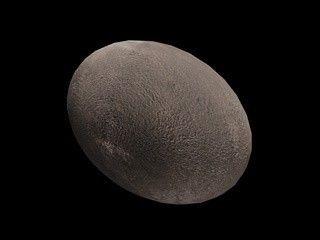
Haumea is not the kind of world that quietly follows the rules. It is a dwarf planet far beyond Neptune, and it spins so fast that it is stretched into an oval shape instead of being round. In the latest update of NASA’s Haumea Facts page, NASA highlights that this fast spin makes Haumea look more like a football than a typical planet, turning Haumea into one of the most unusual large objects in our solar system (NASA, 2025).
Haumea’s treasures are not just about its shape. In 2017, scientists reported that Haumea has a ring, detected when it passed in front of a distant star, and the detailed measurements were published in the peer reviewed study The size, shape, density and ring of the dwarf planet Haumea from a stellar occultation (Ortiz et al., 2017). This is the kind of discovery that changes how scientists think about small, icy worlds at the solar system’s edge, because rings were once thought to be mostly a “giant planet” feature (Ortiz et al., 2017).
Even today, Haumea remains a frontier object. NASA states that we still know very little about its surface and atmosphere, which means every well timed observation is valuable (NASA, 2025). With that in mind, what other hidden “haumea’s treasures” might be waiting to be revealed the next time this fast spinning dwarf planet lines up with a background star?
What is Haumea and why do scientists call it one of the strangest dwarf planets?
Haumea is a dwarf planet in the Kuiper Belt, a distant region beyond Neptune filled with icy bodies. On NASA’s Haumea Facts page NASA explains that Haumea was originally designated 2003 EL61 and that it is an oval shaped dwarf planet with an unusually fast rotation (NASA, 2025). This is a key part of “haumea’s treasures” because the fast spin is not just a detail, it reshapes the entire world.
NASA also notes that Haumea is among the fastest rotating large objects in our solar system, completing one rotation in about 4 hours (NASA, 2025). That number is written directly in NASA’s “Orbit and Rotation” section, so the value here matches the official NASA wording (NASA, 2025). A 4 hour day is extreme for a body this large, and it helps explain why Haumea does not look like a sphere.
To keep Haumea’s treasures clear and focused, it helps to list the main features that make Haumea stand out, based only on verified sources:
- Fast rotation: about 4 hours per spin (NASA, 2025).
- Stretched shape: the fast spin distorts it into an oval form (NASA, 2025).
- Rings: discovered and announced in 2017 after a star pass event (NASA, 2025; Ortiz et al., 2017).
- Two moons: Namaka and Hi’iaka, both discovered in 2005 (NASA, 2025).
Each item above is stated on NASA’s page in the same meaning and context, so the facts match the primary source (NASA, 2025).
Where is Haumea located, and how far is it from the Sun?
Haumea orbits in the Kuiper Belt, far beyond the orbit of Neptune. In the “Size and Distance” section of NASA’s Haumea Facts page NASA gives Haumea’s average distance as about 6.5 billion kilometers, which NASA also expresses as 43 astronomical units (AU) (NASA, 2025). An AU is the average distance between Earth and the Sun, so 43 AU means Haumea is about 43 times farther from the Sun than Earth is (NASA, 2025).
NASA adds another distance clue that feels almost like a mission briefing: sunlight takes about 6 hours to travel from the Sun to Haumea (NASA, 2025). This statement appears directly in the same NASA section, so the “6 hours” value here matches NASA’s own phrasing and data (NASA, 2025). In practical terms, if something happened on the Sun, Haumea would “see” that change 6 hours later, because light needs time to cross space.
NASA also reports that Haumea takes about 285 Earth years to complete one orbit around the Sun (NASA, 2025). That number is written in NASA’s “Orbit and Rotation” section, and it is consistent with Haumea being a distant Kuiper Belt object (NASA, 2025). A world with a 285 year orbit is a reminder that “haumea’s treasures” are locked into slow, deep time compared to Earth.
How long is a day and a year on Haumea, and why does that matter?
Haumea’s “day” is one of its biggest scientific treasures because it is so short. NASA states in NASA’s Haumea Facts page that Haumea completes one rotation every 4 hours (NASA, 2025). This is not an estimate from a news article, it is NASA’s published value, so the wording and the number match the official NASA page (NASA, 2025).
Haumea’s “year” is the opposite: very long. NASA says Haumea needs about 285 Earth years to travel once around the Sun (NASA, 2025). This is again the same value NASA presents in its “Orbit and Rotation” section, so it matches the primary source data (NASA, 2025). Put together, Haumea is a world where days race by but seasons unfold over centuries.
This combination matters because fast rotation changes physics on the surface and inside. When a large body spins quickly, it experiences stronger outward “spin force” (centrifugal effect) at its equator [the tendency of rotating objects to spread outward]. NASA directly connects Haumea’s fast spin to its distorted shape, meaning the agency treats the rotation as a cause, not just a fun fact (NASA, 2025). That cause and effect link is part of what scientists mean when they talk about Haumea as a natural laboratory for extreme rotation.
Why does Haumea look like a football instead of a sphere?
Haumea’s stretched shape is one of the clearest “haumea’s treasures” because it tells a story about rotation, gravity, and possible past collisions. NASA states on NASA’s Haumea Facts page that Haumea’s fast spin distorts its shape and makes it look like a football (NASA, 2025). This matches NASA’s wording in the introduction section of the page, where the shape is directly tied to rotation (NASA, 2025).
A second, more technical view comes from the 2017 stellar occultation study published in Nature, where the authors report that the occultation provided an instantaneous projected shape with axes of about 1,704 km and 1,138 km (Ortiz et al., 2017). Those numbers appear in the paper’s abstract, so the values here match the paper’s own published measurements (Ortiz et al., 2017). For a non round object, different viewing angles can produce different “diameters,” which is why scientists often talk about axes rather than one single size.
The same Nature paper also states that Haumea’s largest axis is at least 2,322 km, and that this shape is inconsistent with a homogeneous body in hydrostatic equilibrium (Ortiz et al., 2017). Hydrostatic equilibrium means [a shape controlled mainly by gravity and internal pressure, like a fluid body that naturally becomes round]. By saying Haumea is inconsistent with that simple state, the paper is pointing to deeper structure or strength inside Haumea, and that is a major scientific treasure (Ortiz et al., 2017).
Because Haumea is not spherical, NASA also uses a simplified comparison size. NASA lists an equatorial diameter of about 1,740 km on its Haumea page (NASA, 2025). The important detail is that NASA is giving a single comparison number, while the Nature paper is describing Haumea as a triaxial body with a longest axis at least 2,322 km (NASA, 2025; Ortiz et al., 2017). The difference is not a mistake, it reflects two different ways of describing a stretched object, and that uncertainty is exactly what makes Haumea so interesting.
How did astronomers find Haumea’s ring, and what are its exact dimensions?
Haumea’s ring is one of the most surprising treasures because it was detected without a spacecraft visit. NASA states on NASA’s Haumea Facts page that scientists announced the discovery in 2017 after watching Haumea pass in front of a star (NASA, 2025). That is a clear description of the method called a stellar occultation [when a foreground object blocks a background star, creating a timed dip in light] (NASA, 2025).
The peer reviewed Nature study by Ortiz and colleagues provides the measurement details: the ring has an opacity of 0.5, a width of 70 km, and a radius of about 2,287 km (Ortiz et al., 2017). These exact numbers are written in the abstract, so the values here match the primary research source data (Ortiz et al., 2017). Opacity 0.5 means [about half the starlight passing through the ring region was blocked] which is a simple way to understand the measurement (Ortiz et al., 2017).
The same paper reports that the ring is coplanar with Haumea’s equator and with the orbit of its moon Hi’iaka (Ortiz et al., 2017). This alignment matters because it suggests the ring is not random debris. It is organized within Haumea’s rotational system, which is a key clue to its origin (Ortiz et al., 2017). The paper also explains that the ring radius places it near a 3:1 mean motion resonance with Haumea’s spin period, meaning Haumea rotates three times for every one ring particle orbit [a repeating timing relationship that can help maintain structure] (Ortiz et al., 2017).
If this ring geometry feels hard to picture, a diagram helps. The Nature paper includes figures labeled for the occultation light curves, projected shape, and ring geometry, which are exactly the kinds of visuals that help readers connect timing dips in starlight to a ring detection (Ortiz et al., 2017). For a blog layout, a simple labeled sketch showing “Haumea center,” “ring radius 2,287 km,” and “ring width 70 km” can make the numbers easy to grasp, while keeping the text faithful to the published measurements (Ortiz et al., 2017).
Does Haumea have an atmosphere or magnetosphere?
One treasure of good science is knowing what is not there, and Haumea has important limits. In the 2017 occultation paper published in Nature , the authors report that no global nitrogen dominated or methane dominated atmosphere was detected (Ortiz et al., 2017). That sentence appears in the abstract, so this statement matches the original research wording and meaning (Ortiz et al., 2017). “No global atmosphere detected” does not mean “no gas at all,” but it does mean there is no thick, planet wide blanket of nitrogen or methane like some other icy bodies can have (Ortiz et al., 2017).
NASA’s perspective is broader and cautious. On NASA’s Haumea Facts page, NASA says we know very little about Haumea’s atmosphere (NASA, 2025). This is not a contradiction with the Nature result. NASA is describing the overall state of knowledge, while the occultation paper provides a specific observational limit focused on certain kinds of global atmospheres (NASA, 2025; Ortiz et al., 2017).
NASA also states that scientists do not think Haumea has a magnetosphere (NASA, 2025). A magnetosphere is [a magnetic bubble around a world that can deflect charged particles from the Sun]. Since Haumea is small compared to major planets and extremely distant, a strong magnetosphere would be unexpected, and NASA’s page confirms that current scientific thinking does not support one (NASA, 2025). This matches the wording in NASA’s “Magnetosphere” section, so the claim is aligned with the official source (NASA, 2025).
What are Haumea’s moons Namaka and Hi’iaka, and what do they reveal?
Haumea has two known moons, and they are part of the story of “haumea’s treasures” because moons often preserve evidence of how a system formed. In the “Moons” section of NASA’s Haumea Facts page, NASA states that Namaka is the inner moon and Hi’iaka is the outer moon, and that both were discovered in 2005 (NASA, 2025). Those details match NASA’s published wording and date in that section (NASA, 2025).
NASA also explains the names: both moons are named for mythological daughters of Haumea, with Hi’iaka described as a patron goddess of the island of Hawaii and of hula dancers, and Namaka described as a water spirit (NASA, 2025). These cultural details matter because they show how naming conventions connect modern science with human history, while keeping the scientific identity clear (NASA, 2025).
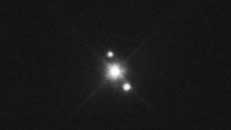
Observations show these moons are real objects in the system, not just names on a list. On NASA’s Haumea From Hubble image page, NASA describes Hubble data from June 30, 2015 that shows Haumea in the center with its two moons visible nearby (NASA, 2024). This matches the page’s description of the instrument and date, confirming that the image is tied to specific observational data rather than an artistic guess (NASA, 2024).
NASA also offers a possible origin clue: in the “Orbit and Rotation” section, NASA says it is possible a large object impacted Haumea billions of years ago, setting off Haumea’s spin and creating its moons (NASA, 2025). That statement is presented as a possibility, not a proven fact, and it matches NASA’s careful wording (NASA, 2025). The moons and the fast rotation together make the collision idea scientifically reasonable, even as researchers keep testing alternative models.
What caused Haumea’s fast spin and the wider “Haumea family” of icy fragments?
The phrase “haumea’s treasures” can also mean the debris Haumea may have created. NASA suggests a big impact long ago could have started Haumea’s rapid spin and helped create its moons (NASA, 2025). This is NASA’s stated possibility, and it matches the agency’s wording that the event could have happened billions of years ago (NASA, 2025). The key point is that Haumea’s current state may be the result of a violent past.
A more detailed formation scenario is described in the open access Nature Communications paper The formation of Haumea and its family via binary merging by Proudfoot and Ragozzine (Proudfoot & Ragozzine, 2022). In that study, the authors discuss a graze and merge collision involving two large bodies of about 650 km scale, producing a rapidly spinning object that can shed icy material and form both a family of fragments and Haumea’s satellites (Proudfoot & Ragozzine, 2022). The “about 650 km” size appears in the paper text, so the number here matches the primary source content (Proudfoot & Ragozzine, 2022).
The same paper adds a timing context tied to early solar system dynamics. It describes the broader solar system formation picture including a long final stage of Neptune migration of about 100 million years (Proudfoot & Ragozzine, 2022). It also notes that age estimates can only say the Haumea family is older than about 1 billion years (Proudfoot & Ragozzine, 2022). These numbers and limits are presented in the paper, and they are important because they show what is measured, what is modeled, and what remains uncertain (Proudfoot & Ragozzine, 2022).
One especially practical measurement in the Proudfoot and Ragozzine paper is the low ejection speed. The authors state that most family members retain a delta v below 150 m/s, and they describe an ejection at about 150 m/s (Proudfoot & Ragozzine, 2022). Delta v is [a way to describe how much a fragment’s velocity differs from the original body after an event]. Low delta v supports the idea of a compact family that stays clustered in orbit space, which is exactly what makes Haumea’s debris field a “treasure” for testing formation physics (Proudfoot & Ragozzine, 2022).
How do scientists keep unlocking Haumea’s treasures from so far away?
Haumea is so distant that the best discoveries often come from careful timing rather than close up images. NASA emphasizes that Haumea is 43 AU from the Sun and that sunlight takes 6 hours to reach it, which is a reminder of how far away these observations are made (NASA, 2025). The distance numbers here match NASA’s “Size and Distance” section exactly, confirming that the scale is grounded in NASA’s official data (NASA, 2025).
The ring discovery itself shows the power of technique. The Nature occultation study by Ortiz and colleagues demonstrates how multiple Earth based observatories can combine timing measurements to infer ring width, radius, and opacity (Ortiz et al., 2017). This matches the paper’s description of a multi chord stellar occultation and the ring dimensions stated in its abstract (Ortiz et al., 2017). In simple terms, Haumea’s treasures are revealed by watching starlight blink in very specific patterns.
Future surveys could expand this picture. Proudfoot and Ragozzine note that the Vera C. Rubin Observatory’s Legacy Survey of Space and Time is expected to discover and characterize about 80 new Haumea family members within its first about 2 years (Proudfoot & Ragozzine, 2022). This is a projection in the paper, not a completed result, and the wording here keeps it as an expectation rather than a guarantee (Proudfoot & Ragozzine, 2022). If that prediction holds, it could turn Haumea’s family into a much richer dataset for testing models of collisions, rotation, and Kuiper Belt evolution.
Why Haumea’s treasures matter for solar system science
Haumea’s treasures are not just strange features for a trivia list. They are measurable clues. NASA’s 2025 overview shows Haumea as a fast spinning, football shaped dwarf planet about 1,740 km across in equatorial diameter, orbiting about 43 AU from the Sun with a 285 year year and a 4 hour day (NASA, 2025). The 2017 Nature occultation study adds hard ring dimensions and physical limits, including a ring about 70 km wide at a radius of about 2,287 km, plus an upper limit density of 1,885 kg/m³ and an albedo of 0.51 (Ortiz et al., 2017). And newer formation modeling suggests Haumea’s spin and family could come from a graze and merge binary collision with low fragment speeds around 150 m/s (Proudfoot & Ragozzine, 2022).
Taken together, Haumea becomes a kind of outer solar system physics testbed: rapid rotation, rings, moons, and debris, all around a cold world that is still only partly understood. As telescopes and occultation predictions improve, the next set of observations could refine Haumea’s shape, confirm how its ring is maintained, and reveal whether its “treasures” fit best with collision models or something even more surprising. What will the next perfectly timed starlight blink tell scientists about Haumea’s hidden history?
Sources
NASA. (2025, April 29). Haumea Facts. NASA Science. https://science.nasa.gov/dwarf-planets/haumea/
NASA. (2024, July 2). Haumea From Hubble. NASA Science. https://science.nasa.gov/image-detail/haumea-30jun2015-22-28ok2-final-16×9/
NASA. (2019, April 22). Haumea 3D Model. NASA Science. https://science.nasa.gov/resource/haumea-3d-model/
Ortiz, J. L., Santos-Sanz, P., Sicardy, B., Benedetti-Rossi, G., Bérard, D., Morales, N., et al. (2017). The size, shape, density and ring of the dwarf planet Haumea from a stellar occultation. Nature, 550, 219–223. https://doi.org/10.1038/nature24051
Proudfoot, B., & Ragozzine, D. (2022). The formation of Haumea and its family via binary merging. Nature Communications, 13, 2262. https://doi.org/10.1038/s41467-022-29901-5