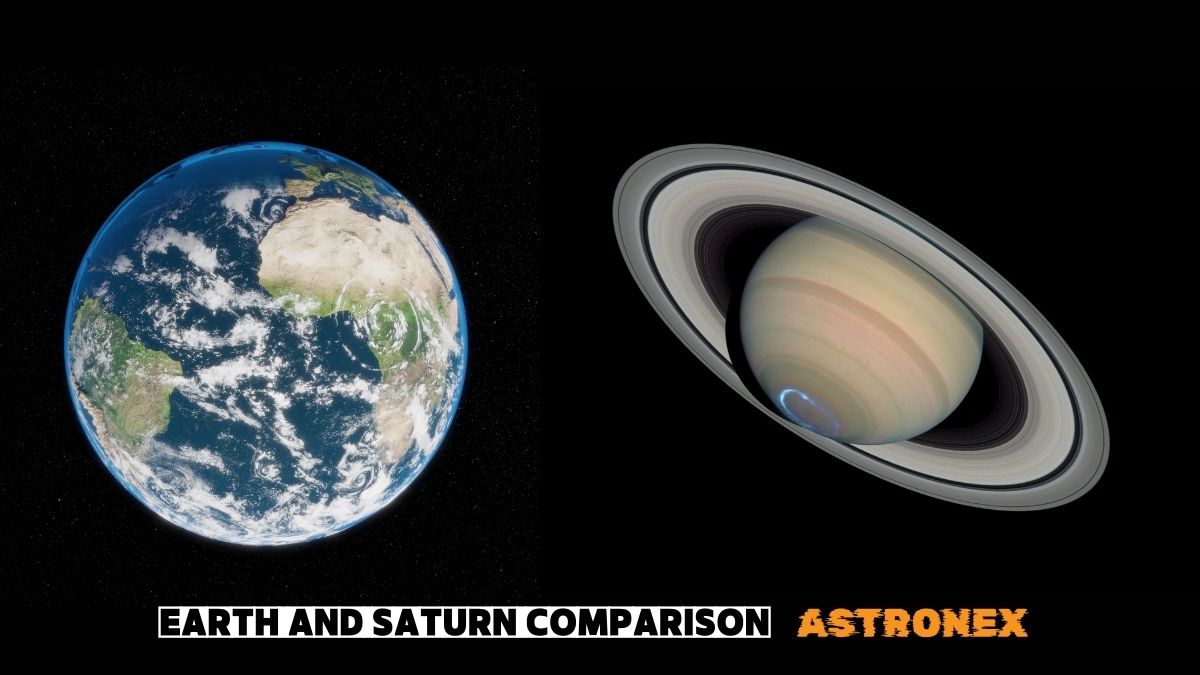
Earth and Saturn Comparison highlights two very different planetary environments within the same solar system. Earth is a dense, rocky planet with a solid surface and a global ocean. Saturn is a far larger gas giant made mostly of hydrogen and helium, known for its rings and shaped by rapid rotation and an expansive magnetic field.
This comparison is built from measurements, not impression. NASA reports values for size, distance, and rotation for both planets, and it summarizes how spacecraft observations have refined what is known about Saturn’s atmosphere, rings, and magnetosphere. Earth, by contrast, is studied in continuous detail, including by many orbiting spacecraft that observe the atmosphere, ocean, glaciers, and the solid Earth together as a connected system.
The scale difference is immediate. NASA lists Earth’s equatorial diameter as about 7,926 miles, or about 12,756 kilometers. Saturn’s equatorial diameter is about 74,897 miles, or about 120,500 kilometers, which NASA describes as about nine times wider than Earth. Composition helps explain why this matters. Earth is built mainly from rock and metal, which produces a compact planet with a well defined surface. Saturn is dominated by light gases, and NASA notes that its average density is less than water, consistent with a world made largely of hydrogen and helium.
Orbit geometry sets the baseline for sunlight and seasonal forcing. Earth’s average distance from the Sun is about 93 million miles, or about 150 million kilometers, which defines one astronomical unit. Saturn’s average distance is about 886 million miles, or about 1.4 billion kilometers, or about 9.5 astronomical units. NASA also expresses the separation in light travel time. Sunlight reaches Earth in about eight minutes and reaches Saturn in about 80 minutes. The much greater distance places Saturn in a region where reduced sunlight and longer travel times shape the overall energy budget available to its atmosphere.
Timekeeping differs for the same reasons. Earth rotates once in about 23.9 hours and completes an orbit in 365.25 days. Saturn’s day is about 10.7 hours, and its year is about 29.4 Earth years, or 10,756 Earth days. Despite these contrasting clocks, both planets have similar axial tilts that support seasonal patterns. NASA gives Earth’s tilt as about 23.4 degrees and Saturn’s as about 26.73 degrees.
Surface conditions separate the planets even more sharply than orbit or rotation. Earth has a dynamic solid exterior with moving plates, and NASA reports that the global ocean covers about 71 percent of the planet’s surface. Saturn does not offer a stable surface to stand on. NASA notes that Saturn lacks a true surface, with visible clouds giving way to deeper layers of gas and liquid under rising pressure and temperature. In an Earth and Saturn Comparison, this distinction matters because it controls how weather is anchored. On Earth, winds interact with terrain and oceans. On Saturn, circulation unfolds within a deep atmosphere overlying no solid ground.
Atmospheric composition underpins those differences. Near the surface, Earth’s atmosphere is about 78 percent nitrogen and about 21 percent oxygen, with about 1 percent made up of other gases such as argon, carbon dioxide, and neon. Saturn’s atmosphere is dominated by hydrogen and helium, and NASA describes clouds, jet streams, and storms that produce faint bands across the planet. Wind speeds illustrate the contrast in circulation. NASA reports upper atmosphere winds near Saturn’s equator reaching about 1,600 feet per second, or about 500 meters per second. In the same context, NASA notes that the strongest hurricane force winds on Earth reach about 360 feet per second, or about 110 meters per second. Saturn also hosts an unusual and persistent feature at its north pole, the hexagon, described by NASA as a large scale jet stream pattern spanning about 20,000 miles, or about 30,000 kilometers, which highlights how stable structure can persist in a rapidly rotating atmosphere.
Rings are the most visible difference from a distance, and they also provide evidence about gravity and particle dynamics close to a planet. Earth has no rings. NASA Saturn facts describe Saturn’s rings as billions of pieces of ice and rock, thought to come from comets, asteroids, or shattered moons torn apart by Saturn’s gravity. The ring system extends up to about 175,000 miles, or about 282,000 kilometers, from the planet, yet the main rings have a typical vertical thickness of about 30 feet, or about 10 meters. NASA also reports that the Cassini Division is a gap about 2,920 miles, or about 4,700 kilometers, wide that separates major ring components in the feature known as the Cassini Division.
Moons and magnetic fields add context for how each planet interacts with its surroundings. Earth has one moon. Saturn’s moon system is far larger, and NASA notes that as of June 8, 2023 Saturn had 146 moons, with additional candidates awaiting confirmation and naming. Both planets generate magnetic fields that guide charged particles into their upper atmospheres and produce auroras. On Earth, NASA explains that rapid rotation and a molten core rich in iron and nickel generate a magnetic field that the solar wind distorts into a teardrop like shape in space. Saturn’s magnetosphere is vast by comparison. NASA states that Saturn’s magnetic field is about 578 times as powerful as Earth’s, and that the rings and many moons lie within Saturn’s enormous magnetosphere.
Earth and Saturn Comparison therefore links straightforward measurements to physical interpretation. Earth’s compact size, rocky structure, surface water, and nitrogen oxygen air support a planet where geology, oceans, and atmosphere are tightly coupled. Saturn’s vast diameter, low density, rapid rotation, extensive rings, and powerful magnetic field define a different category of world, one dominated by deep atmospheric dynamics and magnetospheric processes.
References
NASA Science. (2025, December 5). Facts about Earth. https://science.nasa.gov/earth/facts/
NASA Science. (2025, April 21). Saturn facts. https://science.nasa.gov/saturn/facts/