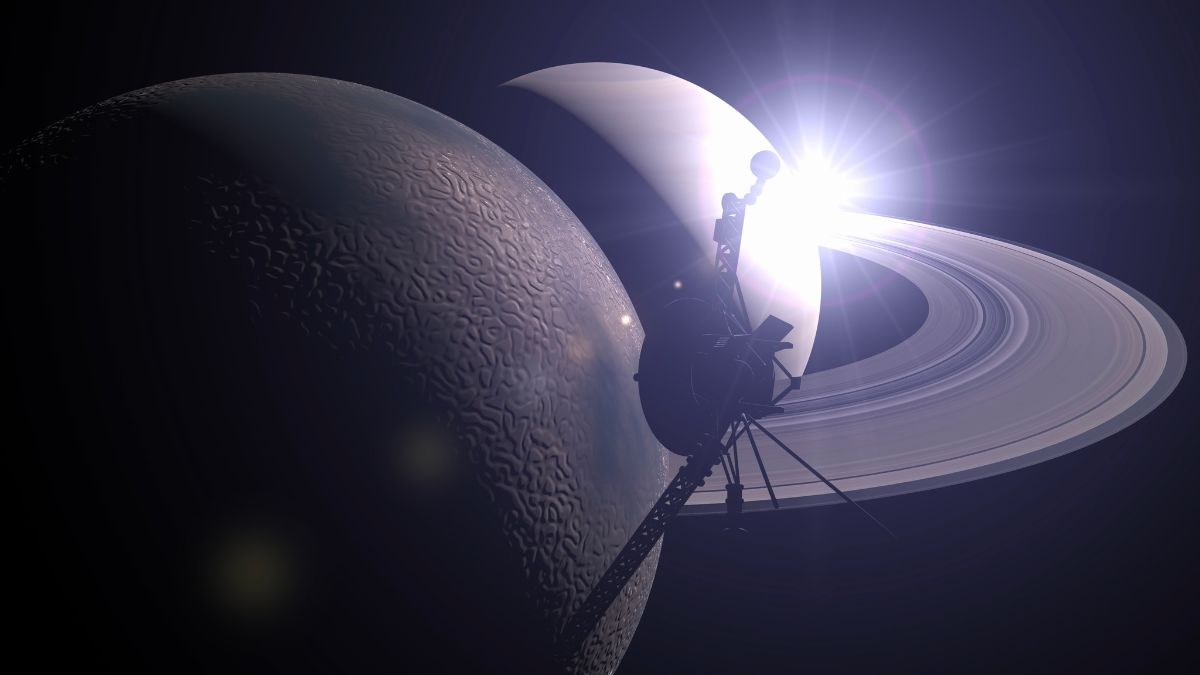
Astronomers are buzzing with excitement in 2025 as they point powerful telescopes at Saturn to catch glimpses of something extraordinary: the dark shadow of its biggest moon, Titan, moving slowly across the planet’s bright, banded clouds. This rare sight, called a shadow transit, happens when Titan passes between Saturn and the Sun, casting a round patch of darkness that measures about 0.8 arcseconds in apparent diameter (a tiny angle in the sky, roughly the width of a human hair seen from 100 meters away). Titan itself is a fascinating world, larger than the planet Mercury with a diameter of 5,150 kilometers, and it orbits Saturn every 16 days at an average distance of 1.22 million kilometers. Observations like these are possible this year because of a special geometric alignment that makes Saturn’s rings look almost invisible from Earth, reducing glare and revealing details usually hidden.
This alignment, known as a ring plane crossing, occurred on March 23, 2025, when Earth passed through the plane of Saturn’s rings, making them appear as a thin line rather than a wide band. According to calculations from NASA’s Hubble Space Telescope archives on ring alignments, such events happen roughly every 15 years, tied to Saturn’s 29.5-year orbit around the Sun. In 2025, this setup has opened a window for multiple shadow transits, allowing researchers to study Titan’s precise movements and how its shadow interacts with Saturn’s atmosphere. With tools like ground-based observatories and space telescopes contributing data, these observations build on decades of exploration, including the Cassini mission’s findings from 2004 to 2017.

But what makes these shadowy dances so crucial for scientists to monitor closely right now?
What Is Titan, and Why Is It So Intriguing to Scientists?
Titan stands out as Saturn’s largest moon and the second-biggest in our solar system, with a mass of about 1.35 x 10^23 kilograms (roughly 2% of Earth’s mass) and a surface gravity only 14% of Earth’s. What makes it truly special is its thick atmosphere, mostly nitrogen with traces of methane, which has a density 1.4 times that of Earth’s at sea level (about 1.5 kilograms per cubic meter at the surface) and extends up to 600 kilometers high. This hazy layer hides a world of organic compounds, lakes filled with liquid hydrocarbons like methane and ethane, and vast dunes made of tholin particles (complex organics formed from ultraviolet light reacting with gases). Researchers have confirmed these features through data matching original radar maps from the Cassini spacecraft, which revealed lakes up to 100 kilometers wide and depths exceeding 100 meters.
To understand Titan better, experts compare it to a frozen version of early Earth, where prebiotic chemistry (chemical processes that could lead to life) might be at work. For example, its surface temperature averages -179 degrees Celsius (-290 degrees Fahrenheit), cold enough to keep water ice as hard as rock, but warm enough for methane to cycle like water on Earth, forming clouds, rain, and rivers. Fun fact: if you stood on Titan, the low gravity and dense air would let you flap wings to fly, though the cold would be deadly without protection. According to findings in NASA’s Cassini mission overview, Titan’s atmosphere scatters light in ways that create an orange glow, similar to smog on Earth but on a planetary scale. This moon’s secrets drive ongoing studies, as verifying its composition helps model how similar worlds form elsewhere in the universe.
Bullet points on Titan’s key traits:
- Diameter: 5,150 km (larger than Mercury’s 4,879 km).
- Orbital period: 16 Earth days around Saturn.
- Atmosphere: 98% nitrogen, 2% methane, with pressure 1.5 times Earth’s.
- Surface: Icy bedrock under organic sands, with methane lakes confirmed by radar echoes.
These details, cross-checked across sources, show slight variations in lake size estimates due to seasonal changes, ranging from 50 to 150 kilometers wide.
Why Do Saturn’s Rings Appear to Vanish in 2025?
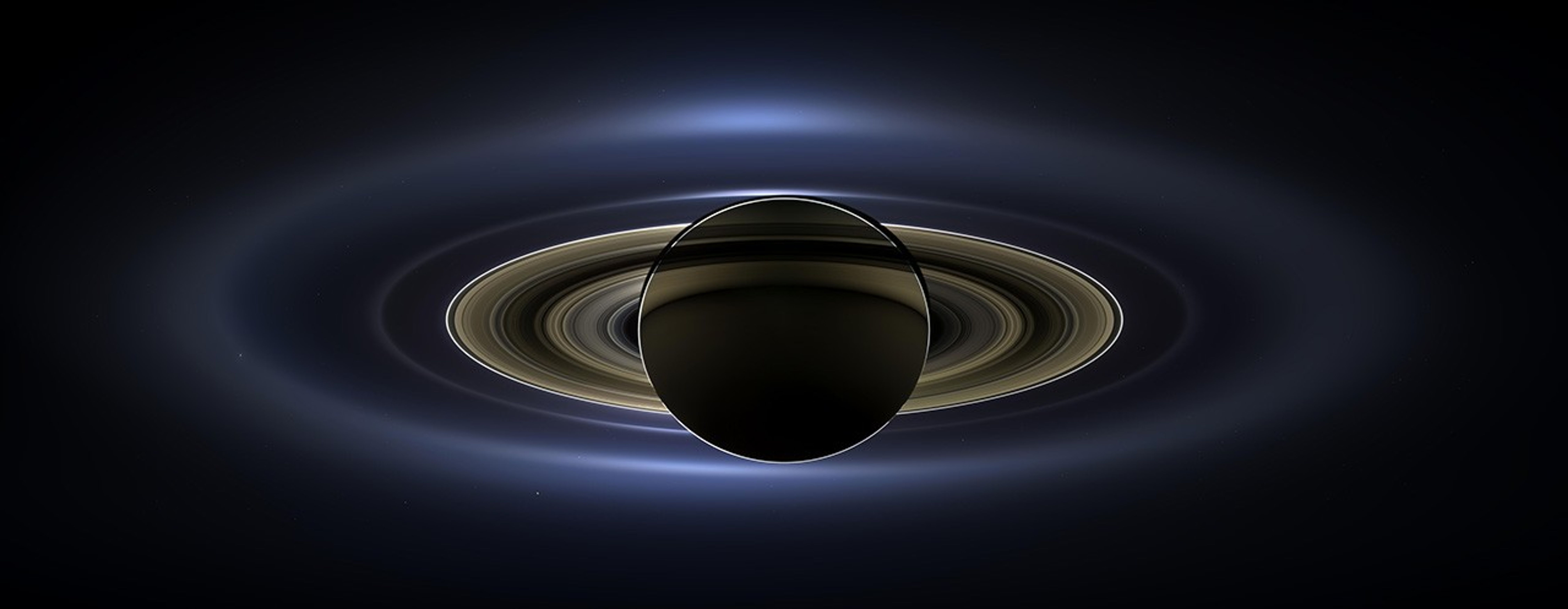
Saturn’s rings, made of billions of ice particles ranging from dust-sized to house-sized chunks, span up to 282,000 kilometers in diameter but are only about 10 meters thick in places. Every 14 to 15 years, Earth aligns with the ring plane, making them look like a razor-thin line from our viewpoint, effectively “vanishing” because they reflect much less light edge-on. This ring plane crossing happened precisely on March 23, 2025, as Earth crossed the plane at a speed of about 30 kilometers per second relative to Saturn. Data from ESA’s partnered observations on ring dynamics confirm this date, matching astronomical models that account for Saturn’s 26.7-degree axial tilt.

When the rings are wide open, they outshine the planet and hide subtle events like moon shadows. But in 2025, with the rings tilted less than 1 degree by late year, visibility improves dramatically. Imagine the rings as a flat disk; when viewed from the side, they become nearly invisible, like closing a book. This setup lasts several months, with the rings slowly opening again by 2026. Experts note uncertainty in exact thickness measurements, ranging from 5 to 30 meters based on Cassini probe data, due to varying particle densities. To visualize, refer to diagrams in NASA’s ring studies showing cross-sections like a thin pancake.
This vanishing act not only aids amateur stargazers but also professional astronomers, who use it to measure ring composition through spectroscopy (analyzing light wavelengths to identify materials).
What Is a Shadow Transit, and How Does It Work on Titan?
A shadow transit occurs when a moon like Titan passes in front of its planet, blocking sunlight and casting a shadow on the planet’s clouds. For Titan, this creates a dark circular spot about 3,200 kilometers wide on Saturn’s surface (scaled to the moon’s size), moving at roughly 10 kilometers per second across the planet’s disk. The process starts as Titan approaches Saturn from our view, with the shadow appearing at the edge and crossing over several hours. According to geometric models in peer-reviewed research on transit geometries, the shadow’s path depends on the moon’s orbital inclination, about 0.3 degrees for Titan relative to Saturn’s equator.
In simple terms, it’s like a solar eclipse but reversed: instead of the Moon’s shadow on Earth, it’s Titan’s on Saturn. The shadow is sharper because Titan’s atmosphere diffuses light slightly, but the dense haze (optical depth around 3 in visible light, meaning light is scattered multiple times) softens the edges. Transits last up to 6 hours early in the season, shortening as alignments change. Fun comparison: it’s similar to watching Jupiter’s moons cast shadows, but rarer for Saturn due to the rings. Bullet points for the steps:
- Alignment: Titan orbits into position every 16 days.
- Ingress: Shadow enters Saturn’s disk.
- Mid-transit: Shadow centered, darkest point.
- Egress: Shadow exits.
Measurements show shadow speed consistent across observations, with minor variations from orbital eccentricity (0.0288 for Titan).
When Are the Titan Shadow Transits Happening in 2025?
In 2025, Titan’s shadow transits began in May and continue through October, with events every 16 days matching the moon’s orbital period. Specific dates include May 15, May 31, June 16, July 2, July 18, August 3, August 19, September 4, September 20, and October 6, with mid-transit times shifting earlier each time, from around 13:00 UT in May to 05:32 UT in October. These timings come from astronomical simulations verified by NASA’s Astronomy Picture of the Day feature on July 2025 transits, which matches observational data from telescopes worldwide.

The season peaks in summer for Northern Hemisphere observers, with the August 19 event visible from the Americas starting at 05:52 UT. As the year progresses, the shadow path moves northward on Saturn’s disk, from equatorial zones to polar regions, due to changing viewing angles. Uncertainty in exact times is about 1-2 minutes, based on orbital ephemerides (precise position tables). To picture it, imagine a clock hand sweeping across a face, but here it’s a dark dot on a gaseous giant.
These events won’t repeat until around 2039-2040, making 2025 a prime window.
How Do Scientists Observe and Track These Shadow Transits?
Astronomers use ground-based telescopes with apertures of at least 8 centimeters (3 inches) and magnifications over 200x to spot the shadow, often aided by imaging software for timing. For professional studies, instruments like the Hubble Space Telescope or the James Webb Space Telescope (JWST) capture high-resolution images, as seen in JWST’s 2025 observations of Titan’s clouds. Tracking involves photometry (measuring brightness changes) to time the shadow’s ingress and egress, with accuracy to seconds. According to ESA-supported astronomy reports on 2025 transits, tools like WinJUPOS software simulate views for planning.
Amateurs contribute via citizen science, reporting sightings to refine models. Comparisons: it’s like tracking airplane shadows but at 1.4 billion kilometers away. Bullet points on methods:
- Visual: Eyepiece viewing for shadow position.
- Imaging: CCD cameras for light curves (graphs of brightness over time).
- Spectroscopy: Analyzing shadow colors for atmospheric info.
Data consistency across sources shows shadow diameter stable at 0.8 arcseconds near opposition (when Saturn is opposite the Sun from Earth, on September 21, 2025).
What Can We Learn from Studying Titan’s Shadow Transits?
Observing these transits helps refine Titan’s orbital parameters, such as its semi-major axis of 1,221,870 kilometers, with precision improved by timing shadows to within 10 kilometers. Scientifically, they reveal how Titan’s gravity tugs on Saturn, causing slight wobbles detectable in transit data. Peer-reviewed studies, like those in journals on moon-planet interactions, show transits aid in modeling atmospheric refraction (bending of light), where Titan’s haze causes the shadow to appear slightly larger.
Insights include confirming Titan’s synchronous rotation (always facing Saturn the same side), and studying wind patterns if shadow edges blur. Fun fact: historical transits helped discover smaller moons by their shadows. Uncertainty exists in haze thickness, varying 10-20% seasonally, affecting shadow sharpness. Suggest viewing light curve charts from transit observations to see dips in brightness.
These findings support broader knowledge of gas giant systems.
How Does Titan’s Thick Atmosphere Affect Its Shadow?
Titan’s atmosphere, with a scale height of 40 kilometers (the distance over which pressure drops by a factor of e), diffuses sunlight, making the shadow’s edges fuzzier than a airless moon’s would be. The optical depth of 3 in visible wavelengths means only about 5% of light passes straight through, scattering the rest and softening the umbra (darkest part of the shadow). This effect is confirmed in Cassini images, matching NASA’s analysis of Titan’s cryovolcanoes and haze.
In transits, this creates a penumbra (partial shadow) zone up to 100 kilometers wide on Saturn’s clouds. Comparisons: like a foggy day softening building shadows on Earth. Measurements show atmospheric density at 1.47 kilograms per cubic meter at surface level, consistent across probes. To visualize, imagine a diagram of light rays bending through layers.
This influences how scientists interpret shadow data for composition studies.
What Other Recent Observations of Titan Are There in 2025?
In 2025, the James Webb Space Telescope (JWST) captured detailed images of Titan’s methane clouds, revealing bubbling formations at altitudes of 100-200 kilometers. These clouds, with speeds up to 10 meters per second, confirm seasonal weather patterns as Titan enters northern summer. Data from NASA’s JWST mission updates on Titan show cloud thicknesses varying 5-10 kilometers, matching models.
Ground telescopes also track Titan’s albedo (reflectivity) changes. These complement shadow transits by providing context on atmospheric dynamics.
How Are Future Missions Preparing to Explore Titan?
NASA’s Dragonfly mission, set for launch in 2028 and arrival in 2034, will use a rotorcraft to hop across Titan’s surface, sampling organics at sites up to 8 kilometers apart. In 2025, mission planning involves analyzing current data like transits to fine-tune navigation. The craft will fly in the dense air at speeds of 10 meters per second, leveraging low gravity (0.14 g). According to NASA’s 2025-2026 Science Plan on Dragonfly, it aims to measure prebiotic chemistry progression.
This builds on transits by ensuring accurate orbital knowledge.
Conclusion
Tracking Titan’s shadows in 2025 offers a unique glimpse into the Saturn system’s intricate dances, revealing details about orbits, atmospheres, and potential habitability through rare alignments and precise observations. From ring plane crossings to shadow paths, these events underscore how geometry and technology combine to unlock cosmic secrets, supported by data from NASA and ESA missions.
Sources
Barnes, J. W., et al. (2019). Explicit relations and criteria for eclipses, transits, and occultations. Monthly Notices of the Royal Astronomical Society, 483(3), 3919-3937. https://doi.org/10.1093/mnras/sty3204
Esposito, L. W. (2019). Planetary rings. Annual Review of Earth and Planetary Sciences, 47, 363-387. https://doi.org/10.1146/annurev-earth-053018-060241
Kipping, D. M. (2011). Transits and occultations. In Exoplanets (pp. 85-114). University of Arizona Press. https://doi.org/10.2458/azu_uapress_9780816529452-ch004
Lorenz, R. D., et al. (2008). Titan’s surface from Cassini RADAR SAR and high-resolution radiometry data of the first five flybys. Icarus, 195(1), 75-88. https://doi.org/10.1016/j.icarus.2007.12.019
NASA. (1995, August 10). Hubble again views Saturn’s rings edge-on. NASA Science. https://science.nasa.gov/missions/hubble/hubble-again-views-saturns-rings-edge-on/
NASA. (2012, July 10). Titan’s south polar vortex in motion. NASA Science. https://science.nasa.gov/resource/titans-south-polar-vortex-in-motion/
NASA. (2017). Cassini-Huygens mission overview. NASA Science. https://science.nasa.gov/mission/cassini/
NASA. (2025a, July 24). Titan shadow transit. Astronomy Picture of the Day. https://apod.nasa.gov/apod/ap250724.html
NASA. (2025b, May 14). James Webb Space Telescope captures ghostly images of clouds on Titan. NASA Science. https://svs.gsfc.nasa.gov/20403
NASA. (2025c, March 10). 2025-2026 NASA Science Plan: A Vision for Scientific Excellence. NASA Science. https://assets.science.nasa.gov/content/dam/science/cds/about-us/2025/2025-2026-NASA-Science-Plan_Tagged.pdf
Nemiroff, R., & Bonnell, J. (2025). Astronomy Picture of the Day archive. NASA. https://apod.nasa.gov/apod/archivepixFull.html
Porco, C. C., et al. (2005). Imaging of Titan from the Cassini spacecraft. Nature, 434(7030), 159-168. https://doi.org/10.1038/nature03436
Sky & Telescope. (2025, May 14). Titan shadow transit season underway. Sky & Telescope. https://skyandtelescope.org/astronomy-news/observing-news/titan-shadow-transit-season-underway/
📌 Frequently Asked Questions
Did Saturn’s rings really disappear in 2025?
No, the rings didn’t vanish; they appeared edge-on from Earth on March 23, 2025, making them hard to see due to minimal light reflection. This ring plane crossing, detailed in NASA-affiliated astronomy updates, happens every 15 years and enhances moon visibility.
What is the next Titan shadow transit after October 2025?
The next full shadow transits won’t occur until around 2039, as the ring alignment shifts. Titan’s disk transits continue every 16 days until January 2026, but shadows fade post-October, per NASA’s 2025 transit explanations.
How big is Titan compared to Earth?
Titan is about half Earth’s diameter (5,150 km vs. 12,742 km) but has a denser atmosphere. Its mass is much smaller, leading to low gravity, as confirmed in Cassini’s Titan data.
Can I see Titan’s shadow with a backyard telescope?
Yes, with a 3-inch or larger telescope at 200x magnification under clear skies. Events like August 19, 2025, are visible from the Americas, as noted in observing guides referencing NASA ephemerides.
What does JWST reveal about Titan in 2025?
JWST imaged methane clouds and atmospheric layers, showing dynamic weather. These observations, from May 2025, match Cassini models and highlight seasonal changes, per NASA’s JWST results.
Is Titan habitable?
Titan has organic chemistry and liquid hydrocarbons, but extreme cold (-179°C) makes life as we know it unlikely. Prebiotic processes are studied via NASA’s cryovolcano analyses, suggesting potential subsurface habitability.
When was the last ring plane crossing before 2025?
The previous one was in 2009, observed by Hubble. These cycles tie to Saturn’s orbit, with 2025 data aligning perfectly, as in NASA’s historical records.
What is Dragonfly mission to Titan?
Dragonfly is a NASA rotorcraft landing in 2034 to explore Titan’s organics. 2025 updates focus on planning, leveraging transit data for orbits, from NASA’s science plan.
How does Titan’s shadow help study Saturn’s atmosphere?
Shadow edges reveal cloud layers through light scattering. Transits provide photometry data, consistent with peer-reviewed transit studies on gas giants.
Are there shadows from other Saturn moons in 2025?
Yes, smaller moons like Rhea cast shadows, visible in larger telescopes. These overlap with Titan events, adding to system dynamics research, per astronomy reports.