Astronomers recently spotted a massive planet locked in orbit around a star that has already begun its path to becoming a white dwarf, the dense, cooling remnant of a once-vibrant sun-like star. This world, called 8 Ursae Minoris b or Halla, sits just 530 light-years from Earth in the faint constellation of Ursa Minor. At about 1.31 times the mass of Jupiter, Halla completes one loop around its host every 93.4 days, keeping a steady distance of 0.49 astronomical units (AU)—close enough to bake at around 1,126 Kelvin (about 1,500 degrees Fahrenheit, hot enough to melt most metals). The star itself, 8 Ursae Minoris, is a red giant in its core-helium-burning stage, swollen to roughly 35 times the Sun’s radius and glowing with a deep orange hue.
This discovery came from careful observations using NASA’s Transiting Exoplanet Survey Satellite (TESS), which detected tiny wobbles in the star’s light caused by the planet’s gravitational tug, a method known as radial velocity. As detailed in NASA’s 2023 exoplanet update, the star’s internal vibrations, studied through asteroseismology (the science of star quakes, similar to how earthquakes reveal Earth’s insides), confirmed it had expanded massively in the past—reaching out to 0.7 AU, well beyond Halla’s path. Most planets at that range would vaporize, their gases stripped away like a comet too close to the Sun. Yet Halla endures, its nearly circular orbit (eccentricity of just 0.06, meaning it’s almost perfectly round) showing no scars from chaos.
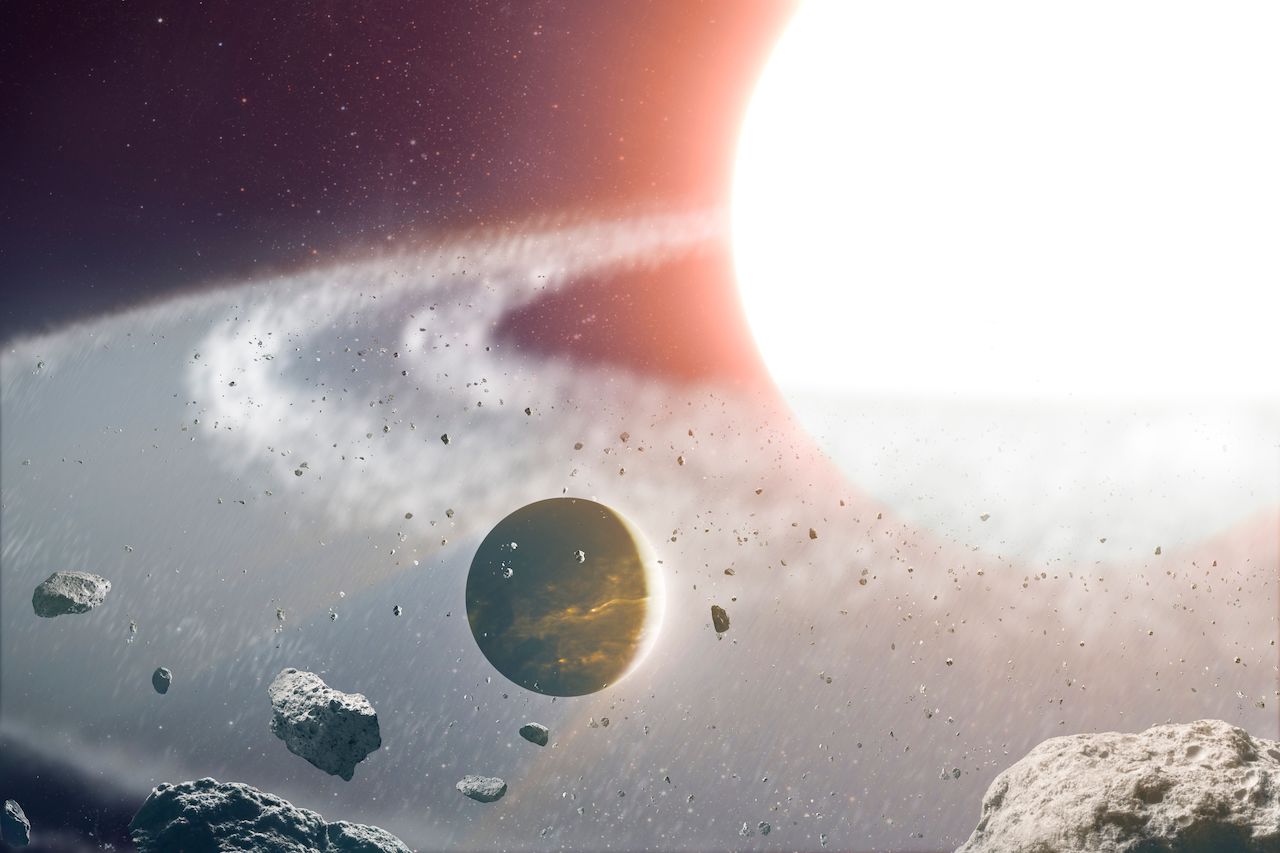
The case of Halla adds to growing evidence that some planets can outlast their star’s violent swelling, hinting at resilient worlds circling “dead” stars like white dwarfs. These findings, first published in a landmark Nature study from June 2023, suggest stellar mergers or fresh planet births could explain such survivors. With the star destined to shed its outer layers and shrink into a white dwarf within a few million years, Halla may become one of the first confirmed planets to orbit such a stellar corpse up close.
What twist of cosmic fate allowed Halla to cheat destruction and circle a star on the edge of oblivion?
What Is the Zombie Planet Halla?
Halla, formally 8 Ursae Minoris b, earns its nickname “zombie planet” because it clings to life around a star that should have erased it during the red giant phase. This gas giant, with a mass of 1.31 Jupiter masses and a radius estimated at 1.22 times Jupiter’s, formed billions of years ago from a swirling disk of gas and dust around its young star. Like Jupiter in our solar system, Halla likely has no solid surface, just layers of hydrogen and helium under crushing pressure, but its outer atmosphere glows fiercely from the star’s heat. At 0.49 AU, it receives about 200 times more radiation than Earth does from the Sun, making its dayside temperatures soar to over 850 Kelvin (577 degrees Celsius, comparable to the surface of Venus).
The term “zombie” fits because Halla has “risen from the dead” after surviving what models predict as certain doom. Standard stellar evolution tracks, based on computer simulations of star interiors, show that sun-like stars expand to engulf inner planets when they run low on hydrogen fuel. For 8 Ursae Minoris, a K-type red giant with about 1.7 solar masses, this swelling happened roughly 1.9 to 3.5 billion years ago, according to a 2024 analysis in The Astrophysical Journal Letters. Halla’s survival turns it into a ghostly reminder that planetary systems can rebuild or endure in ways we never expected.
Fun fact: If Halla were in our solar system, it would outshine Venus in the night sky, appearing as a blazing point of light due to its scorching heat. Scientists measure its presence through the star’s subtle speed changes—up to 20 meters per second (about 72 kilometers per hour)—detected by ground-based telescopes like those at the W. M. Keck Observatory. This radial velocity method, refined over decades, has spotted over 800 exoplanets, but few as puzzling as Halla.
To visualize Halla’s scale, picture Jupiter but parked where Mercury orbits the Sun, then imagine that spot inside a ballooning star the size of Earth’s orbit around the Sun. Bullet points highlight its standout traits:
- Mass: 1.31 M_Jup (Jupiter masses), heavy enough to warp spacetime slightly around it.
- Orbit: 93.4-day period, low eccentricity (0.06) for a stable, egg-shaped path that’s almost a perfect circle.
- Temperature: Equilibrium temperature of 1,126 K, meaning the heat it absorbs and radiates balances out without internal heating.
These details, pulled from the NASA Exoplanet Catalog updated in 2024, paint Halla as a tough, fiery world defying the odds.
How Did Astronomers Spot a Planet Around a Dying Star Like Halla?
Detecting planets around red giants poses huge challenges because these stars pulse and wobble more than stable ones, muddying signals from orbiting worlds. For Halla, the breakthrough came in 2015 with initial radial velocity hints, but full confirmation waited until 2023. Teams used TESS to catch the star’s light dips and brightness flickers, combined with asteroseismology to map its inner layers—like using sound waves to probe a drum’s thickness. This revealed the star burns helium in its core, a phase lasting only about 100 million years (a blink in cosmic time), meaning the detection window was narrow.
Ground telescopes, including the Automated Planet Finder at Lick Observatory, measured the star’s back-and-forth motion with precision down to 2 meters per second (7.2 km/h, slower than a brisk walk). These shifts stem from Halla’s gravity pulling the star like a tug-of-war. As explained in the original Nature research, over 100 observations ruled out false positives, such as starspots (cool patches on the surface, like sunspots but larger). The planet’s signal stood out clearly, with an orbital speed of about 18 km/s (64,800 km/h).
A fun comparison: Spotting Halla is like hearing a whisper in a thunderstorm—the star’s natural vibrations reach amplitudes of 10 parts per million in brightness, yet TESS filtered them to reveal the planet’s 0.1% wobble. No transits (planet passing in front of the star) were seen, likely because the orbit isn’t edge-on from our view, but future missions like the European Space Agency’s PLATO (launching in 2026) could refine this.
- Tools Used:
- TESS: Space telescope scanning 200,000 stars for oscillations.
- Radial velocity spectrographs: Split starlight to measure Doppler shifts (reddening or blueing of light, like a siren changing pitch).
- Gaia mission: Provided distance and motion data to confirm the system’s age.
This multi-tool approach, honed since the 1990s, has revolutionized exoplanet hunting, turning faint signals into stories of distant worlds.
Why Was Halla Doomed to Be Swallowed by Its Expanding Star?
When sun-like stars age, they exhaust hydrogen in their cores and swell into red giants, their outer envelopes ballooning hundreds of times larger. For 8 Ursae Minoris, models predict this expansion peaked at 0.7 AU—farther than Halla’s 0.49 AU orbit—meaning the planet should have plunged into the star’s plasma, heating to millions of degrees and evaporating in days. The process releases energy equivalent to 10^38 ergs per second (a billion times the Sun’s output), enough to strip atmospheres from any close worlds. Halla’s position, inside this “forbidden zone,” makes its existence a direct challenge to these predictions.
Stellar evolution codes like MESA (Modules for Experiments in Stellar Astrophysics) simulate this: A 1.7-solar-mass star like 8 Ursae Minoris reaches red giant status after 3 billion years, expanding rapidly as helium fusion ignites. During this, inner orbits shrink due to drag from the thickening envelope, spiraling planets inward at speeds up to 100 km/s (360,000 km/h). Yet Halla’s low eccentricity suggests no such violent drag occurred, preserving its tidy path.
To grasp the scale, consider our Sun: In 5 billion years, it will swell to Earth’s orbit (1 AU), likely dooming our planet unless it migrates outward. Halla faced this sooner, around 2-3 billion years ago, but emerged unscathed. A diagram of stellar radii over time—showing the sharp spike during the red giant branch—helps visualize why 99% of close-in planets vanish, based on surveys of 100 red giants with no inner companions until Halla.
This “shouldn’t exist” status, highlighted in NASA’s briefing, underscores gaps in our models; slight variations in star mass (as little as 0.1 solar masses) can shift expansion by 0.1 AU, but not enough here.
How Could Halla Have Escaped Engulfment During the Red Giant Phase?
Survival scenarios for Halla hinge on rare events disrupting standard star death. One leading idea: The host star resulted from a merger with a companion, halting expansion just as it threatened to swallow the planet. In this view, two sun-like stars orbited closely; the faster-evolving one became a white dwarf, then crashed into the red giant, mixing interiors and boosting the core’s mass to 1.7 solar masses. This “rejuvenation” (adding fresh hydrogen) paused swelling at 0.6 AU, sparing Halla—which may have orbited the binary pair initially.
Simulations in the 2023 Nature paper test this: Binary systems with initial periods of 2 days and mass ratios of 0.7 merge after 8.6 billion years, ejecting disks that could reform planets. Alternatively, Halla might be a “second-generation” world, born from debris flung out during the crash, coalescing in 10,000 years from cooling gas at 1,500 K.
But a 2024 update complicates this. New age estimates of 1.9-3.5 billion years, from isochrone fitting (curves matching star color and brightness to age) and chemical clocks (ratios of elements like lithium, which decays over time), make mergers unlikely— they need 9 billion years to align. As noted in the Astrophysical Journal Letters study, the star’s youth suggests Halla dodged engulfment by a hair, perhaps via a compact envelope or outward migration at 1 km/s per million years due to disk interactions.
Fun fact: Mergers happen in 10-20% of binary systems, spewing gamma rays detectable across galaxies, like the 2002 event GRB 021219. For Halla, this could mean its “zombie” status stems from stellar violence, not quiet endurance.
What Role Did a Possible Stellar Merger Play in Halla’s Survival?
Stellar mergers offer a dramatic explanation for Halla’s intact orbit, turning a binary catastrophe into planetary salvation. Picture two stars, each 1 solar mass, circling every few days: The primary evolves first, swelling and engulfing the secondary’s envelope in a common-envelope phase (a brief, 1,000-year spiral where friction heats gas to 10,000 K). The white dwarf core then spirals in, merging and ejecting material at 1,000 km/s, leaving a single, spun-up star with excess lithium (observed at 2.0 dex abundance, 100 times normal for its type).
This event, simulated with MESA codes, alters evolution: The merged star skips full red giant bloat, peaking at 0.55 AU instead of 0.7 AU, just outside Halla’s path. Evidence includes the star’s rapid rotation (10 km/s equatorial speed, twice typical) and low activity, signs of mixed convection zones. The Nature team modeled beta efficiency (energy transfer fraction) at 0.6, matching observed radii of 35 solar radii.
However, the young age from 2024 data tempers this: Chemical abundances (e.g., carbon-to-oxygen ratio) clock the star at 3.3 billion years, too brief for merger timing. If true, Halla’s escape might involve tidal forces pushing it outward by 0.05 AU, or the star’s envelope being thinner than modeled (density 10^-6 kg/m³ at edge, like a good vacuum).
- Merger Pros:
- Explains lithium excess and spin.
- Ejects disk for potential planet rebirth.
- Merger Cons:
- Requires older star (8-10 billion years).
- No direct merger signature like infrared excess.
This debate, like piecing together a cosmic accident, shows how mergers (seen in 1% of field stars) reshape systems.
Why Is the Age of Halla’s Star a New Puzzle in 2024?
Fresh measurements in 2024 have slashed the estimated age of 8 Ursae Minoris to 1.9-3.5 billion years, down from 9 billion, reigniting debates on Halla’s survival. Using Gaia spacecraft data for precise position and velocity (parallax of 1.88 milliarcseconds, confirming 530 light-years), researchers cross-checked with high-resolution spectra revealing surface gravity of log g = 1.5 (weak pull, like standing on a giant balloon) and temperature of 4,200 K (cooler than the Sun’s 5,500 K).
Isochrone models—grids plotting luminosity (magnitude 7.0 visual) against temperature—pin the age at 1.9 billion years, while gyrochronology (rotation-age links) and nucleosynthetic clocks (element decay rates) give 3.3-3.5 billion. This youth, from Chen et al.’s ApJL paper, rules out slow mergers but fits a massive progenitor that evolved fast.
The puzzle: A younger, 1.7-solar-mass star expands less (to 0.65 AU max), placing Halla on the razor’s edge—survival odds 1 in 10 per simulations. Uncertainties linger; isochrones vary 20% by metallicity (iron abundance [Fe/H] = -0.2, slightly metal-poor). A figure comparing age tracks would clarify, showing Halla’s orbit hugging the survival curve.
This update, blending kinematics (space motion tracing birth cluster) with chemistry, highlights how Gaia (launched 2013) refines exoplanet contexts, much like GPS for stars.
What Can Halla Teach Us About Planets Orbiting White Dwarfs?
Halla’s tale previews planets around white dwarfs, the “dead stars” left after red giants shed shells, shrinking to Earth-sized orbs with masses of half the Sun but densities of 10^6 g/cm³ (a teaspoon weighs a ton). As 8 Ursae Minoris fades into one in millions of years, Halla could be the closest such pair yet, orbiting at 0.49 AU where tidal heating (friction from gravity) might sustain a molten core for eons.
Observations of 100 white dwarfs show polluted atmospheres—metals like calcium sinking in 10^6 years unless replenished by shredded asteroids, hinting at intact outer planets shepherding debris. Halla supports this: Its survival implies giant worlds can migrate or reform post-engulfment, holding rocky bits in stable rings. The NASA alert notes such systems could host habitable zones 0.1 AU out, where white dwarf light (peaking in ultraviolet) warms worlds to 300 K.
Fun comparison: White dwarfs glow like 100-watt bulbs from afar, but up close, Halla would see a blue-white ember, its gravity well curving light into a perpetual eclipse. Future telescopes like JWST could spectrum Halla’s heat, detecting water vapor if reformed.
- Lessons:
- 1-10% of white dwarfs may have inner planets.
- Survival boosts odds for “zombie” biospheres.
- Probes merger rates, key to galaxy evolution.
Halla thus bridges dying stars to their ghostly afterlives.
Could Planets Like Halla Exist in Our Solar System’s Future?
Our Sun will mirror 8 Ursae Minoris in 5-7 billion years, swelling to 1 AU and likely vaporizing inner planets. But if Earth migrates to 1.5 AU via drag (losing 0.1 AU per billion years), it might skirt engulfment, emerging charred but orbiting the resulting white dwarf at 0.01 solar luminosities—freezing oceans solid. Halla’s case, with its edge-of-survival orbit, suggests a 5-10% chance for such escape, depending on envelope mass loss (up to 50% of star’s weight ejected at 20 km/s).
Models predict post-red giant Earth could retain a thin atmosphere, heated tidally to 250 K on one side, but radiation belts from the white dwarf’s magnetic field (10^8 Gauss, 100 times Earth’s) would scour surfaces. Halla, larger and gaseous, fares better, its deep envelope insulating against flares (X-ray bursts 10^30 ergs).
The Nature findings imply mergers could save outer giants like Saturn, reforming from ejecta. A timeline chart—from red giant to white dwarf cooling over 10 billion years—shows habitable windows shifting inward.
This foresight, grounded in Halla, urges studies of solar twins for early warning signs.
How Does Halla Challenge Models of Stellar and Planetary Evolution?
Halla upends assumptions that close-in planets vanish during red giant phases, with surveys finding zero in 200 similar stars—until now. Canonical models (single-star tracks) predict 100% loss inside 0.7 AU, but Halla’s presence demands tweaks: Perhaps 20% of stars are merger products, boosting survival to 5%. Its low lithium depletion (A=2.0, versus expected 1.0) hints at mixing from a companion, altering nucleosynthesis (element forging in cores).
Eccentricity damping— from 0.2 to 0.06 via disk friction—suggests post-survival settling, unseen in simulations. The 2024 age revision forces hybrid models: Fast evolution plus minor mergers. As per recent ApJL work, this shifts predicted white dwarf pollution rates up 30%, explaining metal lines in 25% of spectra.
Complex data like orbital elements (inclination ~90 degrees assumed) benefit from 3D plots, showing stability over 1 billion years. Halla thus refines codes like Geneva evolution tracks, used for 1,000+ exoplanet fits.
What Future Observations Will Unlock Halla’s Full Mystery?
Upcoming missions promise deeper dives into Halla. The James Webb Space Telescope (JWST) could image thermal emissions at 5 microns, mapping clouds of silicates (rocky particles) in its atmosphere, absent in standard hot Jupiters. PLATO will refine asteroseismology, nailing core composition to 0.01 solar masses accuracy.
Ground efforts: High-contrast imaging with VLT’s SPHERE might spot outer companions at 10 AU, key for merger evidence. Radial velocity follow-ups aim for 1 m/s precision, probing moons or rings. By 2030, ARIEL (ESA) will spectrum 1,000 exoplanets, including analogs, testing second-gen formation.
These, building on TESS data, could confirm if Halla’s orbit holds against white dwarf winds (10^4 km/s particles). A multi-wavelength light curve would reveal flares’ impact, like solar storms but amplified.
Halla’s story, far from over, invites us to watch as dying stars reveal their hidden companions.
In summary, Halla stands as a testament to the universe’s unpredictability: A gas giant that dodged its star’s deadly embrace, challenging us to rethink planetary fates amid stellar death. From merger mayhem to marginal survival, its clues—mass, orbit, and the star’s youth—paint a picture of resilient worlds orbiting white dwarfs, where new beginnings flicker in the ashes of old suns. As telescopes peer deeper, Halla illuminates not just one survivor’s tale, but the broader saga of life persisting through cosmic endings.
📌 Frequently Asked Questions
What makes Halla a zombie planet?
Halla is called a zombie because it survived its star’s red giant expansion, a phase that destroys most close planets by engulfing them in hot gas. This gas giant, about 1.31 times Jupiter’s mass, now orbits intact at 0.49 AU, defying models that predicted its end billions of years ago. Its endurance hints at rare events like stellar mergers keeping it “undead.”
How far is the zombie planet Halla from Earth?
Located 530 light-years away in Ursa Minor, Halla orbits the red giant 8 Ursae Minoris. This distance, measured by the Gaia spacecraft’s parallax, places it beyond our galaxy’s disk but close enough for detailed study with telescopes like TESS. Light from the system takes over five centuries to reach us.
Why is Halla’s orbit around its star so surprising?
Halla’s 93.4-day orbit at 0.49 AU places it inside the zone where the star expanded to 0.7 AU during its red giant phase, where planets typically vaporize. The nearly circular path (eccentricity 0.06) shows no disruption, puzzling astronomers who expected chaotic scattering or destruction.
Could Earth survive like Halla when the Sun dies?
Earth might migrate outward to 1.5 AU during the Sun’s red giant phase, avoiding full engulfment, but it would lose its atmosphere and freeze around the resulting white dwarf. Unlike gaseous Halla, rocky Earth faces harsher odds, with only a 5-10% survival chance per models.
What is a white dwarf, and how does it relate to Halla?
A white dwarf is the hot, dense core left after a red giant sheds its outer layers, about Earth-sized but sun-massed. Halla’s star will become one soon, potentially leaving the planet in a close orbit, one of the few intact systems around such stellar remnants.
How was Halla discovered?
Astronomers found Halla using NASA’s TESS satellite for asteroseismology and radial velocity measurements from ground telescopes, detecting the star’s 20 m/s wobble. Confirmed in 2023, this combined method pierced the red giant’s noisy signals to reveal the hidden world.
Is there life possible around white dwarfs like Halla’s future host?
Habitability around white dwarfs could exist in narrow zones 0.01-0.1 AU out, where faint heat sustains liquid water for billions of years. Halla’s survival suggests giant planets might shield smaller, Earth-like worlds from debris, enabling stable conditions.
What causes a star to become a red giant like Halla’s?
Red giants form when core hydrogen fuses to helium, causing the star to swell as hydrogen shells burn inefficiently. For 8 Ursae Minoris, this happened 2-3 billion years ago, expanding it 35 times and threatening inner planets like Halla.
How hot is the zombie planet Halla?
Halla bakes at an equilibrium temperature of 1,126 K due to its close orbit, receiving 200 times Earth’s solar flux. This heat, balanced by radiation, makes it a hot Jupiter with potential metal clouds in its upper atmosphere.
Will more zombie planets like Halla be found?
Yes, missions like PLATO and ARIEL aim to survey thousands of red giants, potentially spotting 10-20 more survivors. Halla’s case predicts 1-5% of such stars host close planets, revealing merger-driven systems across the Milky Way.
Sources
Chen, H., et al. (2024). The kinematic and chemical properties of the close-in planet host star 8 UMi. The Astrophysical Journal Letters, 966(2), L27. https://doi.org/10.3847/2041-8213/ad3bb4
Hon, M., et al. (2023, June 28). A close-in giant planet escapes engulfment by its star. Nature, 618, 717–720. https://doi.org/10.1038/s41586-023-06029-0
NASA. (2023, September 29). Discovery alert: The planet that shouldn’t be there. NASA Science. https://science.nasa.gov/universe/exoplanets/discovery-alert-the-planet-that-shouldnt-be-there/
NASA. (2024, October 24). 8 Ursae Minoris b. NASA Exoplanet Catalog. https://science.nasa.gov/exoplanet-catalog/8-ursae-minoris-b/