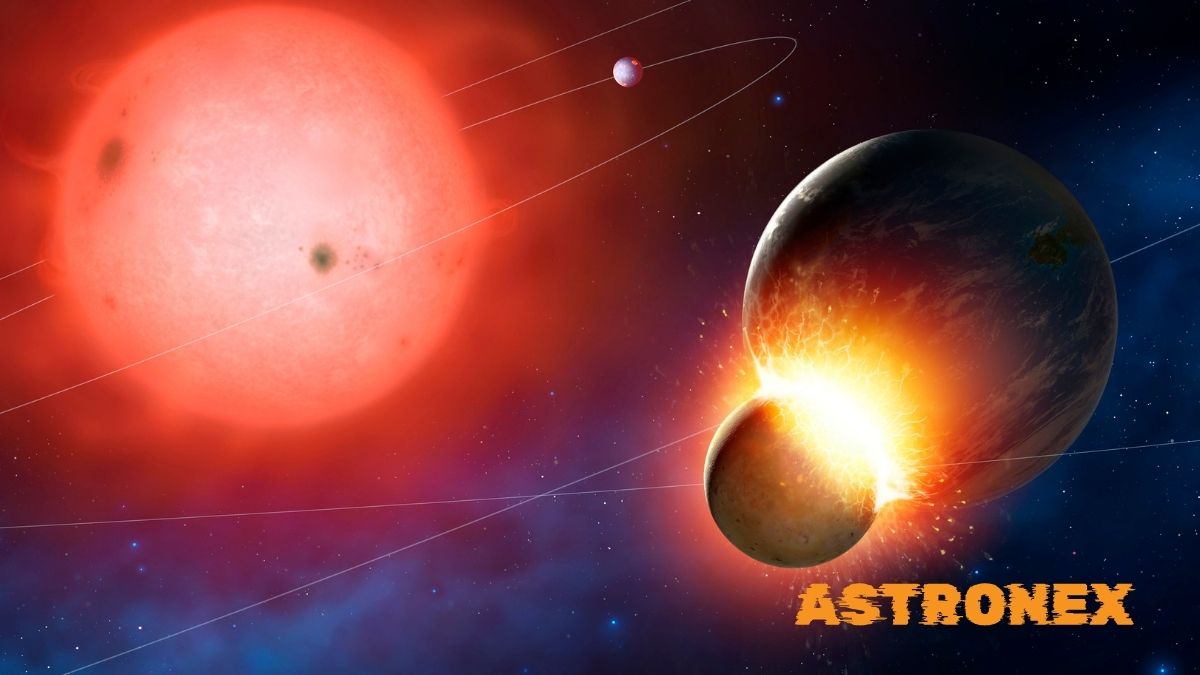
The early stages of planetary systems are marked by intense chaos, where growing planetary embryos collide in massive events known as giant impacts. These collisions, occurring billions of years ago in our solar system, involved bodies as large as Mars smashing into proto-planets at speeds around 9 kilometers per second (about 20,000 miles per hour, fast enough to cross the Atlantic Ocean in under 15 minutes). Recent high-resolution computer simulations reveal that such impacts could melt entire hemispheres, creating magma oceans and ejecting debris that forms moons or alters planetary compositions. For example, according to NASA’s latest Moon origin simulation, a Mars-sized object struck early Earth, launching material directly into orbit to form the Moon in just hours rather than months.
These giant impacts represent the final chapter in planet formation, after smaller planetesimals (building blocks roughly 1 to 100 kilometers in diameter, like rocky or icy asteroids) have accreted into larger bodies. In our solar system, this phase happened about 4.5 billion years ago, shaping the worlds we see today. Scientists use smoothed particle hydrodynamics (SPH, a computational method that models fluids and solids as particles) to study these events, showing how they influence everything from a planet’s core-mantle boundary to its orbital path. With data from missions like NASA’s InSight lander, which detected seismic waves traveling at speeds up to 8 kilometers per second (revealing deep mantle structures), experts confirm that remnants of these ancient crashes linger in planetary interiors.
But beyond building mass, these violent encounters can send planets wandering across their systems. How exactly do giant impacts trigger such dramatic shifts in planetary positions, and what clues do they leave behind in our own backyard?
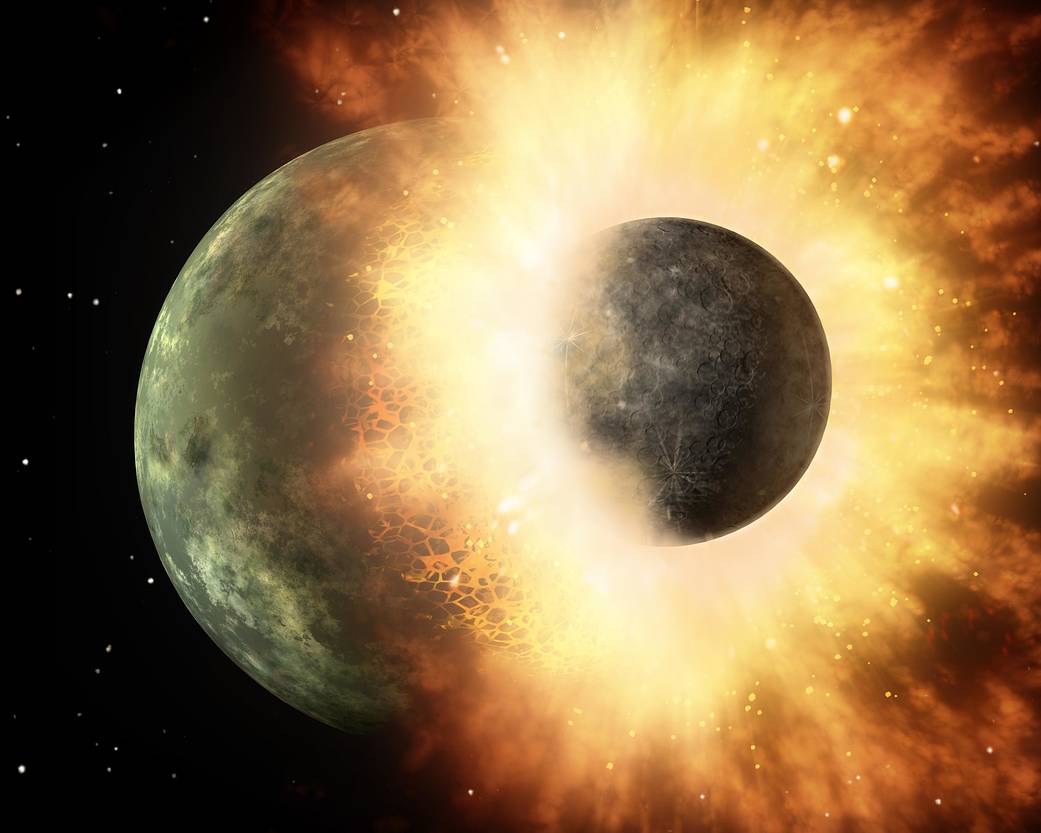
An artistic depiction of a giant impact between early Earth and a Mars-sized body, leading to the Moon’s formation.Image Credit: NASA / Ames Research Center.
What Are Giant Impacts in Planetary Formation?
Giant impacts refer to collisions between large planetary embryos during the late stages of planet formation, typically when bodies have grown to sizes comparable to Mars or larger. These events dominate after the protoplanetary disk (a flattened cloud of gas and dust surrounding a young star, spanning up to 100 astronomical units or about 15 billion kilometers) has mostly cleared, leaving behind proto-planets that compete for remaining material. In simulations, these impacts occur at relative velocities of 5 to 20 kilometers per second (11,000 to 45,000 miles per hour, enough to vaporize rock on contact), releasing energy equivalent to billions of nuclear bombs. This heat can create global magma oceans, layers of molten rock up to 1,000 kilometers deep, where denser iron sinks to form cores while lighter silicates rise.
According to research in the role of giant impacts in planet formation, these collisions exhibit diverse outcomes, from perfect mergers where two bodies combine into one, to hit-and-run scenarios where they graze and separate with altered compositions. For instance, in a hit-and-run, the smaller body might lose its silicate mantle (the rocky layer between crust and core, making up about 84% of Earth’s volume), leaving an iron-rich remnant. Fun fact: such processes explain why Mercury has a disproportionately large core, comprising about 70% of its radius compared to Earth’s 55%. To visualize the energy involved, consider that a single giant impact can raise planetary temperatures to over 2,000 Kelvin (about 1,700 degrees Celsius, hotter than lava), promoting chemical differentiation (the separation of materials by density).
- Merging collisions: Both bodies fully combine, increasing mass by up to 50% and often forming debris disks.
- Erosive impacts: Strip away outer layers, reducing size but enriching cores with heavy elements.
- Disruptive hits: Shatter the target into fragments, which may reaccrete or form smaller moons.
Experts note that the frequency of these impacts decreases over time, with most occurring within the first 100 million years of a system’s life. Recent studies from 2018 to 2022, using N-body simulations (computational models tracking gravitational interactions among multiple bodies), show that in systems with multiple embryos, up to 50% of growth happens through 1 to 10 giant impacts. If data on crater sizes is complex, like those on the Moon ranging from 1 to 1,100 kilometers in diameter, a diagram of impact scaling laws (relating crater diameter to impactor mass and velocity) helps illustrate how larger projectiles create proportionally bigger features.
These impacts not only build planets but also set the stage for migration by scattering bodies gravitationally.
How Do Giant Impacts Influence Planetary Migration?
Planetary migration happens when planets change their orbits, often moving closer to or farther from their star due to gravitational interactions. Giant impacts play a key role by causing sudden orbital shifts through direct collisions or scattering events, where bodies are flung into new paths. In the Nice model (a scenario explaining the outer solar system’s architecture, named after the French city where it was developed), giant planets like Jupiter and Saturn underwent migration after scattering smaller bodies, leading to impacts that reshaped the system. For example, a close encounter can increase a planet’s eccentricity (how elliptical its orbit is, measured from 0 for circular to nearly 1 for highly elongated), prompting it to cross paths with others and trigger more collisions.
Research shows that hit-and-run impacts, common in crowded early systems, can alter velocities by 1 to 5 kilometers per second, enough to eject bodies or send them migrating inward. In exoplanet systems, compact arrangements of super-Earths (planets 1 to 4 times Earth’s radius, with masses up to 10 Earth masses) often experience late instabilities, where giant impacts during migration strip mantles and change semi-major axes (the average distance from the star, like Earth’s 1 astronomical unit or 150 million kilometers). A 2023 review highlights that these events can lead to atmospheric loss, with vaporized material escaping at speeds exceeding the planet’s escape velocity (for Earth, about 11 kilometers per second).
Comparisons help: think of billiard balls on a table; a glancing shot (hit-and-run) sends both scattering, much like how a Mars-sized impactor might have nudged proto-Venus into its current orbit. Fun fact: without migration influenced by impacts, hot Jupiters (gas giants orbiting very close to their stars, with periods under 10 days) couldn’t exist, as they form farther out and migrate in. Bullet points for types:
- Type I migration: Smaller planets embedded in gas disks migrate slowly, but impacts accelerate this.
- Type II migration: Giants open gaps in disks, migrating with them; post-impact scattering disrupts this.
- Scattering-induced migration: Direct result of giant impacts, common in the late stages.
If uncertainties exist, like the exact timing (ranging from 10 to 100 million years after star formation across models), it reflects ongoing debates in the community. Diagrams of orbital evolution, showing before-and-after paths, clarify these dynamic changes.
What Evidence of Giant Impacts Exists in Our Solar System?
Our solar system bears scars from giant impacts, visible in craters, unusual compositions, and orbital oddities. On Mars, NASA’s InSight mission detected dense mantle structures from impacts 4.5 billion years ago, where projectiles injected debris deep into the planet, creating regions with densities up to 3.5 grams per cubic centimeter (compared to average mantle 3.3 grams per cubic centimeter). These events melted continent-sized areas, forming magma oceans that solidified into distinct layers. The Hellas basin, a crater 2,300 kilometers wide (larger than Alaska), likely formed from a 200-kilometer impactor traveling at 10 kilometers per second.
Mercury’s high density, 5.4 grams per cubic centimeter (versus Earth’s 5.5, but with a larger core fraction), suggests a giant impact stripped its mantle, leaving a core radius of about 2,000 kilometers. Pluto’s moon Charon probably formed from a similar collision, with the system’s tilted orbit as evidence. Fun fact: the asteroid belt contains families of fragments from ancient impacts, like the Vesta family, sharing spectral signatures (reflected light patterns indicating composition).
- Lunar basins: South Pole-Aitken, 2,500 kilometers across, from a 200-kilometer impactor.
- Martian dichotomy: Northern lowlands versus southern highlands, possibly from a polar impact.
- Uranus’ tilt: 98 degrees, likely from a Earth-sized collision knocking it sideways.
Recent data from 2022 InSight quakes, with waves propagating at 4 to 8 kilometers per second, confirm buried impact debris. For complex crater frequency charts, referencing a figure from NASA’s lunar reconnaissance shows impact rates dropping over time.
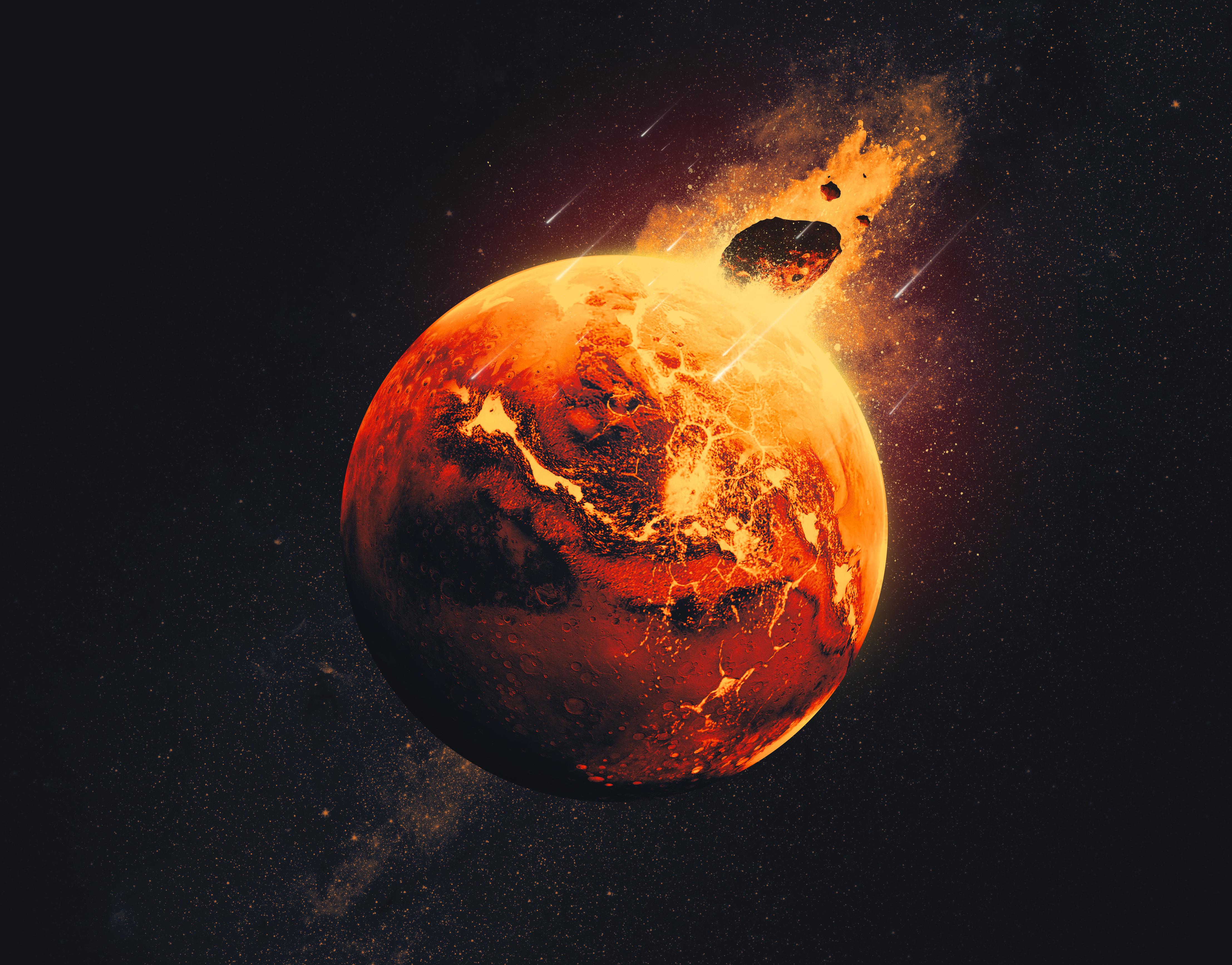
Artist’s concept showing a massive asteroid impacting ancient Mars, creating vast magma oceans. Image Credit: NASA / Jet Propulsion Laboratory.
How Did a Giant Impact Form Earth’s Moon?
The Moon formed from a giant impact when a Mars-sized body, called Theia, collided with proto-Earth about 4.5 billion years ago. High-resolution simulations show the crash happened at an angle, with impact speed around 20 kilometers per second, ejecting 5% of Earth’s mass into orbit. This debris, mostly from Earth’s mantle, coalesced into the Moon in hours, explaining its similar isotopic composition (ratios of oxygen-16 to oxygen-18 matching Earth’s to within parts per million). The Moon’s mass is 1.2% of Earth’s (7.3 x 10^22 kilograms), with a tilted orbit of 5 degrees.
This single-stage formation resolves older models’ issues, like why the Moon has a small iron core (only 1-2% of its mass versus Earth’s 32%). Heat from the impact created a synestia (a vaporized, donut-shaped cloud of rock and gas, extending thousands of kilometers), where the Moon assembled quickly. Fun fact: without this impact, Earth’s day might be shorter than 8 hours, as the collision slowed our rotation.
- Impactor mass: About 0.1 Earth masses (6 x 10^23 kilograms).
- Debris disk: Formed at 20,000-30,000 kilometers from Earth.
- Cooling time: Moon’s surface solidified in 1,000 years.
Uncertainties in Theia’s exact size (ranging 0.09 to 0.13 Earth masses across models) highlight simulation variations. A cross-section diagram of the collision phases aids understanding.
Can Giant Impacts Create High-Density, Metal-Rich Planets?
Yes, giant impacts can strip rocky mantles from super-Earths, forming metal-rich planets with iron cores making up 50-70% of their mass. Simulations of unstable compact systems show hit-and-run collisions, where velocities reach 1.5 times escape speed (for a 5 Earth-mass planet, about 20 kilometers per second), erode silicates and leave dense remnants. According to a 2025 study on metal-rich world formation, this process occurs in 0.5% of terrestrial planets, producing bodies with densities 1.4 to 2.7 times Earth’s average (5.5 grams per cubic centimeter).
These remnants are often sub-Earth sized, under 1.3 Earth radii (about 8,300 kilometers), matching observed exoplanets like GJ 367b (density 8.1 grams per cubic centimeter). Fun fact: this explains “super-Mercuries,” planets denser than pure iron spheres compressed by gravity.
- Core fraction: Increases from 33% to over 50% post-impact.
- Occurrence rate: Up to 21% for sub-Earths.
- Simulation count: Over 100,000 runs using neural networks.
For mass-radius plots, a figure comparing observed and simulated planets visualizes the density spread.
What Are the Mechanisms and Scaling of Atmospheric Loss in Giant Impacts?
During giant impacts, atmospheres can be lost through shock waves and vaporization, with scaling laws predicting erosion based on impactor mass and velocity. For impacts at 10-20 kilometers per second, energy release strips gas layers, especially on super-Earths where escape velocities are higher (15-25 kilometers per second). A 2025 paper details that loss fractions range 10-90%, depending on atmospheric density (for proto-Earth, about 10^-3 grams per cubic centimeter).
Mechanisms include hydrodynamic escape (gas flowing outward faster than escape speed) and ejecta drag (debris carrying away atmosphere). Fun fact: this process might have thinned Venus’ early atmosphere, contributing to its runaway greenhouse.
- Scaling law: Loss proportional to (impactor mass / target mass)^0.5.
- Threshold velocity: Above 2 times escape speed for total loss.
- Examples: Moon-forming impact removed Earth’s primordial envelope.
Diagrams of atmospheric density profiles before and after help depict the changes.
Conclusion
Giant impacts represent the dramatic finale of planetary formation, forging worlds through collisions that melt, strip, and scatter. From shaping Earth’s Moon to enabling metal-rich exoplanets, these events, backed by recent simulations and mission data, reveal a violent birth for stable systems. They link formation to migration, where orbital shifts from impacts create diverse architectures.
What undiscovered remnants of ancient giant impacts might future missions uncover in distant worlds?
📌 Frequently Asked Questions
What is the giant impact hypothesis for the Moon’s formation?
The giant impact hypothesis explains that the Moon formed when a Mars-sized body collided with early Earth, ejecting debris that coalesced into our satellite. This event, occurring 4.5 billion years ago, accounts for the Moon’s composition matching Earth’s mantle.
How big was the impactor that formed the Moon?
The impactor, named Theia, was about the size of Mars, with a mass around 6 x 10^23 kilograms or 10% of Earth’s mass. Simulations show it struck at an oblique angle, leading to rapid Moon formation.
What are giant impacts in astronomy?
Giant impacts are collisions between large planetary bodies during formation, releasing immense energy that can melt surfaces and alter compositions. They occur in the late accretion phase, shaping planets like Earth and Mercury.
Did giant impacts happen on Mars?
Yes, ancient giant impacts on Mars created features like the Hellas basin and injected dense debris into its mantle. NASA’s InSight detected these structures through seismic data in 2022.
How do giant impacts affect planetary atmospheres?
Giant impacts can strip or erode atmospheres through shock heating and ejecta, with loss scaling to impact energy. For example, super-Earths might lose 10-90% of their gas envelopes in such events.
What role do giant impacts play in exoplanet formation?
In exoplanet systems, giant impacts during instabilities can create diverse compositions, like metal-rich worlds by stripping mantles. They contribute to observed density variations in super-Earths.
Is planetary migration caused by giant impacts?
Giant impacts can trigger migration through gravitational scattering and orbital changes, especially in crowded systems. This complements disk-driven migration in early phases.
What evidence supports giant impacts in the solar system?
Evidence includes large craters like South Pole-Aitken on the Moon, Mercury’s large core, and Uranus’ extreme tilt, all pointing to ancient collisions.
Can giant impacts form moons?
Yes, giant impacts often eject debris that forms moons, as seen with Earth’s Moon and Pluto’s Charon. The process involves a disk of material coalescing over time.
How frequent were giant impacts during planet formation?
Giant impacts were common in the first 100 million years, with terrestrial planets experiencing 1 to 10 such events. Their frequency decreased as systems stabilized.
Sources
Asphaug, E., & Emsenhuber, A. (2023). The role of giant impacts in planet formation. Annual Review of Earth and Planetary Sciences, 51, 419-448. https://doi.org/10.1146/annurev-earth-031621-055545
Cambioni, S., Weiss, B. P., Volk, K., & Lin, Z. (2025). Can metal-rich worlds form by giant impacts? Astronomy & Astrophysics, 685, A123. https://doi.org/10.1051/0004-6361/202450128
NASA. (2022, October 4). Collision may have formed the Moon in mere hours, simulations reveal. NASA Solar System Exploration. https://www.nasa.gov/solar-system/collision-may-have-formed-the-moon-in-mere-hours-simulations-reveal/
NASA. (2025, August 28). Giant impacts on ancient Mars (artist’s concept). NASA Science. https://science.nasa.gov/photojournal/giant-impacts-on-ancient-mars-artists-concept/