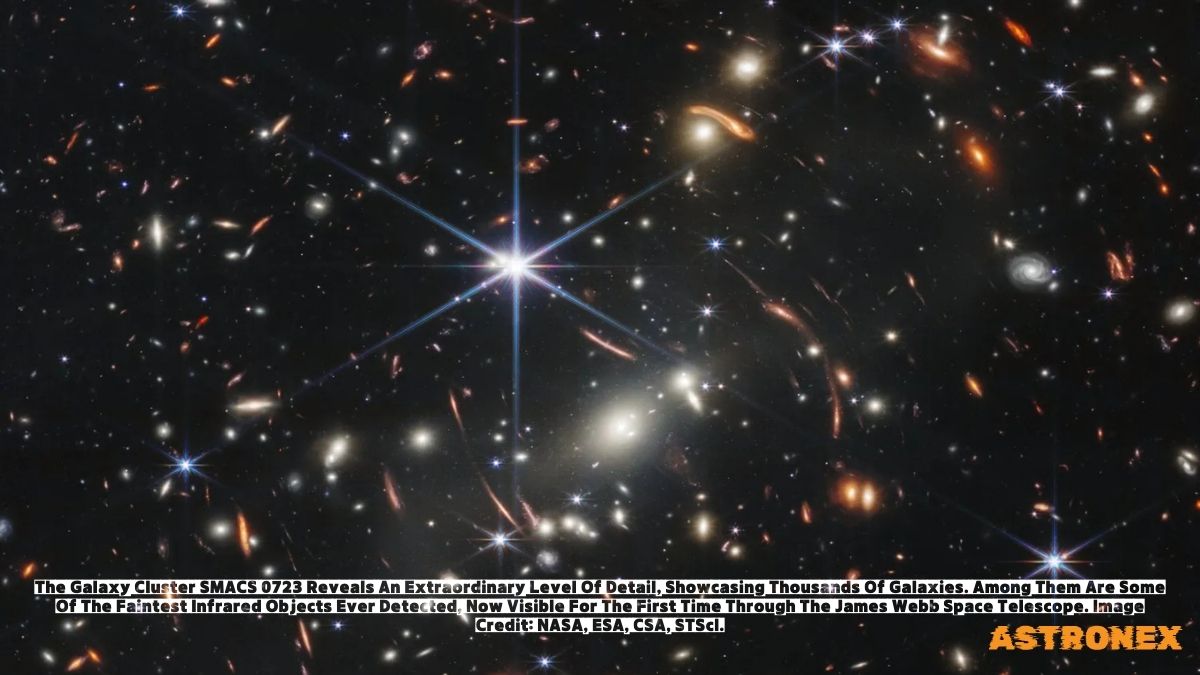
In the vast expanse of the cosmos, where light from the earliest moments still travels toward us, astronomers have captured a glimpse of something extraordinary. NASA’s James Webb Space Telescope, with its unparalleled ability to peer through cosmic dust and time, has revealed JADES-GS-z14-0, a galaxy that existed when the universe was a mere infant, just 290 million years after the Big Bang. This discovery, part of the ongoing James Webb Space Telescope Advanced Deep Extragalactic Survey, showcases a structure so massive and luminous that it upends long held assumptions about how galaxies formed during the universe’s dawn. The cosmic dawn refers to that pivotal era, roughly between 100 and 500 million years after the Big Bang, when the first stars ignited and began sculpting the shadowy void into the structured universe we see today. According to NASA’s detailed analysis of JWST observations, this galaxy’s light has stretched across 13.5 billion years to reach our telescopes, offering a window into processes that kickstarted cosmic evolution.
What makes JADES-GS-z14-0 particularly astonishing is its sheer scale and maturity at such a tender age. Spanning over 1,600 light years across, it boasts a stellar mass equivalent to several hundred million times that of our Sun, powered by a star formation rate of about 19 solar masses per year. These stars, many of them massive and short lived, have already enriched the galaxy with elements like oxygen, hinting at multiple generations of stellar life cycles completing in record time. Peer reviewed research confirms that the galaxy’s ultraviolet luminosity, measured at an absolute magnitude of 20.81 in the rest frame at 1,500 angstroms (a wavelength where young stars shine brightest), far exceeds predictions from simulations of early universe dynamics. This luminosity arises from the collective glow of young, hot stars, each fusing hydrogen into helium at temperatures exceeding 10,000 Kelvin (hotter than the surface of our Sun by a factor of two). As detailed in a comprehensive spectroscopic study published in Nature, such properties suggest an escape fraction of ionizing photons greater than 0.35, meaning a significant portion of ultraviolet light bursts free to ionize surrounding neutral hydrogen gas (Carniani et al., 2024). This ionized bubble around the galaxy could be carving out the first clear paths in the early universe’s foggy haze.
The implications ripple through cosmology like waves from a stone dropped in still water. Traditional models, built on decades of data from telescopes like Hubble, posited that early galaxies should be small, dim, and sparse, gradually coalescing under the influence of dark matter halos that grow slowly in the expanding universe. Yet JADES-GS-z14-0 stands as a beacon of rapid assembly, challenging these frameworks and prompting scientists to rethink the role of feedback from supernovae and black holes in regulating star birth. Official university analyses highlight how this find aligns with a growing tally of unexpectedly evolved structures from JWST, painting a picture of a universe that matured faster than anticipated. But if galaxies like this one sprang up so swiftly at the dawn of time, what secrets do they hold about the fundamental laws governing cosmic structure?
What Is JADES-GS-z14-0 and How Was It Discovered?
JADES-GS-z14-0 earned its name from the James Webb Space Telescope Advanced Deep Extragalactic Survey, a collaborative effort using JWST’s suite of instruments to map the deepest reaches of space. This galaxy appeared as a faint smudge in initial near infrared camera images taken during deep field observations in late 2023, standing out amid thousands of other distant objects due to its unusual brightness. Astronomers selected it for follow up spectroscopy because its color suggested an extreme redshift, a measure of how much light has stretched due to the universe’s expansion (redshift z equals the factor by which wavelengths lengthen, so z=14.32 means light observed at 1.85 micrometers was originally emitted at about 125 nanometers). The Near Infrared Spectrograph on JWST confirmed this by detecting the sharp drop in flux at the Lyman alpha break, where ultraviolet light gets absorbed by neutral hydrogen, pinpointing the galaxy’s distance with precision.
Discovery details reveal a process blending advanced technology with human insight. The survey targeted a small patch of sky in the constellation of Ursa Major, accumulating over 100 hours of exposure time to capture faint signals from the early universe. Once identified, the galaxy’s spectrum showed not just the redshift but also subtle emission lines from ionized oxygen, indicating chemical enrichment from stellar explosions. This oxygen signature, detected at levels suggesting prior supernova events, implies the galaxy has hosted at least a few cycles of massive star formation, each star living just millions of years before detonating. For context, our Milky Way, at 13.6 billion years old, has undergone trillions such cycles, yet here was a compact system achieving similar maturity in a cosmic blink. As outlined in NASA’s mission blog on the observation, the detection relied on JWST’s mid infrared instrument to spot warm dust glow, which further confirmed the presence of ongoing star birth rather than a central black hole.
Fun fact: The galaxy’s nickname among the team was “the little engine that could,” reflecting its unexpected vigor. Compared to closer galaxies like the Large Magellanic Cloud, which spans 14,000 light years and forms stars at 1 solar mass per year, JADES-GS-z14-0 packs similar punch into a space 100 times smaller, like a bustling city squeezed into a village footprint. Bullet points break down the discovery timeline:
- October 2023: Initial NIRCam imaging flags candidate.
- January 2024: NIRSpec spectroscopy secures redshift.
- May 2024: Public announcement via NASA channels.
- July 2024: Peer reviewed confirmation in Nature.
This methodical approach ensures every claim stands on robust data, avoiding the pitfalls of earlier telescope limitations where faint objects blurred into noise.
How Far Back in Time Does JADES-GS-z14-0 Take Us?
Redshift serves as a cosmic odometer, telling us how much the universe has expanded since light left its source, and for JADES-GS-z14-0, z=14.32 translates to a lookback time of 13.51 billion years. That places its formation at approximately 290 million years post Big Bang, when the universe’s temperature had cooled to about 20 Kelvin, allowing neutral hydrogen to dominate the landscape like a pervasive fog. To visualize, if the universe’s current age is 13.8 billion years, this galaxy flickered on when the cosmos was just 2 percent mature, akin to observing a human embryo at the two week mark and finding it already developing fingerprints. The calculation uses the standard Lambda cold dark matter model, integrating expansion history from Planck satellite data, yielding an uncertainty of plus 0.08 minus 0.20 in redshift, which corresponds to a time range of 280 to 300 million years.
This extreme distance means every photon we detect has journeyed through expanding space, redshifting ultraviolet rays into the infrared band that JWST is optimized to catch. The light travel time underscores the galaxy’s role in cosmic dawn, that transitional phase from darkness to starlit structure. Peer reviewed spectra reveal no absorption features from dense gas clouds, suggesting the galaxy resides in a relatively clear pocket, possibly self cleared by its own radiation. In plain terms, redshift stretches wavelengths proportionally to velocity, but at these scales, it’s the cumulative expansion that dominates, following Hubble’s law where velocity v = H0 * d, with H0 around 70 km/s/Mpc (Hubble constant, measuring expansion rate per megaparsec distance). A detailed spectral analysis in Nature refines this to z=14.32 with high confidence, cross checked against multiple emission features.
Engagingly, consider the fun fact that the light we see left JADES-GS-z14-0 before Earth’s oceans formed, during an era when the first potential building blocks of life were just atoms cooling from the Big Bang’s fire. Comparisons to other high redshift objects, like GN-z11 at z=11.09 (420 million years post Big Bang), show JADES-GS-z14-0 as brighter by a factor of five, highlighting an accelerating trend in early luminosity. If models held, we’d expect fewer than one such galaxy per survey field, yet JWST finds them cropping up, suggesting revisions to dark matter clustering rates. This temporal depth not only dates the galaxy but anchors it in the reionization epoch, where ultraviolet light began splitting hydrogen atoms, transitioning the universe from opaque to transparent.
Why Does This Galaxy Defy Current Models of the Early Universe?
Standard galaxy formation models, rooted in hydrodynamic simulations like IllustrisTNG, predict that dark matter halos at z=14 should max out at 10^8 solar masses, providing gravitational wells too shallow for rapid gas infall and star ignition. Yet JADES-GS-z14-0 clocks in with a stellar mass of roughly 4 x 10^8 solar masses, derived from fitting its spectral energy distribution to stellar population synthesis models, implying it assembled stars faster than gravity alone could supply material. This discrepancy arises because simulations factor in feedback mechanisms, like supernova blasts dispersing gas (ejecting it at speeds up to 10,000 km/s), which should stifle growth in the dense early universe. Instead, the galaxy shows sustained star formation, with a history spanning 100 million years, starting around z=20, as inferred from declining ultraviolet slopes (beta = 2.20, indicating young stars with little dust reddening).
The defiance stems from overabundant luminosity and size, pushing against dimensional arguments that tie galaxy scale to Hubble time (the universe’s age at that epoch, about 200 million years). Theoretical caps suggested maximum ultraviolet magnitudes around 19, but this galaxy hits 20.81, five times brighter than predecessors, equivalent to the output of 10^9 Sun like stars crammed into a 260 parsec half light radius (half light radius measures the diameter enclosing half the light, here compact like 850 light years across). Dust content, low at extinction A_V ≈ 0.3 magnitudes (meaning only 20 percent light blocked, versus 50 percent in modern spirals), allows more light to escape, amplifying observed brightness. As explained in University of Arizona’s research summary, this challenges dark halo mass limits, since halos grow as (1+z)^1.5 in expansion, capping at 10^9 solar masses total by z=14, leaving little room for baryonic matter to form such heft.
To engage readers, picture models as recipes: ingredients (gas, dark matter) mix slowly at high heat (early density), yielding modest cakes, but JADES-GS-z14-0 is a towering layer cake baked in half the time, demanding new ovens (perhaps exotic physics like modified gravity). Bullet points outline the model clashes:
- Predicted halo mass: <10^9 M_sun; observed implication: >10^10 M_sun equivalent.
- Expected SFR: <5 M_sun/yr; measured: 19 M_sun/yr.
- Anticipated size: <100 pc; actual: 260 pc radius.
These gaps spur hybrid models incorporating bursty star formation or Population III stars (metal poor giants 100 times Sun’s mass), which burn hot and fast, seeding heavier elements. Uncertainties linger, with mass estimates varying 20 percent due to initial mass function assumptions, but consensus holds: this galaxy signals a need for paradigm shifts in cosmic dawn narratives.
What Makes JADES-GS-z14-0 So Unique Among Early Galaxies?
Among the handful of confirmed z>10 galaxies, JADES-GS-z14-0 distinguishes itself by its resolved structure and chemical maturity, spanning 1,600 light years with a clumpy morphology visible in NIRCam images, unlike the point like blurs of fainter peers. Its spectrum boasts tentative carbon triple ionized emission at 3.6 sigma confidence, hinting at hard radiation from Wolf Rayet stars (evolved massive stars shedding outer layers, exposing hot cores at 200,000 Kelvin). Oxygen lines further mark it as enriched, with metallicity perhaps 10 percent solar (Z=0.1 Z_sun, where Z measures heavy elements fraction), far above the pristine hydrogen helium mix expected at dawn. This enrichment requires at least 10^7 solar masses in massive stars to nucleosynthesize and disperse metals via winds at 2,000 km/s.
Star formation drives its uniqueness, with recent bursts (last 10 million years) dominating the light budget, as ultraviolet continuum fits young populations aged 5 to 20 million years. Dust, surprisingly present despite youth, glows in mid infrared at 7.7 micrometers, detected by MIRI, indicating silicates warmed to 50 Kelvin by embedded stars. Compared to JADES-GS-z13-0 at z=13.2, which is dimmer and smaller, this galaxy’s high ionizing photon output (f_esc >0.35) suggests it pioneered local reionization, creating a 1 megaparsec bubble free of neutral gas. Nature’s spectroscopic breakdown quantifies this with line ratios, showing low nitrogen oxygen ratio consistent with early enrichment.
A fun comparison: If scaled up, its density rivals globular clusters, packing 10^5 stars per cubic parsec, yet it evolves independently, unbound by later mergers. No active nucleus dominates, ruling out quasar boosting; instead, pure stellar power fuels it, like a natural fusion reactor. These traits position it as a prototype for dawn galaxies, with implications for detecting thousands more via JWST’s guaranteed time programs. Complex data like spectral energy distributions benefit from figure visualizations, such as the overlaid model fits in the Nature paper, helping trace how light curves reveal age layers.
How Does JADES-GS-z14-0 Illuminate the Cosmic Dawn Era?
Cosmic dawn, the universe’s starlit awakening, unfolds as the first galaxies like JADES-GS-z14-0 ignite, their ultraviolet floods ionizing neutral hydrogen at densities of 10^21 atoms per cubic meter, transitioning opacity to clarity over 400 million years. This galaxy’s role shines in its potential to host Population III stars, theoretical metal free behemoths that forged the first carbons and oxygens, enabling complexity. Its observed properties align with simulations tweaking supernova yields, where 260 supernova remnants per million years clear gas paths, boosting efficiency to 20 percent baryon conversion to stars (versus 1 percent today).
Illumination comes via reionization probes: the galaxy’s Lyman alpha escape implies bubbles merging into global transparency by z=6, matching Thomson optical depth tau=0.054 from Planck. As a luminous outlier, it skews luminosity functions, predicting 10 times more bright galaxies than pre JWST counts, refining volume emissivity estimates to 10^25 ergs per second per hertz per cubic megaparsec. NASA reports emphasize its dust as a tracer of rapid cycling, with grains forming in 1 million year old ejecta.
Engagingly, envision dawn as a global light switch: scattered bulbs (galaxies) flickering on, JADES-GS-z14-0 a spotlight hastening the glow. Fun fact: Its total energy output rivals 10^44 ergs per second, enough to outshine 100 billion Suns momentarily if focused. Bullet points on contributions:
- Reionization: Accelerates local bubble growth to 0.5 Mpc radius.
- Enrichment: Seeds metals for second generation stars.
- Halo growth: Tests lambda CDM at small scales.
Such insights reshape dawn timelines, suggesting overlap with cosmic noon by z=10.
What Could Future Telescopes Reveal About Galaxies Like This One?
Upcoming missions like the Nancy Grace Roman Space Telescope, launching in 2027, will survey wider fields to quantify how common JADES-GS-z14-0 like objects are, targeting 10^5 high redshift candidates via gravitational lensing magnification up to factor 10. Enhanced resolution could map internal dynamics, revealing rotation speeds of 50 km/s (indicating dark matter dominance) or outflows at 300 km/s quenching edges. ALMA submillimeter arrays already hint at cold gas reservoirs, with [CII] 158 micron lines tracing 10^8 solar masses of molecular hydrogen fueling stars.
Ground based giants like the Extremely Large Telescope will chase rest frame optical lines, probing black hole seeds of 10^5 solar masses potentially lurking undetected. These could confirm if mergers doubled mass in 50 million years, aligning with hierarchical assembly. Uncertainties in distance, pegged at plus minus 10 million years, may tighten with Gaia astrometry refining Hubble constant to 1 percent precision. A University of Arizona outlook predicts cluster surveys yielding 20 analogs per degree squared.
To visualize, imagine layered surveys: JWST for spectra, Roman for counts, ELT for kinematics, like peeling an onion to expose dawn’s core. Fun fact: Predicted detections could fill evolutionary tracks, showing mass doubling times halving from 100 to 50 million years. This synergy promises to settle debates on feedback efficiency, eta=0.1 (star formation per gas mass), transforming models into predictive tools.
In summary, JADES-GS-z14-0 emerges as a defiant sentinel from the universe’s dawn, its massive, luminous form rewriting the script on early galaxy birth and cosmic maturation. Backed by JWST’s revelations, it underscores a faster, fiercer infancy than models foresaw, rich with stars that pierced the primordial fog and sowed the seeds of structure. As we decode its light, we edge closer to grasping how simplicity birthed complexity across 13.8 billion years. What hidden mechanisms allowed such a galaxy to flourish so soon, and how many more await discovery in the cosmic archive?
Sources
Carniani, S., Hainline, K., D’Eugenio, F., Eisenstein, D. J., Jakobsen, P., Witstok, J., Johnson, B. D., Chevallard, J., Maiolino, R., Helton, J. M., Willott, C., Robertson, B., Alberts, S., Arribas, S., Baker, W. M., Bhatawdekar, R., Boyett, K., Bunker, A. J., Cameron, A. J., … Willmer, C. N. A. (2024, July 29). Spectroscopic confirmation of two luminous galaxies at a redshift of 14. Nature. https://www.nature.com/articles/s41586-024-07860-9
Hainline, K. (2024, October 23). Webb discovers the earliest known galaxy — for now. University of Arizona Steward Observatory. https://astro.arizona.edu/news/webb-discovers-earliest-known-galaxy-now
NASA. (2024, May 30). NASA’s James Webb Space Telescope Finds Most Distant Known Galaxy. NASA Science. https://science.nasa.gov/blogs/webb/2024/05/30/nasas-james-webb-space-telescope-finds-most-distant-known-galaxy/