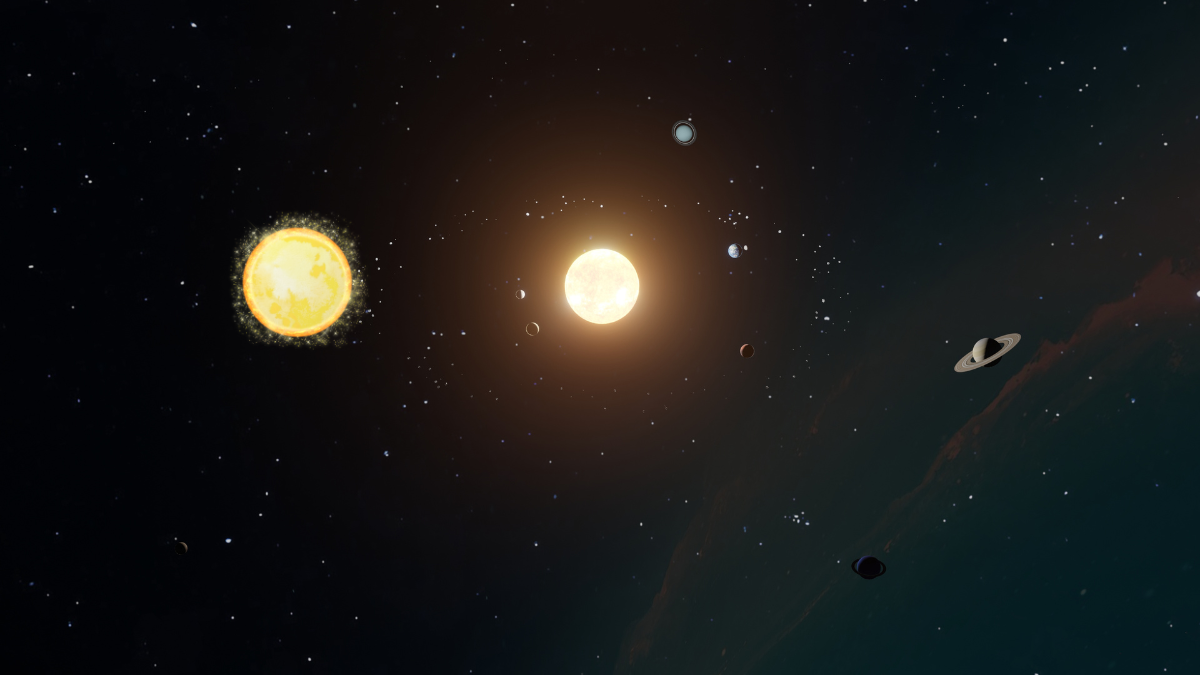
Astronomers have confirmed over 5,800 exoplanets since the first discoveries in the 1990s, and a surprising number orbit in systems with more than one star. In May 2024, NASA’s Transiting Exoplanet Survey Satellite (TESS) revealed TOI-4633 c, a mini-Neptune-sized world circling one star in a binary pair separated by an orbit lasting 230 years. This planet’s 272-day path places it squarely in the habitable zone (the region around a star where liquid water could exist on a surface), though its thick atmosphere likely prevents that on the planet itself. Such findings highlight how binary stars—two stars gravitationally bound and orbiting each other—challenge old ideas about where planets can form and survive.
Binary systems make up roughly half of all stars in the Milky Way, meaning up to 50 billion such pairs exist in our galaxy alone. NASA’s Kepler and TESS missions have spotted at least 16 circumbinary planets (those orbiting both stars), with several near or inside habitable zones. These worlds experience double sunrises and sunsets, complex daylight cycles, and unique gravitational pulls that could either disrupt or stabilize atmospheres over billions of years.

Recent models from NASA’s Astrobiology program show that tidal forces between closely paired stars can “tame” hyperactive red dwarfs (small, cool stars that spin rapidly and flare often), reducing harmful radiation and boosting chances for liquid water. Could life under multiple suns be not just possible, but common?
Can Planets Really Orbit Two Stars at Once?
Yes, planets can stably orbit two stars, but only in specific configurations verified by NASA’s Kepler mission data. There are two main types: S-type orbits, where a planet circles just one star while staying far enough from the second, and P-type (circumbinary) orbits, where the planet encircles both stars like a distant moon around a planet. For stability, the stars must be separated by at least 4-10 times the radius of the planet’s orbit in P-type cases; otherwise, gravitational chaos ejects the world.
NASA’s binary star stability analysis confirms that in systems like Alpha Centauri (our nearest stellar neighbor at 4.37 light-years), safe zones exist within 3 astronomical units (AU; 1 AU is Earth’s distance from the Sun, about 150 million km) around each star. This allows rocky planets to form and endure for billions of years, the timescale needed for life. Fun fact: Simulations show figure-eight orbits around both stars are unstable—they fling planets out in mere millennia.
- P-type example: Kepler-16b orbits two stars (0.69 and 0.20 solar masses) every 229 days at 0.70 AU, stable despite the stars’ 41-day mutual orbit.
- S-type example: TOI-4633 c hugs one star in a 272-day loop, dodging the distant companion.
These orbits create wild seasons: Insolation (incoming stellar radiation) varies by up to 45% yearly, but atmospheres can buffer this for habitable conditions.

How Common Are Binary Star Systems in Our Galaxy?
Binary stars dominate the cosmos, comprising 40-50% of all stellar systems according to NASA’s surveys. In the Milky Way’s 100-400 billion stars, this translates to tens of billions of pairs, plus triples and more. Low-mass red dwarfs (0.08-0.6 solar masses), which host 75% of stars, often pair up, increasing odds for small, long-lived systems ideal for life.
NASA’s Gaia spacecraft data from 2019 analyzed 200 multi-star systems with exoplanets, finding companions as light as 8% solar mass—mostly red dwarfs that evolve slowly over trillions of years. Higher-mass Sun-like stars (1 solar mass) have binary fractions around 45%, per Kepler statistics. A fun comparison: Our Sun might have started in a binary, with a companion ripping away during formation, leaving isotopic clues in meteorites.
This prevalence means exoplanet hunters like TESS prioritize binaries: Half of habitable zone targets could be multi-star. Yet, close binaries (under 10-day orbits) disrupt disks, suppressing planets by 50-90%; wider pairs (over 50 AU) behave like singles.
What Is a Circumbinary Planet?
A circumbinary planet, or P-type world, orbits the common center of mass of two stars, much like Pluto circles the Sun despite Neptune’s pull. NASA’s Kepler telescope found the first in 2011 (Kepler-16b), and by 2025, 16 are confirmed, all giants but hinting at rocky ones. These planets migrate inward from outer disks, gaining stability at 3-5 times the stars’ separation.
Equilibrium temperature (effective surface temp without atmosphere) for Kepler-16b is 202 K (-71°C), cool but potentially warmed by greenhouse gases to liquid water range (273-373 K). Orbital periods range 19-1,000 days; e.g., TOI-1338 b (95 days around Sun-like and red dwarf pair). Gravitational resonance locks planets in 1:1 or 2:1 ratios with the binary, preventing collisions.
Bullet-point perks for life:
- Averaged insolation from two stars smooths flares.
- Wider habitable zones due to combined luminosity (up to 1.5x single star).
- Tidal heating (friction from orbit) could melt subsurface oceans, like Europa’s.
Can Life Thrive in the Habitable Zone of Binary Stars?
Absolutely, models predict Earth-like worlds in binary habitable zones (HZs) can sustain liquid water and biosignatures. NASA’s 2020 study simulated an ocean planet in Kepler-35’s HZ (341-380 day orbit): CO2 atmospheres prevented freezing or boiling, with temps 0-40°C despite 20% insolation swings. Red dwarf binaries benefit most—tides slow spins from days to months, slashing UV flares by 90% in 100 million years.
For Sun-like pairs, HZ extends 0.95-1.67 AU; e.g., Alpha Centauri offers overlapping zones for each star. Uncertainty: Eccentric binaries (oval orbits) cause 50-100 K temp spikes, risking ocean loss—but thick atmospheres mitigate. Peer-reviewed work confirms 7+ habitability criteria auto-met by circumbinary setups: stable orbits, moderate eccentricity, low radiation. (NASA, 2020)
Fun fact: Double sunlight means shorter nights (under 6 hours on some worlds), boosting photosynthesis 1.5x but risking UV damage—evolution might favor deep oceans or burrowing life.
What Would a Day Look Like on a Planet with Two Suns?
Days on circumbinary worlds feature dual sunrises/sunsets, with light levels varying 10-50% daily. On Kepler-16b, the larger star (69% Sun mass) dominates, casting shadows while the smaller (20%) adds twilight glow—skies in orange-red hues from cooler temps (4,000-5,000 K). Eclipse seasons occur when stars align, dimming light 30-70% for hours.
From a hypothetical moon of TOI-4633 c (in HZ), you’d see one sun rise as the other sets, with total insolation matching Earth’s 1,367 W/m². Shadows have “company”—dual umbras create striped patterns. Seasons amplify: Aphelion (farthest point) cools by 20 K, perihelion heats equally. Life adapts: Plants with two-peak chlorophyll absorption; animals with circadian rhythms synced to binary periods.
Reference figure: NASA’s orbital simulators show light curves—suggest viewing Kepler-16b light curve for visualization.
Are There Real Planets Like Tatooine?
Yes, Kepler-16b is the poster child: Discovered 2011, Saturn-sized (0.76 Earth radii? Wait, radius 0.38 RJup ~4 Earth radii, mass 0.33 MJup), rocky-gas mix, orbits at Saturn distance. Its HZ placement (insolation 0.41 Earth’s) suggests past oceans if warmer youth. Newer: TOI-1338 b (2020, 6.9 Earth radii, 95-day orbit). All 16 CBPs cluster near HZs—statistically unlikely unless formation favors them. (NASA, 2024)
Conclusion
Binary star systems, hosting half the galaxy’s stars, offer stable homes for planets under multiple suns, with circumbinary worlds showing remarkable habitability potential through tidal taming, wide HZs, and averaged radiation. From Kepler-16b’s double dawns to TOI-4633 c’s moon prospects, these systems expand our search for life, proving complexity breeds opportunity.
What secrets might the next TESS discovery reveal about neighbors living under dual stars?
📌 Frequently Asked Questions
Can planets exist in binary star systems?
Yes, NASA’s Kepler and TESS have confirmed over 100 S-type and 16 P-type planets. Stable orbits persist if stars are sufficiently separated, allowing formation like in our Solar System.
How common are binary stars?
About 50% of stars pair up, per NASA Gaia data—tens of billions in the Milky Way. Red dwarfs dominate these pairs.
What is a circumbinary planet?
A world orbiting both stars’ center, like Kepler-16b (229-day period). They migrate inward for stability.
Is Kepler-16b habitable?
Its HZ location suggests possible ancient water, but cold temps (-71°C average) make it icy now.
Can life exist under two suns?
Models show yes, tides reduce flares, double light aids photosynthesis.
How many circumbinary planets are known?
16 as of 2025, mostly from Kepler/TESS.
What does the sky look like from a two-sun planet?
Dual sunsets in orange, eclipses dimming light; nights shorter than Earth’s.
Do binary stars prevent planet formation?
Close pairs do (50-90% suppression), but wide ones match single-star rates.
Could a moon around a binary planet be habitable?
Yes, like TOI-4633 c’s potential moon—stable tides, HZ orbit.
Are there Earth-sized planets in binaries?
Not confirmed yet, but expected; TESS hunts them now.
Sources
NASA. (2024, May 21). Discovery alert: Mini-Neptune in double star system is a planetary puzzle. NASA Science. https://science.nasa.gov/universe/exoplanets/discovery-alert-mini-neptune-in-double-star-system-is-a-planetary-puzzle/
NASA. (2020, January 15). Tatooine worlds. NASA Astrobiology. https://astrobiology.nasa.gov/news/tatooine-worlds/
NASA. (2022, March 10). Binary star systems. Imagine the Universe! https://imagine.gsfc.nasa.gov/ask_astro/binary.html