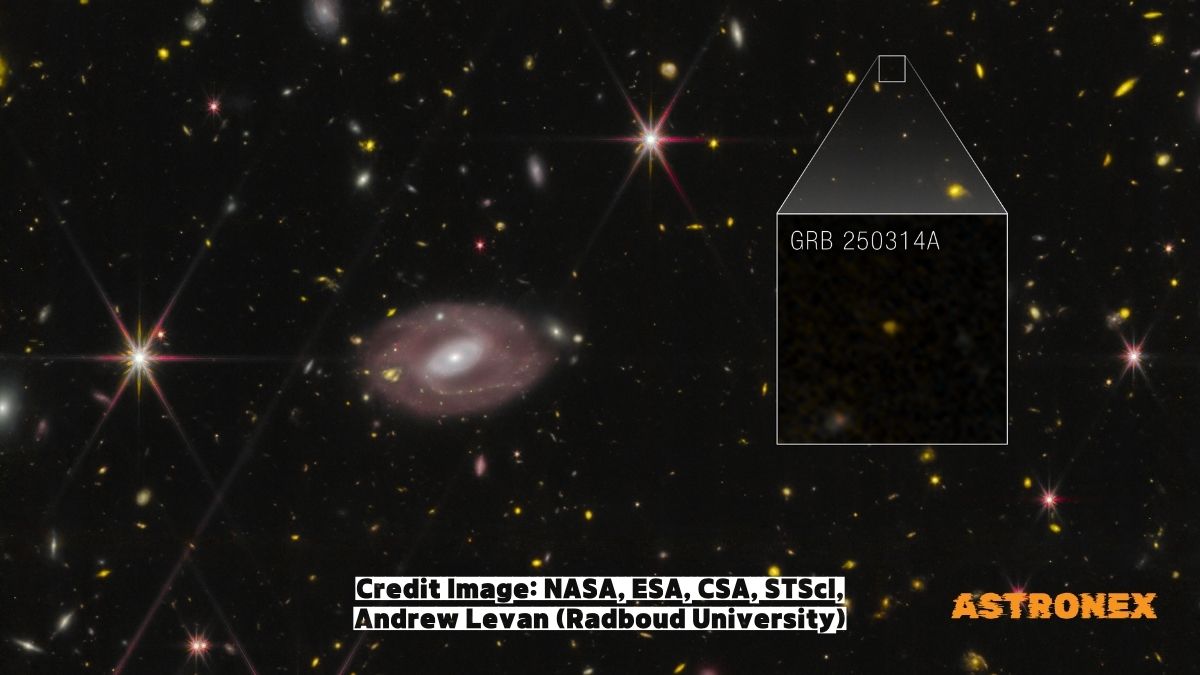
Astronomers have long sought to peer back into the earliest epochs of the cosmos and recent observations from the James Webb Space Telescope have delivered a groundbreaking view. This powerful instrument captured light from a supernova that detonated just 730 million years after the Big Bang marking a pivotal moment in our understanding of stellar explosions in the young universe. The event known as GRB 250314A originated from the collapse of a massive star and its detection pushes the boundaries of what we know about cosmic history. This supernova stands out because its light traveled across vast distances reaching us after billions of years and providing a snapshot of conditions when the universe was only about 5 percent of its current age.
The discovery highlights the telescope’s ability to detect faint signals from extreme distances revealing details that previous observatories could not achieve. Scientists confirmed the supernova through follow up imaging that showed both the explosion’s aftermath and its host galaxy blending into a subtle glow in near infrared light. This finding not only sets a new record for the most distant supernova observed but also challenges expectations about how stars behaved in the early universe. With precise measurements and spectral analysis experts determined the event’s redshift at approximately 7.3 indicating the immense stretch of spacetime the light endured.
What surprises researchers most about this ancient blast and how does it reshape our views on the formation of the first stars?
What Is the Earliest Supernova Ever Observed by Astronomers?
The earliest supernova observed to date is GRB 250314A a stellar explosion that occurred when the universe was merely 730 million years old. This event was first detected as a gamma ray burst on March 14 2025 by the Space based multi band astronomical Variable Objects Monitor mission a collaborative effort involving multiple space agencies. According to NASA’s Webb supernova discovery update the burst lasted around 10 seconds before fading but its afterglow persisted allowing for detailed study. The supernova’s light stretched over time due to the expansion of the universe making it appear to brighten gradually over months rather than the typical weeks seen in nearby explosions. This time dilation effect where cosmic expansion elongates observed durations provided crucial clues to its immense distance.
To put this in perspective the universe is currently about 13.8 billion years old so this supernova exploded during the era of reionization a period when the first stars and galaxies began to ionize neutral hydrogen gas filling the cosmos. Comparisons to modern supernovae show striking similarities despite the vastly different conditions back then such as lower abundances of heavy elements metals in astronomical terms produced by previous stellar generations. For instance the luminosity of this supernova measures about 70 percent that of SN 1998bw a well studied gamma ray burst associated supernova from 1998 serving as a benchmark for such events. Fun fact gamma ray bursts like this one release more energy in seconds than our Sun will emit over its entire 10 billion year lifetime emphasizing their extreme nature.
Astronomers used spectroscopy to measure the redshift z approximately 7.3 which quantifies how much the light has been stretched by the expanding universe (a higher redshift means greater distance and earlier time). This value corresponds to a lookback time of roughly 13.07 billion years confirming the young age of the universe at the time of the blast. If we consider the uncertainty in cosmological models the age could vary slightly by a few million years but sources agree on 730 million years as the standard figure. Bullet points for key parameters include redshift z equals 7.3 universe age at explosion 730 million years gamma ray burst duration 10 seconds observation delay for peak brightness three and a half months.
The detection breaks previous records set by the same telescope which had spotted supernovae from about 1.8 billion years after the Big Bang. This leap forward demonstrates advancements in infrared astronomy since visible light from such distances shifts into infrared wavelengths due to redshift. Researchers suggest visualizing this as looking through a cosmic time machine where each layer of distance reveals earlier chapters of universal evolution.
How Did the James Webb Space Telescope Detect This Ancient Supernova?
The James Webb Space Telescope detected this ancient supernova through a combination of rapid response observations and its advanced near infrared camera NIRCam. After the initial gamma ray burst alert on March 14 2025 several ground and space based telescopes swung into action. For example NASAs Neil Gehrels Swift Observatory pinpointed the X ray source within 1.5 hours while the Nordic Optical Telescope captured an infrared afterglow 11 hours later. The European Southern Observatorys Very Large Telescope followed up 15 hours post detection to estimate the distance via spectroscopy. These efforts paved the way for Webb to observe the site on July 1 2025 about 110 days after the burst in Earth time but only 13 days in the supernovas rest frame due to time dilation.
Webb’s NIRCam instrument captured high resolution images in multiple filters revealing a faint source that brightened in redder wavelengths consistent with a supernova’s spectral signature. According to ESA’s Webb earliest supernova report the images showed the host galaxy as a reddened smudge spanning just a few pixels blending the supernova light with galactic emission. Photometric data from filters like F150W2 magnitude 29.25 plus or minus 0.11 and F444W magnitude 27.64 plus or minus 0.11 indicated a flat spectrum turning steeper in red bands matching models of a Type Ic supernova. Explanations in brackets technical terms like magnitude a measure of brightness where lower numbers mean brighter objects help clarify that these values denote extremely faint signals requiring Webb’s sensitivity.
To model the data scientists compared the observed light curve the change in brightness over time to templates of known supernovae adjusted for redshift. They used power law fits for the afterglow F nu proportional to t to the power of minus alpha times nu to the power of minus beta where alpha is 2.1 plus or minus 0.6 and beta is 0.2 plus or minus 0.4 describing the fading behavior. The supernova component matched 70 percent luminosity of SN 1998bw with absolute magnitude M B approximately minus 18.9 after subtracting host galaxy contribution. If uncertainties in host brightness are considered the range could be 50 to 100 percent but brighter events like superluminous supernovae are ruled out.
Fun fact Webb’s mirrors coated in gold optimize infrared detection allowing it to see through cosmic dust that obscures visible light views. Bullet points for detection steps initial alert from SVOM mission swift localization in X rays ground telescope afterglow imaging Webb NIRCam photometry and imaging. This multi wavelength approach ensured comprehensive data collection highlighting international collaboration in astronomy.
For visual aid readers might refer to figures in official reports showing the light curve with overlaid models or the multi band images where the source evolves from undetectable in blue filters to prominent in red ones illustrating the redshift effect.
What Type of Supernova Is GRB 250314A and How Does It Form?
GRB 250314A is classified as a broad lined Type Ic supernova arising from the core collapse of a massive star typically 25 to 40 times the mass of our Sun. This type lacks hydrogen and helium in its spectrum broad lined meaning absorption lines are widened by high velocity ejecta moving at thousands of kilometers per second. The formation begins when such a star exhausts its nuclear fuel its core collapses under gravity forming a neutron star or black hole while the outer layers explode outward at speeds up to 30000 kilometers per second. In this case the collapse also produced a gamma ray burst a focused beam of high energy radiation lasting 10 seconds observed as the initial flash.
Details from spectral analysis show low dust extinction based on blue afterglow colors meaning little obscuring material along the line of sight allowing clear views of the supernova. According to the peer reviewed study on JWST supernova observations the event’s properties mirror those of local universe supernovae despite occurring in an era with fewer heavy elements (Levan et al. 2025). Heavy elements or metals enrich stars over time but early stars were mostly hydrogen and helium yet this supernova’s luminosity and spectrum suggest the progenitor star was not unusually massive or different.
Comparisons to SN 1998bw include similar peak brightness and decline rates adjusted for redshift with the absolute magnitude in blue bands around minus 19.4 before host subtraction. Uncertainties arise from the blended light but models exclude alternatives like a pure afterglow or host galaxy dominance. For example if only the host contributed the spectral energy distribution would require an ancient stellar population formed at redshift 21 which is unlikely given the young universe age.
Fun fact core collapse supernovae like this one forge heavy elements such as iron and gold dispersing them into space to seed future stars and planets. Bullet points for formation stages massive star burns fuel rapidly over millions of years core collapses in seconds releasing neutrinos and gravitational waves outer layers explode as supernova jets produce gamma ray burst if aligned toward Earth. Measurements include ejecta velocity inferred from line broadening around 20000 kilometers per second and energy output equivalent to 10 to the 52 ergs immense compared to the Suns 10 to the 41 ergs per year.
To visualize suggest diagrams of stellar evolution showing the onion like layers of fusion products leading to iron core instability the point where fusion no longer provides support against gravity.
What Does the Host Galaxy of This Earliest Supernova Look Like?
The host galaxy of GRB 250314A appears as a faint blue compact object typical of galaxies in the early universe during the reionization era. Observations reveal it with an absolute ultraviolet magnitude M UV approximately minus 17.8 making it dimmer than many nearby galaxies but consistent with high redshift hosts of gamma ray bursts. This magnitude indicates low luminosity but high star formation rate as young hot stars dominate the light output. The galaxy shows marginal extension in shorter wavelength filters like F150W2 suggesting a compact size perhaps a few thousand light years across though precise measurements are challenging due to distance.
Spectral energy distribution analysis shows a blue color flatter in mid wavelengths then rising in red consistent with a young stellar population and minimal dust. According to NASA’s Webb supernova discovery update it resembles Lyman break galaxies common at redshift 7 characterized by a spectral break from neutral hydrogen absorption. Comparisons to other high z galaxies show similarities in metallicity low metal content and star formation efficiency though this one hosts a gamma ray burst progenitor implying regions of intense massive star birth.
Uncertainties in separation from the supernova light mean the host contribution could range from dominant in blue bands to minor in red but models favor a combination. For instance subtracting a supernova template leaves a host SED fitting delayed star formation history with maximum age 700 million years and color excess E B minus V less than 0.2 indicating low dust attenuation.
Fun fact such early galaxies were building blocks for larger structures like our Milky Way merging over billions of years. Bullet points for characteristics absolute magnitude M UV minus 17.8 blue SED indicative of young stars compact morphology blended in images similar to z 7 Lyman break galaxies. If data tables of photometric magnitudes were plotted a chart would show the flux drop in bluest filters due to intergalactic absorption helping visualize the distance effect.
What Are the Scientific Implications of Observing This Early Supernova?
Observing this early supernova implies that massive stars in the young universe exploded in ways remarkably similar to those today challenging models of stellar evolution in metal poor environments. Early stars were expected to be more massive and live shorter lives due to lacking heavy elements which affect opacity and mass loss rates yet GRB 250314A’s properties match local analogs like SN 1998bw. This suggests limited evolution in gamma ray burst progenitors across cosmic time meaning the physical processes governing core collapse remain consistent.
The rarity of such detections only a handful of gamma ray bursts in the first billion years underscores their value as probes of distant galaxies. According to ESA’s Webb earliest supernova report the afterglow acts as a fingerprint revealing galactic composition through absorption lines. Implications extend to understanding reionization as these explosions ionize surrounding gas aiding the transition from opaque to transparent universe.
Measurements like the supernova’s luminosity 70 percent of benchmark and low extinction open avenues for studying individual stars at 5 percent universe age. Uncertainties include whether the progenitor was slightly less massive but sources agree on no need for exotic models. Future observations could target more events to map star formation history.
Fun fact this discovery validates Webb’s rapid turnaround programs enabling time sensitive science. Bullet points for implications similarity to modern supernovae probe for early star formation insight into reionization era potential for galaxy fingerprinting via afterglows. Suggest figures comparing SEDs of early versus local supernovae to illustrate the unexpected resemblance.
The ability to detect such faint distant events pushes telescope technology highlighting international efforts in uncovering cosmic origins.
Conclusion
This discovery of GRB 250314A by the James Webb Space Telescope marks a milestone as the earliest supernova observed exploding 730 million years after the Big Bang and revealing a universe where stellar deaths mirrored those in later epochs. From the gamma ray burst detection to detailed infrared imaging the event showcases how massive stars shaped early galaxies providing essential data on cosmic evolution. With its host galaxy and supernova properties aligning closely to expectations yet surprising in their familiarity it bridges the gap between ancient and modern cosmos.
How might future detections of even earlier supernovae further unravel the mysteries of the universe’s infancy?
Sources
European Space Agency. (2025 December 9). Webb identifies earliest supernova to date. ESA. https://www.esa.int/Science_Exploration/Space_Science/Webb/Webb_identifies_earliest_supernova_to_date
Levan A. J. et al. (2025 December). JWST reveals a supernova following a gamma-ray burst at z ≃ 7.3. Astronomy & Astrophysics 704. https://www.aanda.org/articles/aa/full_html/2025/12/aa56581-25/aa56581-25.html
NASA. (2025 December 9). NASA’s Webb identifies earliest supernova to date shows host galaxy. NASA Science. https://science.nasa.gov/missions/webb/nasas-webb-identifies-earliest-supernova-to-date-shows-host-galaxy