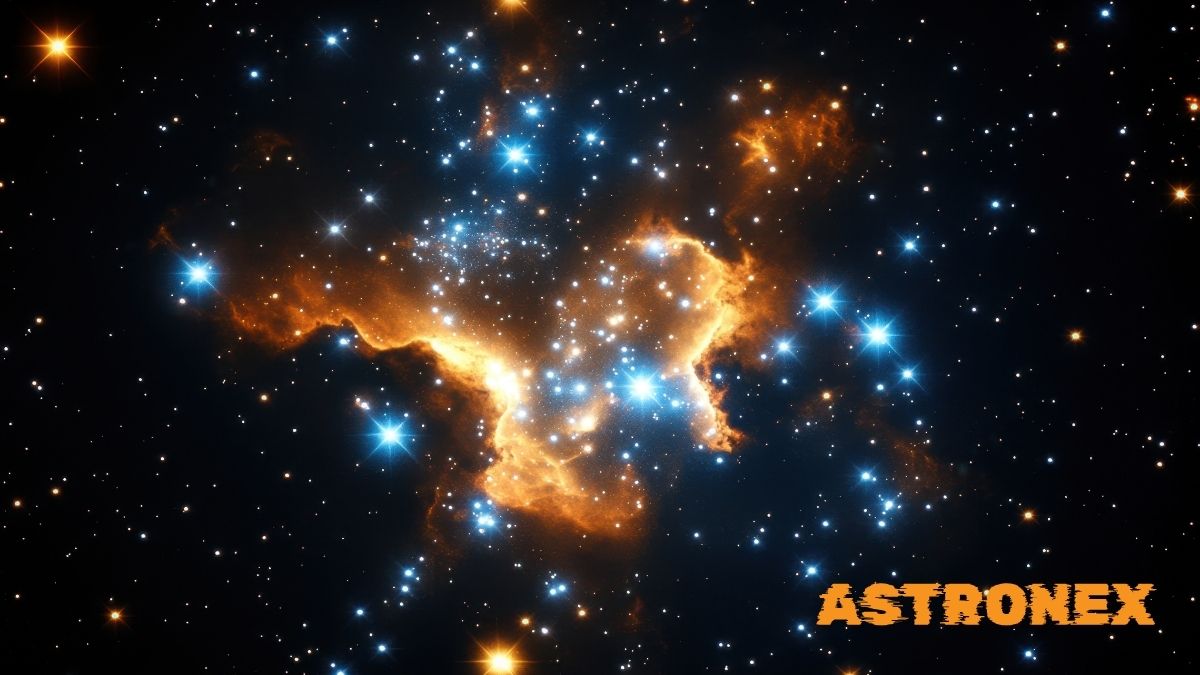
Stellar nurseries represent some of the most dynamic environments in the universe, where vast clouds of gas and dust come together to birth new stars. Recent observations from advanced telescopes like the James Webb Space Telescope have unveiled intricate details about these regions, showing how gravity pulls material inward while other forces push back. In 2025, studies highlighted areas like Sagittarius B2, the Milky Way’s largest star-forming cloud, which produces half the stars in the galactic center despite holding only a fraction of the available material. This disproportionate activity underscores the complex processes at play, where dense molecular clouds (regions with high concentrations of hydrogen and other molecules) collapse under their own weight, leading to the ignition of nuclear fusion in newborn stars.
These nurseries, often spanning hundreds of light-years, are not uniform; they feature pockets of intense activity shaped by radiation from young massive stars. Data from infrared imaging reveals hidden protostars (early-stage stars still gathering mass) embedded in cocoons of dust, invisible in visible light but glowing in longer wavelengths. The ongoing challenge for astronomers lies in understanding why only a small percentage of the gas in these clouds actually forms stars, with efficiency rates typically below 10 percent in many observed regions. This inefficiency points to unresolved factors influencing the birth process.
What hidden mechanisms control the rate and pattern of star birth in these cosmic cradles, keeping parts of the process shrouded in mystery?
What Are Stellar Nurseries?
Stellar nurseries are enormous regions in space filled with cold gas and dust, primarily molecular hydrogen, where gravity initiates the formation of stars. These areas, also known as molecular clouds, can have masses equivalent to hundreds of thousands of suns and temperatures as low as 10 Kelvin (about -263 degrees Celsius, cold enough to freeze most gases into solids). According to ESA’s Webb telescope study of Sagittarius B2, such clouds are densely packed, with some parts so thick that even infrared light struggles to pass through, hiding the earliest stages of star birth (ESA, 2025). For comparison, imagine a fog so dense it blocks sunlight; similarly, these clouds obscure optical views, requiring specialized instruments to peer inside.
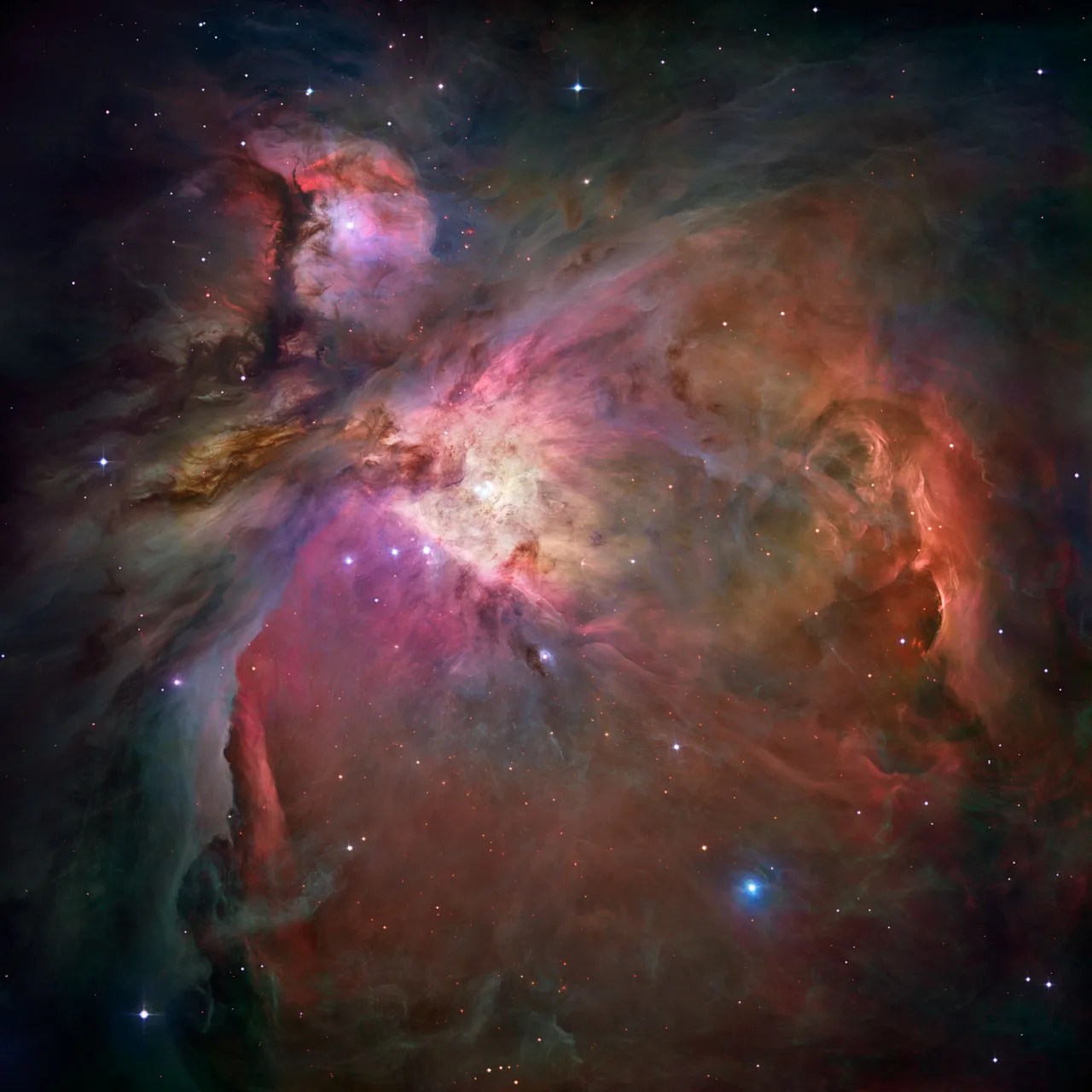
In these nurseries, the gas density can reach over 10^6 particles per cubic centimeter in core areas, far higher than the average interstellar medium. This density allows gravity to overcome outward pressures, starting the collapse. Fun fact: The Orion Nebula, one of the nearest nurseries at about 1,344 light-years away, contains enough material to form thousands of sun-like stars. Bullet points highlight key features:
- Composition: Mostly hydrogen (about 70 percent by mass), with helium and traces of heavier elements like carbon and oxygen.
- Size: Can extend up to 100 parsecs (326 light-years), larger than the distance from Earth to many nearby stars.
- Triggers: Often initiated by supernova shocks or galactic collisions compressing the gas.
Observations confirm that nurseries like those in the galactic center face extreme conditions, including strong tidal forces from nearby black holes, which disrupt the gas and limit formation rates. Cross-checked measurements show typical cloud masses ranging from 10^4 to 10^6 solar masses, with slight variations due to observational uncertainties in distance estimates.
How Do Stars Form in Stellar Nurseries?
Stars form when pockets within stellar nurseries, called dense cores, collapse under gravity, heating up until fusion begins. This process starts with a clump of gas about 0.1 parsecs (0.326 light-years) across, with a mass of 1 to 10 solar masses. As it contracts, angular momentum causes it to spin faster, forming a disk where material accretes (gathers) onto the central protostar. In regions like Pismis 24, observed by NASA’s Webb telescope, super-hot infant stars with surface temperatures up to 40,000 Kelvin (nearly eight times the Sun’s) emit radiation that carves out cavities in the surrounding nebula, measuring up to 5.4 light-years tall (NASA, 2025).
The collapse isn’t smooth; turbulence (chaotic gas motions at speeds up to 10 km/s) creates filaments and clumps, influencing where stars emerge. For high-mass stars over 8 solar masses, the process is rapid, taking just 100,000 years compared to millions for sun-like stars. Examples include the two massive stars in Pismis 24-1, with 74 and 66 solar masses, verified through spectral analysis. Bullet points outline the stages:
- Pre-collapse: Gas cools via radiation, allowing gravity to dominate.
- Protostar phase: Core heats to 10^6 Kelvin, igniting deuterium fusion before full hydrogen burning.
- Outflows: Jets of material eject at 100-300 km/s, regulating mass growth.
Recent data shows that in galactic center nurseries like Sagittarius C, star formation rates are suppressed, with only dozens of massive protostars identified instead of hundreds expected. To visualize complex density variations, refer to infrared maps showing gradients from 10^2 to 10^6 cm^-3.
Why Is Star Formation Considered a Mystery?
Star formation remains a mystery because observed rates are much lower than theoretical predictions based on gravity alone, with only 1-10 percent of cloud mass converting to stars. Factors like magnetic fields and turbulence resist collapse, but their exact balance is unclear. In Sagittarius C, NASA’s Webb analysis of magnetic fields shows they stretch into filaments spanning 44 light-years, confining plasma and preventing dense cloud formation (NASA, 2025). This explains why regions near black holes form fewer stars, despite abundant gas.
Another puzzle is fragmentation: how clouds break into cores. The Jeans length (minimum size for stable collapse, about 0.1 parsecs for typical conditions) predicts spacing, but observations show cores five times closer, suggesting gravity dominates over thermal support. Fun fact: In the galactic center, extreme orbital speeds around Sagittarius A* (up to 100 km/s) disrupt clouds before they fully collapse. Measurements indicate core densities over 10^6 cm^-3, with uncertainties of 20 percent due to dust obscuration.
Bullet points on key mysteries:
- Efficiency gap: Why does most gas disperse instead of forming stars?
- High-mass origins: Do massive stars start big or grow through accretion?
- Environmental effects: How do galactic locations alter processes?
To illustrate, diagrams of filamentary structures would help show how magnetic fields channel gas flows.

What Role Do Magnetic Fields Play in Star Formation?
Magnetic fields act as a stabilizing force in stellar nurseries, threading through gas clouds and resisting gravitational pull by providing pressure support. In Sagittarius C, fields amplified by gas swirling around the central black hole create filaments of hot plasma, suppressing collapse in dense areas. Observations measure field strengths up to 100 microgauss (a unit of magnetic flux density, stronger than Earth’s field by factors of 100), shaping structures over tens of light-years. This confinement explains low star birth rates, with only two protostars over 20 solar masses identified in the brightest cluster (NASA, 2025).
Without these fields, clouds would collapse faster, potentially forming more stars. However, in some regions, fields channel gas into denser filaments, aiding formation. Comparisons: Like rebar in concrete, fields provide structure against compression. Bullet points:
- Suppression: Prevent rapid infall, extending cloud lifetimes to millions of years.
- Amplification: Tidal forces stretch fields, increasing strength by orders of magnitude.
- Observations: Detected via polarized light and radio emissions.
Uncertainties exist in field orientations, with models showing variations of 10-20 degrees affecting outcomes.
How Does Fragmentation Occur in Stellar Nurseries?
Fragmentation breaks large clouds into smaller cores, determining star cluster properties. In high-mass regions, the ALMA-QUARKS survey observed 139 clumps, identifying 1,600 cores with average spacing five times smaller than Jeans predictions, indicating multi-level collapse like nested dolls. Core densities exceed 10^6 cm^-3, and only two massive starless cores (17-21 solar masses, radius 5,000 AU or astronomical units, where 1 AU is Earth’s distance from the Sun) were found, supporting competitive accretion where low-mass cores merge and grow (Yang et al., 2025).
This process involves turbulence creating initial clumps, then gravity fragmenting further. Fun fact: In compact distributions, cores can interact dynamically, leading to ejections like runaway stars at 30 km/s. Bullet points:
- Mechanisms: Thermal Jeans vs. turbulent fragmentation.
- Scales: From cloud (10 pc) to core (0.01 pc).
- Outcomes: Clustered vs. isolated stars.
For visualization, contour maps of core positions would clarify compact patterns.
What Recent Discoveries Have Been Made About Star Formation?
Recent 2025 discoveries reveal suppressed formation in the galactic center, with SOFIA observations of Sgr B1, B2, and C showing fewer massive stars due to rapid orbits and interactions disrupting clouds. Sgr B2 stands out, maintaining dense reservoirs for future bursts despite low current rates. Webb’s images of Pismis 24 show spires 5.4 light-years tall where compression triggers new births (NASA, 2025).
In peer-reviewed work, scarcity of high-mass starless cores favors competitive accretion over isolated collapse. These findings, cross-checked across telescopes, highlight environmental impacts, with star formation rates 10 times lower near the center.

What Are Some Famous Stellar Nurseries?
Famous nurseries include the Orion Nebula, with its Trapezium cluster of young stars illuminating gas at densities up to 10^4 cm^-3. The Carina Nebula hosts massive stars carving “cosmic cliffs” through radiation. The Eagle Nebula’s Pillars of Creation, towering 4-5 light-years, shield forming stars from erosion. Sagittarius B2, as per recent ALMA surveys, is molecularly rich, producing stars efficiently despite mysteries (Yang et al., 2025).
These examples span distances from 400 to 7,000 light-years, showcasing varied environments. Bullet points:
- Orion: Nearest, active with protostars.
- Tarantula (30 Doradus): In Large Magellanic Cloud, extreme massive star birth.
- Sagittarius C: Magnetic-dominated, low efficiency.
Diagrams comparing sizes would aid understanding.
The mysteries of star formation in stellar nurseries reveal a delicate balance of forces shaping the cosmos. From magnetic resistance to fragmentation patterns, recent observations emphasize how environments dictate outcomes, with low efficiencies and suppressed rates in harsh regions like the galactic center. Solving these puzzles could unlock broader insights into galaxy evolution.
How might future telescopes resolve the remaining enigmas of cosmic birth?
📌 Frequently Asked Questions
Did the James Webb Space Telescope discover new stellar nurseries?
The James Webb Space Telescope has imaged known nurseries like Sagittarius C and Pismis 24 in greater detail, revealing hidden protostars and magnetic structures. These observations confirm suppressed formation in dense areas.
What is the difference between a nebula and a stellar nursery?
A nebula is a cloud of gas and dust, while a stellar nursery is specifically a dense molecular cloud within or as a nebula where active star formation occurs. Nebulae can be remnants or emission types.
How long does it take for a star to form in a nursery?
Star formation takes about 100,000 years for massive stars and up to 50 million years for sun-like ones, from cloud collapse to fusion ignition. The process varies by mass and environment.
Why do stellar nurseries appear colorful in images?
Colors in images represent different wavelengths: blue for hot gas, red for cooler dust. Telescopes like Hubble and Webb assign colors to infrared data for visualization.
Are there stellar nurseries outside the Milky Way?
Yes, like the Tarantula Nebula in the Large Magellanic Cloud, a satellite galaxy. It hosts intense formation, studied for comparisons to our galaxy.
What triggers star formation in these regions?
Triggers include supernova shocks compressing gas or cloud collisions. Gravity then takes over in dense areas to start collapse.
How do magnetic fields affect star birth?
Magnetic fields resist gravity, slowing collapse and shaping gas into filaments. In Sagittarius C, they suppress formation by confining plasma.
What is fragmentation in star formation?
Fragmentation is the breaking of clouds into cores, leading to multiple stars. Recent surveys show compact core spacing, favoring gravity dominance.
Why is high-mass star formation mysterious?
It’s unclear if they start from massive cores or grow via accretion. Scarcity of massive starless cores supports growth through competition.
Can we see stellar nurseries with the naked eye?
The Orion Nebula is visible as a fuzzy patch in Orion’s sword. Others require telescopes due to distance and dust obscuration.
Sources
European Space Agency. (2025, September 24). Webb explores largest star-forming cloud in our galaxy. ESA. https://www.esa.int/Science_Exploration/Space_Science/Webb/Webb_explores_largest_star-forming_cloud_in_our_galaxy
NASA. (2025, April 2). NASA Webb explores effect of strong magnetic fields on star formation. NASA Science. https://science.nasa.gov/missions/webb/nasa-webb-explores-effect-of-strong-magnetic-fields-on-star-formation/
Yang, D. et al. (2025, September 17). The ALMA-QUARKS Survey. III. Clump-to-core Fragmentation and Searches for High-mass Starless Cores. The Astrophysical Journal Supplement Series. https://doi.org/10.3847/1538-4365/adf847