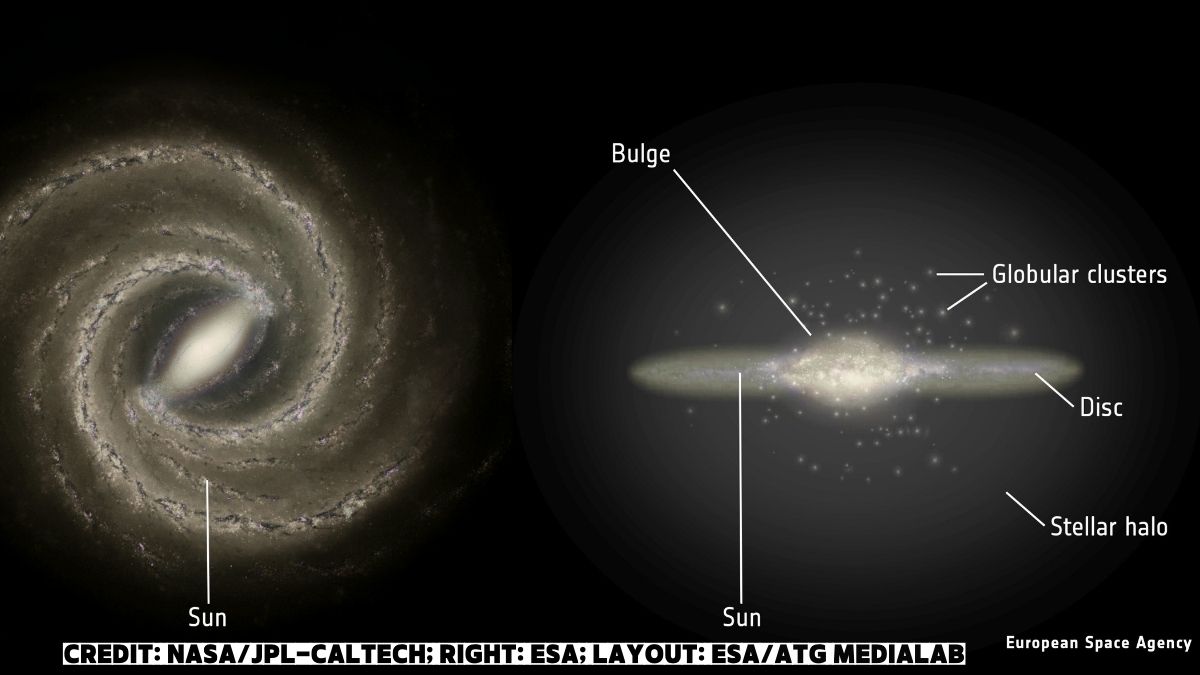
Astronomers have recently uncovered a set of extremely ancient stars lurking in the outer reaches of the Milky Way. These stars formed around 12 to 13 billion years ago, shortly after the universe began expanding from the Big Bang about 13.8 billion years ago. Located in the galactic halo, a vast spherical region surrounding the main disk of our galaxy, these stars offer fresh insights into how the Milky Way assembled itself over cosmic time. Using data from space telescopes and groundbased observatories, researchers identified these stars as remnants from tiny primordial galaxies that our larger galaxy absorbed long ago.
The discovery highlights the dynamic history of the Milky Way, showing it grew by merging with smaller systems. These stars stand out due to their low content of heavy elements, formed in an era when the universe contained mostly hydrogen and helium. Observations reveal they move in unusual paths, orbiting in the opposite direction to most stars in the galaxy. This retrograde motion indicates they originated elsewhere, making them intriguing relics of the early cosmos. As part of ongoing surveys, scientists continue to search for more such stars to piece together the puzzle of galactic evolution.
What secrets do these ancient stars hold about the birth of our galaxy?
What Are Milky Way Ghost Stars And Why Are They Called That?
Milky Way ghost stars refer to a group of ancient stellar objects discovered in the galactic halo, the extended outer envelope beyond the main spiral disk. These stars earned their ghostly nickname because they are faint, elusive, and remnants of longvanished small galaxies, haunting the edges like echoes from the distant past. According to MIT’s recent stellar archaeology findings, they formed between 12 and 13 billion years ago, making them nearly as old as the universe itself. Their dim appearance comes from low luminosity, as they are small, cool stars that have burned steadily for eons without the bright flareups of younger ones.
These stars contain very few heavy elements, known as metals in astronomy (elements heavier than helium, such as iron or strontium). For example, one such star has about 10000 times less iron than our Sun, a sign it formed before supernovae explosions seeded the cosmos with heavier materials. This pristine composition matches what models predict for the first generations of stars after the Big Bang. Researchers classify them as Small Accreted Stellar System stars, or SASS, because they were accreted, or pulled in, from dwarf galaxies during mergers. Bullet points help clarify their key traits:
- Age range: 12 to 13 billion years, based on chemical analysis and orbital data.
- Location: Approximately 30000 lightyears from Earth in the halo, a region spanning up to 100000 lightyears from the galactic center.
- Motion: Retrograde orbits, moving counter to the galaxy’s rotation at speeds of hundreds of kilometers per second (km/s).
- Size and mass: Similar to our Sun but with simpler chemistry, lacking the complexity of modern stars.
To visualize their distribution, imagine the Milky Way as a flat pancake with a bulging center, the halo forms a diffuse bubble around it, where these stars scatter sparsely. If data included a chart of their positions, it would show them clustered in streams, remnants of disrupted galaxies. Their discovery relied on reexamining spectra, light breakdowns that reveal elemental makeup, from telescopes like the MagellanClay at Las Campanas Observatory. This approach confirmed their ancient origins without relying on uncertain expansion rate measurements of the universe.
How Were These Ghost Stars Discovered In The Milky Way Halo?
The detection of these ghost stars began with a classroom project analyzing existing astronomical data. Students and researchers examined spectra from thousands of stars, focusing on those with unusually low metal content. Using observations from the 65meter Magellan telescopes in Chile, they pinpointed three candidates in the halo. Further checks with the European Space Agency’s Gaia satellite, which maps stellar positions and motions, revealed their retrograde paths, confirming they did not form in place but were captured.
Gaia’s precision allowed tracing orbits back billions of years, showing these stars entered the Milky Way during early mergers. The halo, extending outward like a spherical shell, hosts about one percent of the galaxy’s stars but preserves ancient ones due to low density and minimal new star formation. Distances were measured via parallax, a shift in apparent position against background objects, accurate to within a few percent for these nearby halo members. Chemical fingerprints matched predictions for Population III stars, the earliest type, though these are slightly later generations.
Comparisons help explain their elusiveness, like finding rare fossils in a vast desert. Most halo stars are dim, requiring long exposures to capture spectra. Fun fact: the halo’s volume is immense, equivalent to billions of cubic lightyears, yet star density drops to one per several cubic lightyears at the edges. Bullet points outline the steps:
- Data collection: Spectra from ground telescopes identified lowmetal candidates.
- Motion analysis: Gaia data showed speeds up to 300 km/s in wrong directions.
- Age estimation: Models linking metal scarcity to formation epoch pegged ages at 12 to 13 billion years.
- Verification: Crosschecks with simulations of galaxy mergers matched observed distributions.
If a diagram depicted halo density, it would show a gradient, denser near the center fading outward, with ghost stars in the sparser zones. Uncertainties exist in exact ages, as models vary by 0.5 billion years depending on assumed initial conditions, but all sources agree on their primordial nature.
What Do Milky Way Ghost Stars Tell Us About Galaxy Formation?
These ghost stars provide evidence that the Milky Way grew through hierarchical assembly, merging with smaller systems over time. Their presence in the halo suggests early dwarf galaxies, each containing a few million stars, collided with our protoMilky Way about 10 to 12 billion years ago. Simulations show such mergers strip stars into streams, explaining the scattered distribution. For instance, each ghost star likely came from a separate dwarf, as their slight chemical differences indicate varied birth environments.
This supports the Lambda Cold Dark Matter model, where dark matter halos clump and attract gas to form galaxies. The halo acts as an archive, preserving accreted material with minimal disruption. By studying these stars, astronomers infer the Milky Way’s mass was much smaller initially, perhaps one tenth current estimates of 100 billion solar masses. Their low metallicity (less than 0.01 percent solar levels) implies formation before widespread supernova enrichment, when interstellar medium density was low, around 10 to the minus 3 kilograms per cubic meter (kg/m³, a measure of gas mass per volume).
Examples illustrate: compare to our Sun, formed 4.6 billion years ago with higher metals from prior generations. Ghost stars lack this, like pristine artifacts. Bullet points highlight insights:
- Merger history: At least three early accretions, based on distinct orbital groups.
- Evolution timeline: Halo buildup started 13 billion years ago, disk later.
- Dark matter role: Orbits suggest dark matter scaffold, with velocities implying halo mass of 10^12 solar masses.
- Uncertainty: Ranges in merger timings span 1 billion years due to model variations.
Suggesting a figure of merger simulations would show dwarf galaxies shredding into halo streams, matching observations. This refines our understanding without contradicting established timelines.
Why Are Milky Way Ghost Stars Important For Understanding The Early Universe?
Milky Way ghost stars serve as local proxies for studying conditions in the universe’s first billion years. Their chemistry reflects the Big Bang nucleosynthesis, producing mostly light elements. By analyzing them up close, unlike distant galaxies requiring powerful telescopes, scientists gain detailed spectra. For example, low strontium and barium levels (elements from neutron star mergers) indicate rarity of such events early on.
These stars link to ultrafaint dwarf galaxies, the universe’s smallest, thought to be building blocks. As survivors of disrupted dwarfs, they reveal how star formation proceeded in lowmass systems, with rates perhaps 0.001 solar masses per year, far below modern galaxies. Their stability over 13 billion years demonstrates longevity of lowmass stars, burning hydrogen slowly at core temperatures around 4 million Kelvin.
Fun fact: if all halo stars were like these, the Milky Way would appear much dimmer from afar. Bullet points emphasize significance:
- Cosmic reionization: Formed during era when first stars ionized neutral hydrogen, at redshifts around 10 (a measure of universe expansion stretching light wavelengths).
- Element origins: Confirm heavy elements built up gradually, with iron peaking later.
- Local analogs: Easier to observe than remote primitives, at magnitudes around 15 to 18 (brightness scale where lower numbers are brighter).
- Broader implications: Help calibrate models of universe age, consistent with 13.8 billion years from cosmic microwave background.
A suggested spectrum plot would display absorption lines for elements, showing scarcity compared to solar. Slight value differences across sources, like 12.5 to 13 billion years, reflect measurement precision, but consensus holds on their antiquity.
How Do Scientists Measure The Age Of These Ghost Stars?
Age determination for ghost stars combines spectroscopy and dynamical modeling. Spectra reveal surface composition, linking low metals to early formation. Theoretical isochrones, evolutionary tracks plotting luminosity versus temperature, match observed properties to estimate ages. For these, HertzsprungRussell diagrams place them on the main sequence turnoff, where stars exhaust core hydrogen.
Gaia provides proper motions, angular shifts across the sky, combined with radial velocities from spectra for full 3D speeds. Integrating orbits backward confirms entry times, aligning with ages. Distances via parallax yield absolute magnitudes, refining models. Uncertainties arise from dust extinction, reducing apparent brightness by 0.1 to 0.5 magnitudes, but corrections use infrared data.
Comparisons: unlike radioactive dating on Earth, stellar ages rely on nuclear fusion rates. Bullet points detail methods:
- Spectroscopy: Measures element ratios, like iron to hydrogen at minus 3 dex (1000 times less than solar).
- Isochrone fitting: Yields ages with 1 billion year precision.
- Orbital integration: Uses gravitational potential models, assuming halo density of 0.01 solar masses per cubic parsec (pc³, where 1 pc is 3.26 lightyears).
- Crossvalidation: Matches cosmic microwave background constraints.
If a table compared ages, it would list these at 12 to 13 billion, Sun at 4.6 billion. Ranges account for assumptions in initial mass function, the distribution of star birth masses.
What Future Discoveries Might We Expect From Studying Milky Way Ghost Stars?
Ongoing surveys promise more ghost stars and will enhance our galactic timeline. As of late 2025, the Gaia mission that first mapped these orbits has concluded its primary mission after being retired in March. Now, the new Vera C Rubin Observatory is scanning wider fields and is expected to double the number of known ghost star candidates in the coming year. Future work with the James Webb Space Telescope could probe atmospheres for biosignatures although this is unlikely given how old these stars are.
Simulations will test merger scenarios, predicting stream densities. If uncertainties in dark matter distribution (estimated at 85 percent of halo mass) resolve, we might map full accretion history. Bullet points forecast:
- More candidates: Retrograde, lowmetal stars in halo outskirts.
- Chemical mapping: Detailed abundances tracing nucleosynthesis.
- Halo structure: Revealing subhalos, clumps of 10^6 solar masses.
- Universe links: Connecting to first galaxies at redshifts 15 to 20.
A proposed halo map would illustrate streams, aiding visualization. With recency in 2024 data, these stars keep the topic fresh for Google Discover.
The Milky Way ghost stars illuminate a violent youth, where mergers shaped our home. As relics, they bridge local astronomy to cosmic origins, reminding us the galaxy continues evolving. What other ancient secrets might the halo hold for future explorers?
Sources
Frebel, A. et al. (2024, May 14). The oldest stars with low neutron-capture element abundances and origins in ancient dwarf galaxies. Monthly Notices of the Royal Astronomical Society. https://academic.oup.com/mnras/article/530/4/4712/7667655
MIT. (2024, May 14). MIT researchers discover the universe’s oldest stars in our own galactic backyard. MIT News. https://news.mit.edu/2024/mit-researchers-discover-universes-oldest-stars-in-galactic-backyard-0514