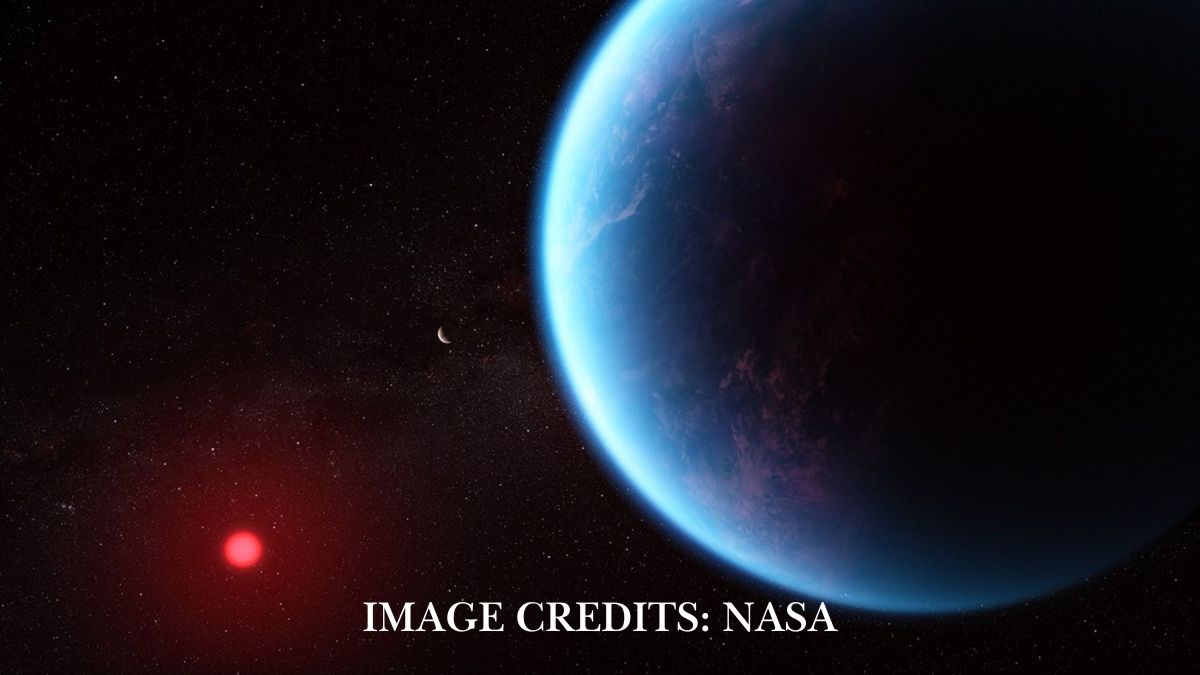
Scientists using the James Webb Space Telescope have found intriguing signs in the atmosphere of a faraway world called K2-18b. This exoplanet sits about 124 light years from Earth in the direction of the constellation Leo. Researchers detected possible traces of dimethyl sulfide or a closely related molecule in its atmosphere. On Earth this type of gas comes mainly from living organisms such as marine phytoplankton.
The James Webb Space Telescope continues to deliver new views into distant planetary atmospheres. Data from its instruments show carbon-bearing molecules along with this potential biosignature. While scientists remain careful not to claim proof of life the findings mark one of the most interesting results so far in the search for habitable conditions beyond our solar system. K2-18b orbits a cool red dwarf star in its habitable zone where temperatures could allow liquid water under the right conditions.
What could this mean for our understanding of life in the universe? This question drives continued study of worlds like K2-18b.
What makes K2-18b an interesting target for the James Webb Space Telescope?
K2-18b is a sub-Neptune type planet with a radius about 2.6 times that of Earth and a mass around 8.6 times Earth’s mass. It orbits its star every 33 days at a distance that places it in the habitable zone. According to data from the NASA/ESA/CSA James Webb Space Telescope mission the planet likely has a hydrogen-rich atmosphere possibly with a water ocean beneath.
This combination makes it different from rocky planets like Earth or gas giants like Neptune. Researchers call such worlds Hycean planets a term that combines hydrogen and ocean. The thick atmosphere and possible surface ocean create conditions where complex chemistry could occur. Measurements show an equilibrium temperature near 265 Kelvin which is cold but could support liquid water depending on greenhouse effects and pressure.
The planet was first discovered by the Kepler space telescope through the transit method where it passes in front of its star causing a small dip in light. Later observations with Hubble and then Webb provided details about its atmosphere. Its size and location make it one of the better targets for transmission spectroscopy the technique that studies starlight filtered through the planet’s atmosphere during transits.
How did the James Webb Space Telescope detect possible signs of dimethyl sulfide on K2-18b?
The James Webb Space Telescope used its Near-Infrared Imager and Slitless Spectrograph along with the Near-Infrared Spectrograph and Mid-Infrared Instrument to study K2-18b. These tools captured spectra in different wavelength ranges from 0.8 to 12 microns. In 2023 observations first hinted at dimethyl sulfide. Follow-up work in 2025 using the Mid-Infrared Instrument provided stronger though still tentative evidence.
Dimethyl sulfide (often shortened to DMS) and the related dimethyl disulfide produce distinct absorption features in infrared light. On Earth these gases come almost entirely from biological processes especially from ocean plankton. Non-biological ways to make them exist but they are rare under Earth-like conditions. The amounts suggested in the K2-18b data appear higher than levels found in Earth’s atmosphere which adds to the interest.
Scientists analyze the data by comparing observed spectra to models of different atmospheric compositions. The presence of methane and carbon dioxide was confirmed more clearly. The DMS signal is weaker and requires careful statistical checks to separate from noise or instrumental effects. Researchers note the detection sits at a confidence level that needs more observations for full confirmation.
What do methane and carbon dioxide tell us about the atmosphere of K2-18b?
Webb data clearly show methane and carbon dioxide in the atmosphere of K2-18b. These carbon-bearing molecules suggest active chemistry. Methane can come from geological processes or biological activity while carbon dioxide is common in many planetary atmospheres. Their combination with a possible hydrogen background fits models of a Hycean world.
The atmosphere likely contains a mix of gases with water vapor possible as well. Pressure and temperature at different depths could allow clouds or haze layers that affect how light passes through. Scientists use computer models to simulate thousands of possible compositions and find the best match to the observed spectra. These models account for things like molecular absorption cross-sections the way different gases block specific wavelengths of light.
Finding both methane and carbon dioxide together is important because some chemical processes would destroy one or the other over time unless replenished. This balance keeps researchers considering both geological and biological explanations.
Could K2-18b have a water ocean suitable for life?
Many models suggest K2-18b could have a global ocean covered by a hydrogen atmosphere. The planet’s density is lower than a purely rocky world which points to a large volatile layer such as water or ice. Surface gravity is higher than Earth’s at around 12.4 meters per second squared but still allows for a substantial atmosphere.
Temperatures in the habitable zone mean that if greenhouse effects are right liquid water could exist. However some calculations show the ocean might be too hot at depth or under high pressure turning into supercritical fluid. Ongoing research refines these interior models using data from Webb and theoretical work from university teams.
A water ocean would provide a place for chemical reactions similar to those in Earth’s early oceans. If microbes lived there they could produce gases like DMS that rise into the atmosphere. This idea remains one possibility among others.
Why is dimethyl sulfide considered a potential biosignature gas?
On Earth dimethyl sulfide is produced primarily by marine life. Phytoplankton release it as part of their metabolism and it enters the atmosphere where it can influence cloud formation. Few known non-biological processes make significant amounts of it under temperate conditions. This makes it a useful marker when searching for life.
In the context of K2-18b the detection if confirmed would suggest an ongoing source replenishing the gas. The amounts appear elevated compared to Earth which could mean a very active biosphere or different chemistry. Scientists stress that unknown abiotic pathways cannot be ruled out especially on a world so different from ours.
Other potential biosignatures include oxygen phosphine and certain combinations of gases. DMS stands out because of its strong link to life here. Future observations with Webb and planned telescopes will look for multiple signals together to build a stronger case.
What challenges remain in confirming life-related gases on distant exoplanets?
Confirming a biosignature requires high statistical confidence and ruling out false positives. Instrumental noise stellar activity and model uncertainties all play a role. For K2-18b additional transit observations and different instruments will help strengthen or refute the current hints.
Red dwarf stars like the one K2-18b orbits can be active with flares that affect atmospheres. This activity might influence chemistry in ways not yet fully understood. Separating planetary signals from stellar effects needs careful data processing.
Larger samples of similar planets will help scientists understand whether DMS-like signals appear only under specific conditions. The James Webb Space Telescope is scheduled for more time on K2-18b and similar targets providing a growing dataset.
How does this discovery fit into the broader search for life beyond Earth?
The possible detection on K2-18b represents progress in a long scientific effort. Space agencies like NASA and ESA develop instruments and missions aimed at characterizing exoplanet atmospheres. Each world adds a piece to the puzzle of planetary diversity and habitability.
K2-18b shows that sub-Neptunes which are common in our galaxy deserve close study. Their atmospheres can reveal chemistry not seen in our solar system. Whether or not life exists there the data push forward our ability to interpret distant spectra.
Continued observations will refine our knowledge. New instruments on ground-based telescopes and future space missions will complement Webb’s work. The goal remains understanding if the conditions for life are rare or widespread in the universe.
This finding from the James Webb Space Telescope opens exciting possibilities while reminding us of the careful work needed in science. What other surprises might await in the atmospheres of distant worlds?