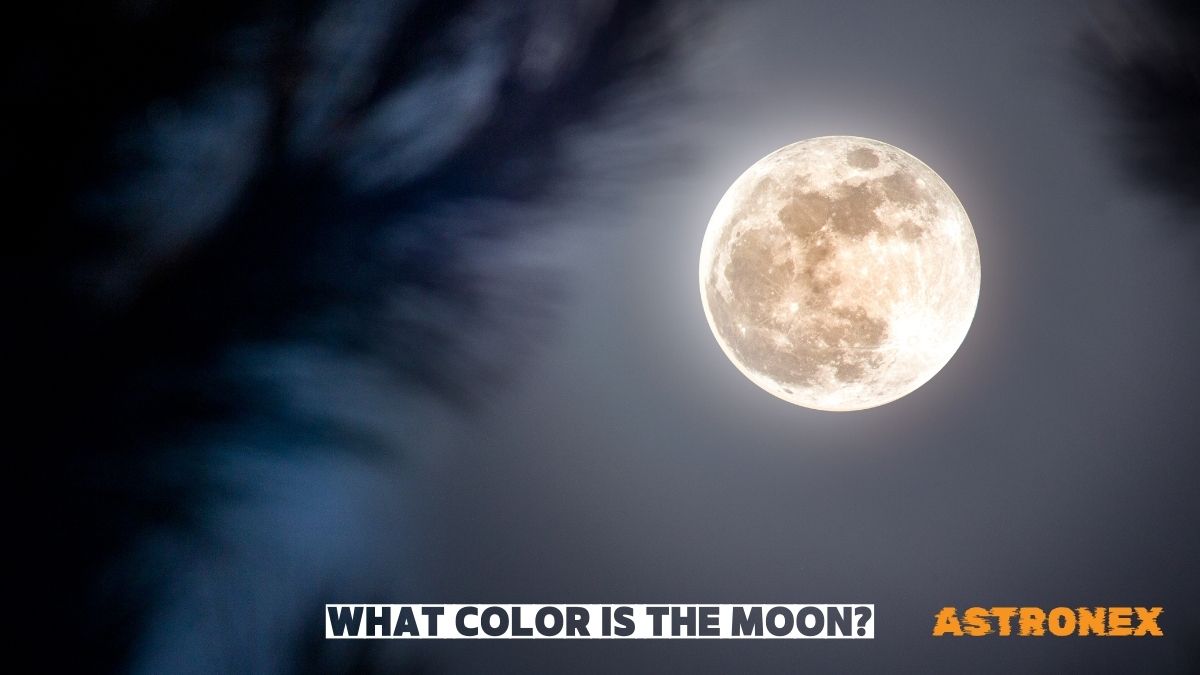
The question what color is moon has a precise scientific answer, but it depends on what is being measured. There is the Moon’s intrinsic surface color, the reflectance of its rocks and dust under sunlight. There is also the Moon’s apparent color from the ground, which is shaped by illumination and by the filtering effects of Earth’s atmosphere.
When those factors are separated, the Moon’s changing appearance becomes easier to interpret. The Moon shines because it reflects sunlight, and close range observations show a world dominated by dark gray materials. The bright Moon seen from Earth is therefore a visual result of reflected sunlight and viewing conditions rather than a white surface.
Spacecraft imagery and surface photography make clear that the lunar surface is not bright white. The ground is covered by regolith, a layer of pulverized rock produced by impacts over time. Large areas on the near side are maria, ancient lava plains whose basalt absorbs more visible light and therefore looks darker. Brighter highlands contain more reflective rocks, including anorthosite, and appear as lighter gray terrain. NASA Moonlight describes these contrasts and links them to the familiar pattern of darker and lighter regions across the lunar disk.
The same NASA resource emphasizes that brightness can mask true surface color when the Moon is viewed from far away. It reports that the Moon reflects only about one tenth of the sunlight that reaches it, which makes it a low reflectance object. Even so, the sunlit portion can look close to white in many situations because the reflected light is intense enough to overwhelm subtle gray tones in a distant view.
Instrument based color mapping helps separate genuine lunar color from changes introduced by camera settings and uncalibrated processing. NASA’s Scientific Visualization Studio CGI Moon Kit includes global natural color maps derived from the Lunar Reconnaissance Orbiter camera dataset. The project notes that the underlying mosaic was built from more than 100,000 wide angle camera images. It also explains that the natural color map is assembled from three wavelength bands, 643 nanometers for red, 566 nanometers for green, and 415 nanometers for blue, with exposure and white balance adjusted to better match human visual response.
Those calibrated products show that the Moon is not perfectly uniform in color, but they also show that real color differences are subtle in natural viewing. The maria and highlands differ mainly in reflectance and appear as darker and lighter grays, while smaller differences in composition and surface properties can introduce faint tints that are easier to see in carefully processed datasets than in typical visual observing.
Earth’s atmosphere can shift the Moon’s apparent color even when the surface itself has not changed. Moonlight seen through a longer path of air is altered because shorter wavelength light toward blue and violet is scattered more strongly than longer wavelength red and orange light. When the Moon is low, the atmospheric path is longer, so the light that reaches an observer can be weighted toward warmer tones. This is one reason a rising or setting Moon can look more amber than the same Moon higher in the sky.
A total lunar eclipse shows atmospheric filtering in a concentrated way. During a lunar eclipse, direct sunlight is blocked, but some sunlight passing through Earth’s atmosphere is refracted into the shadow and reaches the lunar surface. NASA The Moon and Eclipses explains that the shorter wavelength colors scatter away more readily, while red and orange light is more likely to persist through the atmospheric path. The eclipsed Moon can therefore appear orange or red, and the amount of dust or cloud in the atmosphere can make the hue deeper.
In scientific terms, the Moon is mostly dark gray, with brighter gray highlands and darker basaltic maria defining its main surface contrasts. Its low reflectivity means that a white Moon is usually an effect of illumination and observation conditions, not the inherent color of lunar material. Calibrated spacecraft color products confirm modest, physically meaningful variations, while Earth’s atmosphere can shift the Moon’s apparent hue toward warmer colors near the horizon and during eclipses.
References
National Aeronautics and Space Administration. (2025, April 8). Moonlight. NASA Science. https://science.nasa.gov/moon/moonlight/.
National Aeronautics and Space Administration. (2025, September 30). The Moon and Eclipses. NASA Science. https://science.nasa.gov/moon/eclipses/.
National Aeronautics and Space Administration. (2025, December 3). CGI Moon Kit. NASA Scientific Visualization Studio. https://svs.gsfc.nasa.gov/4720.