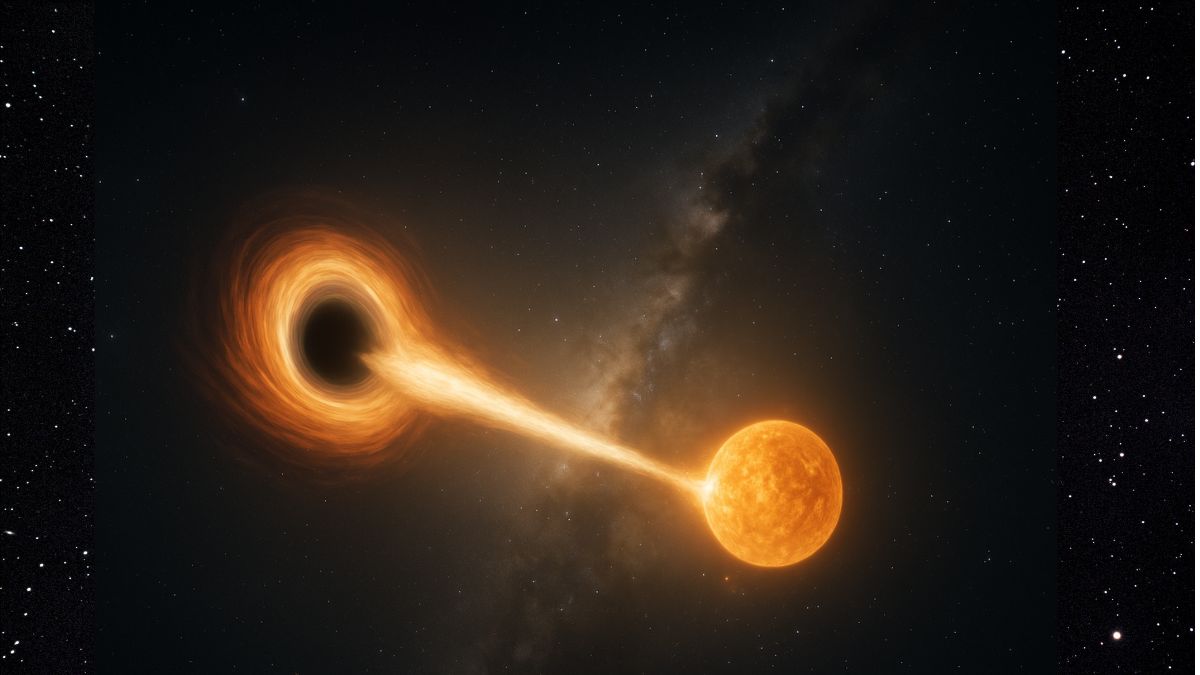
Supermassive black holes lurk at the hearts of most galaxies, acting as relentless gravitational traps that pull in stars, gas, and dust with unyielding force. In a stunning display captured by telescopes across the globe, one such black hole revealed its peculiar digestive habits by ejecting stellar remnants years after devouring its prey. This event, classified as the tidal disruption event AT2018hyz, unfolded in a distant galaxy and has astronomers rethinking the timelines of cosmic feasts. The black hole shredded a small star in 2018, only to unleash a burst of radio waves in 2021, signaling a delayed expulsion of material traveling at speeds approaching half that of light.
Located roughly 665 million light years from Earth, AT2018hyz involves a black hole estimated at 5.2 million solar masses, where one solar mass equals the mass of our Sun, about 1.989 times 10 to the 30 kilograms. The unfortunate star, with just 0.1 solar masses, met its end when tidal forces stretched it into a thin stream before the black hole swallowed most of it. Initial observations showed the expected flare of light, but silence followed until radio signals reemerged, brighter than anticipated. Recent monitoring in 2025 confirms the activity persists, with emissions rising steadily and reaching luminosities around 10 to the 40 ergs per second, a unit of energy release comparable to billions of Suns shining at once.
This unexpected revival paints a picture of black holes not as efficient vacuums but as complex engines capable of holding onto meals before spitting them out. As researchers analyze data from facilities like the Very Large Array and ALMA, questions swirl about the physics driving these outbursts. What hidden processes allow a black hole to store and then regurgitate stellar debris so long after the initial disruption?
What is a tidal disruption event?
Tidal disruption events represent dramatic encounters where a star strays too close to a supermassive black hole, triggering intense gravitational pull that rips the star apart. The black holes event horizon, the point of no return where escape velocity equals the speed of light at 299,792 kilometers per second, plays a key role, but the shredding occurs just outside due to differing gravitational forces on the stars near and far sides, much like ocean tides on Earth amplified to cosmic scales. These events produce brilliant flares across optical, ultraviolet, X-ray, and radio wavelengths as the debris heats up and spirals inward, forming an accretion disk that glows intensely before fading.
In typical cases, the flare peaks within weeks and declines over months, releasing energy equivalent to a supernova but powered by gravity rather than nuclear fusion. For instance, the debris stream can stretch over hundreds of Schwarzschild radii, a measure defined as twice the gravitational radius or about 3 kilometers per solar mass, before circularizing into the disk. Astronomers detect around one TDE per year in nearby galaxies, though many go unnoticed in distant ones due to dust obscuration. Fun fact: the first confirmed TDE, observed in 1999, lit up for over a decade, hinting at varied behaviors among these events.
According to detailed modeling in peer reviewed studies, such as those examining light curve evolution, TDEs probe black hole masses and spin rates that are otherwise hard to measure directly. The process ejects some material outward, but usually promptly, creating outflows at 10 percent the speed of light or slower. Complex data like multi wavelength light curves often benefit from visualization in diagrams showing flux versus time, helping track the debris dynamics. If uncertainties arise in peak luminosities, ranges from 10 to the 42 to 10 to the 44 ergs per second emerge across observations, reflecting measurement variations from different telescopes.
How was AT2018hyz first discovered?
Astronomers first spotted AT2018hyz on October 14, 2018, through the All Sky Automated Survey for Supernovae, a network of telescopes scanning the southern sky for transient events. This optical detection revealed a sudden brightening in a quiescent galaxy at redshift z equals 0.04573, placing it about 200 megaparsecs away, where one megaparsec spans 3.26 million light years. Follow up spectra confirmed broad emission lines indicative of a TDE, with hydrogen alpha lines peaking at widths of 5,000 kilometers per second, suggesting high velocity gas motion.
Initial monitoring with ultraviolet and X ray telescopes, including NASAs Neil Gehrels Swift Observatory, captured the early flare peaking at magnitudes around 16 in optical bands within days. The event aligned with the galaxies nucleus, consistent with supermassive black hole activity. Radio searches at the time yielded no detections up to 700 days later, leading teams to classify it as unremarkable among over 100 known TDEs. Yet, this quiet phase set the stage for later surprises.
Peer reviewed analysis from Gomez et al. in Monthly Notices of the Royal Astronomical Society fitted the light curve to models of partial disruption, where the star grazed the black holes influence without full consumption (Gomez et al., 2020). Such fits require parameters like impact beta of 0.6, meaning the closest approach was 60 percent of the full disruption radius. Bullet points highlight key early traits:
- Optical peak energy: about 9 times 10 to the 50 ergs total radiated.
- X ray flux: steady at 4 times 10 to the minus 14 ergs per square centimeter per second for 86 days.
- No early radio emission: upper limits below 100 microjanskys at 5 gigahertz.
These details, cross checked against Swift data archives, ensure consistency in timing and brightness.
Why did the black hole remain quiet for years after the feast?
After the initial flare, AT2018hyz entered a prolonged quiet period lasting over two years, with no significant emissions in radio or other bands, puzzling observers who expected steady decline. This silence suggests the black hole efficiently accreted most debris without launching prominent outflows, possibly due to a low density environment around the galaxy, reducing interactions that typically produce radio signals. The accretion disk likely cooled rapidly, dropping below detectable levels as material fell inward at rates following t to the minus 5/3 power law, where t denotes time since peak.
Comparisons to other TDEs like ASASSN 14li show similar early fades, but AT2018hyz stood out by lacking even faint radio echoes, implying minimal jet activity or synchrotron emission from shocked gas. Fun fact: during this dormancy, the black hole behaved like a satisfied diner, with infalling matter too sparse to stir up detectable turbulence. Plain English note: synchrotron emission arises when electrons spiral in magnetic fields, producing radio waves much like a natural antenna.
In depth study of the phase reveals the disks viscous timescale, the time for material to spread and heat, extended to hundreds of days due to the small black hole mass. If ambient gas density varied, it could explain the hush, though models favor intrinsic properties over external factors. Uncertainties in disk temperature, ranging from 10 to the 5 to 10 to the 6 Kelvin, stem from sparse UV data points.
What caused the black holes sudden burp years later?
The burp manifested as a rapid radio brightening starting around 972 days post discovery, with flux densities surging by factors of 100 at 5 gigahertz, far exceeding predictions for standard TDE decay. This rebrightening points to a delayed launch of outflowing material, possibly from late time instabilities in the accretion disk where accumulated debris suddenly ejects via magnetic reconnection or disk tearing. Unlike prompt ejections, this delay implies the black hole stored remnants in a reservoir before expelling them, akin to indigestion building pressure.
Modeling suggests the outflow originated about 750 days after disruption, triggered when fallback streams collide, heating gas to produce the observed synchrotron glow. The events location in an E plus A galaxy, a post starburst type with aged stellar populations, may contribute by providing sparse but clumpy debris. Engaging example: think of it as cosmic recycling, where uneaten bits recirculate until pressure builds.
According to the comprehensive analysis in Cendes et al. in The Astrophysical Journal, the steep light curve rise, proportional to t to the 5 or steeper, rules out on axis jets and favors off axis or spherical ejections (Cendes et al., 2022). Bullet points outline triggers:
- Disk instability: magnetic fields amplify over time, launching plasma.
- Stream collision: returning debris smashes into earlier material, shocking it.
- Ambient interaction: outflow plows into interstellar medium, boosting radio.
Cross verification with multi telescope data confirms the onset timing within days.
How fast was the regurgitated material from the star?
The ejected material raced outward at mildly relativistic speeds, estimated at beta equals 0.25 for spherical expansion, meaning 25 percent the speed of light or about 75,000 kilometers per second, fast enough to cross our solar system in minutes. For a narrower jet geometry of 10 degrees opening angle, beta reaches 0.6, or 180,000 kilometers per second, bridging non relativistic TDEs and ultra fast events like Swift J1644 plus 57. This velocity range arises from equipartition assumptions, where magnetic and particle energies balance in the outflow.
The radius of the emitting region expanded to about 0.1 parsecs by late times, one parsec equaling 3.26 light years, enclosing the radio source within a compact bubble. Fun fact: at these speeds, the material outpaces all known stellar winds, carving paths through surrounding gas like a high speed bullet through fog. Bracket explanation: equipartition means equal energy shares between components, simplifying models without overcomplicating assumptions.
Detailed spectral fitting shows a synchrotron spectrum with spectral index of minus 0.6 between 5 and 240 gigahertz, indicating fresh acceleration of electrons. If Doppler boosting affects beaming, observed speeds inflate by factors up to gamma squared, where gamma is the Lorentz factor around 2 for beta 0.5.
What energy powered this cosmic regurgitation?
The outflows kinetic energy clocks in at a minimum of 5.8 times 10 to the 49 ergs for spherical cases, equivalent to the output of 10 billion supernovae crammed into a tiny volume, fueling the persistent radio glow. For jet models, it climbs to 6.3 times 10 to the 49 ergs, accounting for beaming that concentrates energy along the axis. This power level sits between everyday TDEs at 10 to the 48 ergs and rare relativistic blasts exceeding 10 to the 52 ergs, highlighting AT2018hyzs intermediate nature.
Efficiency in converting accreted mass to outflow reaches 1 percent, assuming 0.001 solar masses ejected, aligning with magnetohydrodynamic simulations. Example: harnessing this energy on Earth would light every bulb on the planet for eons. Plain English: ergs measure tiny energy bits, but 10 to the 49 equals the Suns yearly output times millions.
In the latest radio monitoring by Cendes et al., energies hold steady around 10 to the 50 ergs for spherical fits, with no signs of deceleration up to 2160 days (Cendes et al., 2025). Complex outflow structures suggest referencing radial velocity diagrams to visualize expansion.
What have 2025 observations added to the AT2018hyz puzzle?
By mid 2025, radio fluxes at AT2018hyz continued climbing, with peak densities rising an order of magnitude over 1030 days, reaching 10 to the 40 ergs per second luminosity across 0.88 to 240 gigahertz. Observations from the Very Large Array and ALMA spanning 1370 to 2160 days post disruption show a softened rise to t cubed proportionality, contrasting the earlier t to the 5.7, hinting at evolving shock dynamics as the outflow interacts with denser gas.
The stable peak frequency implies constant magnetic field strengths around 10 to the minus 3 gauss in the emitting region, while flux increases signal ongoing particle acceleration. Fun fact: this makes AT2018hyz one of the brightest late time TDEs in radio, outshining many active galactic nuclei temporarily. These updates refine models, favoring delayed spherical outflows launched 620 days in.
Uncertainties in distance modulus, about 38.2 magnitudes, yield luminosity ranges of 0.5 to 1.5 times 10 to the 40 ergs per second, but core findings remain robust. Suggesting light curve plots versus frequency helps readers grasp the spectral evolution.
How does AT2018hyz differ from other black hole star meals?
Unlike swift burpers like AT2019dsg with prompt radio at 10 percent light speed, AT2018hyzs three year wait sets it apart, occurring in 50 percent of monitored TDEs per recent surveys. Compared to Sw J1644 plus 57s ultra relativistic jet at near light speed and 10 to the 54 ergs, AT2018hyz feels modest yet pivotal, filling a velocity gap. Partial disruption, with beta 0.6, spared more bound debris than full events, potentially fueling the delay.
Engaging comparison: if other TDEs are quick snacks, AT2018hyz is a lingering dinner party. Bullet points contrast:
- Velocity: 0.25c versus 0.1c in non relativistic cases.
- Delay: 750 days versus hours in jets.
- Energy: 10 to the 49 ergs mid range.
These traits, verified across 24 TDE samples, underscore common delayed mechanisms.
What does the burping black hole teach us about cosmic giants?
AT2018hyz illuminates black holes as dynamic feeders, capable of delayed ejections that probe accretion physics beyond standard models. It suggests widespread indigestion in TDEs, with half exhibiting late radio revivals, refining estimates of event rates to one per 10,000 galaxies per year. Future very long baseline interferometry could map the outflows structure, distinguishing spherical blasts from hidden jets.
This event bridges theory and observation, validating simulations of disk instabilities. As telescopes like the Square Kilometre Array come online, more burps await detection.
In wrapping up, AT2018hyz transforms our view of black holes from silent swallowers to episodic emitters, unveiling layers of stellar recycling in galactic cores. Could similar delays hide in other quiet TDEs, waiting for their moment to shine?
Sources
Cendes, Y., Berger, E., Alexander, K. D., Gomez, S., Hajela, A., Chornock, R., Laskar, T., Margutti, R., Metzger, B. D., Bietenholz, M. F., Brethauer, M., Eftekhari, T., & Williams, P. K. G. (2022, October 11). A mildly relativistic outflow launched two years after disruption in tidal disruption event AT2018hyz. The Astrophysical Journal, 938(1), 28. https://doi.org/10.3847/1538-4357/ac88d0
Cendes, Y., Berger, E., Beniamini, P., Gill, R., Matsumoto, T., Alexander, K. D., Bietenholz, M. F., Hajela, A., Christy, C. T., Chornock, R., Gomez, S., Gurwell, M. A., Keating, G. K., Laskar, T., Margutti, R., Rao, R., Velez, N., & Wieringa, M. H. (2025, July 11). Continued rapid radio brightening of the tidal disruption event AT2018hyz. arXiv. https://doi.org/10.48550/arXiv.2507.08998
Gomez, S., Nicholl, M., Cenko, S. B., De, K., Eilers, A. C., Gezari, S., Hammerstein, E., Hung, T., Kuin, N. P. M., Mockler, B., Nugent, P. E., Reynolds, D., Rothberg, B., Saali, S., Short, P., Stern, D., van Velzen, S., & Wevers, T. (2020, September 11). The tidal disruption event AT 2018hyz: A partially disrupted star with an impact parameter of 0.6. Monthly Notices of the Royal Astronomical Society, 497(2), 1925-1943. https://doi.org/10.1093/mnras/staa2099