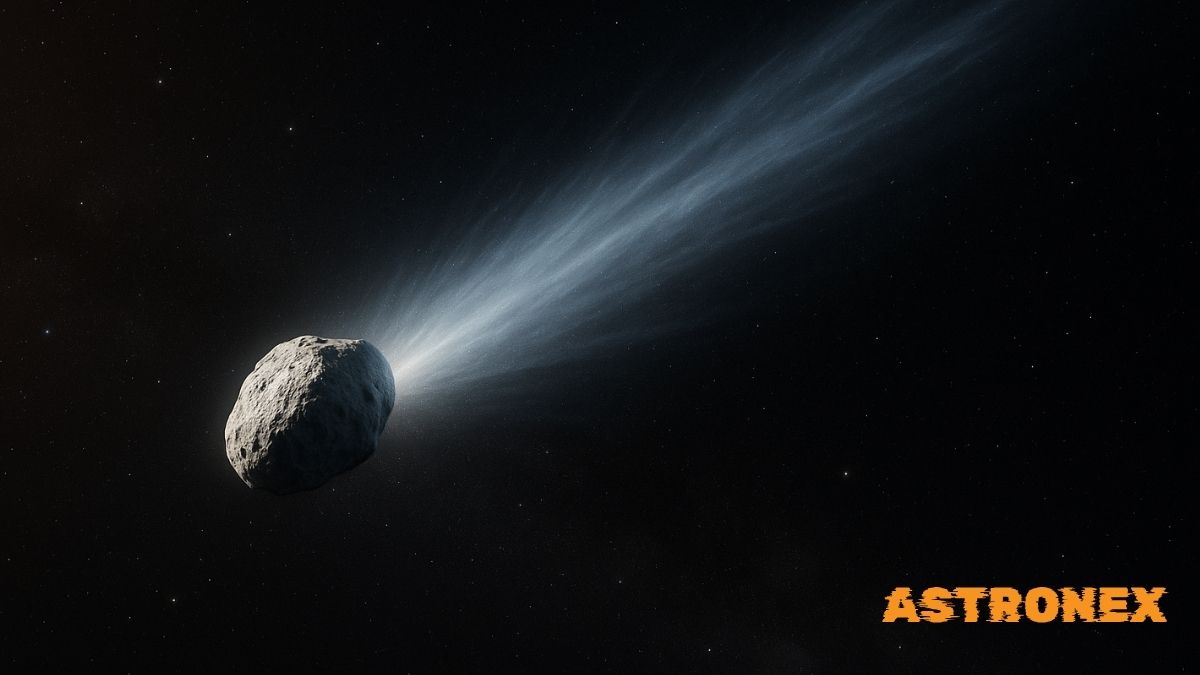
Astronomers detected a remarkable visitor from outside our solar system in July 2025 when the ATLAS survey telescope in Chile spotted a faint object moving rapidly against the stars. This object, officially named 3I/ATLAS, became the third confirmed interstellar body to pass through our neighborhood, after 1I/’Oumuamua and 2I/Borisov. Traveling on a hyperbolic path with an eccentricity greater than 1, it entered from interstellar space at high speed and reached its closest point to the Sun, called perihelion, on October 30, 2025, at about 1.4 astronomical units, or roughly 210 million kilometers away. Observations revealed activity typical of comets, including a coma and developing tails, as solar heating caused ices to sublimate into gas.
What makes 3I/ATLAS particularly interesting is its behavior under solar influence, showing signs of non-gravitational acceleration that slightly alter its predicted path. This effect, common in active comets, results from uneven outgassing pushing the nucleus like gentle jets. Multiple space missions, including Hubble and ESA’s Juice, captured images of its coma and tails, providing data on its composition and dynamics. As the comet heads outbound, passing closest to Earth on December 19, 2025, at around 1.8 astronomical units or 270 million kilometers, scientists continue studying this pristine sample from another star system.
Could the subtle forces acting on 3I/ATLAS tell us more about how comets from distant worlds differ from our own?
What Is Interstellar Comet 3I/ATLAS?
Interstellar comet 3I/ATLAS is an icy body originating from beyond our solar system, ejected long ago from its parent star and now briefly visiting us. Its hyperbolic orbit confirms it is unbound to the Sun, with an incoming velocity of about 58 kilometers per second relative to our star system. According to NASA’s comet 3I/ATLAS overview, the object reached perihelion at 1.4 astronomical units on October 30, 2025, and poses no threat to Earth, staying at least 270 million kilometers away at closest approach.
Estimates place the nucleus diameter between 440 meters and 5.6 kilometers, based on Hubble observations assuming low reflectivity typical of comets (brackets: albedo around 0.04, meaning it reflects only 4 percent of sunlight). Spectral data from the James Webb Space Telescope indicate volatiles like carbon dioxide, water, and carbon monoxide, driving activity as they turn directly from ice to gas under solar heat. This creates a coma, the fuzzy envelope around the nucleus, and tails extending millions of kilometers.
Fun comparison: the nucleus is likely smaller than many cities, yet its speed exceeds 137,000 miles per hour at discovery, faster than any human-made spacecraft. Images from NASA’s Psyche mission in September 2025 showed a fuzzy point from 53 million kilometers, confirming the coma without resolved details.
- Orbital highlights: Eccentricity over 1, inclination allowing retrograde motion relative to planets.
- Activity level: Steady brightening pre-perihelion, with dust and gas release rates under study.
- Significance: Offers clues to planetary formation in other systems, potentially billions of years old.
These traits make 3I/ATLAS a unique laboratory for extraterrestrial ices.
When Was Comet 3I/ATLAS Discovered?
The discovery occurred on July 1, 2025, when the NASA-funded ATLAS telescope in Río Hurtado, Chile, flagged a moving object initially faint at magnitude 18. Pre-discovery images traced back to June 14, 2025, extending the data arc for precise orbit calculation. The Minor Planet Center quickly recognized its hyperbolic trajectory, confirming interstellar origin within days.
By July 2, 2025, ground telescopes detected a marginal coma, leading to its cometary classification and name 3I/ATLAS. As detailed in ESA’s comet 3I/ATLAS FAQ, rapid follow-up involved Hubble imaging on July 21, 2025, from 277 million miles away, revealing a teardrop-shaped dust cocoon.
This fast detection, months before perihelion, allowed extensive pre-heating studies unlike delayed discoveries of prior interlopers. Brightness evolved steadily, enabling amateur contributions for positional refinements.
Key timeline points:
- July 1, 2025: Initial ATLAS detection at heliocentric distance over 4 astronomical units.
- July 21, 2025: First Hubble view showing early activity.
- October 30, 2025: Perihelion passage, peak heating.
The coordinated global response highlights advances in survey technology for rare visitors.
Why Does Comet 3I/ATLAS Show Non-Gravitational Acceleration?
Non-gravitational acceleration occurs when outgassing from a comet’s surface creates thrust, deviating the nucleus from a pure gravitational orbit (brackets: measured in astronomical units per day squared, small but detectable over time). For 3I/ATLAS, positional data around perihelion revealed this effect, consistent with asymmetric sublimation of ices pushing the body radially away from the Sun.
This is standard for active comets, where jets act like rockets from uneven heating or rotation. Estimates suggest modest levels, implying mass loss through volatiles without extreme anomalies. Hubble and ground data align with models of carbon dioxide and water-driven outgassing.
Example: similar to garden hose recoil, but from vapor jets ejecting at hundreds of meters per second. Uncertainties exist due to limited pre-perihelion positions, but values fit typical cometary behavior.
Bullet points on effects:
- Radial component: Primary push away from Sun.
- Transverse: Minor sideways nudge from spin.
- Orbital impact: Small path adjustments, kilometers over weeks.
This acceleration helps estimate nucleus mass and active fractions, refining size to under a few kilometers.
What Causes the Tail Structure in Comet 3I/ATLAS?
The tails of 3I/ATLAS form from solar forces acting on released material: radiation pressure curves dust into broad arcs, while solar wind straightens ionized gas into narrow ion tails. Post-perihelion images show a greenish coma from fluorescing gases and dual tails, one dusty and bent, the other straight and blue-tinted.
ESA’s Juice navigation camera in November 2025 captured activity from 286 million kilometers, revealing coma glow and possible dust extension. Hubble’s November 30 revisit tracked motion, streaking stars against the fuzzy head.
Fun fact: tails always point away from the Sun, even post-perihelion, creating illusion of leading when comet recedes. Some reports note anti-tail appearances from viewing geometry, where larger particles lag in orbital plane.
- Dust tail: Broad, millions of kilometers, sunlight-scattered.
- Ion tail: Linear, potentially longer, charged particles aligned with magnetic fields.
- Coma size: Extends tens of thousands of kilometers, enveloping nucleus.
Visualize via stacked mission composites, showing evolution from teardrop pre-perihelion to elongated outbound.
How Have Space Missions Observed Comet 3I/ATLAS?
A fleet of spacecraft provided multi-angle views: Hubble reobserved on November 30, 2025, detailing coma structure. ESA’s Juice used science instruments in November for composition hints. Earlier, Psyche tracked from 53 million kilometers in September, refining trajectory.
Mars orbiters like ExoMars Trace Gas Orbiter imaged during October close pass at 29 million kilometers. SOHO coronagraph stacked views October 15-26, 2025, isolating faint features against glare.
XMM-Newton’s December 3, 2025, X-ray observation detected glow from solar wind interactions with cometary gases.
Mission highlights:
- Hubble: Sharp optical, size constraints.
- Juice: Post-perihelion activity from afar.
- Mars assets: Closest relative views.
These complement ground data for comprehensive dynamics.
What Does Non-Gravitational Acceleration Reveal About Interstellar Comets?
Non-gravitational acceleration in 3I/ATLAS indicates active outgassing, probing internal volatiles preserved from its origin. Levels suggest pristine ices, richer in certain species than solar system norms, hinting at formation conditions around a different star.
Comparisons to Borisov show similarities in thrust from sublimation, supporting natural processes. This data refines models of mass loss and nucleus properties.
In summary, the non-gravitational acceleration of interstellar comet 3I/ATLAS underscores its active, icy nature, offering insights into alien planetary building blocks through outgassing dynamics observed by NASA and ESA missions. As it departs, what might future interstellar visitors teach us about the galaxy’s diversity?
Sources
ESA. (2025). Comet 3I/ATLAS – frequently asked questions. European Space Agency. https://www.esa.int/Science_Exploration/Space_Science/Comet_3I_ATLAS_frequently_asked_questions
NASA. (2025, December 4). Comet 3I/ATLAS. NASA Science. https://science.nasa.gov/solar-system/comets/3i-atlas/