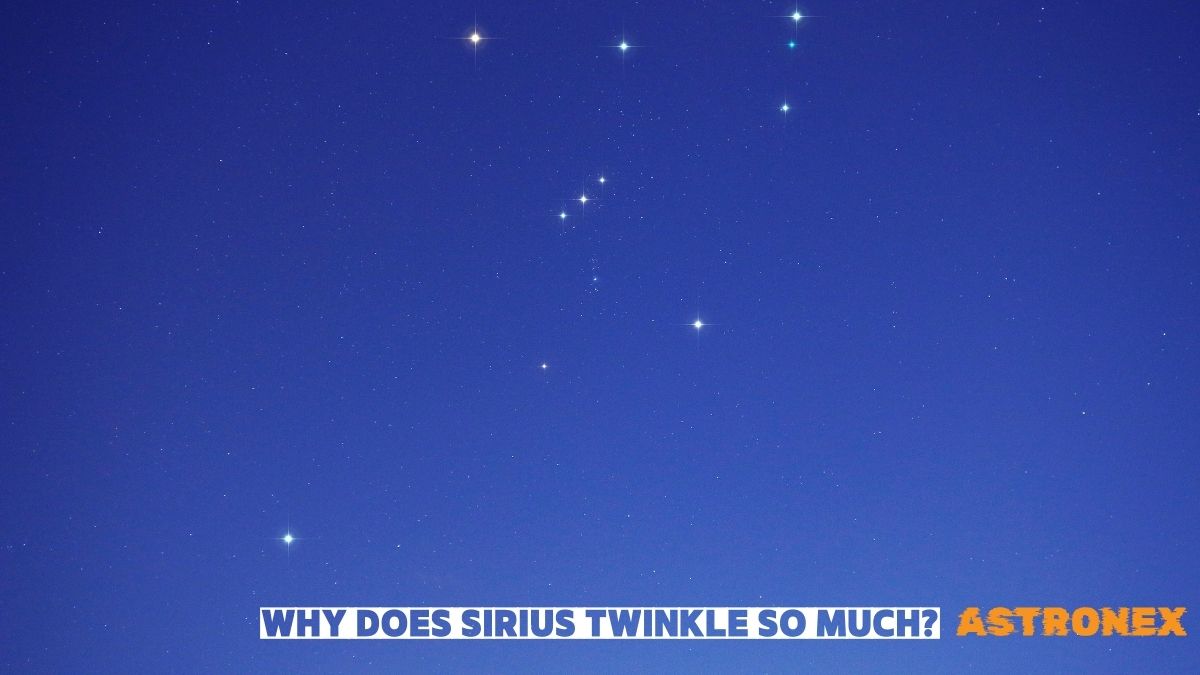
Sirius is the brightest star in the night sky, and it often appears unusually unsteady to the unaided eye. In the winter sky, the Orion Sirius pairing is widely noticed because Sirius lies near Orion on the sky and dominates its surroundings with intense starlight.
That apparent instability is not a change inside the star. The rapid brightening, dimming, and shifting color are produced in Earth’s atmosphere, not at the source.
The effect becomes most dramatic when Sirius is close to the horizon during its rise or set. NASA Jet Propulsion Laboratory notes that, near the horizon, turbulence in the atmosphere can make Sirius shimmer with fast and obvious changes in brightness and color. The same star can look steadier later in the night when it is higher, because the line of sight crosses less air.
In technical terms, the twinkling of Sirius is atmospheric scintillation. Air is transparent, but it is not perfectly uniform. Small variations in temperature and density move continually through the lower atmosphere. Because the refractive index of air depends on those properties, starlight is bent by slightly different amounts from one moment to the next. At the observer, that produces rapid fluctuations in the amount of light delivered to the eye, along with subtle, rapid shifts in apparent position.
NASA Astronomy Picture of the Day describes the same process in practical terms, pointing to moving pockets of air that alter the paths taken by incoming light from distant objects. For Sirius, the effect is unusually conspicuous because the star is so bright. The eye can register quick intensity changes that might be less noticeable in fainter stars, so even modest atmospheric instability can create a strong visual impression of flicker.
Geometry amplifies the twinkle. Light from a star high in the sky travels through a shorter column of atmosphere than light from the same star seen at low altitude. Near the horizon, the path is longer and it passes through more of the lower atmosphere, where turbulence is often strongest. When Sirius is observed low, its light samples a larger volume of turbulent air, increasing both the strength and the speed of scintillation. This is why the star often looks most active soon after it rises or shortly before it sets, especially when the atmosphere is changing rapidly.
Sirius is also known for a vivid color component to its twinkling. Color flicker follows from the fact that refraction depends on wavelength. Shorter wavelengths are bent slightly more than longer wavelengths as light passes through a refracting medium. In a steady atmosphere the separation is subtle, but turbulence continuously redirects the beam, and a long path through air makes wavelength dependent refraction easier to notice. Small changes in the atmospheric path can briefly shift the balance of wavelengths delivered to the eye, so the star can appear to change color from moment to moment.
ESA explains the underlying optical idea by describing how a prism separates starlight by wavelength, which is also what creates a rainbow. Earth’s atmosphere is not a laboratory prism, but it can still introduce wavelength dependent refraction. When turbulence is layered on top of that dispersion, Sirius can show quick, noticeable shifts in color that are much harder to see in dimmer stars.
These atmospheric effects do not indicate that Sirius is physically variable on second to second timescales. The star’s intrinsic output is stable on the timescale of naked eye scintillation. What changes from moment to moment is the state of the air along the line of sight, including small temperature gradients and wind driven mixing that continually rearrange refractive irregularities.
The same physics has measurable consequences for ground based astronomy. Scintillation adds noise to precise brightness measurements and limits the sharpness of images collected through the atmosphere. Professional observatories reduce these effects with careful site selection and techniques that measure atmospheric distortions and correct them in the optical system. The prominent flicker of Sirius is therefore a direct demonstration of how strongly the atmosphere can shape what appears to be a simple point of light.
Sirius twinkles so much because its intense light is filtered through turbulent air that continually changes its refractive properties. The effect becomes strongest when the star is low and the light travels through a longer path in the lower atmosphere, where scintillation and wavelength dependent refraction can produce rapid brightness and color changes. The star remains steady, while Earth’s atmosphere supplies the apparent motion, fluctuations, and shifting hues.
References
European Space Agency. (2023, September 1). A star’s spectrum explained. https://www.esa.int/ESA_Multimedia/Images/2023/09/A_star_s_spectrum_explained
NASA Jet Propulsion Laboratory. (2021, February 12). Taking the Dog Stars for a Springtime Walk: Sirius and Procyon. https://nightsky.jpl.nasa.gov/news/428/
National Aeronautics and Space Administration. (2021, February 10). Firing Lasers to Tame the Sky. Astronomy Picture of the Day. https://apod.nasa.gov/apod/ap210210.html