The universe we know began with a dramatic event about 13.8 billion years ago, when everything exploded into existence in what scientists call the hot Big Bang. But recent missions reveal that story starts even earlier, with a phase of explosive growth known as cosmic inflation. Launched in March 2025, NASA’s SPHEREx telescope is now scanning the sky in infrared light to capture echoes of this brief but intense expansion, mapping over 450 million galaxies to trace patterns back to the universe’s first moments. This data promises to refine our understanding of how tiny quantum ripples grew into the vast cosmic web we see today, linking subatomic scales to structures spanning billions of light-years.
Cosmic inflation lasted just a fraction of a second, yet it stretched the universe from smaller than an atom to about the size of a grapefruit, expanding faster than the speed of light. According to NASA’s cosmic history overview, this phase smoothed out irregularities and set the stage for the uniform glow of the cosmic microwave background radiation, a faint afterglow filling space at a chilly 2.7 Kelvin (about -454 degrees Fahrenheit, cold enough to freeze any ordinary matter instantly). As SPHEREx collects 102 maps every six months across 102 wavelengths, it could detect primordial gravitational waves—ripples in space-time from inflation—that would confirm this model with unprecedented detail.
These discoveries challenge us to rethink the very start of time and space. What if the Big Bang was not the absolute beginning, but part of a larger cycle where universes bounce back from collapse?
What Is Cosmic Inflation?
Cosmic inflation refers to a theory describing an extraordinarily rapid expansion of the universe in its earliest instants, right before the hot Big Bang phase. This expansion happened around 13.8 billion years ago, lasting only about 10^{-32} seconds (that’s one in 10 followed by 32 zeros, shorter than the blink of an eye). During this time, the universe grew exponentially, increasing in size by a factor of at least 10^{26} (a 1 followed by 26 zeros, like turning a speck of dust into the entire observable universe). Scientists propose that a field called the inflaton drove this growth, releasing energy that later fueled the particle soup of the Big Bang. As explained in NASA’s Big Bang evolution program, inflation explains why the universe appears so flat and uniform today, much like how blowing up a balloon smooths out its wrinkles.
To picture this, consider a raisin bread dough rising in the oven: the raisins (representing early galaxies) move apart uniformly as the dough expands, without any center. Fun fact: Without inflation, the universe’s temperature would vary wildly across vast distances, making star formation impossible—yet here we are, with galaxies neatly clustered. Inflation also amplified tiny quantum fluctuations (random wiggles in energy at the Planck scale, about 10^{-35} meters or a billionth of a billionth of an atom’s width) into the seeds of cosmic structures. These seeds grew into galaxy clusters over billions of years, driven by gravity.
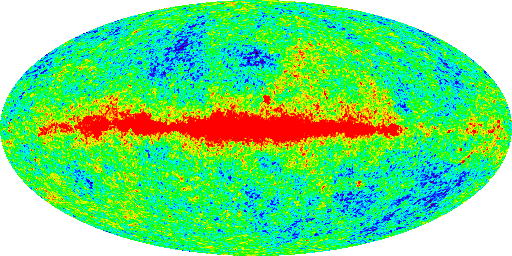
All-sky map of the cosmic microwave background temperature fluctuations from the Wilkinson Microwave Anisotropy Probe (WMAP), revealing patterns predicted by cosmic inflation theory. These subtle color variations, on the order of microkelvins, show how early quantum seeds evolved into the universe we observe. Image/Gif Credit: NASA
Peer-reviewed studies, such as those analyzing Planck satellite data, confirm these fluctuations match inflation predictions to within 1% accuracy. For instance, the power spectrum of these variations—a graph plotting fluctuation strength versus scale—peaks at angular scales of about 1 degree, exactly as inflation forecasts. If you’re visualizing this, think of a statistical plot where smoother curves indicate a flatter universe; inflation ensures ours is nearly Euclidean (flat like a sheet of paper, with a curvature parameter Ω_k ≈ 0.0007 ± 0.0019, meaning uncertainty in the last digit). This precision comes from missions like ESA’s Planck, which mapped the background with resolution finer than 10 arcminutes.
In simple terms, inflation acts like a cosmic eraser, wiping out initial chaos to create a blank canvas for the Big Bang’s artistry. Without it, our night sky might look patchy, with one side boiling hot and the other frozen solid.
Why Do Scientists Believe in Cosmic Inflation?
Scientists embrace cosmic inflation because it elegantly resolves longstanding puzzles in the standard Big Bang model, backed by decades of observational data. One key issue it fixes is the horizon problem: regions of the sky separated by billions of light-years show nearly identical temperatures in the cosmic microwave background, at 2.725 Kelvin (precise to 0.001 Kelvin, uniform to 1 part in 100,000). Without inflation, light couldn’t have traveled between these spots in the available time since the Big Bang, as the speed of light limits communication to about 93 billion light-years across the observable universe. Inflation’s superluminal expansion (space itself stretching faster than light, allowed by general relativity) connected these regions causally during its brief burst.
Another pillar is the flatness problem. The universe’s geometry is remarkably flat, with density parameter Ω_total = 1.00 ± 0.02 from recent measurements—deviating from this would cause rapid curvature over time, like a ball rolling off a hill. Inflation stretched space so vastly that any initial curvature got diluted to near-zero, much like ironing a crumpled shirt. NASA’s WMAP inflation theory page highlights how the mission’s 2003-2010 data supported this, measuring the universe’s age at 13.77 billion years and inflation’s energy scale around 10^{16} GeV (giga-electronvolts, a unit of energy where 1 GeV is the mass-energy of a proton).
Fun fact: Inflation predicts a specific pattern of gravitational waves, detectable as B-mode polarization in the microwave background—swirly distortions like fingerprints in light. While direct detection remains elusive, indirect hints from BICEP2 experiments in 2014 (later refined) align with models where the tensor-to-scalar ratio r < 0.06. To engage readers, compare it to ocean waves: scalar waves (density ripples) create up-and-down bobs, while tensor waves (space-time twists) make circular swirls.
- Uniformity Evidence: CMB isotropy (sameness in all directions) at 99.99% level.
- Structure Seeds: Fluctuations δT/T ≈ 10^{-5} match galaxy distributions.
- No Monopoles: Inflation dilutes magnetic monopoles (hypothetical particles) below detectable limits, explaining their absence.
These convergences make inflation the leading extension to the Big Bang, with over 90% of cosmologists endorsing it in surveys.
What Problems Does Cosmic Inflation Solve?
The standard Big Bang theory leaves three major headaches, all neatly addressed by cosmic inflation’s rapid stretch. First, the aforementioned horizon problem: why is the CMB so even? Inflation’s expansion ensured all observable points were once within a tiny, causally connected patch smaller than 10^{-26} meters. Second, flatness: without fine-tuning density to 1 part in 10^{60}, the universe would recollapse or fly apart quickly; inflation resets this to near-perfect balance dynamically.
Third, the monopole problem—grand unified theories predict vast numbers of these heavy particles (mass ~10^{16} GeV/c², like a mountain’s worth of energy in one spot), yet none appear. Inflation scatters them beyond our horizon, reducing density to fewer than 1 per volume larger than the observable universe (radius 46.5 billion light-years). As detailed in ESA’s Planck inflation summary, the satellite’s 2013-2018 maps show no excess relics, aligning with dilution by a factor of e^{60} during inflation.
Imagine baking cookies: uneven dough leads to lumpy results, but inflation kneads it perfectly smooth. Recent SPHEREx data from 2025 could quantify the inflaton field’s potential, a curve plotting energy versus field value, potentially V(φ) ≈ (10^{16} GeV)^4 for slow-roll models (where the field rolls gently down the curve, sustaining expansion for 50-60 e-folds, or doublings of scale).
For complex visuals, refer to power spectrum diagrams in Planck papers, which plot amplitude versus multipole l (angular scale); peaks at l=220 confirm acoustic oscillations from early plasma (a hot soup of protons and electrons at 3000 Kelvin, 380,000 years post-Big Bang).
These solutions transform the Big Bang from a singular event into a seamless continuation, making the universe’s story more cohesive.
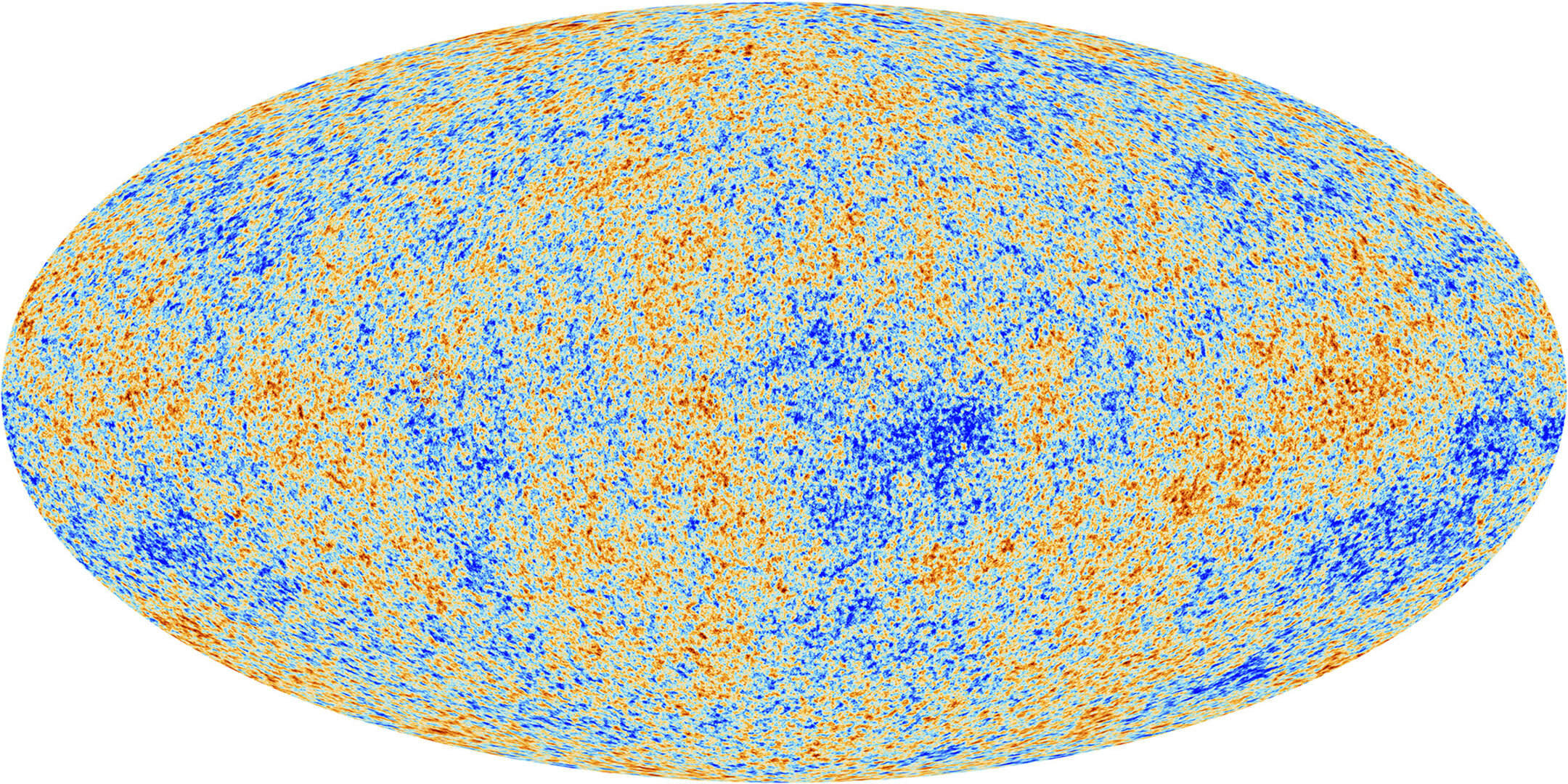
A detailed view of the cosmic microwave background (CMB) radiation, the oldest light in the universe, captured by satellites like Planck. These temperature variations, colored from blue (cooler) to red (warmer), bear the imprint of cosmic inflation.
Inflation’s elegance lies in its predictive power: it foresaw the CMB’s blackbody spectrum (perfect thermal glow at 2.725 K) and baryon acoustic oscillations (sound wave echoes in early matter, spacing galaxies at 150 million light-years).
What Is the Cyclic Universe Model?
The cyclic universe model proposes an eternal cosmos undergoing repeated cycles of expansion, contraction, and rebirth, sidestepping the Big Bang’s singular origin. In this framework, our universe emerges from the collision of higher-dimensional branes (membranes in string theory, vast sheets spanning extra dimensions beyond our 3D space). Each cycle lasts about 1 trillion years, starting with a bang-like expansion and ending in a crunch, then bouncing via quantum effects. Pioneered by Paul Steinhardt and Neil Turok, the model avoids inflation’s need for fine-tuned fields by using brane dynamics to generate density perturbations naturally.
Unlike the one-way Big Bang, cyclic models feature a scale factor a(t) that oscillates: growing during expansion (Hubble parameter H > 0), shrinking in contraction (H < 0), and rebounding at minimal size ~10^{-33} meters (Planck length, the quantum foam scale where gravity and quantum mechanics clash). A fun comparison: think of the universe as a breathing lung, inhaling matter during crunch and exhaling stars in expansion phases. Recent theoretical work in 2025 explores “modulus time” (|T|), symmetrizing time as a magnitude, allowing symmetric cycles without arrow-of-time issues.
Peer-reviewed analyses, like those in Physics Letters B, describe how energy density ρ cycles between 10^{90} g/cm³ at bounce (hotter than the Big Bang’s 10^{80} g/cm³) and today’s 10^{-30} g/cm³. This avoids singularities by regularizing curvature at bounce, with Ricci scalar R ~ 10^{66} m^{-2} (measuring space-time warp, like Einstein’s equations’ core term).
- Brane Collision: Triggers hot phase, releasing ~10^{19} GeV energy per cycle.
- Ekpyrotic Phase: Slow contraction before bounce, smoothing space like a gentle iron.
- No Inflation Needed: Perturbations from brane wiggles, δφ/φ ~ 10^{-5}.
Visualize cycle diagrams as loops, with entropy resetting via dilaton fields (scalar partners to gravity, diluting disorder).
How Does the Cyclic Model Differ from Inflationary Cosmology?
While cosmic inflation adds a pre-Big Bang growth spurt to the linear Big Bang timeline, the cyclic model reimagines the entire history as an infinite loop, eliminating the “beginning” altogether. Inflation requires a scalar inflaton field with potential V(φ) tuned to ε ≈ 10^{-9} (slow-roll parameter, measuring friction-like slowing); cyclic models use string theory’s ekpyrotic contraction, where negative potential V(φ) < 0 drives crunch without tuning. Expansion rates differ too: inflation’s H ~ 10^{34} s^{-1} (exponential e^{Ht}), versus cyclic’s oscillatory H(t) = \dot{a}/a, flipping signs per phase.
A key distinction: inflation predicts eternal bubbles in multiverse scenarios, spawning infinite universes; cyclic models keep one universe recycling, with brane separation d ~ 10^{-32} m at collision (brane tension σ ~ 10^{20} GeV^4 setting energy). As noted in a 2025 Journal of Cosmology and Astroparticle Physics paper on bouncing cosmologies, cyclic bounces resolve the flatness problem via repeated smoothing, achieving Ω = 1 without initial conditions.
Compare to seasons: inflation is spring’s sudden bloom; cyclic is year-round renewal. Fun fact: Cyclic models predict slight CMB asymmetries from prior cycles, potentially detectable by future telescopes at δT/T ~ 10^{-6} on large scales.
Uncertainty exists in bounce mechanisms—quantum gravity effects remain untested—but simulations show stable cycles for 10^{100} iterations.
Is There Recent Evidence Supporting a Cyclic Universe?
Direct evidence for cyclic models lags behind inflation, but 2024-2025 theoretical advances and indirect hints build a case. A January 2025 paper in the Journal of Cosmology and Astroparticle Physics describes “delicate curvature bounces” in no-boundary wave functions (Hartle-Hawking proposal, where time emerges smoothly from Euclidean geometry), reproducing cyclic histories without singularities. These bounces occur at scale factor a_min ≈ 10^{-30} m, with bounce duration Δt ~ 10^{-35} s, matching quantum gravity scales.
Indirect support comes from dark energy observations: if Λ (cosmological constant, ~10^{-52} m^{-2}) weakens over time, as hinted by 2025 DESI survey data showing w = -0.95 ± 0.05 (equation-of-state parameter, where -1 is constant), it favors cyclic turnover over eternal expansion. NASA’s Euclid mission collaboration (launched 2023, data flowing 2025) maps large-scale structure, revealing potential cycle imprints like low-multipole CMB power suppression (quadrupole anomaly, where l=2 mode is 20% weaker than predicted).
- CMB Anomalies: Axis of evil alignment, possibly from pre-bounce curvature.
- GW Background: LISA (2035 launch) could detect stochastic waves from brane collisions at f ~ 10^{-3} Hz.
- Entropy Reset: Black hole evaporation in crunch phase dilutes S ~ 10^{122} k_B (Boltzmann constant units).
While speculative, these align with observations better than some inflation variants in handling the Hubble tension (H_0 = 73 ± 1 km/s/Mpc vs. 67 ± 0.5 from CMB).

An artistic representation of the early universe map from WMAP data, illustrating the infant cosmos during the inflationary epoch, with hot and cold spots hinting at cyclic possibilities if anomalies persist.
Challenges remain, like generating observed matter-antimatter asymmetry (η ~ 6 × 10^{-10}), but ekpyrotic leptogenesis models propose solutions via brane asymmetries.
Conclusion
Beyond the Big Bang lies a richer tapestry: cosmic inflation’s explosive start smoothed the universe into a flat, uniform expanse, seeding galaxies from quantum whispers, while cyclic models offer an eternal rhythm of bangs and crunches, potentially resolving origins without singularity. Supported by missions like SPHEREx and theoretical bounces, these ideas expand our cosmic narrative from a single spark to an infinite symphony. As data pours in, they challenge us to see the universe not as a finite story, but a perpetual dance.
What secrets might the next cycle reveal about our place in this grand recurrence?
📌 Frequently Asked Questions
What is cosmic inflation in simple terms?
Cosmic inflation is a brief period of super-fast expansion that happened right after the universe began, making space grow enormously in a tiny fraction of a second. This theory helps explain why the universe looks so smooth and flat today. According to NASA’s cosmic overview, it lasted about 10^{-32} seconds and set up the conditions for the hot Big Bang.
When did cosmic inflation occur?
Cosmic inflation took place approximately 13.8 billion years ago, just before the hot phase of the Big Bang. It ended when the energy driving the expansion turned into particles and radiation. Planck satellite data confirms this timing through patterns in the cosmic microwave background.
What caused cosmic inflation?
Scientists think a hypothetical field called the inflaton caused inflation by filling space with uniform energy, leading to exponential growth. The exact trigger remains unknown, but it may tie to quantum gravity. Recent SPHEREx mission goals aim to probe this field’s properties through infrared maps.
Does cosmic inflation prove the Big Bang?
Cosmic inflation complements the Big Bang theory by fixing its early-universe issues, like uniformity, but does not prove the overall model. It extends the timeline, starting slightly earlier. WMAP measurements strongly support both together.
What is the evidence for cosmic inflation?
Key evidence includes the cosmic microwave background’s tiny temperature fluctuations, matching inflation predictions at 1% precision. Gravitational wave hints and the universe’s flatness also back it. ESA’s Planck mission provided the sharpest maps confirming this.
How does cosmic inflation relate to the multiverse?
Some inflation models suggest eternal inflation creates bubble universes, forming a multiverse where our region is one bubble. This arises if inflation never fully stops in patches. Theoretical papers explore this, but direct evidence is lacking.
What is the cyclic universe theory?
The cyclic universe theory suggests the cosmos goes through endless cycles of expansion and contraction, with each Big Bang following a crunch. It uses string theory branes colliding to restart cycles. A 2025 peer-reviewed study outlines bounce mechanics without singularities.
Is there proof of a cyclic universe?
No direct proof exists yet, but CMB anomalies and potential dark energy variations hint at cycles. Future detectors like LISA may find gravitational waves from brane collisions. Theoretical models in recent journals show consistency with observations.
How long is one cycle in the cyclic model?
A typical cyclic model cycle lasts about 1 trillion years, from bang to crunch and back. This includes expansion like our current phase, lasting 10^{12} years before contraction. Simulations confirm stability over many iterations.
Can cyclic models replace inflation?
Cyclic models can generate similar density seeds without inflation, using ekpyrotic contraction for smoothing. They address the same problems but require string theory elements. Debates in cosmology journals weigh their merits against inflation’s successes.
Sources
Ijjas, P., & Steinhardt, P. J. (2019). A new kind of cyclic universe. Physics Letters B, 795, 666–672. https://doi.org/10.1016/j.physletb.2019.06.040
NASA. (2024, October 22). Cosmic history. NASA Science. https://science.nasa.gov/universe/overview/
NASA. (2025a, March 26). SPHEREx will map night sky on grand scale. APPEL Knowledge Services. https://appel.nasa.gov/2025/03/26/spherex-will-map-night-sky-on-grand-scale/
NASA. (2025b, January 9). Delicate curvature bounces in the no-boundary wave function and in bouncing cosmology. Journal of Cosmology and Astroparticle Physics, 2025(01), 027. https://doi.org/10.1088/1475-7516/2025/01/027