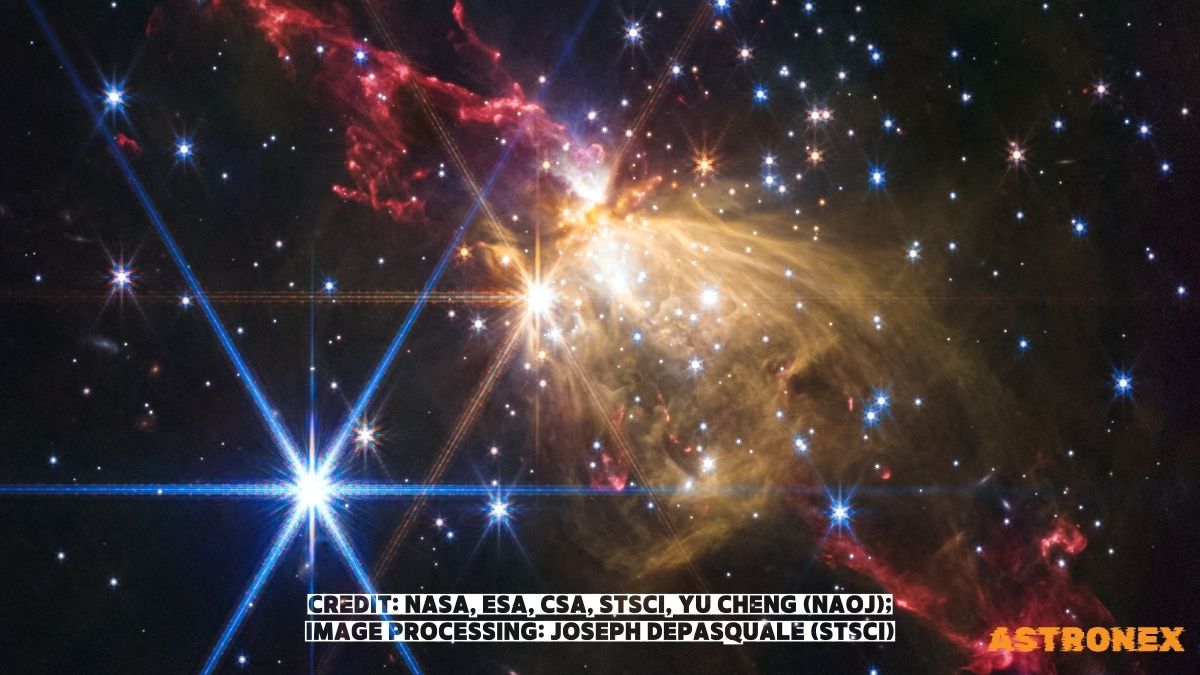
Astronomers have uncovered a remarkable feature in the far reaches of our Milky Way galaxy a massive stellar jet extending over eight light years. This jet emerges from a young star that is still in the process of forming and offers fresh insights into how stars especially massive ones come into being. Captured in stunning detail by advanced telescopes this discovery highlights the dynamic processes at play during star birth where powerful forces shape the surrounding space.
The jet located in a region known as Sharpless 2284 or Sh2284 for short consists of twin streams of hot gas shooting out from the central star. These streams travel at incredible speeds carving through the interstellar medium and creating intricate structures visible in infrared light. Such findings build on our understanding of protostellar outflows which are essential for regulating star growth. With the help of cuttingedge observations scientists are piecing together the story of this distant cosmic event.
What mysteries might this enormous jet reveal about the birth of stars in remote galactic areas
What Are Stellar Jets and How Do They Form
Stellar jets are narrow beams of plasma and gas ejected from young stars during their formation phase. They act as a way for the star to release excess energy and material preventing it from becoming too unstable as it accretes mass from its surroundings. In the case of this recent discovery the jets form when superheated gases fall onto the protostar and get redirected along its rotational axis. Powerful magnetic fields then channel these gases into tight streams that blast outward at high velocities. This process is crucial because it helps balance the gravitational pull that draws material inward allowing the star to grow steadily over time.
According to observations from the James Webb Space Telescope these jets can span vast distances interacting with nearby dust and gas to form glowing knots and shock waves. For instance in lowmass stars jets are common but shorter often less than a light year long. However when powered by a more massive star like the one in Sh2284 they scale up dramatically reaching lengths that dwarf our solar systems scale. This scaling effect suggests that the jets energy output ties directly to the stars mass with heavier stars producing more powerful outflows. To visualize this think of a garden hose versus a fire hose the latter pushes out more water over greater distances due to higher pressure.
The formation mechanism involves accretion disks flat rotating structures of gas and dust around the star. As material spirals in some gets heated and launched poleward. Magnetic fields act like invisible guides keeping the flow collimated meaning focused into a beam rather than spreading out. In technical terms this collimation (the process of narrowing the beam) relies on magnetohydrodynamic forces which combine magnetic and fluid dynamics. Without these jets stars might collapse under their own weight halting formation altogether. Bullet points can help break down the steps Material gathers in a dense cloud collapsing under gravity to form a protostar. An accretion disk develops feeding the star while spinning rapidly. Magnetic fields twist and amplify directing outflows along the axis. Jets erupt clearing excess angular momentum (rotational energy) for stable growth. This discovery reinforces models where jets are integral to star evolution providing a natural regulator for mass buildup.
How Was the Stellar Jet in Sh2284 Discovered
The stellar jet in Sh2284 was spotted unexpectedly during routine observations with the James Webb Space Telescope a collaborative effort between NASA ESA and CSA. Using its NearInfrared Camera or NIRCam instrument the telescope pierced through dust clouds that obscure visible light revealing the jets intricate details in infrared wavelengths. This serendipitous find occurred while studying a proto cluster a group of forming stars in the galaxys outer regions about 15000 light years from Earth. The data showed twin jets stretching across eight light years equivalent to roughly 245 parsecs (a parsec being 326 light years) making it one of the largest known from a single star.
Lead researchers analyzed the images noting the jets symmetry and scale which stood out immediately. Complementary data from the Atacama Large Millimeter/submillimeter Array in Chile helped identify the central protostar and another nearby dense core possibly in an earlier stage. The observations captured filamentary structures where the jets plow into interstellar material creating bow shocks curved fronts like a boats wake and linear chains of glowing gas. These features indicate ongoing interactions over tens of thousands of years with the jets tips representing older ejected material traveling farther out.
To put the discovery in context typical stellar jets from lowmass stars span fractions of a light year but this one powered by a star ten times our Suns mass demonstrates how size correlates with power. The teams models fitted to the data estimate the protostars current mass at about 10 solar masses with ongoing accretion. Infrared imaging was key because it detects heat from molecular hydrogen a main component excited by the jets passage. This method allows astronomers to trace the outflows path even in dusty environments. The find was published in a peerreviewed journal confirming its validity through rigorous analysis.
What Are the Key Characteristics of This Gigantic Jet
This stellar jet stands out due to its immense length of eight light years blazing across space like a cosmic lightsaber with twin blades extending in opposite directions. The jets move at speeds of hundreds of thousands of kilometers per hour roughly 100 to 300 kilometers per second (km/s a unit for velocity in astronomy). Composed mainly of hot plasma and molecular hydrogen these streams carry energy equivalent to thousands of solar luminosities the Suns total energy output. The central protostar located 15000 light years away in the Milky Ways outskirts drives this phenomenon from a lowmetallicity environment meaning it has fewer heavy elements than typical inner galaxy regions.
Detailed imaging shows the jets creating separate knots small clumps of shocked gas and bow shocks where they compress the surrounding medium. These structures form a tapestry recording the stars formation history with older material at the tips ejected over 100000 years ago and fresher outflows closer to the source. The jets alignment nearly 180 degrees apart indicates a stable accretion disk without significant twisting. In comparison to other known jets like those in HerbigHaro objects this one is rarer because massive stars produce fewer but more energetic outflows. For scale eight light years is twice the distance to Alpha Centauri our nearest star system beyond the Sun.
Composition wise the jets include superheated gases ionized by the extreme conditions. Molecular hydrogen glows in infrared as it gets excited providing the vivid colors in telescope images. The low metallicity pristine like the early universe affects how stars form here leading to more lowmass stars in the cluster. Bullet points for key measurements Length 8 light years or 75 trillion kilometers. Speed Up to 500000 km/h translating to about 139 km/s. Protostar mass Approximately 10 times the Suns mass or 2 x 10^31 kilograms. Distance from Earth 15000 light years toward the galaxys edge. These traits make it a prime example for studying scaledup jet dynamics.
What Does This Discovery Tell Us About Massive Star Formation
This jet discovery provides strong evidence that stellar outflows scale with the driving stars mass meaning larger stars create bigger jets. In Sh2284 the protostars hefty 10 solar masses allow for such an extensive structure validating theoretical models of star birth. Specifically it supports the core accretion model where a stable disk around the star enables steady growth through gravitational collapse. In this scenario material accretes smoothly without major disruptions keeping the jets straight and symmetric. Alternative models like competitive accretion predict chaotic disks with twisted outflows but the observed 180degree alignment contradicts that.
The lowmetallicity setting deficient in elements heavier than helium mimics conditions in the early universe billions of years ago. This makes Sh2284 a local laboratory for understanding ancient star formation processes. Observations show that in such environments more stars form at lower masses compared to metalrich clusters closer to the galactic center. Massive stars like this one influence galaxy evolution by injecting energy and enriching the medium with new elements through their winds and eventual supernovae. The jets role in clearing excess material ensures the star doesnt grow uncontrollably highlighting a feedback mechanism in cosmology.
To illustrate consider how jets act as pressure valves releasing builtup energy. Without them accretion might overwhelm the star leading to instability. The data from Webb fitted to core accretion simulations estimate the protostar is still gaining mass at a rate that could see it become even larger. This insight extends to extragalactic studies where similar jets might be spotted in distant galaxies. Overall it refines our models of how massive stars which drive galactic chemistry and structure emerge in varied cosmic conditions.
How Does the LowMetallicity Environment Influence This Jet
The environment in Sh2284 features low metallicity with fewer heavy elements making it more pristine than typical starforming regions. This scarcity affects cooling rates in the gas cloud as metals help dissipate heat allowing denser clumps to form stars more easily. In lowmetallicity areas like this outer galactic region star formation proceeds differently often favoring lower mass stars as seen in the proto clusters few hundred members. The jet thrives here because the less dense medium offers less resistance letting it extend farther before dissipating.
Comparisons to metalrich areas show that high metallicity leads to quicker fragmentation into many stars while low levels result in slower more isolated births. This jets size benefits from the sparse surroundings plowing through with minimal disruption creating longer chains of shocks. As an analog to early universe conditions where metals were rare Sh2284 helps astronomers model primordial galaxies. For example the first stars population III were likely massive and formed in similar lowmetal setups their jets potentially even grander.
Technical details include metallicity measured as a fraction of solar values here perhaps 01 to 05 times lower based on cluster analysis. This influences the jets composition with more pure hydrogen and helium dominating. Visual aids like diagrams of density gradients would help show how the jet propagates farther in thinner gas. The discovery underscores environmental roles in scaling jet properties linking local observations to cosmic history.
What Are the Broader Implications for Astronomy
Beyond star formation this jet offers clues to galaxy evolution as massive stars sculpt their surroundings. Their outflows stir interstellar gas promoting new star births or halting them in overenergized areas. In Sh2284 the jets energy input could shape the clusters future determining how many stars survive to maturity. Since massive stars end as supernovae they seed the galaxy with heavy elements but in lowmetallicity outskirts this process is slower preserving ancientlike chemistry.
The validation of core accretion over competitive models refines simulations used for predicting star populations in galaxies. With Webs sensitivity to infrared we can now probe distant similar regions potentially spotting jets in other galaxies. This advances our grasp of the universes stellar census estimating how many massive stars formed early on influencing reionization when light from first stars cleared cosmic fog. Fun fact such jets might contribute to cosmic rays highenergy particles zipping through space.
In summary the implications tie local discoveries to bigpicture cosmology using this jet as a bridge to the past.
This gigantic stellar jet in Sh2284 exemplifies the dramatic processes of star birth revealing how massive protostars announce their presence across vast cosmic distances. From its eightlightyear span to the insights on accretion models it enriches our knowledge of galactic frontiers. Supported by precise observations this find bridges modern astronomy with early universe conditions.
What other hidden cosmic giants might await discovery in the Milky Ways remote edges
(NASA 2025) (ESA 2025) (Cheng et al. 2025)
Sources
Cheng Y. Tan J. C. Andersen M. et al. (2025 September 10). A Massive Protostellar Outflow in the Periphery of the Milky Way Revealed by the JWST. The Astrophysical Journal. https://doi.org/10.3847/1538-4357/addf4b
European Space Agency. (2025 September 10). Webb Observes Immense Stellar Jet on Outskirts of Our Milky Way. ESAWebb. https://esawebb.org/news/weic2519/
NASA. (2025 September 10). NASA’s Webb Observes Immense Stellar Jet on Outskirts of Our Milky Way. NASA Science. https://science.nasa.gov/missions/webb/nasas-webb-observes-immense-stellar-jet-on-outskirts-of-our-milky-way/