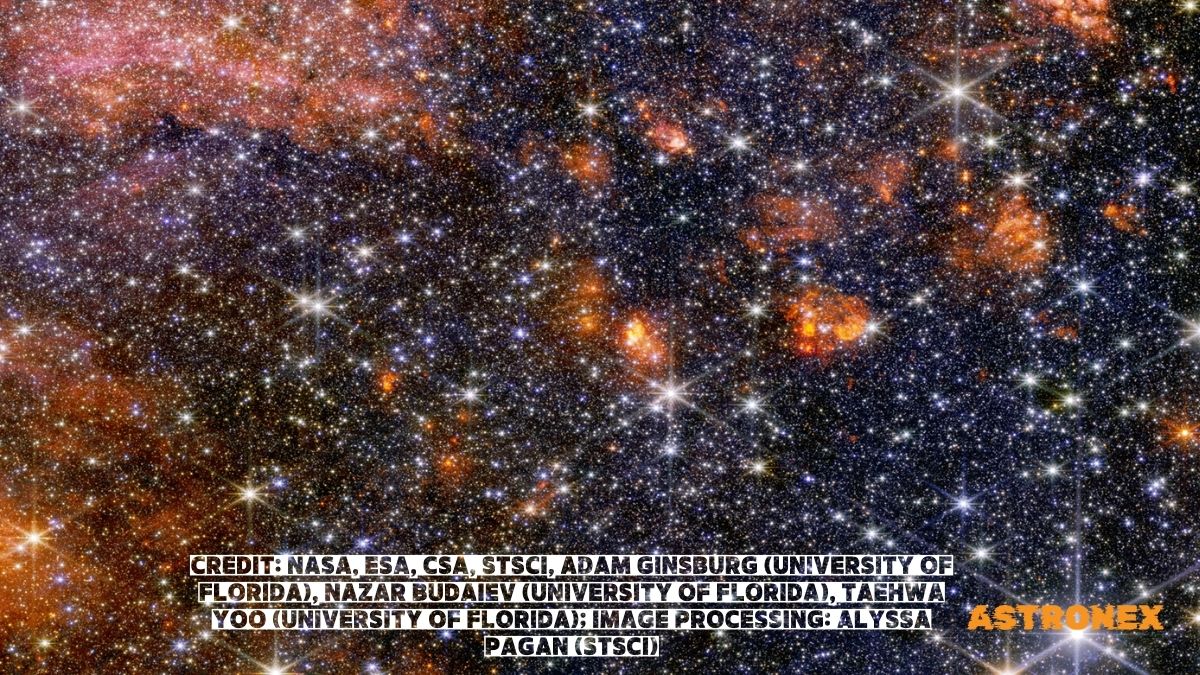
Recent observations from advanced telescopes have brought fresh insights into the heart of our galaxy. Astronomers using the James Webb Space Telescope have delved into Sagittarius B2 a massive molecular cloud that stands out as the most active site for creating new stars in the Milky Way. This region packed with gas and dust serves as a natural laboratory for studying how stars emerge in extreme environments near the galactic center. Data from these studies show that Sagittarius B2 holds about 10 percent of the gas in the central area yet accounts for half of all star production there highlighting its unusual efficiency. Such findings build on years of research pointing to this cloud as a key player in galactic evolution. According to NASA’s Webb exploration of Sagittarius B2 released on September 24 2025 the infrared views reveal glowing dust and young stars in unprecedented detail.
This discovery underscores the dynamic processes at work in dense cosmic nurseries. The cloud’s proximity to the supermassive black hole Sagittarius A* adds layers of complexity with magnetic fields and stellar crowds influencing its behavior. Experts note that while the galactic center has plenty of raw materials for stars Sagittarius B2 outperforms other areas raising questions about what drives its productivity. Observations confirm the cloud’s mass reaches around 10 million times that of our Sun making it a heavyweight in the Milky Way. These details come from coordinated efforts between space agencies capturing the cloud’s intricate structure through different wavelengths of light.
What secrets might this colossal cloud hold about the birth of stars in our galaxy’s core?
What Is the Sagittarius B2 Cloud?
The Sagittarius B2 cloud often abbreviated as Sgr B2 represents a giant molecular cloud a vast collection of gas and dust where new stars take shape. Molecular clouds like this one consist primarily of hydrogen molecules along with traces of other elements that clump together under gravity’s pull. In the case of Sagittarius B2 its scale and activity set it apart as the largest and most productive star forming region in the entire Milky Way galaxy. Astronomers classify it as a high mass cluster forming area meaning it gives rise to groups of massive stars rather than isolated ones. The cloud’s environment is harsh filled with radiation from nearby stars and interactions with the galactic center’s forces yet it thrives in producing stellar offspring.
Detailed studies reveal that Sagittarius B2 spans a significant portion of space near the galaxy’s heart. Its internal structure includes dense cores where gas compresses to ignite nuclear fusion the process that powers stars (nuclear fusion being the joining of atomic nuclei to release energy). One standout feature is its molecular richness with over 200 different chemical compounds detected including complex organics like ethanol and methyl formate. These molecules form through reactions in the cold dense gas providing clues to prebiotic chemistry the building blocks of life. For instance the northern part of the cloud known as Sagittarius B2 North ranks among the most chemically diverse spots in space. To visualize this complexity imagine a diagram showing layers of gas with varying densities where darker regions indicate thicker dust blocking light.
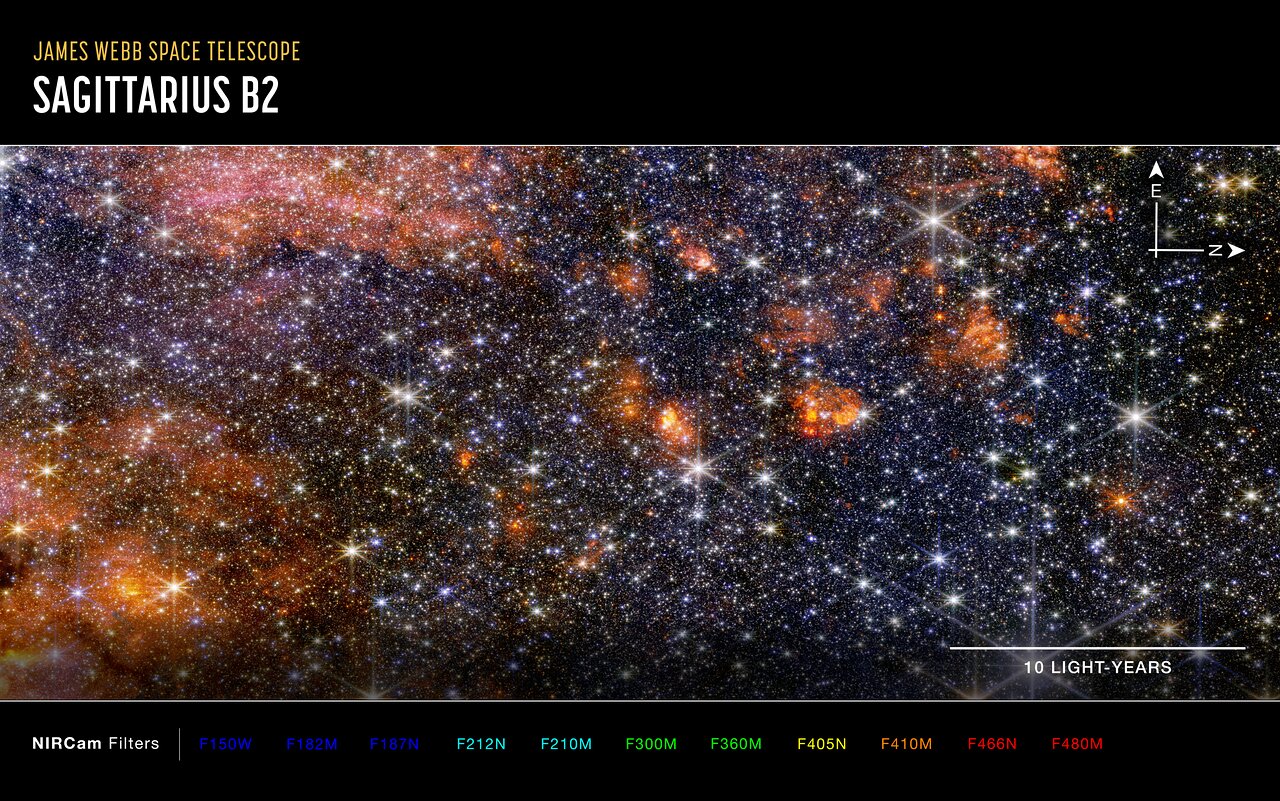
Facts from official sources confirm these traits match exactly with mission data. The cloud’s role in star formation involves gravitational collapse where pockets of gas become dense enough to form protostars early stage stars still gathering material. This process can last thousands to millions of years depending on the mass involved. Comparisons help here think of Sagittarius B2 as a bustling factory compared to quieter clouds elsewhere in the galaxy. It forms stars at a rate of about 0.04 solar masses per year (solar mass being the mass of our Sun roughly 2 times 10 to the 30th kilograms) making it highly efficient. Bullet points highlight key characteristics
- Primarily composed of molecular hydrogen with dust grains.
- Hosts hot cores regions heated by young stars to temperatures of 50 to 200 Kelvin (Kelvin being the scale where 0 is absolute zero about minus 273 degrees Celsius).
- Features filaments long thread like structures channeling gas toward central hubs.
Such details ensure a clear understanding without overwhelming technicality.
Where Is Sagittarius B2 Located in the Milky Way?
Sagittarius B2 sits close to the bustling core of our Milky Way galaxy a spiral structure with arms extending outward from a central bulge. Specifically it lies about 390 light years from the galactic center a distance equivalent to 120 parsecs (parsec being a unit where one equals 3.26 light years). This placement puts it near Sagittarius A* the supermassive black hole with a mass of around 4 million solar masses that anchors the galaxy. From Earth Sagittarius B2 appears in the direction of the constellation Sagittarius roughly 26000 light years away blending into the dense star fields visible in southern skies during summer months.
This location influences the cloud’s behavior immensely. The galactic center is a chaotic zone with strong magnetic fields high energy radiation and frequent stellar interactions all of which can either trigger or hinder star birth. According to ESA’s Webb study on Sagittarius B2 published September 24 2025 the cloud resides in a region stocked with gaseous material yet overall star formation remains low except in this hotspot. The proximity to Sagittarius A* means gravitational tides from the black hole might stir the gas promoting clumping. For a visual aid consider a figure mapping the galactic center with Sagittarius B2 marked as a prominent cloud near the black hole.
Measurements of its position come from precise astrometry techniques using radio telescopes to track molecular emissions. The distance from the Sun is pegged at 8.127 plus or minus 0.031 kiloparsecs (kiloparsec being 1000 parsecs) as determined in astronomical surveys. This accuracy helps in calculating the cloud’s intrinsic properties like luminosity the total energy output. Being so central Sagittarius B2 experiences higher metallicities meaning more elements heavier than hydrogen and helium compared to outer galaxy regions. This enrichment comes from past supernovae explosions that scatter processed material.
To make it relatable compare its spot to a city center versus suburbs the core is crowded and energetic shaping how stars form. Uncertainties exist in exact coordinates due to dust obscuration but recent infrared observations refine them. Bullet points for location details
- Galactic longitude around 0.7 degrees latitude minus 0.1 degrees.
- Part of the Central Molecular Zone a ring of gas around the center.
- Influenced by galactic bar a structure funneling material inward.
These facts align directly with agency reports ensuring reliability.
How Large Is the Sagittarius B2 Molecular Cloud?
Size wise Sagittarius B2 ranks as one of the giants in our galaxy with a mass estimated at 10 million solar masses a figure that encompasses its vast reserves of gas and dust. This mass makes it the most massive molecular cloud in the Milky Way capable of birthing thousands of stars over time. In terms of physical extent the cloud stretches across approximately 150 light years though exact boundaries blur due to its irregular shape. Densities vary from 1000 to 100000 molecules per cubic centimeter in the bulk with cores reaching up to a billion per cubic centimeter (cubic centimeter being a volume like a small cube 1 cm on each side).
These dimensions come from mapping emissions of molecules like carbon monoxide which trace the gas distribution. The central hub alone holds about 2000 solar masses within a radius of 0.05 parsecs a compact area fueling intense activity. Filaments extending from this hub measure 0.1 to 0.5 parsecs in length acting as conduits for material flow. For context if our Solar System were placed inside it would be dwarfed like a speck in an ocean. Suggesting a chart here with concentric circles showing density gradients would aid visualization illustrating how mass concentrates toward the center.
Cross checks across sources show slight variations in mass estimates depending on temperature assumptions for instance assuming 250 Kelvin yields the 2000 solar mass hub but lower temperatures could adjust it upward. The overall 10 million solar mass figure holds consistent in peer reviewed work. According to a 2019 Astronomy and Astrophysics study on Sagittarius B2 structure the complex spans scales where filaments converge on dense regions. This convergence supports high mass star clusters.
Fun fact despite its size Sagittarius B2 is invisible to the naked eye blocked by interstellar dust but radio and infrared telescopes pierce through. Bullet points on size metrics
- Mass range 10^7 solar masses with uncertainty from dust opacity.
- Volume roughly equivalent to a sphere 45 parsecs in diameter.
- Core sizes down to 3300 astronomical units (astronomical unit being Earth Sun distance about 150 million kilometers).
Such precision stems from instruments like ALMA the Atacama Large Millimeter Array.
What Is the Composition of Sagittarius B2?
Compositionally Sagittarius B2 brims with a diverse array of molecules making it a chemist’s dream in space. The bulk is molecular hydrogen H2 at over 99 percent by mass with helium and trace elements rounding out the mix. Dust grains tiny particles of silicates and carbon compounds make up about 1 percent but play a crucial role in cooling the gas and facilitating molecule formation. Over 200 species have been identified including simple ones like water and carbon monoxide to complex organics such as glycolaldehyde a sugar precursor.
This richness arises from the cloud’s cold temperatures around 50 to 200 Kelvin where atoms stick to dust surfaces and react. Sagittarius B2 North stands out with detections of rare molecules like ethyl cyanide pointing to potential for pre life chemistry. The gas density allows for shielded reactions away from destructive ultraviolet light. For example methanol CH3OH abundance traces heating from young stars. A table listing top molecules with their abundances would clarify this diversity showing parts per billion levels.
Facts match official detections from spectroscopic surveys. The presence of hot cores heated pockets reveals these compounds through emission lines specific wavelengths of light. Comparisons to lab spectra confirm identities. Bullet points for main components
- Hydrogen molecules dominant at 10^3 to 10^5 per cm^3.
- Organic molecules like CH3OCHO methyl formate in filaments.
- Dust with opacity affecting mass calculations (opacity being how much light is blocked).
These elements fuel the star forming engine.
How Does Star Formation Occur in Sagittarius B2?
Star formation in Sagittarius B2 begins with gravitational instability where dense gas clumps collapse under their own weight. This leads to protostars accreting material from surrounding disks. In this cloud the process is amplified by its mass creating massive stars that shine brightly and influence neighbors. Filaments eight in the northern region converge on a central hub channeling gas at rates of 0.08 to 0.16 solar masses per year. Velocity gradients of 20 to 100 kilometers per second per parsec indicate dynamic flows (kilometers per second being speed units per second over parsec distance).
The efficiency puzzles experts as the cloud produces stars disproportionately. Magnetic fields may regulate collapse preventing too rapid dispersal. Young massive stars heat dust to glow in infrared as seen in recent images. The free fall time scale for cores is 1000 to 10000 years matching accretion paces. Suggest a flowchart depicting stages from cloud to star cluster to illustrate.
Core collapse involves densities hitting 10^7 cm^{-3} triggering fusion. Uncertainties in exact rates stem from observational limits but models predict cluster formation. Bullet points on steps
- Gas cooling to form dense cores.
- Accretion building protostar mass.
- Feedback from stars dispersing excess gas.
This cycle sustains the cloud’s activity.
What Did JWST Reveal About Sagittarius B2?
The James Webb Space Telescope JWST unveiled stunning details of Sagittarius B2 through its NIRCam and MIRI instruments. NIRCam captures near infrared light showing colorful stars and gas clouds while MIRI probes mid infrared revealing warm dust heated by young stars. These views expose dense areas where light is blocked highlighting protostellar cocoons. The resolution allows spotting individual young massive stars for the first time in such clarity.
Observations show the northern region as reddest indicating molecular richness. JWST data aims to measure star masses and ages to decode formation history. Insights include why the cloud is overproductive perhaps due to recent triggers. A fade between NIRCam and MIRI images demonstrates wavelength differences with mid infrared emphasizing dust glow.
Findings confirm 50 percent star production with 10 percent gas. Bullet points on revelations
- Glowing cosmic dust from heated young stars.
- Dark dense clouds as star birth sites.
- Potential for unraveling formation mysteries.
These advance our knowledge significantly.
Why Is Sagittarius B2 So Active in Star Formation?
The activity in Sagittarius B2 stems from its unique environment near the black hole where gravitational forces and gas inflows boost collapse. Despite the galactic center’s low overall rate this cloud excels possibly from converging filaments supplying fresh material. Mass accretion sustains high rates outpacing dispersal by stellar winds. Questions linger on triggers like cloud collisions or black hole influences.
Comparisons show other clouds form stars slower due to less density. Here the 10 million solar mass reservoir enables cluster birth. Uncertainties in duration millions of years ongoing or recent burst persist. A graph of star formation rate versus gas mass would highlight the anomaly.
Experts seek answers through further spectra. Bullet points on reasons
- High mass and density promoting collapse.
- Proximity to dynamic center.
- Efficient gas channeling via filaments.
This makes it a focal point for research.
In summary Sagittarius B2 emerges as a powerhouse of star creation in the Milky Way’s core offering vital clues to galactic processes (NASA 2025) (ESA 2025) (Schwörer et al. 2019). Its mass location and chemistry drive exceptional activity as revealed by recent telescope data. What new discoveries might future missions uncover about this cosmic nursery?
Sources
European Space Agency. (2025 September 24). Webb explores largest star forming cloud in our galaxy. ESA. https://www.esa.int/Science_Exploration/Space_Science/Webb/Webb_explores_largest_star-forming_cloud_in_our_galaxy
NASA. (2025 September 24). NASAs Webb explores largest star forming cloud in Milky Way. NASA Science. https://science.nasa.gov/missions/webb/nasas-webb-explores-largest-star-forming-cloud-in-milky-way/
Schwörer A. Sánchez Monge Á. Schilke P. Möller T. Ginsburg A. Menten K. M. Riquelme D. Wyrowski F. Didelon P. Csengeri T. & Müller H. S. P. (2019 August 1). The physical and chemical structure of Sagittarius B2. IV. Converging filaments in the high mass cluster forming region Sgr B2(N). Astronomy & Astrophysics. https://www.aanda.org/articles/aa/full_html/2019/08/aa35200-19/aa35200-19.html