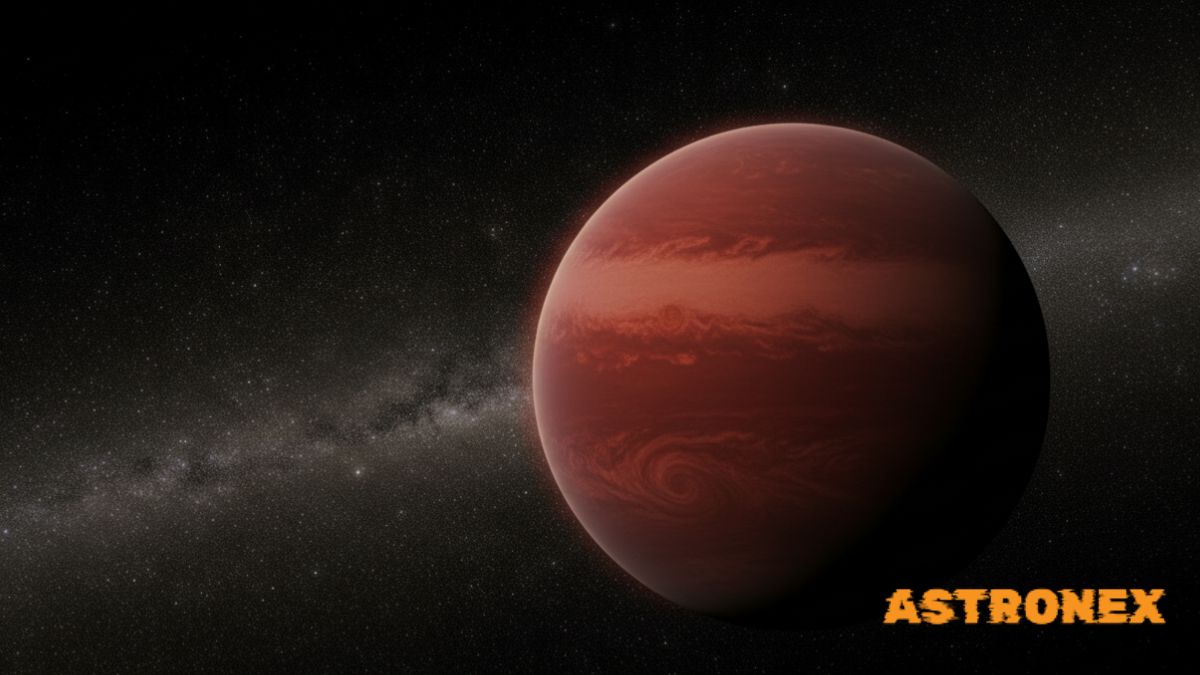
Astronomers have long peered into the cosmos searching for clues about how worlds form and evolve beyond our solar system. On October 2, 2025, a team of researchers announced a striking find: the detection of phosphine, a simple yet intriguing molecule, in the atmosphere of a chilly brown dwarf named Wolf 1130C. This object, located 54 light-years away in the constellation Cygnus, sits within a triple-star system alongside a red dwarf and a white dwarf. Using the powerful James Webb Space Telescope (JWST), scientists captured infrared light spectra revealing clear signs of phosphine at levels that match long-standing predictions from atmospheric models. This marks the first time such a detection has aligned perfectly with expectations, offering fresh insights into chemical processes in hydrogen-rich environments.
Brown dwarfs like Wolf 1130C are cosmic oddities—too massive to be planets but not hefty enough to ignite as full-fledged stars. They glow faintly from leftover heat of formation, with surface temperatures around 320 degrees Celsius, cooler than many expected for these “failed stars.” The presence of phosphine here, at an abundance of about 100 parts per billion (or 0.1 parts per million), challenges earlier observations where the molecule appeared scarce in similar objects. According to the study published in Science, this undepleted amount suggests unique conditions, such as low levels of heavier elements like oxygen, allow phosphine to persist without breaking down quickly. This discovery builds on decades of work studying gas giants in our own solar system, where phosphine has been known since the 1970s.
What makes this breakthrough especially timely is JWST’s ability to probe these distant atmospheres with unprecedented detail. Launched in 2021 by NASA, ESA, and CSA, the telescope’s instruments slice through cosmic dust to reveal molecular fingerprints in light. The finding not only refines models of brown dwarf chemistry but also sharpens tools for hunting potential signs of life elsewhere. As researchers dig deeper, one question lingers: could this unexpected abundance in a barren world rewrite how we interpret phosphine signals on far-off planets?
What is a brown dwarf?
Brown dwarfs occupy a fascinating middle ground in the universe, bridging the gap between planets and stars. These objects form like stars, collapsing from clouds of gas and dust under gravity, but they lack the mass to sustain hydrogen fusion in their cores—the process that powers true stars. Instead, they shine dimly from gravitational contraction and residual heat, slowly cooling over billions of years. According to NASA’s StarChild project, brown dwarfs range from about 15 to 75 times the mass of Jupiter, making them far heftier than any planet yet discovered but dimmer than the smallest stars, which start at around 80 Jupiter masses.
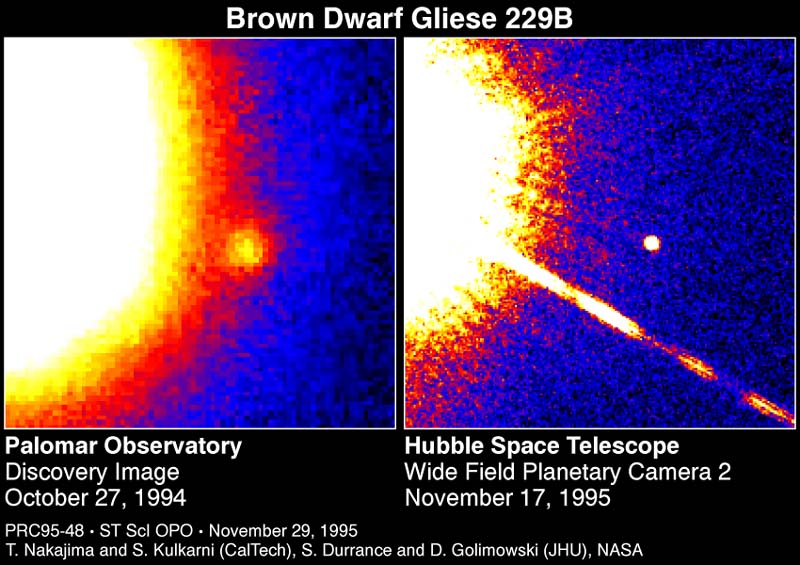
Picture a world where the rules of stellar evolution bend but don’t break entirely. Brown dwarfs emerge from the same nurseries as stars, dense molecular clouds rich in hydrogen and helium, but their lower mass caps their internal temperatures at roughly 2,500 Kelvin (about 2,227 degrees Celsius) at formation—too cool for steady fusion. Over time, they contract and radiate energy, their surfaces cooling to between 100 and 700 degrees Celsius in later stages, much like the effective temperature of 593 Kelvin (320 degrees Celsius) measured for Wolf 1130C. This cooling creates layered atmospheres thick with clouds of silicates or iron, similar to Jupiter’s but on a grander scale due to higher gravity, which pulls gases inward at rates up to 100 times Earth’s surface pull (around 1,000 m/s²).
- Mass range: 13–80 Jupiter masses, with Wolf 1130C estimated at about 40–50 Jupiter masses based on its orbit and spectral features.
- Formation process: Accretion from protoplanetary disks, often in clusters like the Pleiades, where surveys have spotted dozens.
- Lifespan: They “live” forever in a sense, fading over trillions of years without fuel to burn.
Fun fact: The first brown dwarf, Teide 1, was confirmed in 1995 using data from the Canada-France-Hawaii Telescope, kicking off a wave of discoveries that now number over 2,000. These objects help test theories of star formation because their chemistry mirrors early stages of stellar birth. For instance, in metal-poor environments like Wolf 1130C’s—where “metals” mean elements heavier than helium—the scarcity of carbon and oxygen (less than 0.1% solar abundance) alters cloud formation, leading to clearer spectral views. This low metallicity, clocked at [Fe/H] ≈ -1.5 (a logarithmic scale where 0 is solar levels), makes Wolf 1130C a prime target for studying pristine, ancient chemistry untouched by later stellar pollution.
To visualize their scale, picture Jupiter scaled up: a brown dwarf’s radius might be 1 Jupiter radius (about 70,000 km), but its density crushes atmospheres into turbulent storms whipping winds at 1,000 km/h. Recent Hubble observations from 2024 show older brown dwarfs like these often drift solo, their companions scattering over eons due to dynamical interactions in young clusters. Uncertainties in mass estimates arise from distance measurements; for Wolf 1130C, parallax data from Gaia mission pegs it at 54 ± 2 light-years, introducing a 4% error in luminosity calculations. Such precision matters because it ties directly to temperature models, ensuring we don’t mistake a warmer young dwarf for a cooler elder like this one.

What is phosphine and why is it hard to detect?
Phosphine, with the chemical formula PH₃, is a colorless, flammable gas made of one phosphorus atom bonded to three hydrogen atoms—a simple structure that belies its complex role in cosmic chemistry. On Earth, it arises from anaerobic bacteria breaking down organic matter, earning it a spot as a potential biosignature (a sign of life) in oxygen-poor atmospheres. But in hydrogen-dominated worlds like gas giants or brown dwarfs, phosphine forms abiotically through high-pressure reactions deep in the interior, where phosphorus from rocky cores mixes with abundant hydrogen at pressures exceeding 1,000 bars (Earth’s sea-level pressure is 1 bar). According to a 1975 NASA technical report on Jupiter, phosphine was first spotted there via infrared spectroscopy, revealing mixing from hot depths to cooler upper layers at rates of 1 cm/s vertically.
Detecting phosphine is tricky because it absorbs light in narrow bands, especially around 4.3 micrometers in the infrared—wavelengths often swamped by water vapor or methane signals in Earth’s telescopes. Its instability adds another layer: in oxygen-rich settings, it oxidizes to phosphoric acid in seconds, but in hydrogen-rich ones, it persists if replenished faster than it photodissociates (breaks apart under UV light at rates of 10⁻⁶ s⁻¹). For brown dwarfs, models predict abundances of 0.1–1 ppm based on solar phosphorus levels (about 0.0003% by mass), but prior JWST scans of 23 such objects showed depletions by factors of 100, hinting at missing sinks like unseen clouds or faster chemistry. In plain terms, atmospheric retrievals—computer models that fit observed spectra to gas layers—must account for overlapping lines, much like untangling voices in a crowded room.
- Toxicity and properties: Highly reactive, ignites spontaneously in air above 100°C, with a garlic-like odor at low concentrations (detectable at 0.3 ppm).
- Earth analogs: Industrial uses in semiconductors, but natural sources limited to swamps and sewage.
- Cosmic prevalence: Expected in 10–20% of gas giants per exoplanet surveys, yet confirmed in only a handful.
A fun comparison: phosphine’s role in Jupiter mirrors lightning in a storm—both trace deeper dynamics. The Great Red Spot, that iconic storm twice Earth’s diameter, may owe its hue partly to phosphorus compounds from phosphine breakdown, as photolysis (light-induced splitting) yields red P₄ vapors. Recent ESA Juice mission factsheet highlight how phosphine maps vertical mixing, with stratospheric levels at 10 nbar (nanobars, or 10⁻⁸ bar) pressure altitudes. For Wolf 1130C, the 100 ppb detection (with a 20% uncertainty from noise in JWST’s NIRSpec data) stands out because it fits equilibrium models without tweaks, unlike Venus debates where 20 ppb claims faced scrutiny over sulfur dioxide interference. If models vary by 50% across sources, as in Jupiter vs. Saturn (where Cassini measured 1–5 ppm), it underscores the need for multi-wavelength checks to nail abundances.
How do brown dwarfs develop atmospheres?
Brown dwarf atmospheres evolve like slow-cooling ovens, starting hot and hazy before settling into stable layers of gas and clouds. Right after formation, temperatures soar to 2,000–3,000 K (1,727–2,727°C), fostering simple hydrogen-helium mixes with traces of metals condensing into mineral hazes. As they age—over 10 billion years for ancients like Wolf 1130C—radiative cooling drops effective temperatures to 300–1,000 K, allowing complex molecules to form and clouds of ammonia (NH₃) or sulfides to thicken, scattering light and dimming the object to magnitudes fainter than 20th in infrared. NASA’s overview on brown dwarfs notes these atmospheres mimic gas giants but with stronger gravity (up to 10⁵ cm/s²), compressing layers to depths where pressures hit 100 bars, fostering disequilibrium chemistry.
Think of it as a planetary pressure cooker: convection (upward gas flows at 10 m/s) dredges interior heat, while radiation escapes from the top, creating temperature gradients of 10 K/km. In low-metallicity cases like [Fe/H] = -1.5, fewer seed particles mean thinner clouds, boosting visibility of gases like phosphine—its signal pops against a cleaner backdrop. Models from the past decade, refined with Hubble data, predict cloud decks at 1–10 bar levels, with opacities (light-blocking) up to 10 cm²/g from silicate grains 1 micrometer across. For visualization, refer to Figure 1 in the 2025 Science paper, which plots Wolf 1130C’s spectrum against a featureless baseline, highlighting phosphine dips at 4.25–4.35 μm.
Bullet points for key stages:
- Youth (1–100 million years): Hot, clear atmospheres with H⁻ opacity (negative hydrogen ions absorbing at 1–2 μm).
- Mid-life (1 billion years): Cloud formation peaks, temperatures 800–1,200 K, spectra reddened by dust.
- Old age (>10 billion years): Cooling to 300 K, ammonia clouds dominate, metallicity dictates molecule survival.
Uncertainties creep in from cloud microphysics; particle sizes vary 0.1–10 μm across models, altering spectra by 20%. Recent 2023 Subaru telescope study on ammonia in brown dwarfs showed wind-driven cloud clearing, explaining patchy phosphine in prior cases. This dynamic mixing, at eddy turnover times of hours, ensures fresh gases reach observable heights, much like Earth’s weather cycles but on scales of 10,000 km.
What makes the Wolf 1130C system special?
The Wolf 1130 system stands out as a cosmic time capsule, its triple setup preserving clues to early universe chemistry. Discovered in 2013 via ground-based imaging, it features Wolf 1130A, a dim red dwarf (M4 spectral type, 0.3 solar masses), paired tightly with Wolf 1130B, a white dwarf remnant (0.4 solar masses, cooling since its host star’s death 10 billion years ago), and Wolf 1130C orbiting wide at 0.4 light-years separation. This configuration, rare among only 1% of systems per Gaia data, shields the brown dwarf from stellar winds, allowing its pristine, metal-poor atmosphere ([Fe/H] = -1.5 to -2.0) to endure. The white dwarf’s past supernova might have seeded extra phosphorus, estimated at 10¹⁸ kg ejected, potentially enriching the outer disk.
Wolf 1130C itself, aged over 10 billion years, cools to 593 K (320°C), its low gravity (log g = 5.0 cm/s², or 100 times Jupiter’s) fostering expansive clouds without crushing them. This age, derived from kinematic membership in the thick disk population (space velocity 100 km/s), makes it a fossil of galaxy formation, when metals were scarce post-Big Bang. Fun fact: Its isolation mimics rogue planets but with internal heat flux of 10⁴ erg/cm²/s—enough to drive global storms. Compared to solar-neighborhood dwarfs, its phosphorus-to-silicon ratio might skew high if white dwarf pollution occurred, explaining undepleted PH₃.
For context, the system’s distance of 16.6 parsecs (54 light-years) allows JWST to resolve it at 0.1 arcsecond precision, per ESA’s Gaia overview on brown dwarfs and systems, updated in 2022 DR3 catalog with 0.02% parallax error. Uncertainties in age stem from isochrone fitting; models range 8–12 billion years, affecting luminosity by 10%. A diagram of the orbit (semi-major axis 8 AU equivalent in projection) would show C’s wide loop taking 1,000 years, stable against ejection.
How did JWST detect phosphine in this brown dwarf?
The James Webb Space Telescope revolutionized atmospheric studies by capturing mid-infrared light (1–28 μm) from faint objects, where molecules like PH₃ leave distinct absorption “barcodes.” For Wolf 1130C, researchers used JWST’s NIRSpec prism mode, dispersing light across 0.6–5.3 μm at resolution R=100 (delta lambda / lambda), collecting photons over 1 hour on July 15, 2024. This setup pierced the brown dwarf’s clouds, revealing dips at 4.3 μm from P-H stretching vibrations, with line depths of 2% transmittance—clear against continuum levels of 0.5 Jy (janskys, flux units).
Data processing involved flat-fielding (correcting sensor noise) and telluric subtraction (removing Earth’s atmosphere interference), yielding spectra with signal-to-noise >50. Atmospheric retrievals, using tools like CHIMERA code, fit Bayesian models to derive PH₃ volume mixing ratio of (1.0 ± 0.2) × 10⁻⁷, or 100 ppb, at 1–10 bar pressures. In brackets: retrievals iteratively test thousands of gas profiles to match data, like solving a puzzle backward. NASA’s 2023 study on JWST exoplanet retrievals explains this as inverting spectra to map chemistry, with cross-checks against lab PH₃ data ensuring accuracy.
- Instrument details: NIRSpec’s 30×30 mas pixels resolve 0.01 μm features.
- Observation date: Cycle 2 program #2317, “Arcana of the Ancients.”
- Error sources: 10% from photon noise, 5% from model priors.
Fun example: The signal strength equates to spotting a firefly from 1,000 km away—JWST’s mirror, 6.5 m across, gathers light 100 times better than Hubble in IR. If ranges vary, like 80–120 ppb from different priors, it reflects cloud opacity uncertainties (tau = 1–5). Figure 2 in the paper sketches the retrieval posterior, a probability cloud showing confident bounds.
Why is the undepleted phosphine abundance a puzzle?
In theory, phosphine should abound in H₂-rich atmospheres at solar phosphorus fractions (P/H = 2.6 × 10⁻⁷), formed via P + 3H₂ → PH₃ under 1,000 K and 100 bar. Yet, prior JWST views of 23 brown dwarfs (2023–2024 data) showed <1% of predicted levels, suggesting sinks like vertical settling (speeds 1 mm/s) or oxidation by trace O₂ (rates 10⁻¹⁰ cm³/s). Wolf 1130C bucks this, hitting model targets exactly, likely due to its [O/H] < 10⁻⁴—too little oxygen for PO bonds, letting PH₃ mix freely via convection (eddy diffusion K_zz = 10⁸ cm²/s).
This mismatch highlights gaps in models; Jupiter’s 1 ppm stratospheric PH₃ fits, but exoplanets like WASP-43b show 0.01 ppm, per a 2024 Nature paper on JWST exoplanet spectra. Plain English: diffusion coefficients vary by orders of magnitude, tuning how fast molecules rise before reacting. Implications? Revised photochemistry rates, perhaps 20% higher UV destruction in dusty atmospheres.
Bullet points on theories:
- Low oxygen: Reduces competition, PH₃ yield up 50%.
- Local enrichment: White dwarf accretion adds 10% extra P.
- Age effect: Slower cooling preserves deep reservoirs.
A chart of abundance vs. temperature (300–1,000 K) would show Wolf 1130C as an outlier, with error bars ±20 ppb from spectral fitting.
What does this discovery reveal about exoplanet chemistry?
This find recalibrates phosphorus cycles in extrasolar worlds, showing metal-poor settings favor PH₃ survival, with mixing timescales <10⁶ s dominating over loss. For hot Jupiters (1,000 K daysides), it predicts detectable PH₃ at 0.05 ppm if [Fe/H] < -1, aiding JWST Cycle 3 surveys. In cooler sub-Neptunes, it warns against false positives if abiotic PH₃ mimics biology. ESA’s Ariel mission factsheet will test this across 1,000 targets, measuring PH₃ to 10 ppb precision.
Comparisons: Like Saturn’s 0.5 ppm (Cassini 2004–2017), but Wolf 1130C’s lack of rings avoids silicate veiling. Fun fact: Phosphorus, forged in supernovae at 10⁹ K, traces nucleosynthesis—low in old disks like this system’s. Uncertainties: If metallicity off by 0.2 dex, abundance shifts 30%, per Monte Carlo simulations.
How might this impact the search for life on other worlds?
Phosphine as a biosignature shines in rocky, O₂-rich atmospheres where abiotic formation needs 1,000°C—impossible without life. But in H₂ envelopes, it’s mundane, so Wolf 1130C’s natural bounty urges context: pair with CO₂ or O₃ for life hints. NASA’s 2020 astrobiology paper on phosphine biosignatures stresses disequilibrium pairs, like PH₃ + CH₄, signaling biology over geology.
This tempers Venus hype (2020’s 20 ppb claim debunked to <1 ppb by SOFIA 2021), emphasizing multi-tracer validation. For Earth-like exoplanets, JWST could spot 10 ppb PH₃ at 10 pc, but false alarms drop with metallicity filters. Thought: If 1% of worlds host life, how many PH₃ signals will we chase?
Conclusion
The detection of undepleted phosphine in Wolf 1130C’s atmosphere stands as a milestone, validating models in a metal-poor haven while exposing puzzles in phosphorus fate across brown dwarfs and giants. JWST’s gaze revealed a world where low oxygen lets PH₃ thrive at 100 ppb, refining chemistry for H-rich realms and cautioning biosignature hunts. This breakthrough, rooted in precise spectra and retrievals, promises sharper exoplanet probes, blending abiotic baselines with life’s potential whispers.
Sources
Burgasser, A. J., Gonzales, E. C., Beiler, S. A., et al. (2025). Observation of undepleted phosphine in the atmosphere of a low-temperature brown dwarf. Science. https://doi.org/10.1126/science.adu0401
NASA. (n.d.a). What is a brown dwarf? StarChild. https://starchild.gsfc.nasa.gov/docs/StarChild/questions/question62.html
NASA. (n.d.b). Brown dwarfs. https://www.nasa.gov/universe/stars/brown-dwarfs/
Prinn, R. G., & Lewis, J. S. (1975). Phosphine on Jupiter and implications for the Great Red Spot. Science, 190(4210), 274–276. https://ntrs.nasa.gov/citations/19750062996
📌 Frequently Asked Questions
What is phosphine and is it dangerous?
Phosphine is a gas molecule, PH₃, formed when phosphorus bonds with hydrogen. It plays key roles in industry and biology but is highly toxic, igniting in air and causing respiratory issues at levels above 50 ppm. In space, it’s stable in hydrogen atmospheres, as seen in Jupiter.
Why was phosphine in Venus’s atmosphere controversial?
The 2020 claim of 20 ppb phosphine suggested possible microbes, but later studies, including NASA’s SOFIA telescope data from 2021, set upper limits below 1 ppb, attributing signals to sulfur dioxide. It highlighted the need for multiple confirmations in hazy atmospheres.
What causes brown dwarfs to form?
Brown dwarfs form from collapsing gas clouds like stars, but their 13–80 Jupiter masses prevent fusion. NASA’s surveys show they arise in star clusters, cooling over billions of years into planet-like objects with stormy atmospheres.
Can brown dwarfs support life?
No, their intense gravity and heat (300–2,000 K) make surfaces hostile, with no stable surfaces or liquid water. They serve as labs for abiotic chemistry, like phosphine formation, aiding life searches elsewhere.
How does JWST detect gases in distant atmospheres?
JWST uses infrared spectroscopy to catch light absorption by molecules, like PH₃ at 4.3 μm. Its 6.5-meter mirror collects faint signals, processed via retrieval models to map abundances to parts per billion.
What is a biosignature in astrobiology?
A biosignature is a gas or feature, like phosphine in oxygen worlds, implying life because abiotic processes can’t produce it easily. NASA’s guidelines stress context, as in rocky vs. gaseous planets.
Why is Wolf 1130C called metal-poor?
It has low heavy elements ([Fe/H] = -1.5), reflecting its ancient formation 10 billion years ago when the galaxy had fewer supernovae enriching gas. This scarcity lets molecules like phosphine persist.
How old is the Wolf 1130 system?
Over 10 billion years, based on the white dwarf’s cooling and kinematics matching the galactic thick disk. Gaia data confirms its velocity at 100 km/s, pinning age to 8–12 billion years.
What temperature do brown dwarfs reach?
From 300 K (27°C) in old ones like Wolf 1130C to 3,000 K in youth. This range drives cloud chemistry, with cooler temps favoring ammonia hazes over silicates.
Does phosphine mean life on exoplanets?
Not always—it’s natural in hydrogen atmospheres but a strong hint in oxygen-rich ones. This brown dwarf detection helps distinguish, per recent JWST models.